Category: Social Media

  • Iranians access Facebook, Twitter accounts for a day – albeit by error

    Iranians access Facebook, Twitter accounts for a day – albeit by error

    NEW DELHI: Facebook and Twitter, which are taboo in Iran, accidentally became available to users on 16 September – only to be shut off the next day with the government blaming a technical glitch for this sudden freedom.

    The two social sites had been shut off in Iran in the summer of 2009 after riots erupted following a disputed win of Mahmoud Ahmadinejad.

    A number of Facebook and Twitter users said on Monday that that they could access the social networking sites without bypassing the firewall which Iranian government had imposed for monitoring the social media.

    Correspondents of almost every western newspaper tweeted that they were able to access their accounts using regular internet services.

    Reuters reported that not only Facebook and Twitter was being accessed, but other blocked sites were also opening.

    But then Secretary of a State Committee Abdolsamad Khoramabadi said it was a technical glitch by a few internet service providers and there were no plans yet to lift the ban. An inquiry has been ordered.

    However, media sources said that the Iranian government may be testing the intensity of response if the ban is lifted. This is borne out by the fact that Iranian Foreign Minister Mohammad Javed Zarid created his Facebook and Twitter accounts during this period.

    Newly-elected President Hassan Rouhani is believed to be more liberal and has already hinted earlier that he would tackle the social media differently.

  • Now, Shah Rukh Khan is just a phone call away

    Now, Shah Rukh Khan is just a phone call away

    MUMBAI: In this era of social engagement with audiences and fans alike Bollywood’s King Khan, Shah Rukh Khan, takes one step ahead to reach out to his fans and become the first celeb to enable all his Indian fans to ‘Dial to follow him on Twitter’.

    Riding on the success of Chennai Express, in response to the love and affection shown by his fans worldwide SRK announced a groundbreaking global integration with Twitter India and ZipDial in which everyone living in India can follow and engage with him on Twitter via SMS.

    Effective immediately, anyone with a mobile phone in India can follow @iamsrk on Twitter by dialing (or giving a missed call) at 09015500555. The experience works for 100 per cent of mobile users in India on any phone, any operator network and is completely free, irrespective of whether they have a Twitter account or data-enabled phone.

    On calling the number this is the text message that is received – Thanks for dialing. Enjoy my Tweets by SMS. To reply to me or see my photos, just follow me on Twitter. Love, Shah Rukh Khan; followed by his latest tweet.

    Commenting on the integration, Shah Rukh Khan said, “I have always believed in the power of technology and use it in various ways to further my connection with my audience. In recent years, Twitter has been a magical place for me to engage with my fans. I hope all my fans in India will avail this new service to connect with me. I thank ZipDial and Twitter India for helping me inaugurate this innovation and help bring together my entire national audience who don’t access Twitter. Very soon I hope to also expand this to multiple countries, languages and platforms.”

    Twitter’s India market director Rishi Jaitly said, “Twitter is the world’s leading real time information network where hundreds of millions of people follow the people and organisations that interest them. In India, Twitter among other things brings our users closer to their favourite stars and icons. We are pleased to see Shah Rukh Khan and ZipDial use the Twitter platform in this way.”

  • YouTube’s founders challenge Vine and Instagram with new video app

    YouTube’s founders challenge Vine and Instagram with new video app

    MUMBAI: After months of teasing, the wait is finally over: Chad Hurley and Steve Chen, who brought forth the video-sharing site YouTube, are taking the wraps off their newest project, a video creation app called MixBit.

    Versions for Apple mobile devices and the Web are already live, and an Android version is due in coming weeks.

    On the surface, MixBit resembles two other leading video apps, Twitter’s Vine and Facebook’s Instagram. As with those apps, users press and hold the screen of their smartphone to record video. Instagram users can capture up to 15 seconds of video, a bit longer than Vine’s six-second maximum. MixBit allows 16 seconds.

    But as the name suggests, MixBit is all about mixing and editing video. Both the app and a related website, MixBit.com, are aimed at making it easy to clip and stitch together snippets of videos. Simple tools built into the app allow users to edit each 16-second clip and combine up to 256 clips into an hour long video. The final product can then be shared on Twitter, Facebook, Google Plus or the MixBit website.

    Think of it as “shoot, mix and share.” You don’t even have to do the shooting – the MixBit site allows anyone to snip and remix any publicly shared video content.

    In fact Hurley said encouraging users to remix other people’s videos to create new works is the principal goal of the service, which is the first big product to emerge from Avos Systems, the start-up he co-founded with Chen two years ago. (The company has received funding from the venture arm of Google, which bought YouTube, as well as from Innovation Works, Madrone Capital and New Enterprise Associates.)

    “The whole purpose of MixBit is to reuse the content within the system,” Hurley said in an interview. “I really want to focus on great stories that people can tell.”

    The ability to create those more complex video stories could give MixBit an edge, at least momentarily, over Vine and Instagram, which are growing rapidly. Vine has no editing tools and Instagram introduced rudimentary ones recently.

    But one crucial decision by Avos is likely to hold it back: the app is totally anonymous and communal. Users cannot post their videos under a name, and they cannot comment on each other’s work.

    Showing off is a big part of modern internet culture. The competition to create popular videos helped build YouTube into the powerful force that it now is, and it propels social networks like Facebook and Twitter.

  • Yahoo to unveil a new logo soon

    Yahoo to unveil a new logo soon

    MUMBAI: Yahoo chief marketing officer Kathy Savitt has announced that it will be introducing a new logo next month.

    From 7 August onwards Yahoo will post new logo on its homepage throughout its network in the US for 30 days on Tumblr, @Yahoo (#dailylogo) and on the official Facebook page as well.

    Yahoo will be revealing its official logo on 4 September at 9 pm PST (Pacific Time).

    Savitt wrote in a press statement that “The new logo will be a modern redesign that’s more reflective of our re imagined design and new experiences, We also want to preserve the character that is unique to Yahoo! – fun, vibrant, and welcoming – so we’ll be keeping the color purple, our iconic exclamation point and of course the famous yodel. After all, some things never go out of style.”

  • Pakistan government not keen to restore YouTube

    Pakistan government not keen to restore YouTube

    NEW DELHI: In separate hearings in Lahore and Peshawar High Courts earlier this month, it became clear that the Pakistan government is not keen to restore the usage of YouTube in the country.

    The Peshawar High Court was told on 1 August by Ministry of Information Technology and Telecom Additional Secretary Muhammad Ijaz Mian that it was in the interest of public to keep the video sharing website blocked.

    He said an Inter-Ministerial Committee (IMC) had reviewed the matter on 8 February 2013 and found that the public stance was the same and the situation had not changed on blasphemous content. He added that since there was no technical solution at the hands of ministry to ensure 100 per cent blockage of controversial URLs, it was decided, keeping in view the security situation and the sentiments of public to continue with the decision of blocking YouTube.

    In the Lahore High Court the same day, Minister of State for Telecom & IT Anusha Rehman Khan and the Secretary IT failed to appear. An additional secretary for the minister who appeared before the court said she could not come as she was busy in making IT policy for the country whereas the Secretary IT had an eye infection that did not allow him to attend the court.

    Although the Court summoned both on 7 August, it was observed during the hearing that the government has not been able to resolve the issue of blasphemous content since September 2012, the month YouTube was blocked by the then PM Pervaiz Ashraf.

    The High Court said an intelligent solution and regulation was required from the government.
    Peshawar High Court was told that the Ministry had issued directives to Pakistan Telecommunication Authority (PTA) for finding a state of the art technological solution to overcome the problem but the authority has not responded positively on the issue.

    The Ministry representative told the Court that it had contacted google administration to remove the content from its server which the search engine giant refused on grounds that it worked under the laws of the United States and existing law in Pakistan did not force it to fulfill the demands of the Pakistan government.

    Google has already told the ministry to pass intermediary legal protection legislation in the country. A worldwide phenomenon, which will make the search engine comply by the local rules and regulations.

    On the other hand, Lahore High Court has stated that it is not a solution to block the entire website which also has very valuable information for general public. There should be an intelligent solution to deal with the menace of anti-social and blasphemous content instead of blocking the entire website.

    The court clearly stated that information flow cannot be controlled in this way and there should be self-regulation in every house as well. A worst action would be to block the whole internet in the country that will also severe links to the outside world.

  • Facebook prepares to insert video ads into users’ news feeds

    Facebook prepares to insert video ads into users’ news feeds

    MUMBAI: According to media reports the social network giant Facebook plans to let marketers insert 15-second video ads directly into people’s news feeds. This step needs to be taken with caution as it may not go down well with its users.

    Buyers could target the age and gender of the users who’d find the ads in their feeds reports claim citing “two people familiar with the matter.” Ads could sell for as much as $2.5 million a day depending on how many people watch them.

    Execs appear to appreciate the possibility of a backlash: CEO Mark Zuckerberg has delayed the plan “at least twice” as he considers ways to minimise user ire over the ads, for example by offering them in high-def and ensuring that people won’t see the same pitch more than three times a day. But the sales opportunity apparently is too lucrative to resist.

    Advertisers likely will spend nearly $64 billion in the US this year on TV ads vs $36 billion on the web. That’s why digital powers including Google, Yahoo, and AOL are gunning for TV advertising – including by staging their own NewFront sales pitches to ad buyers as they also gather for television networks’ upfront presentations.

    Last week Facebook COO Sheryl Sandberg told analysts that her company has “a massive and engaged audience around the world that brands can use to build awareness and drive sales. Every night 88 million to 100 million people are actively using Facebook during primetime TV hours in United States alone.” Nielsen has been working with Facebook to come up with ratings for online videos that would be similar to TV ratings.

  • Google plans device to bring Internet shows to your TV

    Google plans device to bring Internet shows to your TV

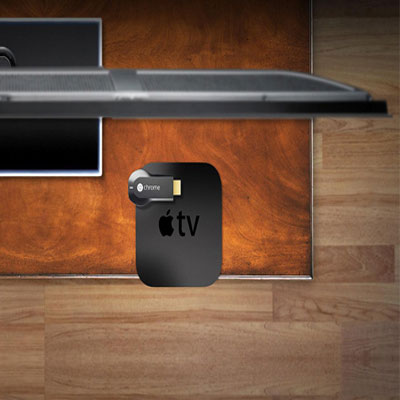
    MUMBAI: Making a new move into internet television, Google will start selling a $35 gadget that will plug into a high-definition TV and stream video from Netflix, YouTube and other sources.

    The two-inch device, dubbed Chromecast, is aimed at replacing set-top boxes and can be controlled by both Android and Apple smartphones or computers. Google said it will also stream music or even show web pages from computers using the Google Chrome web browser.

    Analysts said the device could be a disruptive move by Google to compete with Apple and other tech companies that want to bring internet services to the television set. Forrester analyst Sarah Rotman Epps tweeted that it represents a “smaller, more elegant approach” compared with Google’s previously halting efforts at similar products.

    The new Chromecast gadget looks something like a USB memory stick but packs far more capabilities. When plugged into a TV set, Google said the gadget will connect both to a home wireless router and to other devices such as smartphones, tablets or laptop computers. Anyone in range can then use their smartphone or computer as the “remote control” – to select a video from YouTube or Netflix, for example.

    The Chromecast takes its cue from the selected device but then streams the video or other material directly from the internet, through the home router, so the smartphone’s battery doesn’t drain, Google representatives said.

  • Google’s North America web traffic bigger than FB, Netflix and Instagram combined

    Google’s North America web traffic bigger than FB, Netflix and Instagram combined

    MUMBAI: Search engine giant Google on an average day reportedly handles 25 per cent of web traffic running through North American internet service providers (ISPs) which makes it bigger than Facebook, Netflix and Instagram combined.

    Founder of Deepfield, the internet monitoring company, Craig Labovitz said that over the past year Google has become pervasive not just in Google data centers, but throughout the North American internet and 62 per cent of smartphones, tablets and other devices that tap into the internet from throughout North America connect to Google at least once a day. According to the report, Google’s lion share of the web traffic comes from YouTube and the growing traffic is the reason why Google is building data centers as fast as possible and has data centers on four continents.

    Google has added thousands of servers called Google Global Cache servers to ISPs around the world which store the most popular content from Google’s network and then serve it directly from the ISP’s data center, rather than streaming it all the way from Google’s data center.

    Labovitz said that Google and Netflix’s move into so many of the ISP network operation centers is likely to be followed by other internet giants like Apple and Facebook, the report added.

  • Google joining other tech companies in race to launch pay television

    Google joining other tech companies in race to launch pay television

    NEW DELHI: Google is joining several other technology companies in the race to launch an online version of pay television and has recently approached media companies about licensing their content for an internet TV service that would stream traditional TV programming.

    A report in The Wall Street Journal quoted by CASBAA says if the Web giant goes ahead with the idea, it would join several other companies planning to offer services that deliver cable TV-style packages of channels over broadband connections.

    Intel Corp and Sony Corp are both working on similar offerings, while Apple has pitched various TV licensing ideas to media companies in the past couple of years.

    Google has made overtures to some programmers in recent months about the initiative, sources said.

    In at least one case, Google has provided a demonstration of the product, according to a person who saw the demonstration. Google did not immediately have a comment.

    If launched, the internet-TV services could have major implications for the traditional TV ecosystem, creating new competition for pay-TV operators that are already struggling to retain video subscribers.

    Existing online-video players like Netflix, Hulu and Amazon.com offer on-demand TV, but the latest efforts are aimed at offering conventional channels, allowing consumers to flip through channels just as they would on cable, as well as on-demand programming.

    There is no guarantee Google, or any of the technology companies, will be able to strike licensing deals.

    Media companies are nervous about undermining their lucrative arrangements with existing distributors by licensing to new online pay services.

    The media companies are more focused on expanding online and on-demand availability of their programming through current distributors, say media executives.

    While they are open to licensing their content, they generally give the best prices to the biggest distributors.

    To get decent rates for so-called over-the-top TV services, Google and other companies will almost certainly have to accept the standard programming bundles that cable and satellite operators pay for – packages that include highly popular and less popular channels.

    This is the second time Google has gone down this path. About two years ago Google had conversations with media companies about a similar service but the discussions did not get very far, it is learnt.

    Still, the environment has changed since then: not only are several other technology companies actively working on similar services but pay-TV providers are also asking entertainment companies for nation-wide streaming rights.

    While none of those other discussions has yet resulted in any new services that could soon change. Intel, which plans to launch its service by year-end, has had discussions with several media companies to acquire broadband-service rights for more than a year.

    It is unclear whether the company has yet struck any major programming deals. But it may at least have a name. Documents disclosed last week indicate that the company may call the service OnCue.

    The status of Sony’s plans is not clear either although one media executive said Sony could launch its service before Intel.

    As previously reported, Sony plans to beam its service over broadband connections to Sony-made devices, which include PlayStation gaming consoles, TV sets and Blu-ray players. A Sony spokesman declined to comment.

    Apple has met with resistance from media companies throughout negotiations to license content, said people familiar with the situation.

    All tech companies looking to launch a video service face a fundamental strategic challenge: If they can’t beat cable or satellite TV on pricing and offer the same lineup of channels, it is not clear why consumers would switch.

    One answer, backers say, is that the technology companies can develop far better interfaces to watch television than the clunky programming guides pay-TV operators offer now.
    Indeed, many media executives said they are impressed at the slickness of slick Intel’s set-top box and guide.

    Google has taken several other steps to expand in television and online video in recent years, including financing original programming for its online video site YouTube, launching regular cable service on its Google Fiber network in Kansas City, and developing a Google TV software to be installed on cable TV set-top boxes.