Category: iWorld

  • Airtel launches 4G trials in Mumbai; partners Flipkart, Samsung

    Airtel launches 4G trials in Mumbai; partners Flipkart, Samsung

    MUMBAI: The 4G wave is picking up pace in the country with telcos scrambling to roll out its services and offers to gain subscriber traction. Global telecommunications company Bharti Airtel has now launched 4G trials exclusively for its existing customers in Mumbai.


    As part of this, Airtel customers across the city can now avail a complimentary upgrade to Airtel 4G at 3G prices and be the first to experience blazing Airtel 4G speeds. The company will use this trial phase as an opportunity to gather customer feedback around the quality of its 4G services and assimilate these market insights into Airtel’s wider agenda of building a world-class 4G network infrastructure for the city.


    Additionally, Airtel has also inked go-to-market partnerships with Samsung and Flipkart to proliferate 4G devices and transition more and more customers to experience the fastest browsing experience.


    Bharti Airtel Mumbai, Maharashtra, Goa and Gujarat hub CEO Ashok Ganapathy said, “As an increasing number of Indians show a preference for consuming data and content over their mobile devices, we at Airtel are excited to bring the power of 4G to our customers in Mumbai. While launching Platinum 3G, we significantly augmented our network and now have made further investments in building a robust 4G network here. For us, delivering a compelling service experience to our customers is our utmost priority. We want our existing customers to be the first ones to enjoy the Airtel 4G experience and are offering them a free upgrade to Airtel 4G at the same price as 3G. We look forward to our customers’ valuable feedback towards delivering a truly world-class 4G experience in Mumbai.”


    To avail this offer, existing Airtel customers with 4G ready mobile devices can walk into any of Airtel’s retail touch points across Mumbai and upgrade to a 4G SIM and experience high mobile internet speeds.


    As part of the deal with Samsung India, the two companies have decided to promote each other’s 4G offerings at their respective outlets. Samsung India’s retail stores will now facilitate easy Airtel 4G SIM swap for customers buying 4G smart phones. In the weeks to come, Samsung will also offer bundled Airtel 4G SIMs along with Samsung 4G handsets available in the Indian market. Airtel 4G double data offers are now available for Samsung’s Galaxy S6, Galaxy S6 Edge, Galaxy A7 and Galaxy A5 mobile devices. Samsung will also be looking at launching its all new Core Prime 4G mobile smartphone in Airtel 4G markets.


    Flipkart, on the other hand, will be offering Airtel 4G with double the data benefits for customers buying select 4G handsets. Flipkart-exclusive 4G devices (including brands like Xiaomi, Motorola, Lenovo, Asus and Huawei) that will soon come bundled with an Airtel 4G SIM. While existing Airtel customers will be able to follow a quick SMS registration process to activate 4G, non-Airtel customers buying their 4G device from Flipkart will be guided through a simple process to smoothly transition to the Airtel 4G network.


    Airtel’s 4G services are now available across India including Mumbai, Kolkata, Chennai, Bengaluru, Pune, Chandigarh and Amritsar.

  • Vespa launches online store on Snapdeal

    Vespa launches online store on Snapdeal

    MUMBAI: E-commerce is slowly but surely catching the fancy of brands galore. While until now brands selling clothes, accessories, shoes, furniture, books and the likes have been active in the online market place, in a first of sorts premium scooter brand Piaggio Vespa has launched its online store on Snapdeal.com in India.


    Vespa’s partnership with Snapdeal is targeted towards a younger segment of consumers who are digitally active and prefer instant purchases.


    Piaggio Vehicles, which is an Indian subsidiary of the Italian Piaggio Group, has partnered with Snapdeal to reach out to its Internet savvy customers. The brand store, which is an exclusive in itself, will showcase the entire range of Vespa scooters. Vespa fans will now be able to book their Vespa on a click of a button.


    The European best seller in the two-wheeler category has been successful in creating a niche ‘premium’ audience for their scooters since their presence in India in April 2012.


    Vespa has launched a special offer for the first 100 customers of the store. The store will offer the entire range of Vespa models available at a booking amount of Rs 5000 and the models include Vespa, VX, Vespa S and Vespa Elegante.


    Piaggio Vehicles EVP two wheeler business Sanjeev Goyle said, “Today’s generation loves online shopping and prefers brands that provide buyer friendly shopping options. Hence we decided to launch a virtual store that will offer the fastest possible Vespa buying experience. Snapdeal is India’s largest online marketplace and hence it was the best platform for us to launch our first online store. Through this collaboration, we aim to take our relationship with our consumers to the next level. This initiative of ours will be an integral part of our larger marketing strategy.”


    “Automotive category on Snapdeal has grown at a phenomenal pace in the last 12 months. We have seen a tremendous customer response towards this category. With the Vespa Brand Store, on the Snapdeal platform, we want to create a unique shopping experience for our consumers where they have access the entire Vespa Scooters’ portfolio from the comfort of their homes,” said Snapdeal SVP electronics and home Tony Navin.


    The store has been created keeping in mind the nuances associated with the brand. The store enables Piaggio to manage their product selection, promotions and launches as per their need and basis the analytics shared by Snapdeal.

  • MS Dhoni-led Chennai Super Kings dominate Facebook fandom map

    MS Dhoni-led Chennai Super Kings dominate Facebook fandom map

    MUMBAI: Facebook has been mapping fans of the eight teams playing in the Indian Premier League (IPL), which shows the most-liked teams on Facebook across all of India’s states and districts. Led by Mahendra Singh Dhoni, the Chennai Super Kings (CSK) are the kings of IPL when it comes to their Facebook likes.


    The map shows that every team is the most supported team in their home states. In states that do not have a team, CSK dominates. 


    Interestingly, more people in Delhi like the CSK team than their home team. In fact, the Delhi Daredevils do not have a plurality of fans in an Indian district. And in Gurgaon, Mumbai Indians are the most popular among Facebook fans. 

    The Facebook fandom map is created by the Facebook Data Science team, shows fans of all eight IPL teams across India. Each district is color-coded based on which official team Facebook page has the most likes from the people that live in that district.


    What’s more, from 1 April to 10 May, approximately 26 million people had nearly 250 million Facebook interactions around the IPL wherein people engaged in the conversation their favorite teams, players, and with their friends around IPL content. In India, 19 million people had nearly 200 million interactions.

  • Yash Raj Films partners Twitter to drive innovation

    Yash Raj Films partners Twitter to drive innovation

    MUMBAI: In a move to reach an audience always on the move, Yash Raj Films has teamed up with Twitter India to help reach every Indian film fan with a mobile phone.


    Via its Twitter handle @YRF, the film production house will send selective tweets (driven by #YRFBuzz) as SMS to users, who subscribe to the service by giving a missed call to 0-75054-75054. This feature works on any phone, any network and is a completely free of charge, for online as well as offline users.


    Yash Raj Films vice president – digital Anand Gurnani said, “We are on the cusp of widespread growth across mobile, web and social media. This syndicated mobility program will aim to reach mobile-friendly audiences and analyze consumption patterns and trends across web and mobile. Moreover, the move is aligned to the company’s ‘mobile-first’ approach.”


    Twitter India head of TV and entertainment partnerships Pratiksha Rao added, “In India, Twitter is focused on reaching every person with a mobile phone and this product is in service of that goal. We are excited about Yash Raj Films taking the initiative to make it even more accessible for fans of their movies and content to stay in touch with the latest buzz at one of India’s biggest movie production houses.”


    Yash Raj Films is the first production house to activate this kind of service in the entertainment vertical in India.

  • Virat Kohli gets into overdrive with social media venture Sport Convo

    Virat Kohli gets into overdrive with social media venture Sport Convo

    MUMBAI: Cricketers today are also proving to be smart businessmen, whether it’s the Indian captain Mahendra Singh Dhoni or the cricket sensation Virat Kohli.
     
    When he’s not busy hitting boundaries and sixes on field, he’s busy eyeing business ventures that catch his fancy. Kohli, who invested in the social media start-up Sport Convo last year, is of the opinion that sport benefits greatly from social media, which is one of the reasons why he invested in the London-based company. What’s more, Sport Convo, which aims to bridge the gap between sports stars and fans, has got off to a good start.

    The ICC World Cup 2015 and the on-going Indian Premier League (IPL) raked in numerous impressions on social media platforms  like Twitter and Facebook, where fans discussed various important moments that changed the course of the game. With social media proliferation, niche websites such as Social Convo, catering to specific fields are likely to crop up sooner rather than later.
     
    The Indian cricketer, who has more than 30 million fans on social media platforms, will be using his fan base to promote the venture. Catering to a niche, the sport-specific social media – Sport Convo’s website promises exciting gifts for fans who register in the initial stages. Additionally, Kohli also tweeted that one lucky fan will receive a bat signed by him.


    Kohli was quoted in media reports as saying, “Sport Convo was particularly attractive to me as my belief is sport benefits greatly from social media. It provides fans with the opportunity to showcase their opinion and passion for the game. It also allows me to communicate with my fans quickly and efficiently, which is important because as a professional cricketer, I am always on the go. Sport Convo stood out for me and delivers all of this and beyond and that’s why I opted to back this business venture.”
     
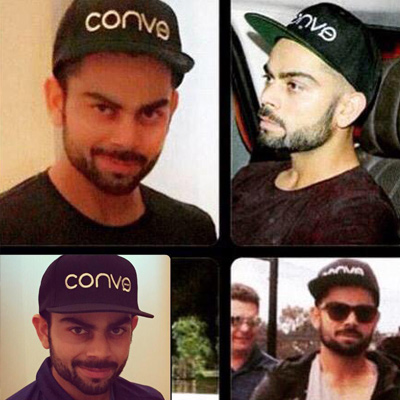
    The website also has a ‘Shop’ link, signifying that Sport Convo will not just be limited to conversation but will also venture into the merchandising business. Currently the website only features one product – a ‘Convo’ branded cap, which can be purchased anytime soon. Kohli has been spotted wearing a similar cap on numerous occasions.
     
    Apart from Kohli, the venture has also roped in England hard-hitting batsman Alex Hales, who would be endorsing the brand. Hales will be sporting the Sport Convo’s logo on his bat.
     
    Sports Convo is also looking at roping in more sports stars on board and the conversation will not be restricted to cricket.

    So far the company, founded by Vishal Patel, Amrit Johal, Praveen Reddy and Jasneel Nagi, is a sports star driven social media platform, which will also have an e-store for fans to buy products promoted by their sports heroes.
     

    Observers believe that the merchandising business which the site has flagged off might well explode into a lucrative one. However, they doubt whether enough fans will get on to the social media platform to chat and connect with each other because of the growth and growth of Facebook. Another social media platform in the US fanbase.com recently announced that it would shut because it had not managed to crack a business model to monetise on the 15 million sports lovers who were logging on every month.

    A sports journo however begs to differ. “Fanbase.com was founded by two young entrepreneurs with investors. They did not have any sports person backing them online to drive conversation. SportConvo however has Virat with his feet firmly entrenched in the venture. And he is driving it through his social following, posting videos, tweets and doling out give aways. I can only see it being a winner all the way in every way.”

    It now remains to be seen if the briskly scoring Kohli succeeds to drive enough fans to Sports Convo and turn it into a resounding success.


  • YouTube ads startup FameBit buys Refame; expands brands’ access to digital stars

    YouTube ads startup FameBit buys Refame; expands brands’ access to digital stars

    MUMBAI: With the advent of YouTube stars, gone are the days when brands were only obsessed with having television, film or sports celebrities as brand ambassadors to endorse their products. In today’s all pervasive digital ecosystem, anyone with enough chutzpah can catapult to fame, amass a cult following, become an instant star… and a money churning one at that. And brands nowadays are more than willing to work with these millennial influencers for branded content and endorsements.


    In a scenario like this, digital stars across platforms like YouTube, Vine etc, who offer unique and differentiated content to a host of followers on the world wide web, have caught the fancy of many a specialised companies. And they’ve left no stones unturned in milking these cash cows.


    Armed with a vision to expand its offerings, FameBit, a marketplace which connects brands to YouTubers for branded content and endorsements, has now acquired the video marketing agency Refame.


    Specializing in super-short-form videos, Refame creates branded videos starring Vine, Snapchat and Instagram personalities. Last year, the company pulled together a roster of social influencers who reach 40 million people across their channels and profile pages.


    FameBit, which is on track to reach a billion subscribers by the end of 2015, will now add Reframe’s roster of creators to its platform. The acquisition also means that FameBit now has access to more digital platforms in the social video marketing business apart from YouTube.


    FameBit’s platform boasts of more than 10,000 creators across YouTube, Vine, Snapchat and Instagram, collectively reaching more than 450 million subscribers. According to the company, YouTubers have submitted more than 100,000 proposals to brands for product integrations through FameBit till date. In July last year, the company helped brands create more than 1,000 videos and paid out more than $500,000 to creators by October.


    “This is a defining moment for FameBit. We see Refame as a natural addition to the long-form content our influencers are currently creating and we are excited to incorporate it into our platform. By expanding our reach to content marketers on Snapchat, Vine and Instagram, we’re giving brands the opportunity to speak to audiences across other creative platforms in ways that are most impactful and appropriate for each one of those platforms,” said FameBit co-founder and CEO David Kierzkowski.


    With the kind of fan following digital stars enjoy, brands now know how valuable they can be as content creators and endorsers. FameBit has already connected YouTube creators with brands like L’Oreal, Adidas, JustFab, Hint and Dollar Shave Club. It’s just a matter of time before more and more brands hop on to the digital stars’ bandwagon in order to pull in and connect to its customers.

  • Telcos support net neutrality but root for checks on OTT platforms

    Telcos support net neutrality but root for checks on OTT platforms

    NEW DELHI: While supporting net neutrality and firmly holding that access should be made available to all on a non-discriminatory manner, the Cellular Operators Association of India (COAI) has said that there is a need to evolve the regulatory framework for Over The Top (OTT) communication services to prevent various regulatory imbalances between the Telecom Service Providers (TSPs) and the OTT communication players.


    It is response to the Telecom Regulatory Authority of India’s (TRAI) consultation paper on OTT, COAI has said a “common regulatory framework for businesses providing the same services is the need of the hour and will benefit all players as it will reduce legal ambiguity and prevent unnecessary litigations.”


    At the outset, COAI said it welcomed the entry of OTT players and believes that they play an important role and offer many new services. However, the body added that, “it is pertinent to note that some of the services that are offered by the OTT players such as messaging/instant messaging and VOIP telephony are perfect substitutes of the services that can be offered by the telcos. These OTT players have rightly been classified by the Authority as “OTT Communication Services” players and their services are in direct competition with the licensed communication services offered by the TSPs.”


     The COAI wants not only net neutrality, but also net equality – the need to connect the one billion citizens of India, who are still not connected to the internet, by facilitating an open, inclusive and affordable access to the Internet, and with the same rules being made applicable to the same services.


    There is a need to review the regulatory framework and “we submit that the time is ripe for a comprehensive review to build a regulatory neutral, forward looking and transparent framework that ensures that the principles of “net equality” and “same service, same rules” are implemented.”


     “The need of the hour is to connect the 80 per cent of India’s population, which is still unconnected; and our campaign “Sabka Internet, Sabka Vikas” reaffirms our commitment to the Government’s vision for “Broadband for All” and Digital India, for socio-economic inclusion of all strata of the society. We believe a customer should be free to choose the device, technology and access platform – paid or subsidized, as long as the Internet is always open in terms of access in a non-discriminatory manner. Also, we offer choice and do not block or provide preferential access to any website or application, thereby safeguarding Net Neutrality,” COAI said.


    Some stakeholders have suggested that there are already adequate laws controlling the operations of OTT players such as Information Technology Act, Indian Penal Code, the Criminal Procedure Code etc. It is pertinent to point out here that such laws are general laws, which in its terms and effect apply to the entire country irrespective of the sector and framework in which they operate. While these laws are important and useful in a general context, they cannot be said to be a substitute of a common regulatory framework, which would govern and regulate similarly placed service providers and give them a common platform for the provision of services on common terms, which would ensure a level playing field.


    The telecom industry has already invested over Rs 7,50,000 crore in setting up world class mobile networks over the last 20 years and is looking at investing another Rs 5,00,000 crore in the next five years to roll-out into rural areas and also upgrade existing networks to connect one billion Indians to the internet. Moreover, going by the Government’s commitments, the Digital India Programme itself will require investments to the tune of Rs 113,000 crore. Additionally, the Planning Commission’s 12th Five Year Plan requires an investment of Rs 943,899 crore with 93 per cent of the total investment expected to come from the private sector.


    The Indian mobile telephony industry today, is in dire financial straits with a cumulative debt of over Rs 300,000 crore, and a one per cent return on investments, with many operators even making negative returns on their investments. This situation puts at risk the nation’s agenda of “Broadband for All”, as private operators will be unable to attract additional investments in the sector, required to support the ambitions of the government.


    COAI said there were various regulatory imbalances that existed between the telecom operators and OTT communication players. “We would like to submit that the TSPs bear the cost of infrastructure, spectrum, and payment of license fees and spectrum usage charges, which are not applicable to the OTT communication players. The TSPs also have the obligations related to roll-out, meeting quality of service parameters and security related obligations. Many of these do not apply to OTT communication players, which result in an arbitrage opportunity. The National Security and consumer security, safety and privacy are of paramount importance, and should not be compromised at any cost. The security framework has evolved over the years along with the growth and proliferation of telecom services and all the telecom operators provide these services under a strict licensing framework, including compliances with the security conditions and service standards. The extensive and stringent security conditions laid down and required to be met by the licensed TSPs are not applicable to the OTT Communication players. Most of the OTT players do not meet the encryption and decryption requirements of the Law Enforcement Agencies (LEA).”


    In response to a Parliamentary question on security threats from OTT applications, COAI said that the Telecom Ministry has acknowledged the fact that security/LEAs are facing difficulty while dealing with encrypted communication services provided by OTT service providers and the same may also be used by anti-national and criminal elements, posing a security threat. Lack of regulation on communication related application services could lead to serious national security and data privacy implications because they bypass the regulatory regime enforced on licensed service providers. Therefore, it is essential to ensure that the principles of “Same service, Same rules” are implemented.


    Referring to claims by some stakeholders that Internet Based Services (IBS) players should not pay for use of the TSPs network over and above data charges paid by customers, COAI highlighted that increased data usage fails to compensate for loss of revenues to TSPs arising due to OTT services. Further, these services demand high-speed networks that require substantial investment in infrastructure, particularly for the development of the broadband infrastructure both from the fixed and mobile perspective. “We hereby advocate for the Open and Pro-innovation Environment wherein pricing flexibility is provided to the operators and the choice is provided to the customers.”


    On traffic management for different OTT services, COAI said traffic management allows operators to secure their networks, prioritize time-critical services and match scarce network resources to service requirements. It is an essential function of networks to meet the performance expectations of different types of traffic to ensure better customer experience. Traffic management is a tool for consumer benefit not consumer harm as it provides a number of clear benefits to end users in terms of improved performance, innovation, consumer protection and efficiency.


    On the contention that TSPs should not be allowed to implement non ­ price based differentiation as it would be grossly uncompetitive and would kill competition leading to all traffic being cornered by a few, the Association said there is a need to look at the internet as a two sided market, which involves the consumer and the content app provider. The TSP is the platform that market together and needs to be given the flexibility of implementing based differentiation.


  • Digital India fails to impact growth of broadband subscribers

    Digital India fails to impact growth of broadband subscribers

    NEW DELHI: At a time when the government is working on programmes like Digital India, there has been an increase of a meager 1.88 per cent in the number of broadband subscribers between February and March this year.


    According to a Telecom Regulatory Authority of India (TRAI) report, the number rose from 97.37 million at the end of February to 99.20 million.


    As in previous months, the largest increase was in the mobile devices users (phones and dongles) segment from 81.48 million to 83.24 million, showing an increase of 2.17 per cent.


    The increase in fixed wire subscribers (Wi-Fi, Wi-Max, Point to Point Radio and VSAT) was from 440,000 to a little above that figure. The rise in wired subscribers was from 15.45 million to 15.45 million to 15.52 million.


    The top five service providers constituted 83.39 per cent market share of total broadband subscribers at the end of March. These service providers were Bharti Airtel (22.01 million), Vodafone (19.37 million), BSNL (18.88 million), Idea Cellular Ltd (14.52 million) and Reliance Communications Group (7.94 million).


    Some wireless service providers exclude incidental data users from their subscriber base, based on minimum usage decided by them.


    As on 31 March, the top five Wired Broadband Service providers were BSNL (9.96 million), Bharti Airtel (1.43 million), MTNL (1.14 million), Atria Convergence Technologies (0.67 million) and YOU Broadband (0.44 million).


    The top five Wireless Broadband Service providers were Bharti Airtel (20.58 million), Vodafone (19.37 million), Idea Cellular (14.52 million), BSNL (8.92 million) and Reliance Communications Group (7.83 million).

  • Indian satellite TV revenues to touch $2.5 billion by 2020: Digital TV Research

    Indian satellite TV revenues to touch $2.5 billion by 2020: Digital TV Research

    NEW DELHI: Satellite TV (DTH or DBS) revenues will overtake total cable TV revenues in 2015, and the growth of digitisation in India will have a major role to play in this.


    According to Digital TV Research, India will add the most satellite TV revenues to the tune of $2.5 billion, moving from tenth to fifth place between 2014 and 2020.


    India will add $3.2 billion in digital cable TV revenues to take its total to $4.3 billion. India’s revenues will climb by $4.7 billion between 2014 and 2020, with China up by $1.6 billion and Japan increasing by $1.1 billion.


    Covering 138 countries, the Digital TV World Revenue Forecasts report estimates that satellite TV accounted for 44 per cent of the total in 2014, going up to 46 per cent by 2020. However, cable TV revenues (both analogue and digital) will drop from 46 per cent of the total in 2014 to 40 per cent in 2020. Meanwhile, IPTV – the fastest growing platform – will climb from a 10 per cent share in 2014 to 13 per cent by 2020.


    Satellite TV revenues will reach $94.8 billion in 2020. The United States will remain satellite TV market leader. Brazil will be second by 2020 ($6.8 billion); having overtaken the United Kingdom in 2013. However, the US will fall by $421 million, Canada by $805 million and France by $232 million.


    Global cable TV revenues peaked at $93.8 billion in 2012, and will fall to $81.9 billion in 2020. However, cable operators will gain extra revenues by converting subscribers to bundles. Analogue cable TV revenues will plummet by $14.4 billion between 2014 and 2020 to only $1.5 billion.


    Digital cable TV revenues will climb by 5.6 per cent from $76.1 billion in 2014 to $80.3 billion in 2020 – or up by nearly $19 billion between 2010 and 2020. Digital cable TV revenues in the US will fall by $8.9 billion between 2014 and 2020 to $34.1 billion. In fact, digital cable TV revenues will drop for 20 countries over the same period. Second-placed China will increase its revenues by $2.1 billion to $8.9 billion and third-placed Japan by $2.0 billion to $5.1 billion.


    IPTV revenues will climb to $27.9 billion in 2020; triple the 2010 figure. US IPTV revenues will increase by $1.3 billion between 2014 and 2020 to $9.5 billion, with Canada second with $2.3 billion. Third-placed China will be up by $1.1 billion to $2.1 billion – just ahead of Japan.


    Pay-TV revenues will more than double in 33 countries between 2014 and 2020. Most of the fast growing nations by percentage increase will be in Africa, with Myanmar, Laos and Bangladesh providing notable exceptions. India’s revenues will climb by $4.7 billion between 2014 and 2020, with China up by $1.6 billion and Japan increasing by $1.1 billion.


    Global pay TV revenues (subscription fees and on-demand movies and TV episodes) will only grow by 2.6 per cent between 2014 and 2020 to $207 billion. This follows 14.5 per cent growth between 2010 and 2014. 


    Total revenues in North America will fall by 11.7 per cent (or $12 billion) between 2014 and 2020. Western Europe will be flat at $32 billion.


    On a more positive note, revenues will grow by nearly $10 billion (up by 30 per cent) in the Asia Pacific region to $42 billion. Asia Pacific will overtake Western Europe in 2015, and will be larger than the whole of Europe by 2019. Eastern Europe will add $1 billion (up by 17 per cent) between 2014 and 2020. Latin America will add a further $2.6 billion (up by 13 per cent) between 2014 and 2020.


    Revenues will rocket by 76 per cent (up by $2.7 billion) in the Sub-Saharan Africa region and by 32 per cent (up by $1.4 billion) in Middle East and North Africa. Sub-Saharan Africa will pass Middle East region in 2018.

  • Amit Agrawal joins Click Digital Studios’ advisory board

    Amit Agrawal joins Click Digital Studios’ advisory board

    MUMBAI: Indian short form video company Click Digital Studios India (CDS) is looking to turbocharge its growth trajectory and has roped in former YouTube India head Amit Agrawal on its advisory board


    The company is working towards major expansion in coming months with a plan to launch 10 new channels in a year.


    At CDS, Agrawal will lend his understanding of the business, market and industry of online videos space to CDS’ portfolio of YouTube channels. He will apply his deep domain experience to guide this expansion plan.


    Click Digital Studios chief strategy officer Sudhir Bagul said, “We are extremely excited to have Amit on board. His extensive experience in the field of digital video content will lend able guidance and help us channel the growth of our portfolio in the most desirable way.”


    Agrawal added, “I am completely blown away by the CDS performance in last 12 months. They have really been on a blitzkrieg on mobile platforms and ShudhDesi Endings in one of the best channels to come from India. At India goes global, we are always looking to help turbocharge such startups and CDS’ understanding of what works on short form is really impressive.”


    CDS’ current portfolio comprises channels such as ShudhDesi Endings, ShudhDesi Raps, CDS India and 70 others ranging in the genres of Bollywood and Hollywood gossip, music, animation, food, fitness, technology, kids education anddevotional music.