Category: iWorld

  • YouTube redesigns mobile app; adds new tabs

    YouTube redesigns mobile app; adds new tabs

    MUMBAI: If you watched a YouTube video recently, chances are you did it on your phone or tablet and also saw the new look and design of the app.


    With more than half the views on YouTube coming from mobile devices, YouTube has now updated the official YouTube apps to bring an even better mobile experience to consumers thus making it easier than ever to find and create videos.


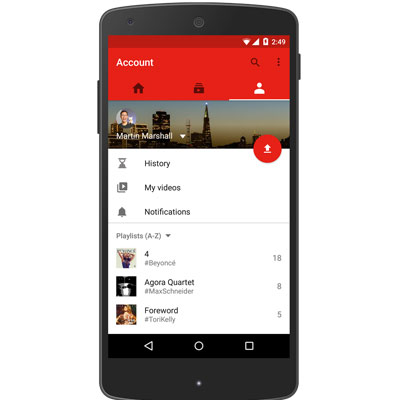
    The update – available now on Android, mobile web, and soon on iOS – introduces three new tabs:


    • Home: Easily explore and discover videos with recommendations based on watch history as well as personalized playlists.

    • Subscriptions: Find the latest videos from your favorite channels and creators on the new Subscriptions tab. And to help make sure one never misses an upload, consumers can now tap the bell icon on channels to get a notification as soon as a new video is posted.

    • Account: One can check out playlists, watch history, and the videos they have uploaded all in one spot.


    Additionally, in the new updated app, one can also now watch full-screen vertical videos with just a single tap for the very first time.


    “But YouTube isn’t just about enjoying videos; it’s a place to express yourself and show the world what you love. With the redesigned app you can take your creativity to new levels using a new set of video creation tools. You’ve got an amazing camera in your phone or tablet, and now you can trim your footage, tint the image with filters, add music, and upload – all inside the app,” said YouTube product managers Matt Darby and Omri Amarilio.


    “These are just a few of the features we’ve been working on, and you’ll see many more later this year,” the duo added.

  • Nokia gets EU nod for Alcatel-Lucent acquisition

    Nokia gets EU nod for Alcatel-Lucent acquisition

    MUMBAI: Nokia has received approval from the European Commission (EU) for its pending acquisition of Alcatel-Lucent. The proposed transaction was notified to the European Commission on 19 June, 2015 and was cleared today (24 July) without conditions following a Phase 1 review. 


    Approval by the European Commission follows previously disclosed antitrust clearances in Brazil and Serbia and the expiration of the antitrust review period in the United States. In addition, the parties confirmed that they have received further antitrust clearances from Albania, Canada, Colombia and Russia. Both companies will continue to cooperate with the remaining authorities to close their reviews as quickly as possible. 


    The transaction remains subject to approval by Nokia shareholders, Nokia holding over 50 per cent of the share capital of Alcatel-Lucent on a fully diluted basis upon completion of the public exchange offer, receipt of other regulatory approvals and other customary conditions. The transaction is expected to close in the first half of 2016.


    As was previously reported by Indiantelevision.com, Nokia had acquired Alcatel-Lucent in April this year for a sum of $16.6 billion. The new company will be known as Nokia Corporation.

  • Times Internet’s Gaana.com looks to raise $150 million

    Times Internet’s Gaana.com looks to raise $150 million

    MUMBAI: After music streaming service Saavn raised over $100 million not so long ago, its competitor Times Internet’s Gaana.com is all set to make a similar move in order to expand its base and invade newer territories. If industry sources are to be believed, the venture is looking to raise over $150 million.


    While Gaana.com business head Pawan Agarwal confirmed to Indiantelevision.com on the fund raising, he declined to disclose the amount as well as the parties that were looking at investing into the venture.


    “India is a vast market and we have aspirations of expansion and to fuel that we plan to raise funds through venture capitals and other private investors,” said Agarwal.


    It may be recalled that recently, Saavn announced its move to enter into delivering video content to its subscribers. When queried as to whether Gaana was also looking to take the same route, Agarwal replied, “At this point of time, we do not have such plans. There is enough room in the music streaming market and we are concentrating on that.”


    So far, the Times Group has invested $25 million in Gaana.com, which has crossed 22 million downloads across Android and iOS as well as clocked 16 million monthly active users. On the other hand, Saavn, which was founded in 2007, has 14 million monthly active users, up from 11 million in the first quarter of 2015. What’s more, it expects to cross 20 million by the end of the year.


    The music streaming players in India are planning thick and fast so as not to leave the market wide open for rivals.

  • ABS Group ties up with BSNL for on-demand services

    ABS Group ties up with BSNL for on-demand services

    MUMBAI: In a bid to expand its services in a highly competitive environment, the Atul Saraf led ABS Group has lined up a spree of developments. The company, which is all set to launch its MPEG 4 headend, is now strengthening its value added services (VAS) offering.


    ABS has entered into an agreement with telecom giant BSNL. As part of this, BSNL’s 10 million broadband subscribers can access the VAS and movies-on-demand services of ABS through its portal www.absplay.in.


    “We are working on setting up the servers in the BSNL premise for our value added services,” ABS CMD Atul B Saraf tells Indiantelevision.com.


    The portal will go live in August, 2015 after which BSNL broadband subscribers can access the library that contains more than 1000 movies, 60,000 songs and videos and approximately 70-80 web channels. “It is a subscription based model. There will be a revenue share between BSNL and us,” informs Saraf.  


    The content will range from Bollywood, Hollywood, Tollywood, regional, sports, devotional, comedy, horror, action to music, short length videos and full length videos. While refraining to divulge the pricing of the content, Saraf says, “It will be in a very cost effective manner.”


    Close to 25 per cent of the catalogue has been purchased by ABS, while 75 per cent of the content will be on revenue sharing basis with content creators. “We have bought content from both national and international content providers. We will have a revenue share with them,” he informs.


    “We saw a gap in the VAS space and so tried to tap into it. This is part of our new revenue generating launches,” says Saraf.

  • Livspace hops on as design partner for Great Online Home Festival

    Livspace hops on as design partner for Great Online Home Festival

    MUMBAI: Livspace has come on board as the exclusive design partner for the Great Online Home festival (GOHF), an initiative of GroupM. The festival is presented by Magicbricks and powered by Google.


    As the design partner for GOHF, Livspace will offer interior design to new homes listed on GOHF platform as well as existing homeowners. GOHF will bring together the best home deals in India including real estate, home decor and home care. The nine day festival began on 18 July.


    Livspace will offer exclusive deals on complete home design service, as well as modular kitchens and wardrobes. The focus will be on making good home design accessible to the Indian homeowner, while making the interior design process fun, simple and exponentially less time-consuming. As a homeowner, you can also get all your design queries answered, by joining Livspace interior designers on Google Hangouts everyday between 7 – 8 pm from 18 – 27 July.


    Livspace has also launched its new mobile app for Android users, with an iOS version to follow soon. The app allows users to discover thousands of new shop-able looks on mobile. In the coming week, app users will also be able to chat with their designer in-app.


    Livspace CEO and co-founder Anuj Srivastava said, “We are thrilled to be featured as the exclusive design partner for the Great Online Home Festival, a one of its kind event which is reflective of the rising trend of the home market moving online quickly. Millions of users will experience online end-to-end home design for all their rooms, kitchens and wardrobes, like never before. Inspired by the fact that over 50% of our traffic comes from the phone, we are also excited to announce the launch of our mobile app for Android, with iOS soon to follow. With the innovative Livspace app, you can discover, save and share thousands of looks for your home on the go.”

  • eBay India launches #SheMeansBusiness campaign

    eBay India launches #SheMeansBusiness campaign

    MUMBAI: eBay India has launched a unique campaign titled #SheMeansBusiness in partnership with Yourstory.com. 


    The campaign invites all online women entrepreneurs to share their success stories, so that other women entrepreneurs are inspired to take advantage of the growth in ecommerce.  


    Online women entrepreneurs across platforms can send their stories in the form of a write-up, a video or an audio, which will be judged by a jury. Six shortlisted women entrepreneurs not only stand a chance to share their stories with the world through www.yourstory.com but also stand to benefit from free listings on www.ebay.in during the festival season from September-December 2015.


    The campaign will be open to all online women entrepreneurs irrespective of the platform they currently trade on. Women entrepreneurs can share their stories starting today till 15 August, 2015.


    “eBay India has been encouraging and supporting women entrepreneurs for over a decade now. We have over 5000 women sellers listed on ebay.in and through this campaign, we want to further encourage and support women entrepreneurs from across India to realize and fulfill their dreams and take their businesses to a global customer base,” said eBay India head of marketing Shivani Suri.


  • Enforcing Net Neutrality: A continuous monitoring challenge

    Enforcing Net Neutrality: A continuous monitoring challenge

    NEW DELHI: Participants at a discussion on net neutrality feel that the Department of Telecom’s (DoT) recommendations on the subject are ‘soft approaches’ for bigger violations that impact principles of Net Neutrality.


    Furthermore, it was felt that there seem to be no recommendations on quantum of penalty or punishments in case of deliberate violations on Net Neutrality.   


    The Indian Legal Foundation (TILF) – a New Delhi based Think Tank organization – in association with Grandmasters India conducted the Brainstorming and Forum Discussion focusing on the various aspects of Net Neutrality with participants from corporates, government, politics, NGOs and startups.


    Even as the DoT panel lead by A K Bhargava released its report on Net Neutrality, there still remained concerns among the free Internet proponents about the enforcement of principles of Net Neutrality.


    The DoT panel suggestions on enforcing Net Neutrality included enacting a law, amending licensing conditions, creating a DoT monitoring cell and also creating training institutions to monitor Net Neutrality violations.


     “While we appreciate the overall intent of DoT report, but where does it talk about penalties, like we saw in the recent AT&T case in United States,” asked TILF chairperson, government affairs Renu Jha.


    Jha further said, “We need to create a regulatory body with powers to impose fine and punishments. It is a necessary step towards creating and regulating Net Neutrality in India.”


    While welcoming DoT recommendations, Samsung general counsel Rajendra Sharma said, “There still needs to be a lot of work in creating an appropriate legislation around the governance of Internet in India. We need to incorporate best practices from EU and United States to ensure freedom of Internet in India.”


    The Think Tank Event was presided over by Member of Parliament and mediaperson Tarun Vijay, who is among the most vocal proponents of free Internet in India and has equated net neutrality to Human Rights of Digital Age. 


    “Net Neutrality is core and essential to the government programme on skill development, Digital India and Make In India. Government and Indian parliament is committed to Net Neutrality. Any apprehension on recent DoT recommendation will be debated and government will fight for democracy of Internet,” said Vijay.


    The event was also marked by a number of startups concerned about their growth in case telcos are allowed to disseminate discriminatory tariffs or bandwidth to users.


    “Will it not be a classic case of crony capitalism if startup applications are discriminated as they are unable to cuff up extra bug for telcos,” asked Yogesh Kochar, a social media start up for school students in India. Agreeing with young startup entrepreneurs, Jha stated, “India is hub of startups for quality software and mobile applications. Any pricing or accessibility discrimination against newer applications by Telcos will certainly kill their growth and stifle innovation.”


    The Government’s hypothesis needs to be supported – “Good” regulations are better than “No” regulations at all. We do not want Indian Government or DoT to be silent on this important subject. If they remain silent and do not positively support Net Neutrality, ISPs on a later date can disrupt access to websites that do not pay them or compete with their interests. Indeed, the survival of Internet depends on DoT and Government of India and it’s implementation and enforcement of principles of Net Neutrality.

  • Ditto TV introduces new #TVBuddy campaign

    Ditto TV introduces new #TVBuddy campaign

    MUMBAI: Zee’s over-the-top (OTT) platform Ditto TV has launched a new campaign called #TVBuddy, which makes viewers aware of the people who have similar TV viewing habits.


    Coming from the bouquet of Zee Digital Convergence, the #TVBuddy campaign narrates how one always discusses their favorite TV shows with someone far away.


    #TVBuddy bridges gaps and brings together common interests of people wanting to view similar things on TV irrespective of being in different cities according to their comfort and convenience. If one is watching Jodha Akbar in their apartment in Mumbai, their TVBuddy can watch it at the same time in another timezone, like Sydney.


    “Indians are like flamingos. They flock together, even virtually while watching TV. As this insight has a strong connect, we kept the film simple to demonstrate dittoTV’s role in the lives of Indian viewers,” said Scarecrow Communications founder and director Manish Bhatt. 


    Talking about the campaign, Zee Digital Convergence CEO Debashish Ghosh added, “Zee has always been an innovator in the media industry over the period of 22 years. Its content has always resonated with the audiences and now we have taken it a notch higher with dittoTV. We believe that India is a country where we celebrate every occasion together; with #TVBuddy campaign we are aiming to lend TV viewing experience a personal touch where you can watch your favorite movie, TV show or a match with your TV buddy who may be miles apart from you. The essence of Indian audiences who have evolved with just one TV set today now have TV at the tip of their fingers!’’


    Scarecrow Communications founder and director Arunava Sengupta informed, “In the category of these app-based products, because of individual consumption, the selling point always has been about offering a personal space. But dittoTV breaches the wall and talks about consuming the entertainment together, instead of being confined to their own personal space. This, we believe, has a potential to create a disruption in the category.”


    TV buddies can watch live TV on their smart phones, tablets or laptops, by downloading the DittoTV app and install it on their devices. The app also has other features like ‘catch up’ that let people catch up with movies and TV serials from where they left them.

  • Strong subscriber growth boosts Netflix revenue in Q2 but profit declines

    Strong subscriber growth boosts Netflix revenue in Q2 but profit declines

    MUMBAI: Movie streaming service provider Netflix has added as many as 2.5 million new subscribers in Q2 2015, taking its total subscribers worldwide to a whopping 65.6 million and counting.


    However, while the company’s Q2 revenue saw a boost at $1.5 billion as compared to $1.223 billion last year, its profit showed a decline by almost 63 per cent. The company earned $26.3 million (6 cents per share), in the second quarter, which was down from $71 million (16 cents per share) during the corresponding period last year.


    Of the 65.6 million subscribers, 42 million are in the US, whereas the remaining 23 million were from international markets. By the end of the third quarter, Netflix predicts that its subscriber number would touch 69 million. The company has ambitious growth plans and plans to make its service available throughout the world by the end of 2016.


    Q2 results and Q3 forecast:


    Netflix’s higher than anticipated level of acquisition was fuelled by the growing strength of its original programming slate, which in Q2 included the first seasons of Marvel’s Daredevil, Sense8, Dragons: Race to the Edge and Grace and Frankie as well as season 3 of Orange is the New Black.


    US revenue growth was also driven by a five per cent year over year increase in ASP due to uptake in its HD 2-stream plan. The company will continue to target a 40 per cent US contribution margin by 2020, even though it is running ahead of plan given stronger than expected top line performance and lower content and other streaming costs. Netflix forecasts Q3 US net adds of 1.15 million, which is slightly higher than the year ago period.


    “Our international segment is growing at a rapid pace. We did not add additional markets in Q2 but saw continued improvement across existing markets, including a full quarter of additions from our successful 24 March, 2015 launch in Australia/New Zealand. We project Q3 international net adds of 2.4 million,” Netflix CEO Reed Hastings said.


    International revenue grew 48 per cent year over year, despite an -$83 million impact from currency (+five per cent ASP growth x-F/X). “As we expected, international losses increased sequentially with a full quarter of operating costs in AU/NZ. We expect this trend to continue in the second half as we launch additional markets (Japan in Q3 and Spain, Italy and Portugal in Q4) and prepare for further global expansion in 2016, including China as we continue to explore options there,” Hastings added.


    EPS for Q2 amounted to $0.06 after adjustment for our 7-for-1 stock split (EPS would have been $0.42 using pre-split share count). Netflix said it remained committed to running around break-even globally on a net income basis through 2016, and to then deliver material global profits in 2017 and beyond.


    Content:


    Netflix is making progress shifting to exclusive content and expanding its original content, which differentiates its service, drives enjoyment for existing members and helps motivate consumers to join in.

    In Q2, Netflix launched its largest number of original series to date. On 10 April, Marvel’s Daredevil debuted to strong audience engagement, particularly for a new show. Grace and Frankie, the bittersweet comedy starring Lily Tomlin and Jane Fonda, which launched on 8 May, also has found a broad and appreciative audience around the world. Both series have already begun their second season of production.


    The company’s global expansion extends to its content strategy as well. Sense8, the mind-bending cinematic thriller from the Wachowski siblings and J. Michael Straczynski that debuted 5 June, is an ambitious, truly international show with talent behind and in front of the camera from multiple countries. Similarly, on 7 August, Netflix will launch in all territories its first non-English language original, Club de Cuervos, a family comedy set in the world of futbol from Mexican filmmaker GazAlazraki, and on 28 August, Narcos, a gripping account of the roots of the cocaine trade, shot in Colombia and starring the great Brazilian star Wagner Moura as Pablo Escobar.


    The original documentary Chef’s Table and its latest DreamWorks Animation series Dragons: Race to the Edge are among its most viewed new originals to date.


    Netflix closed the quarter with season 3 of Orange is the New Black, which went live on 11 June and set off a social media shockwave around the world. On the following Sunday, Netflix members globally watched a record number of hours in a single day, led by Orange, despite the season finale of HBO’s Game of Thrones and game five of the NBA finals also falling on that Sunday.


    “Global enthusiasm for the third season of Orange underlines our ability to create franchise properties that bring new members to Netflix as well as delighting current ones. Nearly ninety percent of Netflix members have engaged with Netflix original content, another indicator that we are on the right path,” Hastings said.


    “We anticipate that as our global content spend approaches $5 billion in 2016 on a P&L basis (over $6 billion cash), we will devote more investment to originals both in absolute dollars and percentage terms. This includes not only series, documentaries and stand-up but also original feature films,” Hastings added.


    Netflix is moving into the original film business in order to have new, high-quality movies that can be found only on its platform. “As with series, we’ve chosen to take a portfolio approach covering a wide variety of genres and based around creators with great track records and stories they are passionate about. The first of our films, Beasts of No Nation, a gripping war drama from the award-winning director Cary Fukunaga and starring award-winning Idris Elba will be available to all Netflix members and in select theaters in October. In June, we announced War Machine, a provocative satirical comedy starring Brad Pitt, which will be exclusively available to Netflix members and in select theaters next year,” Hastings said.


    Strong Net Neutrality:


    “Charter Communications made net neutrality history by committing to open and free interconnection across the Charter/TWC network, if their pending merger is approved. This move ensures that all online video providers can aggressively compete for consumers’ favour, without selective and increasing fees paid to ISPs. Charter’s interconnection policy is the right way to scale the Internet. It means consumer will receive the fast connection speeds they expect. The Charter/TWC transaction, with this condition, would deliver significant public interest benefits to broadband consumers, and we urge its timely approval,” said Hastings.


    DVD:


    The company’s DVD-by-mail business in the US continues to serve 5.3 million members and provided $77.9 million in contribution profit in Q2. 

  • Ofcom completes first phase of digital communications review

    Ofcom completes first phase of digital communications review

    MUMBAI: Ofcom has outlined the challenges facing the UK in ensuring that consumers and businesses receive high-quality digital communications services over the next decade and beyond.


    Ofcom’s Strategic Review of Digital Communications, announced in March 2015, is examining competition, investment, innovation and the availability of all digital communications services. These include broadband, mobile, landline and bundled services.


    Communications are essential to the functioning of the economy, and to the way people work and live. Improving these services for consumers and businesses is Ofcom’s first priority, and the review forms a fundamental part of that work.


    Ofcom is seeking views on its review, which is focusing on four main areas detailed in a discussion document published:

    • investment and innovation in the market, which can help make services widely available;

    • competition, to deliver quality services and affordable prices;

    • empowering consumers and businesses, particularly making sure they have the information and means to choose and switch between providers; and

    • keeping regulation targeted at areas of concern, and deregulating where possible to allow markets to function well.


    Ofcom CEO Sharon White said, “This review is about ensuring people get the best possible communications services, wherever they live and work.

    “Our priorities are clear. We want to promote competition, investment and innovation, so that everyone benefits from even better coverage, choice, price and quality of service in years to come.”


    Investment and innovation


    UK consumers and businesses have benefited from significant investment in communications services in recent years. 4G mobile broadband is now available to 42 per cent of premises from all four operators, and 90 per cent from at least one. Superfast broadband is now available to 83 per cent of premises, with a range of providers competing on service and price.


    Ofcom wants to see the widest possible availability of high-speed broadband at home, at work and on the move. Ofcom estimates that a broadband speed of 10Mbit/s is necessary to benefit from today’s popular online services, such as on-demand video. However, eight per cent of UK households cannot currently access those speeds.


    Availability is a concern in more rural areas, particularly in the nations and regions, but also in some urban places where roll-out costs or low incomes present particular barriers. Ofcom’s review will seek possible solutions to these problems.


    It is examining how regulation can enable the commercial development of future ultrafast broadband, making it as widely available as possible.


    Ofcom is also considering what further options might be available to improve mobile services. Mobile 4G broadband will reach 98 per cent of UK premises, due to Ofcom rules and industry investment. But consumers’ and businesses’ growing expectations for reliable, universal, always-on voice and data services will need to be matched by network investment.


    Making sure competition delivers


    A major focus of the current review is how well competition is delivering benefits to consumers and businesses. Ofcom’s last strategic review began in December 2003, concluding in September 2005. It led to the creation of Openreach, through which BT is required to provide access to competing providers on equal terms, for them to offer telecoms services to consumers.


    This approach has delivered real choice, quality and value for phone and broadband customers over many years. However, some challenges remain. For example, the incentive for BT to discriminate against competing providers can be limited by regulation, but not removed entirely.


    BT’s network has evolved in recent years, with fibre lines running closer to premises. This may require different models of competition than those that worked best for the traditional copper telecoms network.


    In addition, Ofcom has been concerned that Openreach’s performance on behalf of providers has too often been poor, requiring the introduction of rules for faster line installations and fault repairs.


    The review will address these issues, and Ofcom is today seeking views and evidence on future regulatory approaches, including:


    • Retaining the current model, where Openreach operates as ‘functionally separate’ from BT, and using regular market reviews to address any concerns around competition;

    • Strengthening the current model by applying new rules to BT – such as controls on its wholesale charges with stronger incentives to improve quality of service, or tougher penalties if BT falls short;

    • Separating Openreach from BT could deliver competition or wider benefits for end users. It would remove BT’s underlying incentive to discriminate against competitors. Separation could also offer ways to simplify existing regulation. However, the process would be challenging and it may not address some concerns relating to Openreach – such as service quality, or the timing and level of investment decisions;

    • Deregulating and promoting competition between networks. Virgin Media and a variety of smaller operators own networks, which allow them to provide phone and broadband services without using BT’s network at all. This kind of ‘end to end’ competition, which sometimes involves running fibre lines directly to premises, can help incentivise Open reach to improve its infrastructure. However, it could also lead to duplication of networks and weak competition.


    It will also examine converging media services – offered over different platforms, or as a ‘bundle’ by the same operator. For example, telecoms services are increasingly sold to consumers in the form of bundles, sometimes with broadcasting content; this can offer consumer benefits, but may also present risks to competition.


    Empowering consumers and businesses


    People tailor communications services to their own needs, choosing from a range of providers at a price that suits them. For this to work properly, they need to understand the range of options available to them, and be able to switch between them effectively.


    Ofcom’s review is considering whether consumers have all the information they need to make the choice that is right for them, both when researching the market and at the point of sale. It is also looking at how switching between providers might be made easier.


    On 20 June, Ofcom introduced new rules that mean people can switch provider over BT’s network by only dealing with their new supplier. Ofcom is currently considering whether similar processes may be appropriate for mobile and services bundled with pay TV, as consumers increasingly buy services this way.


    Beyond this, Ofcom is keen to explore new ways in which consumers can engage with the market, in order to benefit from competition. Examples might include making services easier to compare, and increasing access to independent advice or feedback generated by users.


    Targeted regulation and deregulation


    The rules that govern the communications sector must evolve to keep pace with developments in technology, consumer needs and expectations. Ofcom’s review will identify where existing regulation may be simplified, removed or replaced.


    For example, the rise of ‘over the top’ (OTT) internet communications services, such as instant messaging, may create a case for less regulation on mobile operators, or for extending existing rules to internet-based services.


    Next steps


    Today’s discussion document marks the conclusion of the first phase of Ofcom’s Strategic Review of Digital Communications. Since announcing the review, Ofcom has been engaging with a wide range of stakeholders – including industry, consumer groups, the UK Government and devolved administrations – through meetings and workshops.


    Ofcom will now take forward the review’s second phase, and is seeking evidence and responses to the discussion document by 8 October, 2015. This will inform a statement at the turn of the year on priorities and action, which will shape Ofcom’s regulatory approach for the next decade.