
Category: iWorld

  • June 16: ACT continues to lead wireline broadband subscriber additions

    June 16: ACT continues to lead wireline broadband subscriber additions

    BENGALURU: Atria Convergence Technologies Private Limited (ACT, ACT Broadband) continued to lead wireline broadband internet (wireline broadband) subscribers in the calendar year 2016 with 1.6 lakh subscribers added between 1 January 2016 and 30 June. As per the Telecom Regulatory Authority of India (TRAI) data, ACT had 8.6 lakh subscribers as on 31 December 2015 (December 15, or 1 January 2016), and it closed with 10.2 lakh subscribers on 30 June, 2016 (June 16).

    Further, as per TRAI data, the top five players in India in the wireline broadband internet space in pecking order are the public sector Bharat Sanchar Nigam Limited (BSNL), Bharti Airtel Limited (Airtel), public sector Mahanagar Telephone Nigam Limited (MTNL), ACTand You Broadband (You BB).

    Among these these, only BSNL and Airtel could be termed as national players at present. BSNL, Airtel and MTNL also provide wireline telephony voice and data and mobile services while Airtel also has a direct to home (DTH) segment. ACT started off as an MSO with operations concentrated in a few major cities and towns located mainly in South India. It started internet services (ACT Broadband) a little later and has grown its broadband internet subscriber base over time thorough organic as well as acquisition growth, to the extent that it is quite likely the biggest private wireline broadband player in South India. You BB offers broadband operations in a few cities in Maharashtra, Gujarat, the NCR region, Andhra Pradesh and Karnataka.

    ACT was followed by Airtel which added 1.5 lakh subscribers in the calendar year 2016 until June 16. Airtel had 16.7 lakh wireline broadband subscribers on 1 January, 2016. In June 16, it had 18.2 lakh subscribers. Among the top five wireline broadband players in India, You Broadband (You BB) was the next with 50 thousand subscriber added during the corresponding period. The other two players among the top five – the public sector telecom companies – reported a decline in subscribers in the same period.

    You BB began the year with 5.1 lakh subscribers and, as on 30 June 2016, it had 5.6 lakh subscribers. BSNL, the largest wireline broadband player in India, opened 2016 with 99.2 lakh subscribers, but lost 40,000 subscribers until 30 June 2016. MTNL lost 20,000, and had a tally of 11 lakh subscribers until 30 June, 2016.

    Please refer to figure 1 below for wireline broadband subscriber data of the top five players:

    Overall, the top five wired broadband players added three lakh subscribers (37.04 percent of the total wireline broadband subscriber additions) between 1 January 2016 and 30 June as opposed to the overall growth of 8.1 lakh subscribers during the same period. Please refer to Fig 2 below:

    In March 16, the largest-ever number of wired broadband subscribers were added – in absolute numbers as well as in month-over-month (m-o-m) percentage terms. In all, 2.3 lakh wired broadband subscribers were added, with m-o-m growth of 1.37 percent in March 16. The combined subscription numbers of the top five wired broadband players also had the largest-ever subscriber additions in terms of absolute numbers at 1 lakh and at 0.71 percent in terms of m-o-m growth in March 16.

    June 16 has seen the second-largest growth in terms of number of wireline broadband subscribers in the current calendar year to date with a m-o-m growth of 0.93 percent and addition of 1.6 lakh subscribers. The top five players saw a m-o-m growth of 0.43 percent
    in June 16.

    The subscriber numbers share of the top five wired broadband players has reduced from 87.62 percent in March 15 to 83.03 percent as on June 16. During the same period, the all-India wireline internet subscriber base has grown 11.60 percent from 155.2 lakh to 173.2 lakh. The combined numbers of the top five players have increased by less than half of that in percentage terms — by 5.43 per cent from 136.4 lakh to 143.8 lakh. The top five have added 7.4 lakh subscribers during these 16 months, with ACT and Airtel contributing a major chunk to the growth.

    Other wireline broadband players in India

    MSOs in India have started providing internet services on the back of their television cable networks using DOCSIS technology. In general, they have started reporting double-digit YoY increase in internet subscribers and revenue. The television cable players see broadband services improving their Average Revenue Per User (ARPU) numbers. Three of the major MSOs and a regional MSO — Hathway, Siti Cable, Den Networks, Ortel Communications, respectively, whose results are available in the public domain have been showing steady growth in their broadband segment over the past few quarters. All the four have been reporting growth in ARPU.

    Overall broadband subscriber numbers for June 2016 including wireless and mobile

    Overall, as per the reports received by TRAI from the service providers, the number ofbroadband subscribers (including wireless, mobile, dongles) increased from 159.76 million (15.976 crore) at the end of May 16 to 159.80 million (15.98 crore) with a monthly growth rate of 0.03 percent at the end of June 16. Wireless broadband subscriber numbers that use mobiles and dongles for internet access have dropped m-o-m by 0.09 percent to 141.94 million (14.194 crore) in June 16 from 142.06 million (14.206 crore) in May 16. Fixed wireless subscribers that access the internet through wi-fi, wi-max, point-to-point radio and VSAT have increased 0.83 percent in June 16 to 0.55 million (5.5 lakh) from 0.54 million (5.4 lakh) in May 16.

    The top five service providers constituted 84.38 percent market share of the total broadband subscribers at the end of May 16. These were Airtel (40.61 million or 4.061 crore), Vodafone (32.28 million or 3.228 crore), Idea Cellular (27.02 million 2.702 crore), BSNL (20.56 million 2.056 crore) and Reliance Communications Group (14.38 million 1.438 crore).

    TRAI’s definition of broadband is internet download speeds greater than or equal to 512 Kpbs.

    Comments
    ACT must have equalled or replaced the public sector MTNL as the third largest wireline broadband services provider in the country at the time of writing of article. However, the Reliance Jio disruption is bound to happen. Also, given the fact that the public sector telecom giant and largest wireline broadband services provider, BSNL, plans to take Jio head-on with attractive offers for broadband consumers, the wireline broadband ecosystem is in for interesting upheavals in the near future.

    As mentioned above, the Cable MSO and LCO fraternity has been banking on higher ARPUs that broadband internet carried on its cable network can offer. Investments into Docs is 2.x and 3.x have been made, and the number of users subscribing to these services has been growing, as is evident from the quarterly results of some of the listed players. The cable TV industry has still to learn to make profits, and is riding on the hope that cable internet is one of the paths to healthy top and bottom lines.

    The consumer will probably become king for the first time since internet services were introduced in the country at the fag-end of the previous century.

    Notes:(1) The unit of currency in this report is the Indian rupee – Rs (also conventionally represented by INR).The Indian numbering system or the Vedic numbering system has been used to denote money values. The basic conversion to the international norm would be:
    (a) 100,00,000 = 100 lakh = 10,000,000 = 10 million = 1 crore.
    (b) 10,000 lakh = 100 crore = 1 arab = 1 billion.

    (2) TRAI reports indicate data in millions of numbers up to 2 decimal places. Hence it is assumed in this report that a figure of 0.47 million (4.7 lakh) subscribers for You BB for July 2015 would be granular to the nearest 10,000. While percentages have been mentioned up to two decimal places, the accuracy may vary, depending upon the exact number.
    (3) Industry sources say that TRAI numbers in the case of ACT for May 2015 are incorrect at 0.66 million and the correct number would be 0.693 million. This paper considers the number as 6.93 lakh or 0.693 million.
    (4) MSOs have a number of subsidiaries and alliances, hence broadband numbers are split as applicable. The consolidated subscription numbers of these entities could be larger. Hathway is a case in point.

  • June 16: ACT continues to lead wireline broadband subscriber additions

    June 16: ACT continues to lead wireline broadband subscriber additions

    BENGALURU: Atria Convergence Technologies Private Limited (ACT, ACT Broadband) continued to lead wireline broadband internet (wireline broadband) subscribers in the calendar year 2016 with 1.6 lakh subscribers added between 1 January 2016 and 30 June. As per the Telecom Regulatory Authority of India (TRAI) data, ACT had 8.6 lakh subscribers as on 31 December 2015 (December 15, or 1 January 2016), and it closed with 10.2 lakh subscribers on 30 June, 2016 (June 16).

    Further, as per TRAI data, the top five players in India in the wireline broadband internet space in pecking order are the public sector Bharat Sanchar Nigam Limited (BSNL), Bharti Airtel Limited (Airtel), public sector Mahanagar Telephone Nigam Limited (MTNL), ACTand You Broadband (You BB).

    Among these these, only BSNL and Airtel could be termed as national players at present. BSNL, Airtel and MTNL also provide wireline telephony voice and data and mobile services while Airtel also has a direct to home (DTH) segment. ACT started off as an MSO with operations concentrated in a few major cities and towns located mainly in South India. It started internet services (ACT Broadband) a little later and has grown its broadband internet subscriber base over time thorough organic as well as acquisition growth, to the extent that it is quite likely the biggest private wireline broadband player in South India. You BB offers broadband operations in a few cities in Maharashtra, Gujarat, the NCR region, Andhra Pradesh and Karnataka.

    ACT was followed by Airtel which added 1.5 lakh subscribers in the calendar year 2016 until June 16. Airtel had 16.7 lakh wireline broadband subscribers on 1 January, 2016. In June 16, it had 18.2 lakh subscribers. Among the top five wireline broadband players in India, You Broadband (You BB) was the next with 50 thousand subscriber added during the corresponding period. The other two players among the top five – the public sector telecom companies – reported a decline in subscribers in the same period.

    You BB began the year with 5.1 lakh subscribers and, as on 30 June 2016, it had 5.6 lakh subscribers. BSNL, the largest wireline broadband player in India, opened 2016 with 99.2 lakh subscribers, but lost 40,000 subscribers until 30 June 2016. MTNL lost 20,000, and had a tally of 11 lakh subscribers until 30 June, 2016.

    Please refer to figure 1 below for wireline broadband subscriber data of the top five players:

    Overall, the top five wired broadband players added three lakh subscribers (37.04 percent of the total wireline broadband subscriber additions) between 1 January 2016 and 30 June as opposed to the overall growth of 8.1 lakh subscribers during the same period. Please refer to Fig 2 below:

    In March 16, the largest-ever number of wired broadband subscribers were added – in absolute numbers as well as in month-over-month (m-o-m) percentage terms. In all, 2.3 lakh wired broadband subscribers were added, with m-o-m growth of 1.37 percent in March 16. The combined subscription numbers of the top five wired broadband players also had the largest-ever subscriber additions in terms of absolute numbers at 1 lakh and at 0.71 percent in terms of m-o-m growth in March 16.

    June 16 has seen the second-largest growth in terms of number of wireline broadband subscribers in the current calendar year to date with a m-o-m growth of 0.93 percent and addition of 1.6 lakh subscribers. The top five players saw a m-o-m growth of 0.43 percent
    in June 16.

    The subscriber numbers share of the top five wired broadband players has reduced from 87.62 percent in March 15 to 83.03 percent as on June 16. During the same period, the all-India wireline internet subscriber base has grown 11.60 percent from 155.2 lakh to 173.2 lakh. The combined numbers of the top five players have increased by less than half of that in percentage terms — by 5.43 per cent from 136.4 lakh to 143.8 lakh. The top five have added 7.4 lakh subscribers during these 16 months, with ACT and Airtel contributing a major chunk to the growth.

    Other wireline broadband players in India

    MSOs in India have started providing internet services on the back of their television cable networks using DOCSIS technology. In general, they have started reporting double-digit YoY increase in internet subscribers and revenue. The television cable players see broadband services improving their Average Revenue Per User (ARPU) numbers. Three of the major MSOs and a regional MSO — Hathway, Siti Cable, Den Networks, Ortel Communications, respectively, whose results are available in the public domain have been showing steady growth in their broadband segment over the past few quarters. All the four have been reporting growth in ARPU.

    Overall broadband subscriber numbers for June 2016 including wireless and mobile

    Overall, as per the reports received by TRAI from the service providers, the number ofbroadband subscribers (including wireless, mobile, dongles) increased from 159.76 million (15.976 crore) at the end of May 16 to 159.80 million (15.98 crore) with a monthly growth rate of 0.03 percent at the end of June 16. Wireless broadband subscriber numbers that use mobiles and dongles for internet access have dropped m-o-m by 0.09 percent to 141.94 million (14.194 crore) in June 16 from 142.06 million (14.206 crore) in May 16. Fixed wireless subscribers that access the internet through wi-fi, wi-max, point-to-point radio and VSAT have increased 0.83 percent in June 16 to 0.55 million (5.5 lakh) from 0.54 million (5.4 lakh) in May 16.

    The top five service providers constituted 84.38 percent market share of the total broadband subscribers at the end of May 16. These were Airtel (40.61 million or 4.061 crore), Vodafone (32.28 million or 3.228 crore), Idea Cellular (27.02 million 2.702 crore), BSNL (20.56 million 2.056 crore) and Reliance Communications Group (14.38 million 1.438 crore).

    TRAI’s definition of broadband is internet download speeds greater than or equal to 512 Kpbs.

    Comments
    ACT must have equalled or replaced the public sector MTNL as the third largest wireline broadband services provider in the country at the time of writing of article. However, the Reliance Jio disruption is bound to happen. Also, given the fact that the public sector telecom giant and largest wireline broadband services provider, BSNL, plans to take Jio head-on with attractive offers for broadband consumers, the wireline broadband ecosystem is in for interesting upheavals in the near future.

    As mentioned above, the Cable MSO and LCO fraternity has been banking on higher ARPUs that broadband internet carried on its cable network can offer. Investments into Docs is 2.x and 3.x have been made, and the number of users subscribing to these services has been growing, as is evident from the quarterly results of some of the listed players. The cable TV industry has still to learn to make profits, and is riding on the hope that cable internet is one of the paths to healthy top and bottom lines.

    The consumer will probably become king for the first time since internet services were introduced in the country at the fag-end of the previous century.

    Notes:(1) The unit of currency in this report is the Indian rupee – Rs (also conventionally represented by INR).The Indian numbering system or the Vedic numbering system has been used to denote money values. The basic conversion to the international norm would be:
    (a) 100,00,000 = 100 lakh = 10,000,000 = 10 million = 1 crore.
    (b) 10,000 lakh = 100 crore = 1 arab = 1 billion.

    (2) TRAI reports indicate data in millions of numbers up to 2 decimal places. Hence it is assumed in this report that a figure of 0.47 million (4.7 lakh) subscribers for You BB for July 2015 would be granular to the nearest 10,000. While percentages have been mentioned up to two decimal places, the accuracy may vary, depending upon the exact number.
    (3) Industry sources say that TRAI numbers in the case of ACT for May 2015 are incorrect at 0.66 million and the correct number would be 0.693 million. This paper considers the number as 6.93 lakh or 0.693 million.
    (4) MSOs have a number of subsidiaries and alliances, hence broadband numbers are split as applicable. The consolidated subscription numbers of these entities could be larger. Hathway is a case in point.
  • Dejero expands video & data transport across IP networks in Europe & Asia

    Dejero expands video & data transport across IP networks in Europe & Asia

    MUMBAI: Dejero today announced that it has expanded its European distributor network while strengthening its European and Asian presence through high-profile sales appointments. Dejero is an innovator in cloud-managed solutions that simplify the transport of live video and real-time data across remote or mobile IP networks. The announcement was made at International Broadcasting Convention (IBC) in Amsterdam.

    In Portugal, AV and broadcast technology systems integrator, Ibertelco, has added the Dejero portfolio to the turn-key solutions it offers customers in the region. Founded in 1997, Ibertelco has a strong presence both, in Portugal and in the international market.

    In Poland, technology distributor DTS also joins the ranks of Dejero distributors across Europe, which also include Italy’s Video Signal, Germany’s Monerjan Medientechnik and France-, Belgium- and Luxumbourg-based Tevios.

    “Dejero has witnessed a steady expansion of our global sales following the appointment of Arco Groenenberg as SVP Global Sales and the appointment of Marc Derks as Director of Sales in EMEA last year,” commented Brian Cram, CEO of Dejero. “Together they have paved more direct routes to market and built up stronger regional channels so that we can offer better pre-sales, sales and local support to our customers.”

    Cram continues, “What’s more, we expect the new additions to our product portfolio such as the roaming packages to our LIVE+ EnGo mobile transmitter to generate even more interest internationally as they provide an affordable, easy to use option for news crews covering stories from remote regions.”

    Further afield, Dejero is strengthening its presence in Asia with the appointment of Mark Moore as Director of Sales for APAC. Moore joins Dejero from Ideal Systems, where he was the Head of Operations for Japan and specialised in new business development. He previously held executive sales and marketing roles for Evertz and Media Global Links in the Asia Pacific region.

    “The calibre of people and distributors that we’ve invested in globally demonstrates how Dejero is strengthening its presence in markets where there is a strong demand for the fast and effective acquisition and distribution of live video content over IP networks from remote locations anywhere in the world,” added Cram.

    Dejero will demonstrate the enhancements to LIVE+ EnGo along with the full LIVE+ platform at stand 12.C56 during the IBC2016 exhibition from September 9 – 13 in Amsterdam.

  • Dejero expands video & data transport across IP networks in Europe & Asia

    Dejero expands video & data transport across IP networks in Europe & Asia

    MUMBAI: Dejero today announced that it has expanded its European distributor network while strengthening its European and Asian presence through high-profile sales appointments. Dejero is an innovator in cloud-managed solutions that simplify the transport of live video and real-time data across remote or mobile IP networks. The announcement was made at International Broadcasting Convention (IBC) in Amsterdam.

    In Portugal, AV and broadcast technology systems integrator, Ibertelco, has added the Dejero portfolio to the turn-key solutions it offers customers in the region. Founded in 1997, Ibertelco has a strong presence both, in Portugal and in the international market.

    In Poland, technology distributor DTS also joins the ranks of Dejero distributors across Europe, which also include Italy’s Video Signal, Germany’s Monerjan Medientechnik and France-, Belgium- and Luxumbourg-based Tevios.

    “Dejero has witnessed a steady expansion of our global sales following the appointment of Arco Groenenberg as SVP Global Sales and the appointment of Marc Derks as Director of Sales in EMEA last year,” commented Brian Cram, CEO of Dejero. “Together they have paved more direct routes to market and built up stronger regional channels so that we can offer better pre-sales, sales and local support to our customers.”

    Cram continues, “What’s more, we expect the new additions to our product portfolio such as the roaming packages to our LIVE+ EnGo mobile transmitter to generate even more interest internationally as they provide an affordable, easy to use option for news crews covering stories from remote regions.”

    Further afield, Dejero is strengthening its presence in Asia with the appointment of Mark Moore as Director of Sales for APAC. Moore joins Dejero from Ideal Systems, where he was the Head of Operations for Japan and specialised in new business development. He previously held executive sales and marketing roles for Evertz and Media Global Links in the Asia Pacific region.

    “The calibre of people and distributors that we’ve invested in globally demonstrates how Dejero is strengthening its presence in markets where there is a strong demand for the fast and effective acquisition and distribution of live video content over IP networks from remote locations anywhere in the world,” added Cram.

    Dejero will demonstrate the enhancements to LIVE+ EnGo along with the full LIVE+ platform at stand 12.C56 during the IBC2016 exhibition from September 9 – 13 in Amsterdam.

  • SVod outpacing pay TV in W. Europe’s consumption trends: Report

    SVod outpacing pay TV in W. Europe’s consumption trends: Report

    MUMBAI: Subscription video on-demand (SVoD) content is increasing more and more as compared to Pay TV.

    Several discussions have taken place in India with the growing number of digital platforms. Broadcasters such as Star India, Viacom18, Zee Media and Sony Television, etc have entered this space with their own OTT/VOD platforms. Debates not just confined to the emergence of VOD platforms but also the entry of various global players have been raging since.

    The fact that digitisation is at a nascent phase in India only paved the way for the players to experiment various models. This also raised a few eyebrows on the existence of cable and satellite television.

    While most follow an advertising-led model or a ‘freemium model’, the countable ones have taken the challenge of following a subscription-based model. As print has survived after the entry of broadcast, analog and digital cable network will also co-exist with the emergence of various digital platforms. With the robust penetration of internet in the US, Pay TV has remained powerful.

    But is it the same everywhere else? Certainly not. The scenario is completely different in Western Europe. SVoD subscription has been outstripping Pay TV since 2012. The subscription net addition of Pay TV in 2016 is 2 million which is estimated to see a downfall by 2021 to 1 million.

    On the other hand, SVoD in 2016 is 9 million only and evaluated to come down to 3 million by 2021. Both the services are currently at its peak but are substantially going to see some disruption. This clearly shows that currently the viewers are ready to pay for good quality content.

    These were some of the findings presented in a report at IBC by Ampere Analysis, a London based analyst firm, at Amsterdam yesterday.

    According to the Ampere report, SVoD is growing as a significant segment not just in the USA but also in other countries such as Poland, France, the Netherlands, Spain, Italy, Germany, the UK, Sweden and Denmark. The average SVoD-only homes in the second quarter of 2015 has been 5 per cent while, in the current scenario, it has grown by 2 per cent for the first quarter.

    US specifically has seen a growth from 9 per cent to 13 per cent whereas the UK has seen an increase of 2 per cent from 8 per cent to 10 per cent in just a year.
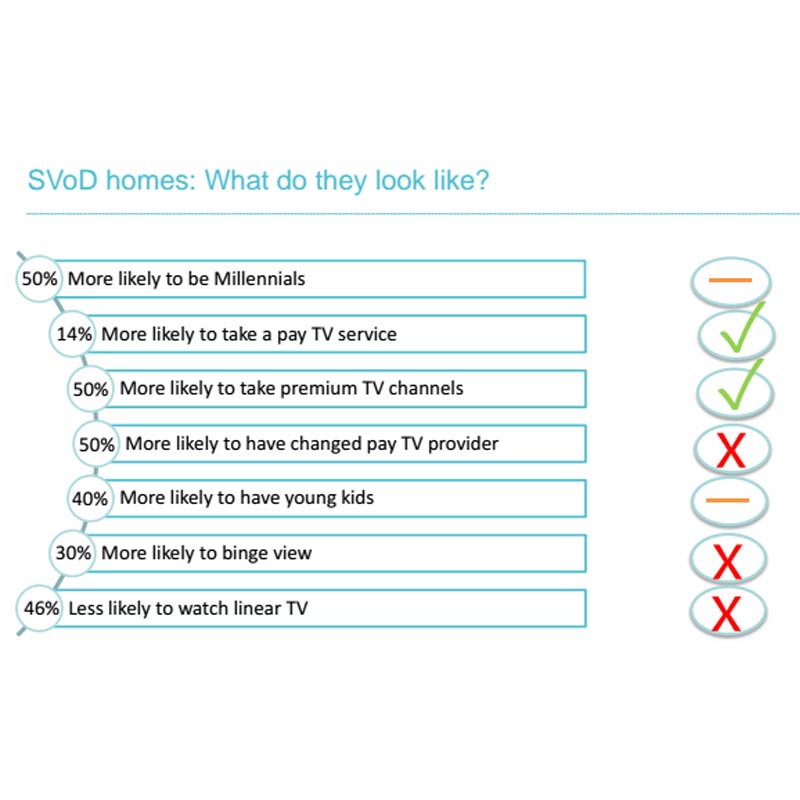
    So, what exactly do the SVoD homes constitute of? The three most relevant observations about who is consuming such massive content on digital platforms are — a big percentage comprise millennials, and the remainder people are more likely to take premium TV channels and some pertcentage have most likely changed their Pay TV provider.

    In all, 46 per cent are less likely to pay for linear TV, while 40 per cent of homes have kids. 30 per cent of the homes have shown an inclination to binge watching. Only 14 per cent of people have opted for a Pay TV service, according to Ampere.

    Business-wise, the concept of platform and channel is evolving though the producer and distributor remain unhampered. Earlier, content was distributed on platforms like Sky, Moviestar and Canalsat, etc which is now replaced by Facebook, Twitter, Snapchat, YouTube, etc. On the other hand, the channel from which content was ideally consumed has converted from Discovery, Fox, HBO, etc to digital platforms like Netflix, SeeSo, CuriosityStream, etc.

    Pay TV and new media products are segmenting, the report states.

    People with lower income are on-demand led whereas people with higher income are linear-led. Young millennials and teenagers can be appealed via services such as Whistle Sports, Soccer, Snapchat, Facebook,etc. Higher income traditional broadcast get pushed through Sky Q to protect high-end broadcast viewers. Direct To Consumers (DTC) cost to get a channel on air are considerably lower. So with a satellite you are going to take your yearly transponder, but with an OTT service you do not have that significant upfront cost. But, what you do have is a scaling cost, CDN delivery, that grows with your customer base.

    Ampere accepts that the latter factor makes OTT uneconomic for reaching very large audiences, estimating that for a single channel or service offering video in any definition from SD to UHD, a satellite feed works out cheaper beyond 10m viewers’ even if they watch on average just one minute of content per day. For a daily viewer base below 20,000, OTT always works out cheaper, even if all viewers watched five hours of content a day and all content was transmitted inUHD, Ampere found.

    With changing economics, channel groups are increasingly looking to Direct To Consumers (DTC) SVOD service. Viewers/advertising spends have shifted to online, operators are pushing back on channel carriage fee, content owners’ margins have squeezed and the DTC, SVoD launch have led to recoup margin. The millennials are already approaching two SVOD services per home. In the US, millennials have crossed the more than 2 number than the average. They are approaching to the number in Germany, Denmark, Poland and UK. Out of the 1002 sample survey, 255 are Netflix customers in UK which only means that the country is most likely to have more Netflix customers.

    It is not all about broadband penetration, because size is also important. And actually if we look at the size of the addressable market, emerging markets like Mexico, Brazil, Russia, China, Taiwan, Thailand, etc all have started to become interesting [DTC] markets when we talk about the total addressable size.

    Ampere’s research found that in the UK a Netflix customer is 1.5 times more likely than average to also take Sky’s Now TV OTT service; 1.8 times more likely to also take Amazon; 2.5 times more likely also to take Spotify’s streaming music services; and 1.5 times more likely to use the catch-up TV apps of the major broadcasters.

    To date, Netflix’s growth strategy has relied on geographic expansion. But, its set to run out of road by 2017. Central, South and Western Europe saw 6 customer additions on an average in 2015 which has reduced to 4 or 5 in 2017 further reducing in 2021. But in Asia Pacific region, the customer addition has gone up from 1 to 5 and is estimated to be 3. Even after this, the fact that Netflix has invested a huge amount of money on content cannot be ignored. Netflix is spending like a broadcast or premium channel group. It spends 60 per cent revenue on program followed by premium platforms contributing 40-70 per cent revenue. Pay multichannels are putting 30-40 per cent revenue on programs.

    Pay TV is still growing but OTT is growing faster – much faster. And that fact sums up both the threat and the opportunity that OTT video presents to platform operators. The survival of service providers depends on their ability to launch new services ahead of the competition.

  • SVod outpacing pay TV in W. Europe’s consumption trends: Report

    SVod outpacing pay TV in W. Europe’s consumption trends: Report

    MUMBAI: Subscription video on-demand (SVoD) content is increasing more and more as compared to Pay TV.

    Several discussions have taken place in India with the growing number of digital platforms. Broadcasters such as Star India, Viacom18, Zee Media and Sony Television, etc have entered this space with their own OTT/VOD platforms. Debates not just confined to the emergence of VOD platforms but also the entry of various global players have been raging since.

    The fact that digitisation is at a nascent phase in India only paved the way for the players to experiment various models. This also raised a few eyebrows on the existence of cable and satellite television.

    While most follow an advertising-led model or a ‘freemium model’, the countable ones have taken the challenge of following a subscription-based model. As print has survived after the entry of broadcast, analog and digital cable network will also co-exist with the emergence of various digital platforms. With the robust penetration of internet in the US, Pay TV has remained powerful.

    But is it the same everywhere else? Certainly not. The scenario is completely different in Western Europe. SVoD subscription has been outstripping Pay TV since 2012. The subscription net addition of Pay TV in 2016 is 2 million which is estimated to see a downfall by 2021 to 1 million.

    On the other hand, SVoD in 2016 is 9 million only and evaluated to come down to 3 million by 2021. Both the services are currently at its peak but are substantially going to see some disruption. This clearly shows that currently the viewers are ready to pay for good quality content.

    These were some of the findings presented in a report at IBC by Ampere Analysis, a London based analyst firm, at Amsterdam yesterday.

    According to the Ampere report, SVoD is growing as a significant segment not just in the USA but also in other countries such as Poland, France, the Netherlands, Spain, Italy, Germany, the UK, Sweden and Denmark. The average SVoD-only homes in the second quarter of 2015 has been 5 per cent while, in the current scenario, it has grown by 2 per cent for the first quarter.

    US specifically has seen a growth from 9 per cent to 13 per cent whereas the UK has seen an increase of 2 per cent from 8 per cent to 10 per cent in just a year.
    So, what exactly do the SVoD homes constitute of? The three most relevant observations about who is consuming such massive content on digital platforms are — a big percentage comprise millennials, and the remainder people are more likely to take premium TV channels and some pertcentage have most likely changed their Pay TV provider.

    In all, 46 per cent are less likely to pay for linear TV, while 40 per cent of homes have kids. 30 per cent of the homes have shown an inclination to binge watching. Only 14 per cent of people have opted for a Pay TV service, according to Ampere.

    Business-wise, the concept of platform and channel is evolving though the producer and distributor remain unhampered. Earlier, content was distributed on platforms like Sky, Moviestar and Canalsat, etc which is now replaced by Facebook, Twitter, Snapchat, YouTube, etc. On the other hand, the channel from which content was ideally consumed has converted from Discovery, Fox, HBO, etc to digital platforms like Netflix, SeeSo, CuriosityStream, etc.

    Pay TV and new media products are segmenting, the report states.

    People with lower income are on-demand led whereas people with higher income are linear-led. Young millennials and teenagers can be appealed via services such as Whistle Sports, Soccer, Snapchat, Facebook,etc. Higher income traditional broadcast get pushed through Sky Q to protect high-end broadcast viewers. Direct To Consumers (DTC) cost to get a channel on air are considerably lower. So with a satellite you are going to take your yearly transponder, but with an OTT service you do not have that significant upfront cost. But, what you do have is a scaling cost, CDN delivery, that grows with your customer base.

    Ampere accepts that the latter factor makes OTT uneconomic for reaching very large audiences, estimating that for a single channel or service offering video in any definition from SD to UHD, a satellite feed works out cheaper beyond 10m viewers’ even if they watch on average just one minute of content per day. For a daily viewer base below 20,000, OTT always works out cheaper, even if all viewers watched five hours of content a day and all content was transmitted inUHD, Ampere found.

    With changing economics, channel groups are increasingly looking to Direct To Consumers (DTC) SVOD service. Viewers/advertising spends have shifted to online, operators are pushing back on channel carriage fee, content owners’ margins have squeezed and the DTC, SVoD launch have led to recoup margin. The millennials are already approaching two SVOD services per home. In the US, millennials have crossed the more than 2 number than the average. They are approaching to the number in Germany, Denmark, Poland and UK. Out of the 1002 sample survey, 255 are Netflix customers in UK which only means that the country is most likely to have more Netflix customers.

    It is not all about broadband penetration, because size is also important. And actually if we look at the size of the addressable market, emerging markets like Mexico, Brazil, Russia, China, Taiwan, Thailand, etc all have started to become interesting [DTC] markets when we talk about the total addressable size.

    Ampere’s research found that in the UK a Netflix customer is 1.5 times more likely than average to also take Sky’s Now TV OTT service; 1.8 times more likely to also take Amazon; 2.5 times more likely also to take Spotify’s streaming music services; and 1.5 times more likely to use the catch-up TV apps of the major broadcasters.

    To date, Netflix’s growth strategy has relied on geographic expansion. But, its set to run out of road by 2017. Central, South and Western Europe saw 6 customer additions on an average in 2015 which has reduced to 4 or 5 in 2017 further reducing in 2021. But in Asia Pacific region, the customer addition has gone up from 1 to 5 and is estimated to be 3. Even after this, the fact that Netflix has invested a huge amount of money on content cannot be ignored. Netflix is spending like a broadcast or premium channel group. It spends 60 per cent revenue on program followed by premium platforms contributing 40-70 per cent revenue. Pay multichannels are putting 30-40 per cent revenue on programs.

    Pay TV is still growing but OTT is growing faster – much faster. And that fact sums up both the threat and the opportunity that OTT video presents to platform operators. The survival of service providers depends on their ability to launch new services ahead of the competition.

  • Spuul features Yash Raj Films ‘Sultan’ digitally

    Spuul features Yash Raj Films ‘Sultan’ digitally

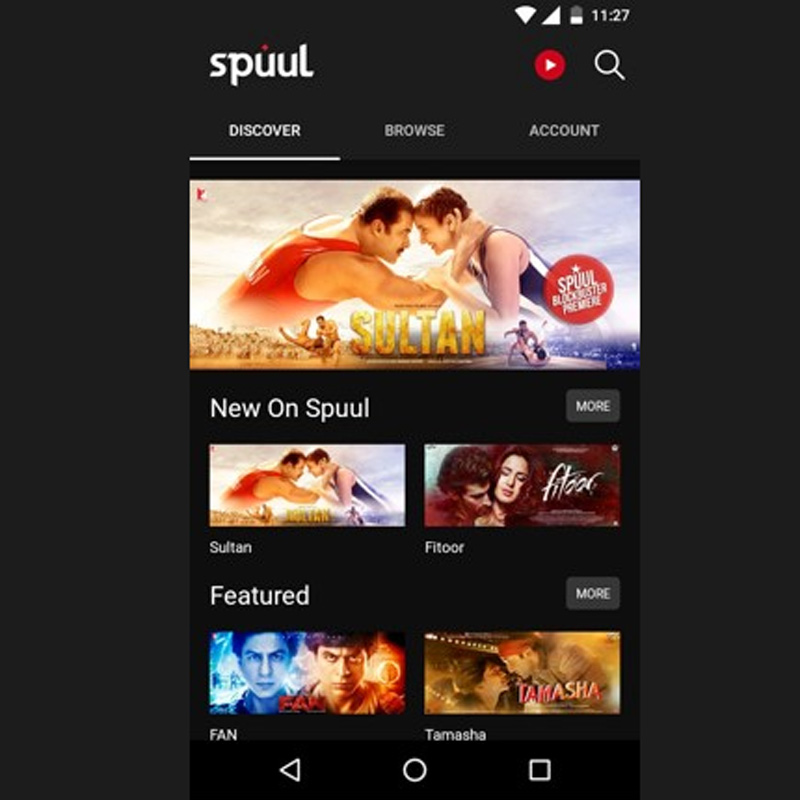
    MUMBAI: Spuul is featuring Yash Raj Films’ latest blockbuster Sultan digitally by adding it to its catalogue of movies. The movie will be available across devices like Web, mobile (iOS, Android), Smart TV (Samsung, Panasonic, LG), Airplay on iOS, Fire on Amazon and Chromecast on Android to viewers all over the world.

    Sultan, one of the highest grossing Indian films of all time, is a 2016 Indian romantic sports-drama film directed by Ali Abbas Zafar. Produced by Aditya Chopra under the Yash Raj Films banner, the film stars Salman Khan opposite Anushka Sharma. The film focuses on Sultan Ali Khan, a wrestling champion from Haryana, whose successful career creates a rift in his personal life.

    Speaking at this milestone, Spuul Global CEO Subin Subaiah said, “With increased internet penetration, smartphone usage and the increasing affordability of data plans, there is also increase in the amount of viewers moving online to consume content. At Spuul, we are constantly striving to bring the latest, best and most awaited films to our viewers in our endeavor to bridge the gap between a film’s theatrical and digital release. Sultan is just another of our steps in this direction.”

    “Our association with Spuul goes back a long way, with Spuul providing our films with a platform to reach out to viewers in the most remote corners of the world – We believe Sultan will get the same or more traction that our previous films have received thus far”, said Yash Raj Films vice president digital Anand Gurnani.

  • Spuul features Yash Raj Films ‘Sultan’ digitally

    Spuul features Yash Raj Films ‘Sultan’ digitally

    MUMBAI: Spuul is featuring Yash Raj Films’ latest blockbuster Sultan digitally by adding it to its catalogue of movies. The movie will be available across devices like Web, mobile (iOS, Android), Smart TV (Samsung, Panasonic, LG), Airplay on iOS, Fire on Amazon and Chromecast on Android to viewers all over the world.

    Sultan, one of the highest grossing Indian films of all time, is a 2016 Indian romantic sports-drama film directed by Ali Abbas Zafar. Produced by Aditya Chopra under the Yash Raj Films banner, the film stars Salman Khan opposite Anushka Sharma. The film focuses on Sultan Ali Khan, a wrestling champion from Haryana, whose successful career creates a rift in his personal life.

    Speaking at this milestone, Spuul Global CEO Subin Subaiah said, “With increased internet penetration, smartphone usage and the increasing affordability of data plans, there is also increase in the amount of viewers moving online to consume content. At Spuul, we are constantly striving to bring the latest, best and most awaited films to our viewers in our endeavor to bridge the gap between a film’s theatrical and digital release. Sultan is just another of our steps in this direction.”

    “Our association with Spuul goes back a long way, with Spuul providing our films with a platform to reach out to viewers in the most remote corners of the world – We believe Sultan will get the same or more traction that our previous films have received thus far”, said Yash Raj Films vice president digital Anand Gurnani.

  • Royal Stag Barrel Select Large presents  Short  ‘Mama’s Boys’

    Royal Stag Barrel Select Large presents Short ‘Mama’s Boys’

    MUMBAI: After the recent success of Sujoy Ghosh’s Ahalya, Jaydeep Sarkar’s Nayantara’s necklace and Adhiraj Bose’s Interior Café, Royal Stag Barrel Select Large Short Films has hit the digital screen again withyet another short film, ‘Mama’s Boys’. Starring the bold and mysterious Neena Gupta and the versatile Aditi Rao Hydari along with the young heartthrob of Bollywood Arunoday Singh, the new release has been directed by Bollywood’s critically acclaimed actor, writer and director, Akshat Verma.

    Themed on the objective of “keep perfecting”, Royal Stag Barrel Select Large Short Films is a platform for independentdirectors to showcase their film making skills and create a niche for themselves in the industry. The platform gives a stage to storytellers to showcase their artistic creativity and reach out to their target audience in through the online world.

    Commenting on the release, Raja Banerji, Assistant Vice President, Marketing, Pernod Ricard India, said “As creativity has no boundaries and filmmakers are constantly innovating to perfect their method of artistic expression, being digitally connected has also become extremely important for them to reach out to the new age audiences. The whole idea of Royal Stag Barrel Select Large Short Films is to enable them to continue to express themselves as great story tellers. Resonating with our core philosophy, this platform is meant to help them keep perfecting their skills and establish themselves in the market. In line with this thought, we are very thrilled to associate with the persistent innovative genius of AkshatVerma’s new film- Mama’s Boys”.

    The man behind Royal Stag Barrel Select Large Short Films’ new release, ‘Mama’s Boys’, Akshat Verma is credited to be the creative force behind movies like ‘Delhi Belly’, ‘Ek main aurEktu’ and ‘The Ode’. With this new short film, Akshat Verma hastried exploring to portray his thought in a modern formin an epic like Mahabharata. The story is an inspiration from director’s believe about the unfairness in Arjun’s marriage and the position he is heaved in where he charms the beautiful Draupadi and wins her hand only to find out later that he has to share her with the rest of his brothers. This excerpt is depicted in the Pandava’s residence and the story intriguingly unfolds where Arjun has to finally compromise despite his unwillingness.

    Talking about his film, director,Akshat Vermasaid, “’Mama’s Boys’ is a reflection of my childhood memories when Amar Chitra Katha fascinated me and Mahabharata enthralled me with its multiple nested stories. I had an amazing time shooting with some of the industry’s most talented actors.Neena Gupta was a delight to work with, Aditi’s versatility was commendable and Arunoday Singh possesses an incredible comic timing where the audience only knows him for being a tough guy onscreen. Royal Stag Barrel Select large Short Films has indeed presented me this great opportunity to me to connect with my audience through the digital platform and it has overall been a remarkable experience”.

    About Royal Stag Barrel Select Large Short Films:

    Royal stag Barrel Select Large Short Films (LSF) is a portal that is the hub of Indian short films. It gives the audience the window to enjoy short films made by large directors. It gives budding film makers a platform to showcase their short films with large ideas. It is a vehicle to submit Indian short film makers to the international festival circuit. LSF is a parallel platform for indie films that can take co-creation with social media to the next level. The platform Pioneered under the aegis of Royal Stag Mega Movies, and Royal Stag Large short Film gains the first mover advantage in a medium that will be the future of entertainment. LSF has released films of well-known Bollywood directors and gives opportunity to upcoming directors. In recent times, Platform has been built on identified core attribute of RSBS – ‘Keep Perfecting’ and hence now targeting a more refined and evolved RSBS audience. Adhiraj Bose is the face of the platform and platform already showcased a digital film on how to make “perfect films”.

  • Royal Stag Barrel Select Large presents  Short  ‘Mama’s Boys’

    Royal Stag Barrel Select Large presents Short ‘Mama’s Boys’

    MUMBAI: After the recent success of Sujoy Ghosh’s Ahalya, Jaydeep Sarkar’s Nayantara’s necklace and Adhiraj Bose’s Interior Café, Royal Stag Barrel Select Large Short Films has hit the digital screen again withyet another short film, ‘Mama’s Boys’. Starring the bold and mysterious Neena Gupta and the versatile Aditi Rao Hydari along with the young heartthrob of Bollywood Arunoday Singh, the new release has been directed by Bollywood’s critically acclaimed actor, writer and director, Akshat Verma.

    Themed on the objective of “keep perfecting”, Royal Stag Barrel Select Large Short Films is a platform for independentdirectors to showcase their film making skills and create a niche for themselves in the industry. The platform gives a stage to storytellers to showcase their artistic creativity and reach out to their target audience in through the online world.

    Commenting on the release, Raja Banerji, Assistant Vice President, Marketing, Pernod Ricard India, said “As creativity has no boundaries and filmmakers are constantly innovating to perfect their method of artistic expression, being digitally connected has also become extremely important for them to reach out to the new age audiences. The whole idea of Royal Stag Barrel Select Large Short Films is to enable them to continue to express themselves as great story tellers. Resonating with our core philosophy, this platform is meant to help them keep perfecting their skills and establish themselves in the market. In line with this thought, we are very thrilled to associate with the persistent innovative genius of AkshatVerma’s new film- Mama’s Boys”.

    The man behind Royal Stag Barrel Select Large Short Films’ new release, ‘Mama’s Boys’, Akshat Verma is credited to be the creative force behind movies like ‘Delhi Belly’, ‘Ek main aurEktu’ and ‘The Ode’. With this new short film, Akshat Verma hastried exploring to portray his thought in a modern formin an epic like Mahabharata. The story is an inspiration from director’s believe about the unfairness in Arjun’s marriage and the position he is heaved in where he charms the beautiful Draupadi and wins her hand only to find out later that he has to share her with the rest of his brothers. This excerpt is depicted in the Pandava’s residence and the story intriguingly unfolds where Arjun has to finally compromise despite his unwillingness.

    Talking about his film, director,Akshat Vermasaid, “’Mama’s Boys’ is a reflection of my childhood memories when Amar Chitra Katha fascinated me and Mahabharata enthralled me with its multiple nested stories. I had an amazing time shooting with some of the industry’s most talented actors.Neena Gupta was a delight to work with, Aditi’s versatility was commendable and Arunoday Singh possesses an incredible comic timing where the audience only knows him for being a tough guy onscreen. Royal Stag Barrel Select large Short Films has indeed presented me this great opportunity to me to connect with my audience through the digital platform and it has overall been a remarkable experience”.

    About Royal Stag Barrel Select Large Short Films:

    Royal stag Barrel Select Large Short Films (LSF) is a portal that is the hub of Indian short films. It gives the audience the window to enjoy short films made by large directors. It gives budding film makers a platform to showcase their short films with large ideas. It is a vehicle to submit Indian short film makers to the international festival circuit. LSF is a parallel platform for indie films that can take co-creation with social media to the next level. The platform Pioneered under the aegis of Royal Stag Mega Movies, and Royal Stag Large short Film gains the first mover advantage in a medium that will be the future of entertainment. LSF has released films of well-known Bollywood directors and gives opportunity to upcoming directors. In recent times, Platform has been built on identified core attribute of RSBS – ‘Keep Perfecting’ and hence now targeting a more refined and evolved RSBS audience. Adhiraj Bose is the face of the platform and platform already showcased a digital film on how to make “perfect films”.