Category: iWorld

  • Planetcast forays into OTT segment

    Planetcast forays into OTT segment

    Mumbai: Planetcast Media Services Limited (formerly Essel Shyam Communication Limited) today announced its foray into OTT segment by introducing its OTT solution targeted towards existing broadcasters and non-TV content owners. Planetcast OTT is a new, turnkey OTT solution for media companies, publishers and content creators to build advanced OTT app and web based entertainment ecosystem and deploy it in a highly cost effective manner.

    Planetcast OTT solution is aimed towards exponential increase in ROI for broadcasters, media companies, video content owners and publishers who wants to take their content over the top. Planetcast OTT empowers the customers to quickly launch, manage and monetize new OTT offerings.

    Planetcast, with its OTT solution will break the glass ceiling which prevents passionate media companies and content owners from making OTT market entry due to the high cost attached to it. An out of the box solution, it enables the customers to deploy premium OTT experience within the time limit and within their budget. Planetcast OTT solution will have a simplistic interface which does not require engineers to manage or build services, Planetcast is very clear about OTT product offering, its to make customer’s life simple and hassle free.

    Commenting on the occasion, M.N Vyas, Executive Director, Planetcast said “Indian market is responding positively towards OTT services and media companies are highly optimistic about tapping into the fast growing opportunity OTT offers. Media companies were not able to do so due to high cost and ambiguity in the market, Planetcast OTT solution will put an end to all this as it will enable the media companies to launch quick, cost effective and easy to manage OTT services across all connected devices.”

    Commenting on the occasion, Sanjay Duda, Chief Marketing Officer, Planetcast said “The global OTT market is projected to surpass $64.9 billion by 2021 , its too big a business not to be done. Media companies and content owners can increase their business exponentially through OTT offerings and I am confident that they will find a like minded partner in Planetcast. Our solution is cost effective, easy to deploy and easy to manage. Our two decades of successful broadcast industry operations is the biggest differentiating factor behind Planetcast OTT solution.”

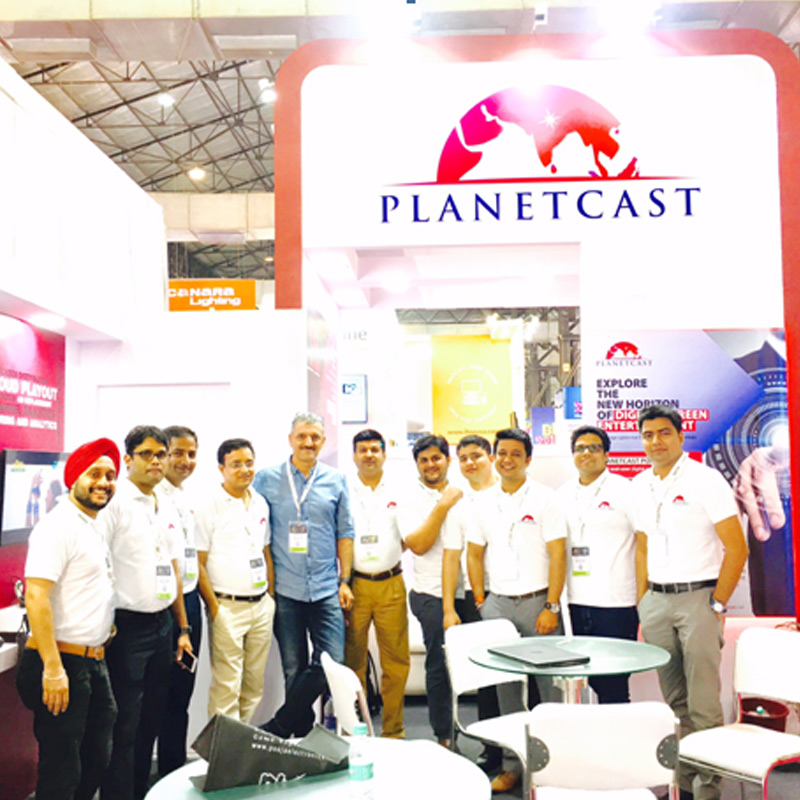
    Planetcast will give a sneak peek into its OTT solution at Broadcast India 2016, Mumbai, booth number B-212-1. The product will be available in December 2016.

  • Planetcast forays into OTT segment

    Planetcast forays into OTT segment

    Mumbai: Planetcast Media Services Limited (formerly Essel Shyam Communication Limited) today announced its foray into OTT segment by introducing its OTT solution targeted towards existing broadcasters and non-TV content owners. Planetcast OTT is a new, turnkey OTT solution for media companies, publishers and content creators to build advanced OTT app and web based entertainment ecosystem and deploy it in a highly cost effective manner.

    Planetcast OTT solution is aimed towards exponential increase in ROI for broadcasters, media companies, video content owners and publishers who wants to take their content over the top. Planetcast OTT empowers the customers to quickly launch, manage and monetize new OTT offerings.

    Planetcast, with its OTT solution will break the glass ceiling which prevents passionate media companies and content owners from making OTT market entry due to the high cost attached to it. An out of the box solution, it enables the customers to deploy premium OTT experience within the time limit and within their budget. Planetcast OTT solution will have a simplistic interface which does not require engineers to manage or build services, Planetcast is very clear about OTT product offering, its to make customer’s life simple and hassle free.

    Commenting on the occasion, M.N Vyas, Executive Director, Planetcast said “Indian market is responding positively towards OTT services and media companies are highly optimistic about tapping into the fast growing opportunity OTT offers. Media companies were not able to do so due to high cost and ambiguity in the market, Planetcast OTT solution will put an end to all this as it will enable the media companies to launch quick, cost effective and easy to manage OTT services across all connected devices.”

    Commenting on the occasion, Sanjay Duda, Chief Marketing Officer, Planetcast said “The global OTT market is projected to surpass $64.9 billion by 2021 , its too big a business not to be done. Media companies and content owners can increase their business exponentially through OTT offerings and I am confident that they will find a like minded partner in Planetcast. Our solution is cost effective, easy to deploy and easy to manage. Our two decades of successful broadcast industry operations is the biggest differentiating factor behind Planetcast OTT solution.”

    Planetcast will give a sneak peek into its OTT solution at Broadcast India 2016, Mumbai, booth number B-212-1. The product will be available in December 2016.

  • Bittree’s redesigned website has real-time price quoting tool

    Bittree’s redesigned website has real-time price quoting tool

    MUMBAI: Bittree, a leading manufacturer of high-quality audio and video patchbays and patching systems, has announced launching of a redesigned website. The new web portal, Bittree.com, improves upon their already responsive and user-friendly experience with enhanced technical data on all their products and real-time price quoting. Customers can now visit the web site to view the large number of available products ready for immediate shipping.

    “The primary goal of our new website is to replicate the outstanding customer service experience our partners receive when communicating one-on-one with our sales representatives,” says Bittree general manager Ari Baron. “We also wanted to create a unified multi-channel user interface that could benefit our growing international presence as well as serve as a one-stop-shop for any technical data our integrators and installers might need.”

    Established in 1978, Bittree is dedicated to offering state-of-the-art patching systems that streamline signal routing and troubleshooting in media and entertainment operations of all sizes. The company offers an innovative line of audio, video, and data patchbays for use in broadcasting, postproduction, and pro A/V operations.

    New benefits of the updated website include a real-time price quoting tool that provides international partners with precise and up-to-the-minute shipping quotes, a dynamic interface that changes to reflect user input, and a simplified ordering process. These features allow international purchasers in different time zones to bid more accurately without having to speak directly with a customer service representative.

    Bittree.com also features enhanced search and download functions for obtaining technical product documentation like DWG’s, designation strip templates, circuit schematics, programming and cleaning instructions, technical and pinout drawings, and warranty information.

    Additionally, custom orders can be initiated directly through the website, and legacy products are still supported. Bittree’s international programs are designed to give their global partners the tools, support, and incentives to grow their businesses and become more profitable through the sale and service of Bittree High-Performance Patching Systems.

    Tailored for use in the post-production, pro A/V, systems integration, and radio and television broadcasting fields, Bittree’s patching solutions are rigorously tested to ensure long-term functionality and dependability, especially for mission-critical operations and live events.

    To ensure consistency, performance, and adherence to rigid quality standards, all of the company’s patching products are designed, assembled, and tested in its state-of-the-art facility in Glendale, California. Bittree is an active member of industry trade organizations NAB (National Association of Broadcasters), NAMM (National Association of Music Merchants), and SMPTE (Society of Motion Picture & Television Engineers).

  • Bittree’s redesigned website has real-time price quoting tool

    Bittree’s redesigned website has real-time price quoting tool

    MUMBAI: Bittree, a leading manufacturer of high-quality audio and video patchbays and patching systems, has announced launching of a redesigned website. The new web portal, Bittree.com, improves upon their already responsive and user-friendly experience with enhanced technical data on all their products and real-time price quoting. Customers can now visit the web site to view the large number of available products ready for immediate shipping.

    “The primary goal of our new website is to replicate the outstanding customer service experience our partners receive when communicating one-on-one with our sales representatives,” says Bittree general manager Ari Baron. “We also wanted to create a unified multi-channel user interface that could benefit our growing international presence as well as serve as a one-stop-shop for any technical data our integrators and installers might need.”

    Established in 1978, Bittree is dedicated to offering state-of-the-art patching systems that streamline signal routing and troubleshooting in media and entertainment operations of all sizes. The company offers an innovative line of audio, video, and data patchbays for use in broadcasting, postproduction, and pro A/V operations.

    New benefits of the updated website include a real-time price quoting tool that provides international partners with precise and up-to-the-minute shipping quotes, a dynamic interface that changes to reflect user input, and a simplified ordering process. These features allow international purchasers in different time zones to bid more accurately without having to speak directly with a customer service representative.

    Bittree.com also features enhanced search and download functions for obtaining technical product documentation like DWG’s, designation strip templates, circuit schematics, programming and cleaning instructions, technical and pinout drawings, and warranty information.

    Additionally, custom orders can be initiated directly through the website, and legacy products are still supported. Bittree’s international programs are designed to give their global partners the tools, support, and incentives to grow their businesses and become more profitable through the sale and service of Bittree High-Performance Patching Systems.

    Tailored for use in the post-production, pro A/V, systems integration, and radio and television broadcasting fields, Bittree’s patching solutions are rigorously tested to ensure long-term functionality and dependability, especially for mission-critical operations and live events.

    To ensure consistency, performance, and adherence to rigid quality standards, all of the company’s patching products are designed, assembled, and tested in its state-of-the-art facility in Glendale, California. Bittree is an active member of industry trade organizations NAB (National Association of Broadcasters), NAMM (National Association of Music Merchants), and SMPTE (Society of Motion Picture & Television Engineers).

  • Q4-16: Apple Services clocks 24 per cent growth, Other Products revenue falls

    Q4-16: Apple Services clocks 24 per cent growth, Other Products revenue falls

    BENGALURU:  Apple Inc (Apple) Services product recorded a 24.4 percent year-over-year (y-o-y) growth in revenue for the quarter ended 30 September 2016 (Q4-16, current quarter) amidst a 9 percent y-o-y fall in total revenues. Apple Services includes revenue from Internet Services, AppleCare, Apple Pay, licensing and other services.

    Apple Services reported revenue of $6,325million for Q4-16 versus $5,086 million in the corresponding year ago quarter, while Apple Total revenue in Q4-16 was $46.852 million versus $51,101 million in Q4-15.

    However, across sequential quarters, Apple Services revenue increased only 5.8 percent in Q4-16 from $5,976 million as against 10.6 percent growth in total revenue from $42,358 million during the same period.

    Apple Services contribution to overall revenue grew to 13.5 percent in the current quarter from 9.9 percent in the corresponding year ago quarter, but was slightly lower than 14.1 percent in the immediate trailing quarter.

    Apple’s “Other Products’, which include sales of Apple TV, Apple Watch, Beats products, iPod and Apple-branded and third-party accessories saw a 22.1 percent y-o-y decline in revenue to $2,373 million in the current quarter from $3,048 million. Across sequential quarters (q-o-q), ‘Other Products’ recorded a 6.9 percent growth in Q4-16 from $2,219 million.

    ‘Other Products’ contribution to overall revenue declined to 5.1 percent in the current quarter from 5.9 percent in the corresponding year ago quarter and 5.2 percent in the immediate trailing quarter.

    Major Products

    Apple’s major Product is the iPhone which saw y-o-y declines of 5.3 percent and 12.6 percent in number of units sold and revenues respectively in Q4-16. iPhone sales revenue in the current quarter was $28,160 million (60.1 percent of total revenue) versus $32,209 million (62.5 percent of total revenue) in Q4-15. 40.513 million iPhones were sold in  the current quarter versus 48.046 million in the corresponding year ago quarter.

    During sequential quarters, iPhone sales witnessed growth rates of 12.7 percent and 17.1 percent in number of units sold and revenues respectively in Q4-16. iPhone sales revenue in Q3-16 was $24,048 million from 40.399 million units.

    Among Apple’s other well-known products, the iPad witnessed y-o-y and q-o-q declines in number of units sold and revenues, while the Apple Mac recorded q-o-q declines.

    Geographical split

    Apple’s segments are Americas, Europe, Greater China, Japan and Rest of Asia Pacific (APac), with the America’s contributing more than 42 percent in terms of revenue.

    Revenue from the Americas declined 7.1 percent y-o-y to $20.229 million (43.2 percent of total revenues) from $21,773 million (42.3 percent of total revenues. Across sequential quarters, revenue from the Americas increased 12.6 percent in the current quarter from $17,963 million (42.4 percent of total revenues).

    Revenue from the European segment grew 2.5 percent y-o-y and 12.4 percent q-o-q to $10,842 million (23.1 percent of total revenue) from $10,577 million (20.5 percent of total revenue) and from $9,643 million (22.8 percent of total revenue) respectively.

    Revenue from the China segment declined 29.8 percent y-o-y and declined 0.7 percent q-o-q to $8,785 million (18.8 percent of total revenue) from $12,518 million (24.3 percent of total revenue) and from $8,848 million (20.9 percent of total revenue) respectively.

    Revenue from the Japan segment grew 10.1 percent y-o-y and 22.5 percent q-o-q to $4,324 million (9.2 percent of total revenue) from $3,939 million (7.6 percent of total revenue) and from $3,529 million (8.3 percent of total revenue) respectively.

    Revenue from the APac segment declined 1.2 percent y-o-, but grew 12.5 percent q-o-q to $2,672 million (5.7 percent of total revenue) from $2,704 million (5.3 percent of total revenue) and grew from $2,375 million (5.6 percent of total revenue) respectively.

    Profits, Apple’s board declares dividend

    Apple posted a 19 percent y-o-y decline in net income at $9,014 million (19.2 percent margin) for Q4-16 versus $11,124 million 21.6 percent margin). Earnings per diluted share declined to $1.68 in the current quarter from $1,96 in Q4-15.

    Apple’s board of directors has declared a cash dividend of $0.57 per share of the Company’s common stock. The dividend is payable on November 10, 2016 to shareholders of record as of the close of business on November 7, 2016.

    Company speak

    “Our strong September quarter results cap a very successful fiscal 2016 for Apple,” said apple CEO Tim Cook. “We’re thrilled with the customer response to iPhone 7, iPhone 7 Plus and Apple Watch Series 2, as well as the incredible momentum of our Services business, where revenue grew 24 percent to set another all-time record.”

    “We are pleased to have generated $16.1 billion in operating cash flow, a new record for the September quarter,” said Apple CFO Luca Maestri. “We also returned $9.3 billion to investors through dividends and share repurchases during the quarter and have now completed over $186 billion of our capital return program,” added Cook.


  • Q4-16: Apple Services clocks 24 per cent growth, Other Products revenue falls

    Q4-16: Apple Services clocks 24 per cent growth, Other Products revenue falls

    BENGALURU:  Apple Inc (Apple) Services product recorded a 24.4 percent year-over-year (y-o-y) growth in revenue for the quarter ended 30 September 2016 (Q4-16, current quarter) amidst a 9 percent y-o-y fall in total revenues. Apple Services includes revenue from Internet Services, AppleCare, Apple Pay, licensing and other services.

    Apple Services reported revenue of $6,325million for Q4-16 versus $5,086 million in the corresponding year ago quarter, while Apple Total revenue in Q4-16 was $46.852 million versus $51,101 million in Q4-15.

    However, across sequential quarters, Apple Services revenue increased only 5.8 percent in Q4-16 from $5,976 million as against 10.6 percent growth in total revenue from $42,358 million during the same period.

    Apple Services contribution to overall revenue grew to 13.5 percent in the current quarter from 9.9 percent in the corresponding year ago quarter, but was slightly lower than 14.1 percent in the immediate trailing quarter.

    Apple’s “Other Products’, which include sales of Apple TV, Apple Watch, Beats products, iPod and Apple-branded and third-party accessories saw a 22.1 percent y-o-y decline in revenue to $2,373 million in the current quarter from $3,048 million. Across sequential quarters (q-o-q), ‘Other Products’ recorded a 6.9 percent growth in Q4-16 from $2,219 million.

    ‘Other Products’ contribution to overall revenue declined to 5.1 percent in the current quarter from 5.9 percent in the corresponding year ago quarter and 5.2 percent in the immediate trailing quarter.

    Major Products

    Apple’s major Product is the iPhone which saw y-o-y declines of 5.3 percent and 12.6 percent in number of units sold and revenues respectively in Q4-16. iPhone sales revenue in the current quarter was $28,160 million (60.1 percent of total revenue) versus $32,209 million (62.5 percent of total revenue) in Q4-15. 40.513 million iPhones were sold in  the current quarter versus 48.046 million in the corresponding year ago quarter.

    During sequential quarters, iPhone sales witnessed growth rates of 12.7 percent and 17.1 percent in number of units sold and revenues respectively in Q4-16. iPhone sales revenue in Q3-16 was $24,048 million from 40.399 million units.

    Among Apple’s other well-known products, the iPad witnessed y-o-y and q-o-q declines in number of units sold and revenues, while the Apple Mac recorded q-o-q declines.

    Geographical split

    Apple’s segments are Americas, Europe, Greater China, Japan and Rest of Asia Pacific (APac), with the America’s contributing more than 42 percent in terms of revenue.

    Revenue from the Americas declined 7.1 percent y-o-y to $20.229 million (43.2 percent of total revenues) from $21,773 million (42.3 percent of total revenues. Across sequential quarters, revenue from the Americas increased 12.6 percent in the current quarter from $17,963 million (42.4 percent of total revenues).

    Revenue from the European segment grew 2.5 percent y-o-y and 12.4 percent q-o-q to $10,842 million (23.1 percent of total revenue) from $10,577 million (20.5 percent of total revenue) and from $9,643 million (22.8 percent of total revenue) respectively.

    Revenue from the China segment declined 29.8 percent y-o-y and declined 0.7 percent q-o-q to $8,785 million (18.8 percent of total revenue) from $12,518 million (24.3 percent of total revenue) and from $8,848 million (20.9 percent of total revenue) respectively.

    Revenue from the Japan segment grew 10.1 percent y-o-y and 22.5 percent q-o-q to $4,324 million (9.2 percent of total revenue) from $3,939 million (7.6 percent of total revenue) and from $3,529 million (8.3 percent of total revenue) respectively.

    Revenue from the APac segment declined 1.2 percent y-o-, but grew 12.5 percent q-o-q to $2,672 million (5.7 percent of total revenue) from $2,704 million (5.3 percent of total revenue) and grew from $2,375 million (5.6 percent of total revenue) respectively.

    Profits, Apple’s board declares dividend

    Apple posted a 19 percent y-o-y decline in net income at $9,014 million (19.2 percent margin) for Q4-16 versus $11,124 million 21.6 percent margin). Earnings per diluted share declined to $1.68 in the current quarter from $1,96 in Q4-15.

    Apple’s board of directors has declared a cash dividend of $0.57 per share of the Company’s common stock. The dividend is payable on November 10, 2016 to shareholders of record as of the close of business on November 7, 2016.

    Company speak

    “Our strong September quarter results cap a very successful fiscal 2016 for Apple,” said apple CEO Tim Cook. “We’re thrilled with the customer response to iPhone 7, iPhone 7 Plus and Apple Watch Series 2, as well as the incredible momentum of our Services business, where revenue grew 24 percent to set another all-time record.”

    “We are pleased to have generated $16.1 billion in operating cash flow, a new record for the September quarter,” said Apple CFO Luca Maestri. “We also returned $9.3 billion to investors through dividends and share repurchases during the quarter and have now completed over $186 billion of our capital return program,” added Cook.


  • Content piracy making b’casters invest in good tech for security: Tata Communications VP Brian Morris

    Content piracy making b’casters invest in good tech for security: Tata Communications VP Brian Morris

    Somebody had aptly said that a new development brings along with it not only benefits, but also various downsides. If technology is opening up new frontiers of content delivery to consumers, the menace of content piracy too is rising globally. So, it’s almost always a race against time to find neutralizers to a menace like piracy for content owners and technology & security companies. 

    And, Tata Communications is one such company that not only helps its customers deliver content, but also does continuous research in safety methods. That’s just one of the many reasons why the company continually makes major investments in building and improving state-of-the-art global communications network. One such example of investments is the $1.19 billion spent on the company’s global subsea fibre network — the company claims it is one of the world’s largest and most advanced —- that covers 700,000 km or more than 17 times around the world; the only Ethernet ring serving the Middle East; more than 400 points of presence on five continents, apart from ownership and operation of over 1 million sq. ft. of data centre space in 44 locations worldwide.

    In an interaction with Indiantelevision.com, Tata Communications VP and GM – Global Media and Entertainment Services Brian Morris holds forth on various aspects of content delivery, tackling content piracy and the need to have a good technology partner for broadcasters.

    Excerpts:

    As broadcasters deliver content on multi-platform like social media and OTT, how can they ensure that they have the highest levels of content security integrated within the core of their business operations and across various delivery platforms?

    Today, content owners, enabled by technology providers, are taking control in a world where the viewing patterns of consumers are dramatically changing due to advances in mobile and flexible content provisioning. The broadcasting counter-revolution is about staying ahead of the game and providing viewers with the platforms and services that give them more control when it comes to dictating their own viewing experiences.

    For broadcasters and Over the Top (OTT) and streaming network providers, this means enabling content to be delivered via non-traditional distribution channels, to support on-demand and catch-up services that allow viewers to watch whatever content they want, whenever they want, on any device.  It is also enabling the disruption of regionalization and rights management as content owners seek to extend reach and distribute their content on a global basis.

    Hence, emergence of OTT and streaming players and growing adoption of various smart devices, in an increasingly growing connected world, has forced pay-TV operators to offer their content on multiple networks and multiple devices. This gradual transformation has led to roll out of parallel systems requiring adoption of multiple service delivery and content security platforms resulting into management complexities.

    To manage the multi-service / multi-platform environment, media service providers need to adopt unified security approach to meet security requirement on any device and any type of content (live or on-demand). Below are the key trends in unified content security space:

    # Single security client combining CAS (conditional access systems) and DRM (digital rights management) functionalities to support DVB, IPTV STB and OTT based media distribution

    # Adaptive security solutions compatible with any devices (including device with HWRoT, Open STBs like Android STB, Legacy STBs without HWRoT and Open CE devices)

    # Security solutions to meet requirements for enhanced content (UHD, HD HDR, early release content) – MovieLabs , an R&D JV of six major motion picture studios, has come with new content security ECP guidelines

    # Security solutions to support open consumer devices – software based security solutions compatible with customer owned devices.

    Is forensic watermarking a step in the right direction when it comes to content security?

    It is the prerogative of content owners to do any kind of watermarking. We, at Tata Communications, are fully supportive and capable of carrying any watermarking through our infrastructure. Forensic watermark is a great help when it comes to content security. It offers a range of benefits to broadcasters and content providers and some of them are the following:

    # Single solution to fight against content redistribution across the value chain– For the content owner, the source of leak can be found out; while for the licensee, session-based watermarking enables them to identify which OTT account or smart card the pirate stream is originating from.

    # Lower total cost of ownership with easy deployment and scalability – all consumers (irrespective of the device they use) receive watermarked content, and not just those users who own watermarked enabled devices.

    # Fast time to market on deployed devices and existing workflows – there is no need for specific client side hardware, which makes it easier to deploy to existing devices.

    # Renewable, robust security based on a centralized design – central architecture is more secure, in order to make it impossible for pirates to exploit the client device and easy to renew if a breach occurs.

    The main limitation of forensic watermarking technology is the occasional occurrence of false positives in which legal copies of a document, image, video or program are tagged as unauthorized. Forensic watermarks have gained acceptance in the software and digital video industries. Other applications in which the technology holds promise include digital music and electronic books (e-books).

    With the rise of number of OTT platforms in India, are the players taking security breach or its possibility seriously as Indian security systems generally tend to be lax?

    A mega-trend noticed in the broadcasting industry in India is the rise in non-traditional content viewing and distribution. With the growing adoption of smart devices and the millennial audience of the country, with 50 per cent of the population under the age of 25, looking to consume videos on-the-go, the video-on-demand is on an exponential growth. This growth has raised a number of concerns around public safety and privacy issues, both at an organizational and a national level.

    OTT players are, therefore, looking to adopt a unified security approach that can meet the security requirement on any platform and any region. An important change noticed amongst the Indian broadcasters is the investment made in technology partners who can keep up with the demand of maximum uptime, reach and security. A strong network player can carry the content applications securely and smoothly. 

    Do you feel that the level of piracy of Indian content within and outside India is growing?

    Piracy has become a major issue for broadcasters globally. One example of this would be the final episode of Game of Thrones’ season five in 2015; it was illegally downloaded 1.5 million times before it had even aired. This shows that there is a complete breakdown of geographical boundaries and India is seeing a boom in online piracy too. The recent addition of Netflix and other big OTT players in the country is an additional reason of worry for the industry. 

    According to a study conducted by Evisional and America’s Motion Pictures Association (MPA), Indians form the largest group to download Indian copyright content from torrent sites. So, broadcasters are not only looking to harness the power of non-traditional distribution methods to get their content to the consumer, they also face a battle to decrease illegal broadcasting.

    If piracy is a growing phenomenon, are Indian broadcasters and content owners really alive to the problem and taking safety measures or these are just ad hoc moves? 

    The biggest challenge for broadcasters is: how do they make content available to global audiences in real-time and in different file formats ranging from HD TV, to tablets and smartphones to protect their content and minimize piracy? Cases like the Game of Thrones are a wake-up call. While there is no foolproof way to completely block content piracy, but iinnovative broadcasting organizations are increasingly looking to fibre to run their content on. The readily available bandwidth of fibre enables the transport of live video in higher resolutions, with more security and more potential for customization than other methods. Fibre is also ideal for moving large video files.

    Content transcoding and delivery technology in the cloud is also making headway. It enables broadcasters to move content files to the cloud and transcode them into broadcast quality formats ready for immediate transmission and secure delivery to selected destinations. This means that it is possible to make authorized content available for simulcast in HD format. with the aim of helping broadcasters and content creators transcode media files into broadcast quality formats ready for immediate delivery and transmission globally. This drastically reduces the delivery time compared with traditional solutions that rely on the physical transport of media, meaning the time to view can be reduced across all regions.

    Considering that Tata Communications also operates in APAC region, how seriously piracy is taken by players in that region?

    According to a recent report by digital TV research, OTT TV and video revenues for 17 countries in the Asia Pacific region will reach $18,396 million in 2021. Another finding shows that Game of Thrones has been crowned as the most pirated television show for a few years with data collected from the first 12 hours during season six’s premiere episode showing that India stood as the second country in top downloads. Content piracy clearly ignores geographical boundaries and the unauthorized distribution of premium content is here to stay. 

    However, with the entry of global players like Netflix, RedBull Media House, OTT players are realizing that content offering and content security are two important factors that will help them differentiate from each other. A technology partner that can help with their global distribution requirements over a secure network is becoming a need. Tata Communications’ partnership with Red Bull Media House or distribution of live Formula1 races over Sky television are some of the recent partnerships we have seen as a result of these requirements.

  • Content piracy making b’casters invest in good tech for security: Tata Communications VP Brian Morris

    Content piracy making b’casters invest in good tech for security: Tata Communications VP Brian Morris

    Somebody had aptly said that a new development brings along with it not only benefits, but also various downsides. If technology is opening up new frontiers of content delivery to consumers, the menace of content piracy too is rising globally. So, it’s almost always a race against time to find neutralizers to a menace like piracy for content owners and technology & security companies. 

    And, Tata Communications is one such company that not only helps its customers deliver content, but also does continuous research in safety methods. That’s just one of the many reasons why the company continually makes major investments in building and improving state-of-the-art global communications network. One such example of investments is the $1.19 billion spent on the company’s global subsea fibre network — the company claims it is one of the world’s largest and most advanced —- that covers 700,000 km or more than 17 times around the world; the only Ethernet ring serving the Middle East; more than 400 points of presence on five continents, apart from ownership and operation of over 1 million sq. ft. of data centre space in 44 locations worldwide.

    In an interaction with Indiantelevision.com, Tata Communications VP and GM – Global Media and Entertainment Services Brian Morris holds forth on various aspects of content delivery, tackling content piracy and the need to have a good technology partner for broadcasters.

    Excerpts:

    As broadcasters deliver content on multi-platform like social media and OTT, how can they ensure that they have the highest levels of content security integrated within the core of their business operations and across various delivery platforms?

    Today, content owners, enabled by technology providers, are taking control in a world where the viewing patterns of consumers are dramatically changing due to advances in mobile and flexible content provisioning. The broadcasting counter-revolution is about staying ahead of the game and providing viewers with the platforms and services that give them more control when it comes to dictating their own viewing experiences.

    For broadcasters and Over the Top (OTT) and streaming network providers, this means enabling content to be delivered via non-traditional distribution channels, to support on-demand and catch-up services that allow viewers to watch whatever content they want, whenever they want, on any device.  It is also enabling the disruption of regionalization and rights management as content owners seek to extend reach and distribute their content on a global basis.

    Hence, emergence of OTT and streaming players and growing adoption of various smart devices, in an increasingly growing connected world, has forced pay-TV operators to offer their content on multiple networks and multiple devices. This gradual transformation has led to roll out of parallel systems requiring adoption of multiple service delivery and content security platforms resulting into management complexities.

    To manage the multi-service / multi-platform environment, media service providers need to adopt unified security approach to meet security requirement on any device and any type of content (live or on-demand). Below are the key trends in unified content security space:

    # Single security client combining CAS (conditional access systems) and DRM (digital rights management) functionalities to support DVB, IPTV STB and OTT based media distribution

    # Adaptive security solutions compatible with any devices (including device with HWRoT, Open STBs like Android STB, Legacy STBs without HWRoT and Open CE devices)

    # Security solutions to meet requirements for enhanced content (UHD, HD HDR, early release content) – MovieLabs , an R&D JV of six major motion picture studios, has come with new content security ECP guidelines

    # Security solutions to support open consumer devices – software based security solutions compatible with customer owned devices.

    Is forensic watermarking a step in the right direction when it comes to content security?

    It is the prerogative of content owners to do any kind of watermarking. We, at Tata Communications, are fully supportive and capable of carrying any watermarking through our infrastructure. Forensic watermark is a great help when it comes to content security. It offers a range of benefits to broadcasters and content providers and some of them are the following:

    # Single solution to fight against content redistribution across the value chain– For the content owner, the source of leak can be found out; while for the licensee, session-based watermarking enables them to identify which OTT account or smart card the pirate stream is originating from.

    # Lower total cost of ownership with easy deployment and scalability – all consumers (irrespective of the device they use) receive watermarked content, and not just those users who own watermarked enabled devices.

    # Fast time to market on deployed devices and existing workflows – there is no need for specific client side hardware, which makes it easier to deploy to existing devices.

    # Renewable, robust security based on a centralized design – central architecture is more secure, in order to make it impossible for pirates to exploit the client device and easy to renew if a breach occurs.

    The main limitation of forensic watermarking technology is the occasional occurrence of false positives in which legal copies of a document, image, video or program are tagged as unauthorized. Forensic watermarks have gained acceptance in the software and digital video industries. Other applications in which the technology holds promise include digital music and electronic books (e-books).

    With the rise of number of OTT platforms in India, are the players taking security breach or its possibility seriously as Indian security systems generally tend to be lax?

    A mega-trend noticed in the broadcasting industry in India is the rise in non-traditional content viewing and distribution. With the growing adoption of smart devices and the millennial audience of the country, with 50 per cent of the population under the age of 25, looking to consume videos on-the-go, the video-on-demand is on an exponential growth. This growth has raised a number of concerns around public safety and privacy issues, both at an organizational and a national level.

    OTT players are, therefore, looking to adopt a unified security approach that can meet the security requirement on any platform and any region. An important change noticed amongst the Indian broadcasters is the investment made in technology partners who can keep up with the demand of maximum uptime, reach and security. A strong network player can carry the content applications securely and smoothly. 

    Do you feel that the level of piracy of Indian content within and outside India is growing?

    Piracy has become a major issue for broadcasters globally. One example of this would be the final episode of Game of Thrones’ season five in 2015; it was illegally downloaded 1.5 million times before it had even aired. This shows that there is a complete breakdown of geographical boundaries and India is seeing a boom in online piracy too. The recent addition of Netflix and other big OTT players in the country is an additional reason of worry for the industry. 

    According to a study conducted by Evisional and America’s Motion Pictures Association (MPA), Indians form the largest group to download Indian copyright content from torrent sites. So, broadcasters are not only looking to harness the power of non-traditional distribution methods to get their content to the consumer, they also face a battle to decrease illegal broadcasting.

    If piracy is a growing phenomenon, are Indian broadcasters and content owners really alive to the problem and taking safety measures or these are just ad hoc moves? 

    The biggest challenge for broadcasters is: how do they make content available to global audiences in real-time and in different file formats ranging from HD TV, to tablets and smartphones to protect their content and minimize piracy? Cases like the Game of Thrones are a wake-up call. While there is no foolproof way to completely block content piracy, but iinnovative broadcasting organizations are increasingly looking to fibre to run their content on. The readily available bandwidth of fibre enables the transport of live video in higher resolutions, with more security and more potential for customization than other methods. Fibre is also ideal for moving large video files.

    Content transcoding and delivery technology in the cloud is also making headway. It enables broadcasters to move content files to the cloud and transcode them into broadcast quality formats ready for immediate transmission and secure delivery to selected destinations. This means that it is possible to make authorized content available for simulcast in HD format. with the aim of helping broadcasters and content creators transcode media files into broadcast quality formats ready for immediate delivery and transmission globally. This drastically reduces the delivery time compared with traditional solutions that rely on the physical transport of media, meaning the time to view can be reduced across all regions.

    Considering that Tata Communications also operates in APAC region, how seriously piracy is taken by players in that region?

    According to a recent report by digital TV research, OTT TV and video revenues for 17 countries in the Asia Pacific region will reach $18,396 million in 2021. Another finding shows that Game of Thrones has been crowned as the most pirated television show for a few years with data collected from the first 12 hours during season six’s premiere episode showing that India stood as the second country in top downloads. Content piracy clearly ignores geographical boundaries and the unauthorized distribution of premium content is here to stay. 

    However, with the entry of global players like Netflix, RedBull Media House, OTT players are realizing that content offering and content security are two important factors that will help them differentiate from each other. A technology partner that can help with their global distribution requirements over a secure network is becoming a need. Tata Communications’ partnership with Red Bull Media House or distribution of live Formula1 races over Sky television are some of the recent partnerships we have seen as a result of these requirements.

  • Voot to stream Big Boss’s ‘Unseen Undekha’ videos

    Voot to stream Big Boss’s ‘Unseen Undekha’ videos

    MUMBAI: Viacom18’s OTT platform, Voot, will showcase exclusive content of its reality show Bigg Boss 10. The on-demand destination has developed a special space called Unseen Undekha wherein users can stream videos of any celebrity or commoner of their choice from inside the house anytime.

    Additionally, the content will include stories on nominations, results, weekly task announcements, captain selection, post eviction interviews of the contestants, discussions on the luxury budget, etc.

    “Voot, in just five months of launch, is amongst the leading on-demand services in the country –and much of this can be credited to the hugely popular content across the Viacom 18 network channels, our unmatched kids’ content library (under the Voot Kids brand) and the truly differentiated Voot Originals that we are creating. And now, we bring the biggest entertainment show on Indian television – Bigg Boss, for our users on Voot. Bigg Boss is one of the few shows, where the fandom goes to epic levels and the viewers want “all that they can get” about the contestants and whats going on in the house. ‘Unseen Undekha’ answers all such questions and gives you much more ‘never seen on TV’ content. This unique property, along with the full episodes of Bigg Boss being available on-demand , would complete the offering for the fans of the show,” said Viacom18 Digital Ventures COO Gaurav Gandhi.

    Voot has garnered more than 12 million app downloads, and has over 15 million monthly active users across mobile and web, with viewers spending approximately 40 minutes on an average per day.

  • Voot to stream Big Boss’s ‘Unseen Undekha’ videos

    Voot to stream Big Boss’s ‘Unseen Undekha’ videos

    MUMBAI: Viacom18’s OTT platform, Voot, will showcase exclusive content of its reality show Bigg Boss 10. The on-demand destination has developed a special space called Unseen Undekha wherein users can stream videos of any celebrity or commoner of their choice from inside the house anytime.

    Additionally, the content will include stories on nominations, results, weekly task announcements, captain selection, post eviction interviews of the contestants, discussions on the luxury budget, etc.

    “Voot, in just five months of launch, is amongst the leading on-demand services in the country –and much of this can be credited to the hugely popular content across the Viacom 18 network channels, our unmatched kids’ content library (under the Voot Kids brand) and the truly differentiated Voot Originals that we are creating. And now, we bring the biggest entertainment show on Indian television – Bigg Boss, for our users on Voot. Bigg Boss is one of the few shows, where the fandom goes to epic levels and the viewers want “all that they can get” about the contestants and whats going on in the house. ‘Unseen Undekha’ answers all such questions and gives you much more ‘never seen on TV’ content. This unique property, along with the full episodes of Bigg Boss being available on-demand , would complete the offering for the fans of the show,” said Viacom18 Digital Ventures COO Gaurav Gandhi.

    Voot has garnered more than 12 million app downloads, and has over 15 million monthly active users across mobile and web, with viewers spending approximately 40 minutes on an average per day.