Category: iWorld

  • Eros Now partners Paytm, Mobikwik & Freecharge

    Eros Now partners Paytm, Mobikwik & Freecharge

    MUMBAI: Eros International pls, a leading global company in the Indian film entertainment industry, announced that Eros Now, its cutting-edge digital over-the-top (OTT) platform, has entered into multiple significant partnerships in India with three major electronic payment platforms — Paytm, Mobikwik and Snapdeal-owned Freecharge — who are the forerunners in the online payment industry in India.

    Eros Now, with 55 million registered users worldwide, is Eros International plc’s leading on-demand Bollywood entertainment network, on most Internet-connected screen including mobile, web, and TV.

    Paytm, one of India’s largest electronic payment platform, has seen over five-fold rise in active users post demonetization at over 150 million users. Mobikwik, the Gurgaon-based company, has recorded a user base of 40 million with a growth of 40% in their daily app downloads and Freecharge, a Bangalore-based company, has been witnessing a steady growth of 15% in their monthly transactions with over 50 million users. Eros Now has tied up with these leading online payment platforms for easier and effortless transactions for its users.

    Commenting on the associations, Eros Digital Rishika CEO Rishika Lulla Singh said, “With the recent demonetization move in India, the online payment industry has seen a surge and we see that as beneficial for our world class OTT platform Eros Now as more of our users now can use any of the leading Indian e-wallet service providers such Paytm, MobiKwik or Freecharge to subscribe to Eros Now’s massive library of premium content and other unique features. I am excited about our exponential growth and confident we will continue to establish leadership position with first mover advantage.”

    Eros Now offers the widest library of films, music, premium television and regional content for packages of Rs 49.00 and Rs 99.00 per month in India.

    Eros International pls is a leading global company in the Indian film entertainment industry that acquires, co-produces and distributes Indian films across all available formats such as cinema, television and digital new media.

    Also Read:

    http://www.indiantelevision.com/iworld/over-the-top-services/global-ott-may-expand-at-145-per-cent-cagr-170117

    http://www.indiantelevision.com/iworld/over-the-top-services/ott/vod-disrupted-traditional-appointment-viewing-in-india-spuuls-subin-subaiah-170116

    http://www.indiantelevision.com/iworld/video-on-demand/netflix-facilitates-downloads-on-android-memory-cards-170127

    http://www.indiantelevision.com/iworld/over-the-top-services/indian-digital-industry-to-be-worth-rs-20k-cr-by-20-ey-report-170114


  • Eros Now partners Paytm, Mobikwik & Freecharge

    Eros Now partners Paytm, Mobikwik & Freecharge

    MUMBAI: Eros International pls, a leading global company in the Indian film entertainment industry, announced that Eros Now, its cutting-edge digital over-the-top (OTT) platform, has entered into multiple significant partnerships in India with three major electronic payment platforms — Paytm, Mobikwik and Snapdeal-owned Freecharge — who are the forerunners in the online payment industry in India.

    Eros Now, with 55 million registered users worldwide, is Eros International plc’s leading on-demand Bollywood entertainment network, on most Internet-connected screen including mobile, web, and TV.

    Paytm, one of India’s largest electronic payment platform, has seen over five-fold rise in active users post demonetization at over 150 million users. Mobikwik, the Gurgaon-based company, has recorded a user base of 40 million with a growth of 40% in their daily app downloads and Freecharge, a Bangalore-based company, has been witnessing a steady growth of 15% in their monthly transactions with over 50 million users. Eros Now has tied up with these leading online payment platforms for easier and effortless transactions for its users.

    Commenting on the associations, Eros Digital Rishika CEO Rishika Lulla Singh said, “With the recent demonetization move in India, the online payment industry has seen a surge and we see that as beneficial for our world class OTT platform Eros Now as more of our users now can use any of the leading Indian e-wallet service providers such Paytm, MobiKwik or Freecharge to subscribe to Eros Now’s massive library of premium content and other unique features. I am excited about our exponential growth and confident we will continue to establish leadership position with first mover advantage.”

    Eros Now offers the widest library of films, music, premium television and regional content for packages of Rs 49.00 and Rs 99.00 per month in India.

    Eros International pls is a leading global company in the Indian film entertainment industry that acquires, co-produces and distributes Indian films across all available formats such as cinema, television and digital new media.

    Also Read:

    http://www.indiantelevision.com/iworld/over-the-top-services/global-ott-may-expand-at-145-per-cent-cagr-170117

    http://www.indiantelevision.com/iworld/over-the-top-services/ott/vod-disrupted-traditional-appointment-viewing-in-india-spuuls-subin-subaiah-170116

    http://www.indiantelevision.com/iworld/video-on-demand/netflix-facilitates-downloads-on-android-memory-cards-170127

    http://www.indiantelevision.com/iworld/over-the-top-services/indian-digital-industry-to-be-worth-rs-20k-cr-by-20-ey-report-170114


  • Net users: India follows leader China; Japan, Indonesia next in queue: Report

    Net users: India follows leader China; Japan, Indonesia next in queue: Report

    MUMBAI: South Korea and Japan are the leading two countries in Asia with regards to internet penetration reaching 91 per cent in 2016. The two are followed by Singapore (84pc), Taiwan (83pc), Azerbaijan (79pc), and Hong Kong (79pc).

    China leads in terms of overall number of internet users in 2016 (730 million), followed by India (290 million), Japan (115 million) and Indonesia (63.1 million). The expansion of broadband was for a long time a phenomenon limited to the developed economies, with narrow-band dial-up access being the norm in the majority of the developing countries of the region, WiseGuy Consultants reported Marketers Media as stating.

    However this has been gradually changing. In those economies, there is now increasing access to broadband, both DSL and cable modem platforms have both proved popular, with DSL establishing a clear advantage. More recently, one ha sseen the arrival of FttX as an alternative platform for broadband access in Asia. There also continues to be considerable activity in the broadband markets across Asia including amongst the many number of smaller countries such as Azerbaijan, Maldives and Macau.

    China leads the fixed broadband market in terms of both overall subscribers and market penetration. Subscribers reached 213 million in 2016 and market penetration reached 53pc. Although China boasts the largest number of broadband connections in the world, annual growth rates are subsiding as housing penetration reaches levels indicative of market maturity.

    China Telecom and China Unicom are the largest suppliers of fixed broadband. Fixed broadband levels in China are expected to continue rise more gradually due to a confluence of factors that includes telecom operators seeking revenue growth, a government seeking to reach ambitious targets, the increasing wealth of end users and digital media giants seeking new audience.

    However, fixed broadband services will continue to grow based on the sheer volume of data traffic as the market shifts from:
    • Connecting people to connecting devices;
    • Increasing usage of cloud services;
    • Increasing bandwidth demands from higher quality HD and 4K streaming services.

    Key highlights of the fixed broadband market in Asia in 2016:
    • South Korea and Japan are the leading two countries in Asia with regards to internet penetration.
    • Behind South Korea and Japan are Singapore, Taiwan, Azerbaijan, and Hong Kong.
    • China leads in terms of overall number of Internet users, followed by India, Japan and Indonesia.
    • China leads the fixed broadband market in terms of both overall subscribers and market penetration (53pc).
    • South Korea holds second place with fixed broadband subscriber penetration of 41pc in 2016.
    • Hong Kong takes third place with fixed broadband subscriber penetration of 32pc in 2016.

  • Net users: India follows leader China; Japan, Indonesia next in queue: Report

    Net users: India follows leader China; Japan, Indonesia next in queue: Report

    MUMBAI: South Korea and Japan are the leading two countries in Asia with regards to internet penetration reaching 91 per cent in 2016. The two are followed by Singapore (84pc), Taiwan (83pc), Azerbaijan (79pc), and Hong Kong (79pc).

    China leads in terms of overall number of internet users in 2016 (730 million), followed by India (290 million), Japan (115 million) and Indonesia (63.1 million). The expansion of broadband was for a long time a phenomenon limited to the developed economies, with narrow-band dial-up access being the norm in the majority of the developing countries of the region, WiseGuy Consultants reported Marketers Media as stating.

    However this has been gradually changing. In those economies, there is now increasing access to broadband, both DSL and cable modem platforms have both proved popular, with DSL establishing a clear advantage. More recently, one ha sseen the arrival of FttX as an alternative platform for broadband access in Asia. There also continues to be considerable activity in the broadband markets across Asia including amongst the many number of smaller countries such as Azerbaijan, Maldives and Macau.

    China leads the fixed broadband market in terms of both overall subscribers and market penetration. Subscribers reached 213 million in 2016 and market penetration reached 53pc. Although China boasts the largest number of broadband connections in the world, annual growth rates are subsiding as housing penetration reaches levels indicative of market maturity.

    China Telecom and China Unicom are the largest suppliers of fixed broadband. Fixed broadband levels in China are expected to continue rise more gradually due to a confluence of factors that includes telecom operators seeking revenue growth, a government seeking to reach ambitious targets, the increasing wealth of end users and digital media giants seeking new audience.

    However, fixed broadband services will continue to grow based on the sheer volume of data traffic as the market shifts from:
    • Connecting people to connecting devices;
    • Increasing usage of cloud services;
    • Increasing bandwidth demands from higher quality HD and 4K streaming services.

    Key highlights of the fixed broadband market in Asia in 2016:
    • South Korea and Japan are the leading two countries in Asia with regards to internet penetration.
    • Behind South Korea and Japan are Singapore, Taiwan, Azerbaijan, and Hong Kong.
    • China leads in terms of overall number of Internet users, followed by India, Japan and Indonesia.
    • China leads the fixed broadband market in terms of both overall subscribers and market penetration (53pc).
    • South Korea holds second place with fixed broadband subscriber penetration of 41pc in 2016.
    • Hong Kong takes third place with fixed broadband subscriber penetration of 32pc in 2016.

  • Google takes down 1.7 bn. ads for violating policies

    Google takes down 1.7 bn. ads for violating policies

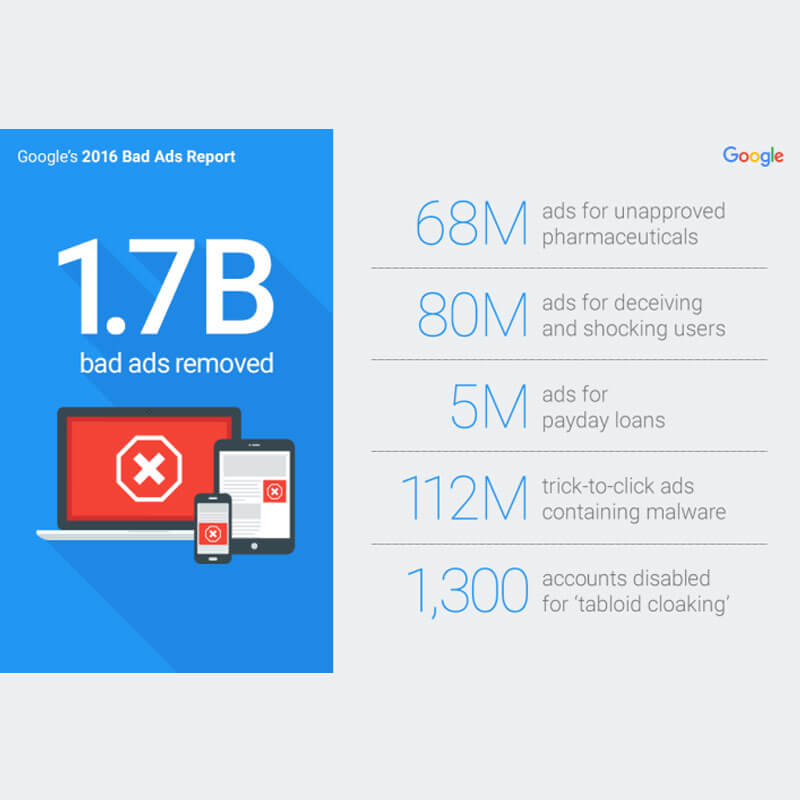
    MUMBAI: In 2016, Google took down 1.7 billion ads that violated its advertising policies, more than double the amount of bad ads it took down in 2015, according to the latest ‘Better Ads Report’ for 2016 released by the company.

    “A free and open web is a vital resource for people and businesses around the world. And ads play a key role in ensuring you have access to accurate, quality information online. But bad ads can ruin the online experience for everyone. They promote illegal products and unrealistic offers. They can trick people into sharing personal information and infect devices with harmful software. Ultimately, bad ads pose a threat to users, Google’s partners, and the sustainability of the open web itself,” said Sustainable Ads Product Management director Scott Spencer.

    Last year, Google did two key things to take down more bad ads. First, it expanded the company’s policies to better protect users from misleading and making predatory offers. For example, in July it introduced a policy to ban ads for payday loans, which often result in unaffordable payments and high default rates for users. In the six months since launching this policy, Google disabled more than five million payday loan ads.

    Second, it beefed up its technology to spot and disable bad ads even faster. For example, “trick to click” ads often appear as system warnings to deceive users into clicking on them, not realizing they are often downloading harmful software or malware. In 2016, Google detected and disabled a total of 112 million ads for “trick to click,” 6X more than in 2015.

    According to the report, most common inappropriate online ads were those for illegal products. Google disabled more than 68 million bad ads for healthcare violations and 17 million ads for illegal gambling violations in 2016.

    Protecting consumers against misleading ads that try to drive clicks and views by intentionally misleading people with false information like asking `Are you at risk for this rare, skin-eating disease?’ or offering miracle cures like a pill that will help people lose 50 pounds in three days without lifting a finger, Google took down nearly 80 million bad ads for deceiving, misleading and shocking users in 2016.

    As for ads developed exclusively for the mobile web, Google’s systems detected and disabled over 23,000 ‘self-clicking ads’ on its platforms as compared to only having to disable a few thousand of these bad ads last year. Similarly, the report highlighted a dramatic increase in scamming activity in 2016 and approximately 7 million bad ads were disabled for intentionally attempting to trick the Google detection systems.

    2016 also saw rise of a new type of scammers called `tabloid cloakers’ that take advantage of current trends and hot topics: a government election or a trending news story or a well-known celebrity. The ads used by these scammers may look like headlines for real articles on a news website but when clicked upon, consumers are redirected to a site selling weight loss products. In 2016, Google suspended over 1,300 accounts for `tabloid cloaking’. In December alone, Google took down 22 `cloakers’ that were responsible for ads seen over 20 million times by people online in a single week.

    Over the years, Google has been working to find ads that violate its policies and blocks the ad or the advertiser, depending on the violation. In 2016, it took action on 47,000 sites for promoting content and products related to weight-loss scams. It also took action on more than 15,000 sites for unwanted software and disabled 900,000 ads for containing malware. Around 6,000 sites and 6,000 accounts were suspended for attempting to advertise counterfeit goods, like imitation designer watches.

    In order to keep Google’s content and search networks safe and clean, Google has introduced stricter policies, including the new AdSense mis-representative content policy. The policy update introduced in November 2016, enables the company to take action against website owners misrepresenting who they were and deceiving users with their content.

  • Google takes down 1.7 bn. ads for violating policies

    Google takes down 1.7 bn. ads for violating policies

    MUMBAI: In 2016, Google took down 1.7 billion ads that violated its advertising policies, more than double the amount of bad ads it took down in 2015, according to the latest ‘Better Ads Report’ for 2016 released by the company.

    “A free and open web is a vital resource for people and businesses around the world. And ads play a key role in ensuring you have access to accurate, quality information online. But bad ads can ruin the online experience for everyone. They promote illegal products and unrealistic offers. They can trick people into sharing personal information and infect devices with harmful software. Ultimately, bad ads pose a threat to users, Google’s partners, and the sustainability of the open web itself,” said Sustainable Ads Product Management director Scott Spencer.

    Last year, Google did two key things to take down more bad ads. First, it expanded the company’s policies to better protect users from misleading and making predatory offers. For example, in July it introduced a policy to ban ads for payday loans, which often result in unaffordable payments and high default rates for users. In the six months since launching this policy, Google disabled more than five million payday loan ads.

    Second, it beefed up its technology to spot and disable bad ads even faster. For example, “trick to click” ads often appear as system warnings to deceive users into clicking on them, not realizing they are often downloading harmful software or malware. In 2016, Google detected and disabled a total of 112 million ads for “trick to click,” 6X more than in 2015.

    According to the report, most common inappropriate online ads were those for illegal products. Google disabled more than 68 million bad ads for healthcare violations and 17 million ads for illegal gambling violations in 2016.

    Protecting consumers against misleading ads that try to drive clicks and views by intentionally misleading people with false information like asking `Are you at risk for this rare, skin-eating disease?’ or offering miracle cures like a pill that will help people lose 50 pounds in three days without lifting a finger, Google took down nearly 80 million bad ads for deceiving, misleading and shocking users in 2016.

    As for ads developed exclusively for the mobile web, Google’s systems detected and disabled over 23,000 ‘self-clicking ads’ on its platforms as compared to only having to disable a few thousand of these bad ads last year. Similarly, the report highlighted a dramatic increase in scamming activity in 2016 and approximately 7 million bad ads were disabled for intentionally attempting to trick the Google detection systems.

    2016 also saw rise of a new type of scammers called `tabloid cloakers’ that take advantage of current trends and hot topics: a government election or a trending news story or a well-known celebrity. The ads used by these scammers may look like headlines for real articles on a news website but when clicked upon, consumers are redirected to a site selling weight loss products. In 2016, Google suspended over 1,300 accounts for `tabloid cloaking’. In December alone, Google took down 22 `cloakers’ that were responsible for ads seen over 20 million times by people online in a single week.

    Over the years, Google has been working to find ads that violate its policies and blocks the ad or the advertiser, depending on the violation. In 2016, it took action on 47,000 sites for promoting content and products related to weight-loss scams. It also took action on more than 15,000 sites for unwanted software and disabled 900,000 ads for containing malware. Around 6,000 sites and 6,000 accounts were suspended for attempting to advertise counterfeit goods, like imitation designer watches.

    In order to keep Google’s content and search networks safe and clean, Google has introduced stricter policies, including the new AdSense mis-representative content policy. The policy update introduced in November 2016, enables the company to take action against website owners misrepresenting who they were and deceiving users with their content.

  • Netflix facilitates downloads on Android memory cards

    Netflix facilitates downloads on Android memory cards

    MUMBAI: OTT and VOD services have been adding a variety of content and myriad features to attract more and more consumers to their service in India. India is one of the fastest growing smartphone-owning countries as hinted by Ericsson recently.

    Launched last year in India, Netflix, the entertainment streaming company, recently added the ability to download its dynamic entertainment content on memory card or expandable storage on Android operating system.

    Users can now download content on Android smartphones and tablets. Earlier, the company had opened up the ‘watch offline’ feature as a response to the growing business race from players such as Amazon Prime and Hotstar.

    The feature however is restricted to inbuilt storage. Players such as YouTube also have a similar limitation. But, the new feather in its cap could Netflix hike its user base in densely populated nations such as India.

    But, the new feature does not surprise Nougat or Android Marshmallow users as they could already avoid limitations by using the adoptable storage option.

    However, for those who can’t do this, they make use of Netflix app and move to the option of ‘download location’ and select from the storage options — SD card or internal storage.

    Also Read:

    Netflix confirms seven million subs; picks up Amazon gauntlet

    OTT/VOD disrupted traditional ‘appointment viewing’ in India: Spuul’s Subin Subaiah

  • Netflix facilitates downloads on Android memory cards

    Netflix facilitates downloads on Android memory cards

    MUMBAI: OTT and VOD services have been adding a variety of content and myriad features to attract more and more consumers to their service in India. India is one of the fastest growing smartphone-owning countries as hinted by Ericsson recently.

    Launched last year in India, Netflix, the entertainment streaming company, recently added the ability to download its dynamic entertainment content on memory card or expandable storage on Android operating system.

    Users can now download content on Android smartphones and tablets. Earlier, the company had opened up the ‘watch offline’ feature as a response to the growing business race from players such as Amazon Prime and Hotstar.

    The feature however is restricted to inbuilt storage. Players such as YouTube also have a similar limitation. But, the new feather in its cap could Netflix hike its user base in densely populated nations such as India.

    But, the new feature does not surprise Nougat or Android Marshmallow users as they could already avoid limitations by using the adoptable storage option.

    However, for those who can’t do this, they make use of Netflix app and move to the option of ‘download location’ and select from the storage options — SD card or internal storage.

    Also Read:

    Netflix confirms seven million subs; picks up Amazon gauntlet

    OTT/VOD disrupted traditional ‘appointment viewing’ in India: Spuul’s Subin Subaiah

  • Budget ’17: Media segments seek succour, digital direction from govt

    Budget ’17: Media segments seek succour, digital direction from govt

    NEW DELHI/MUMBAI: Despite government attempting to allay many fears of the various sectors of the Indian industry, the uncertainty prevailing after demonetisation continues and everybody is looking for the Union Budget 2017 to provide some indications, if not clear-cut answers, on various issues, including a high tax regime, incentivising digital uptake and, of course, the Goods and Services Tax (GST).

    Reliance Broadcast Networks Ltd (RBNL) feels as most radio broadcast players had been advocating for reduction in tax and custom duty on capital equipment, especially given the proposed launch of new frequencies, their expectation this year too remains the same as also the demand for granting infrastructure status to the broadcast industry.

    “Reduction in service tax would be a boon for the media and entertainment industry as a whole,” said Reliance Broadcast Network Limited COO Ashwin Padmanabhan.

    “The media and advertising industry in India is one of the fastest growing in the world. With the Union Budget 2017 expectation will rise for ‘Push for Digital India’ as India ranks second globally with 30 per cent Internet penetration, still to catch up with China (50 per cent) and USA (87 per cent). The implementation of GST is expected to benefit the industry bringing rationalisation of taxation policy by making the taxation process simple, transparent and easy to pay,”  Interspace Solutions CEO Praveen Vadhera.

    Shop CJ COO Dhruva Chandrie, while taking the bigger picture in account, opined if measures are taken to positively impact the overall consumer sentiment and propel their spending trends, it would definitely be good for the Indian economy. “While the government has set a goal of creating around 400 million jobs by 2020, one million people are entering the job market each year. In the given scenario, the government’s quick implementation of programs to create new jobs will give our economy the much needed boost,” he said.

    According to Mukta Arts MD Rahul Puri, the exhibition industry’s biggest hope for the Budget revolved around a formal announcement on the implementation of GST, which is not going to happen till July, but more details could emerge during the Budget speech. “Beside this, we hope that the government would continue to rationalise the corporate tax regime, which would be beneficial for the industry as a whole,” he added.

    Sphereorigins CMD Sunjoy Waddhwa felt that as times were changing for the media and entertainment industry, costs too are going up all round — from remunerations of artistes to costs of production of good programming. “However, I think GST would not have a lot of impact on our industry per se as long as the percentage is not too high,” he added.

    Echoing similar sentiments on rising cost of doing business, Pixel Pictures CEO Prashanti Malisetti said the entertainment industry players were under “heavy burden of multiple taxation and levies” such as license fee, service tax, VAT, etc. Buying props, for instance, currently attract high rates of VAT, depending on the State in question, she explained, adding, “In an ideal world, new technology adaptation should be viewed under a different category and new tax benefits should be applicable despite the age of the production house…(as) current import duties are high and can be a hindrance to smaller companies to make the jump.”

    While highlighting new format of shows in the non-fiction and game show category and arrival of VoD services have led to a host of new opportunities for production companies in the television industry, Malisetti also felt that the entertainment industry was particularly keen to get some clarification on GST.

    Demonetisation and, at times, the present BJP-led government’s unorthodox stand on various policies have been a common theme and, therefore, expectations from various quarters of the media and entertainment industry too have revolved around hoping to get clarifications from the government. Fractal Ink Design Studio CEO, co-founder and CCO Tanay Kumar highlighted that with demonetization “adding friction to our daily routines”, it would be interesting to witness steps taken towards “improving parallel transaction mechanisms”.

    Shop CJ Dhruva Chandrie, while taking the bigger picture in account, opined if measures are taken to positively impact the overall consumer sentiment and propel their spending trends, it would definitely be good for the Indian economy. “While the government has set a goal of creating around 400 million jobs by 2020, one million people are entering the job market each year. In the given scenario, the government’s quick implementation of programs to create new jobs will give our economy the much needed boost,” he said.

    According to Mukta Arts MD Rahul Puri, the exhibition industry’s biggest hope for the Budget revolved around a formal announcement on the implementation of GST, which is not going to happen till July, but more details could emerge during the Budget speech. “Beside this, we hope that the government would continue to rationalise the corporate tax regime, which would be beneficial for the industry as a whole,” he added.

    Sphereorigins CMD Sunjoy Waddhwa felt that as times were changing for the media and entertainment industry, costs too are going up all round — from remunerations of artistes to costs of production of good programming. “However, I think GST would not have a lot of impact on our industry per se as long as the percentage is not too high,” he added.

    Echoing similar sentiments on rising cost of doing business, Pixel Pictures CEO Prashanti Malisetti said the entertainment industry players were under “heavy burden of multiple taxation and levies” such as license fee, service tax, VAT, etc. Buying props, for instance, currently attract high rates of VAT, depending on the State in question, she explained, adding, “In an ideal world, new technology adaptation should be viewed under a different category and new tax benefits should be applicable despite the age of the production house…(as) current import duties are high and can be a hindrance to smaller companies to make the jump.”

    While highlighting new format of shows in the non-fiction and game show category and arrival of VoD services have led to a host of new opportunities for production companies in the television industry, Malisetti also felt that the entertainment industry was particularly keen to get some clarification on GST.

    Demonetisation and, at times, the present BJP-led government’s unorthodox stand on various policies have been a common theme and, therefore, expectations from various quarters of the media and entertainment industry too have revolved around hoping to get clarifications from the government. Fractal Ink Design Studio CEO, co-founder and CCO Tanay Kumar highlighted that with demonetization “adding friction to our daily routines”, it would be interesting to witness steps taken towards “improving parallel transaction mechanisms”.

    “As we see a lot of movement in the start-up world to take on the big pie of the digital world, we hope the Budget 2017 has some easing-down policies on regulatory aspects that will help them concentrate better on problem solving than running after compliance and taxation issues. With unique and easy payment methods like UPI and formation of payment banks, spending patterns and consumer behaviour is going to see a huge shift from being conservative to being more liberal and trusting. We, as a digital experience design agency, expect the Budget to be hugely in favour of creating digitally smart and enabled India in the coming times,” Kumar explained.
    TalentNext.com CEO Shekhar Purohit also felt that this year’s Budget could prove to be critical for the media and entertainment industry as major challenges remain with dual taxation (service tax and VAT), which unduly increases the cost of doing business.

    Pointing out that the media and entertainment industry continues to be a sunrise sector for India, Purohit said, “The implementation, application, and impact of GST on our industry must be addressed immediately and this year’s Budget should also support digitization to the fullest to foster digital empowerment.”

    Also Read:

    Budget 2017 Wish-list: MSOs demand industry status, rationalisation of entertainment & services taxes

    Broadcasters bat for parity with print medium under GST

  • Budget ’17: Media segments seek succour, digital direction from govt

    Budget ’17: Media segments seek succour, digital direction from govt

    NEW DELHI/MUMBAI: Despite government attempting to allay many fears of the various sectors of the Indian industry, the uncertainty prevailing after demonetisation continues and everybody is looking for the Union Budget 2017 to provide some indications, if not clear-cut answers, on various issues, including a high tax regime, incentivising digital uptake and, of course, the Goods and Services Tax (GST).

    Reliance Broadcast Networks Ltd (RBNL) feels as most radio broadcast players had been advocating for reduction in tax and custom duty on capital equipment, especially given the proposed launch of new frequencies, their expectation this year too remains the same as also the demand for granting infrastructure status to the broadcast industry.

    “Reduction in service tax would be a boon for the media and entertainment industry as a whole,” said Reliance Broadcast Network Limited COO Ashwin Padmanabhan.

    “The media and advertising industry in India is one of the fastest growing in the world. With the Union Budget 2017 expectation will rise for ‘Push for Digital India’ as India ranks second globally with 30 per cent Internet penetration, still to catch up with China (50 per cent) and USA (87 per cent). The implementation of GST is expected to benefit the industry bringing rationalisation of taxation policy by making the taxation process simple, transparent and easy to pay,”  Interspace Solutions CEO Praveen Vadhera.

    Shop CJ COO Dhruva Chandrie, while taking the bigger picture in account, opined if measures are taken to positively impact the overall consumer sentiment and propel their spending trends, it would definitely be good for the Indian economy. “While the government has set a goal of creating around 400 million jobs by 2020, one million people are entering the job market each year. In the given scenario, the government’s quick implementation of programs to create new jobs will give our economy the much needed boost,” he said.

    According to Mukta Arts MD Rahul Puri, the exhibition industry’s biggest hope for the Budget revolved around a formal announcement on the implementation of GST, which is not going to happen till July, but more details could emerge during the Budget speech. “Beside this, we hope that the government would continue to rationalise the corporate tax regime, which would be beneficial for the industry as a whole,” he added.

    Sphereorigins CMD Sunjoy Waddhwa felt that as times were changing for the media and entertainment industry, costs too are going up all round — from remunerations of artistes to costs of production of good programming. “However, I think GST would not have a lot of impact on our industry per se as long as the percentage is not too high,” he added.

    Echoing similar sentiments on rising cost of doing business, Pixel Pictures CEO Prashanti Malisetti said the entertainment industry players were under “heavy burden of multiple taxation and levies” such as license fee, service tax, VAT, etc. Buying props, for instance, currently attract high rates of VAT, depending on the State in question, she explained, adding, “In an ideal world, new technology adaptation should be viewed under a different category and new tax benefits should be applicable despite the age of the production house…(as) current import duties are high and can be a hindrance to smaller companies to make the jump.”

    While highlighting new format of shows in the non-fiction and game show category and arrival of VoD services have led to a host of new opportunities for production companies in the television industry, Malisetti also felt that the entertainment industry was particularly keen to get some clarification on GST.

    Demonetisation and, at times, the present BJP-led government’s unorthodox stand on various policies have been a common theme and, therefore, expectations from various quarters of the media and entertainment industry too have revolved around hoping to get clarifications from the government. Fractal Ink Design Studio CEO, co-founder and CCO Tanay Kumar highlighted that with demonetization “adding friction to our daily routines”, it would be interesting to witness steps taken towards “improving parallel transaction mechanisms”.

    Shop CJ Dhruva Chandrie, while taking the bigger picture in account, opined if measures are taken to positively impact the overall consumer sentiment and propel their spending trends, it would definitely be good for the Indian economy. “While the government has set a goal of creating around 400 million jobs by 2020, one million people are entering the job market each year. In the given scenario, the government’s quick implementation of programs to create new jobs will give our economy the much needed boost,” he said.

    According to Mukta Arts MD Rahul Puri, the exhibition industry’s biggest hope for the Budget revolved around a formal announcement on the implementation of GST, which is not going to happen till July, but more details could emerge during the Budget speech. “Beside this, we hope that the government would continue to rationalise the corporate tax regime, which would be beneficial for the industry as a whole,” he added.

    Sphereorigins CMD Sunjoy Waddhwa felt that as times were changing for the media and entertainment industry, costs too are going up all round — from remunerations of artistes to costs of production of good programming. “However, I think GST would not have a lot of impact on our industry per se as long as the percentage is not too high,” he added.

    Echoing similar sentiments on rising cost of doing business, Pixel Pictures CEO Prashanti Malisetti said the entertainment industry players were under “heavy burden of multiple taxation and levies” such as license fee, service tax, VAT, etc. Buying props, for instance, currently attract high rates of VAT, depending on the State in question, she explained, adding, “In an ideal world, new technology adaptation should be viewed under a different category and new tax benefits should be applicable despite the age of the production house…(as) current import duties are high and can be a hindrance to smaller companies to make the jump.”

    While highlighting new format of shows in the non-fiction and game show category and arrival of VoD services have led to a host of new opportunities for production companies in the television industry, Malisetti also felt that the entertainment industry was particularly keen to get some clarification on GST.

    Demonetisation and, at times, the present BJP-led government’s unorthodox stand on various policies have been a common theme and, therefore, expectations from various quarters of the media and entertainment industry too have revolved around hoping to get clarifications from the government. Fractal Ink Design Studio CEO, co-founder and CCO Tanay Kumar highlighted that with demonetization “adding friction to our daily routines”, it would be interesting to witness steps taken towards “improving parallel transaction mechanisms”.

    “As we see a lot of movement in the start-up world to take on the big pie of the digital world, we hope the Budget 2017 has some easing-down policies on regulatory aspects that will help them concentrate better on problem solving than running after compliance and taxation issues. With unique and easy payment methods like UPI and formation of payment banks, spending patterns and consumer behaviour is going to see a huge shift from being conservative to being more liberal and trusting. We, as a digital experience design agency, expect the Budget to be hugely in favour of creating digitally smart and enabled India in the coming times,” Kumar explained.
    TalentNext.com CEO Shekhar Purohit also felt that this year’s Budget could prove to be critical for the media and entertainment industry as major challenges remain with dual taxation (service tax and VAT), which unduly increases the cost of doing business.

    Pointing out that the media and entertainment industry continues to be a sunrise sector for India, Purohit said, “The implementation, application, and impact of GST on our industry must be addressed immediately and this year’s Budget should also support digitization to the fullest to foster digital empowerment.”

    Also Read:

    Budget 2017 Wish-list: MSOs demand industry status, rationalisation of entertainment & services taxes

    Broadcasters bat for parity with print medium under GST