Category: iWorld

  • ditto TV to air ‘Descendants of the Sun’ from 8 Feb

    ditto TV to air ‘Descendants of the Sun’ from 8 Feb

    MUMBAI: After successfully introducing Indian audiences to shows from Turkey and Ukraine, Zindagi, famous for bringing the best of finite drama series from across the globe to viewers in India, is all set to launch “Descendants of the Sun”, an award winning Korean show for the first time on Indian television. The blockbuster Korean drama will also be available live on Zindagi on dittoTV, February 8 onwards. The series has won numerous awards on Korean and international platforms, and will now add to the wide bouquet of shows that dittoTV offers its subscribers.

    Zindagi with its diverse and differentiated content has built a strong core fan base who, with dittoTV, have the option of also tuning into these shows anytime on the go.

    ‘Zindagi with its diverse and differentiated content has built a strong core fan base, as it gives them the opportunity to explore content from beyond the US and UK. Keeping in mind the evolving preferences of viewers, dittoTV offers a wide variety of channels across genres that cater to the diverse content preferences of its subscribers. We are excited to bring to India Zindagi’s first Korean show, “Descendants of the Sun” on dittoTV, enabling viewers who are constantly on-the-go to watch their favourite programs live’, said Z5 Business head of digital, India Archana Anand.

    The heartwarming story line of “Descendants of the Sun” is sure to resonate with the Indian youth, who form an important part of dittoTV’s subscriber base. The trend of finite TV series, a format that Zindagi is well known for introducing to the Indian audience, is gaining momentum amongst viewers. dittoTV will enable them to keep up with the engaging plot twists of the show on their handheld devices, even when they do not have access to a television set.

    dittoTV subscribers can catch this new primetime show from February 8, Monday to Saturday at 8 PM on their Android and iOS phones or any other internet connected device. The subscription charges start from INR 20 per monImage result for Descendants of the Sun’.

  • Over 35,000 PoIs provided to Jio by Airtel

    Over 35,000 PoIs provided to Jio by Airtel

    MUMBAI:  Bharti Airtel has informed the BSE that it has provided a total of over 35,000 points of interconnect (Pols) to Reliance Jio in record time of five months. Of these 27, 719 Pols – 79 per cent  of the total – have been dedicated for incoming calls from Jio customers, which is the highest amongst all operators.

    The Pols have been provided well above the customer growth projection provided by Jio to Airtel. The capacity provided is ideal for serving over 190 million customers on the Jio network and is more than double of the 72.5 million total customers currently claimed by Jio.

    More importantly, the above mentioned capacity has been released at a staggering pace, something not seen before in the Indian telecom industry and is much more than comparable capacity provided by Airtel to other operators.

    • Vodafone with 202 million customers has been provided a total of approx. 40,600 Pols by Airtel over a period of 21 years. Of these 23, 950 Pols are for incoming calls- much less than what has been provided to Jio.

    • Idea with 185 million customers has been provided a total of approx. 38,130 Pols by Airtel over a period of 21 years. Of these 23, 694 Pols are for incoming calls- again much less than what has been provided to Jio.

    • Reliance Communications with 86 million customers has been provided a total of approx.
    13,400 Pols by Airtel over 13 years. Of these 8415 Pols are for incoming calls -less than one third of what has been provided to Jio.

    • Telenor with 58 million customers has been provided a total of approx. 9000 POls over seven years. Of these 6510 Pols are for incoming calls – less than one fourth of what has been provided to Jio.

    Ever since the commercial launch of services by Jio in September 2016, Airtel has honoured its regulatory obligations and ensured that there are no capacity constraints from its end and customers are not inconvenienced. In fact, Airtel has been providing Pols to Jio, well ahead of the commencement of its commercial operations.

    It, therefore, appears that the constant rhetoric by Jio with regard to Pols is aimed at covering up technical issues in their own network or their inability to activate the Pols given.

    On the contrary, due to continued non-compliance of TRAI’s tariff orders by Jio by providing free services for the past 5-6 months, there is a tsunami of incoming voice traffic on the Airtel network, thereby, impacting the service experience of our customers.

    The huge asymmetry in traffic due to Jio’s free offers has also resulted complete failure of the present IUC regime, which assumes nearly symmetric traffic while fixing the below cost termination charge. The present termination charge of 14 paise is less than half of the actual cost of terminating calls on the network, resulting in huge loss to the company.

    Allocation of Pols to operators by Airtel

    http://www.indiantelevision.com/sites/drupal7.indiantelevision.co.in/files/styles/large/public/jio%20%281%29.jpg?itok=zz-Qq-RM

  • Cyberbullying may lead to depression in Asian kids

    Cyberbullying may lead to depression in Asian kids

    MUMBAI: Telenor Group, on this Safer Internet Day 2017, released results from a survey of parents and adults across Asia in order to give greater visibility of the types of digital bullying affecting youth and how they deal with it. The survey was conducted over Facebook with 320 respondents primarily from Bangladesh, India, Malaysia, Myanmar, Pakistan, Singapore, Thailand and other Asian countries. While cyberbullying exists across all countries, the respondents said that they are discussing cyberbullying with youth and feel that resilience is being built, which may help them tackle digital abuse or better empathize with victims. The survey targeted Facebook users from 18-64 with stated interests in parenting, family issues, child welfare and online security.

    “In the lead up to Safer Internet Day, we conducted this digital survey to keep on the pulse of the ever-evolving arena of digital bullying, to see how it affects children in Asia, and what both adults and children can do about it,” says Telenor Group director – Social Responsibility Zainab Hussain Siddiqui. “Encouragingly, across Asia,we see examples of awareness-building efforts – on the part of our company and many others – reaching scores of children, parents and school teachers. And we hope this is leading to more resilience against online mistreatment.”

    Telenor India’s WebWise, a flagship programme on children’s cyber safety & security, also reveals that in India 99 per cent school-going children in urban areas are using internet out of which every second child feels unsafe online. Over 35 per cent children have experienced hacking of their account while 15.74 per cent shared that they have received inappropriate messages.

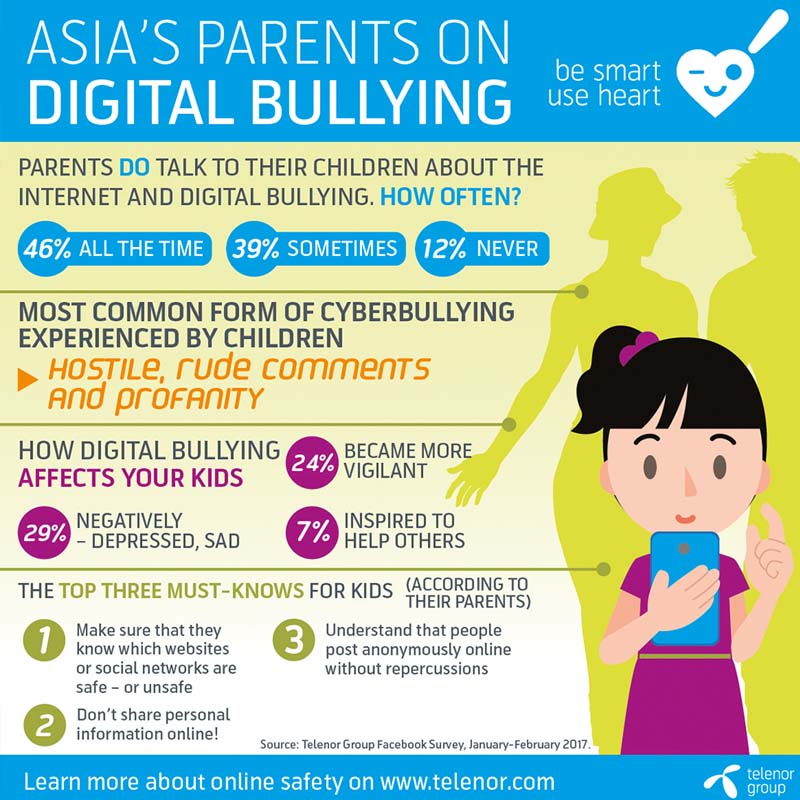
    First things first: Parents say they do talk to their children about cyberbullying Dialogue is the first step in helping children understand how, why and on what channels online mistreatment can happen – and how to manage and report it. One of the first findings of this survey sheds a positive light on the situation. A majority of the respondents (46 per cent) say that they speak to their children ‘all the time’ about internet and online behavior, followed by 39 per cent who discussed this ‘sometimes’. Only 12 per cent said they had never spoken about this topic. A large segment of Asian adults feel empowered and aware enough to address online safety with youth.

    Common experiences in cyberbullying

    ‘Being the target of hostile and rude comments and profanity online’ was the most common form of cyberbullying incidents that respondents’ children had experienced (22.5 per cent of respondents). The next largest group said they ‘did not know’ if any of the listed cyberbullying incidents had occurred to their child. The third largest group said their children had not experienced cyberbullying as they have been ‘trained how to respond and defend themselves’ against this type of activity.

    Effects of cyberbullying vary

    When asked how cyberbullying experiences affected the child, the answer was multi-layered with some surprises. They implied that Asia’s children are increasingly learning how to deal with bullying online, or actively were able to ignore the attacks with no effect on them. While 29 per cent of respondents said that being cyberbullied affected the child negatively and they were ‘depressed’ for a time period, 24 per cent said that the situation made the child more alert and able to defend themselves online. A further 24 per cent said the child did not seem to be affected, with seven per cent even saying the online bullying ‘inspired the child to then help other victims.’

    Cyberbullying and online gaming

    Those whose children play online games reported a higher rate of cyberbullying attacks than standard browsing activities. Of those surveyed, 79 per cent said their child or a child that they know has been threatened with physical harm while playing online games specifically on websites or on social media. This was followed by 41 per cent who said the child was the target of offensive comments including name calling, racist or sexist remarks.

    Important: Education on appropriate websites

    The reportedly most important online safety topic for children was to make sure that they know which websites or social networks are safe – or which should be kept out of bounds (27 per cent of respondents). This was followed closely by education about sharing personal information online (26 per cent), and knowing that people post anonymously online without repercussions (25 per cent).

    Other risks: Sharing personal information and visiting forbidden websites

    Cyberbullying formed part of the online concerns that adults hold for youth, but the responses of the survey point out that risky online actions in general need to be addressed through education. Of the respondents, 55 per cent said their child had given personal information to strangers online, followed by 51 per cent who said the child had visited websites they were not supposed to.

    However, while online scams and social media platforms in an increasingly digital worldappear to be more prolific than ever, it was interesting to note that respondents said their child, or a child they knew, was least likely to experience email and social media account hacking, as well as sharing NSFW (Not Safe for Work) photos or videos.

    Also Read:

    YouTube Kids available for free on Google Play, App Store in India


  • Future Watch: Expectations from Indian OTT Industry in 2017

    Future Watch: Expectations from Indian OTT Industry in 2017

    India has witnessed an over-the-top (OTT) explosion in 2016. The entry of leading international players, coupled with the rise of local OTT ventures, has only intensified the competition in a market earmarked for exponential growth.

    Statistics underline why OTT is fast becoming the primary medium of entertainment consumption for Indian viewers. Over 65% of the 450+ million internet users in India are currently mobile-only, and the country is adding 6 million new internet users every month who are exclusively accessing digital connectivity through on a mobile phone.

    With almost 2.1 billion people, or 28.7% of the world’s population, already estimated to own smartphones, the rate of smartphone adoption will continue to be robust across the globe with double-digit growth. Smartphones will also outstrip feature phones when it comes to sales and adoption. “Nearly 47.4% of mobile phone users own a smartphone at present. Keeping in mind the industry trends, smartphone users could very well outnumber feature phone users by the end of 2017.”

     Nearly 47.4% of mobile phone users will possess smartphones by the end of this year. By the end of 2017, smartphone users will outnumber feature phone users. (Source: eMarketer)

    public://11111.jpg

    Source: eMarketer

    public://2222222.jpg

    Source: iCube

    Mobile is driving the growth for Internet in India; the country is predicted to be home to 640 million internet users and 700 million smartphone users by 2020 (Source: iCube). Online video content, as a result, is thriving; videos comprise 50% of total mobile data traffic at present. This clearly shows the potential that the Indian market is sitting on. The gold rush will continue in the future as well, as more viewers shift towards easy-to-use, on-demand services that offer cross-platform access.

    public://3333333333333.jpg

    The Indian OTT industry has been majorly driven by disruption. OTT Trends to watch for in 2017 (Source: MUVI):

    LIVE Streaming:

    As more consumers shift towards anytime, anywhere viewing experience, live streaming will continue to be in demand in 2017. To make the most of it, OTT platforms must have to leverage the following:
    –    Capture live on Ad-hoc/breaking stories (to capture the thrill)
    –    Live Sports & Events
    –    Linear TV schedule of the series programming (creating a VOD playout)

    People are demanding more and more live experiences for their favorite content over-the-top, especially for top content such as news and sports. Studies suggest that viewers in fact demand this content later if they miss the live broadcast.

    Sports live streaming saw impressive reception in the year 2016, with UEFA European Champions 2016 in France scoring massive viewership on SonyLIV’s web and mobile app platforms. With much more expected in the live streaming space in the coming year, the trend is here to stay.

    AR, VR & 360 videos:
    Videos in recent times have moved beyond their traditional boundaries and have become more immersive with the advent of augmented reality and virtual reality tech. With 4K becoming the hot new trend for device manufacturers, video qualities have improved dramatically. As a result, engaging  life-like experiences through videos are no longer far-fetched fantasies, but are actively becoming a part and parcel of the overall entertainment viewing.

    Original Content:

    OTT players have started coming up with their own original series to hook viewers’ attention. This is generating impressive traction and has viewers switching over from the expensive Pay TV, thanks to the freshness and greater relevance of the content as well as the increased convenience of anytime, anywhere viewing.
    Hybrid Platforms:

    OTT right now, is at a position where e-commerce was a few years ago – new, and trending, and adapting to new ways of winning. Making OTT platforms capable of selling physical products along with audio and video service offerings is definitely going to be an upward trend in 2017 due to the synergy between the two sectors. A prime example of this is Amazon, an e-commerce company, which has now jumped into video streaming. Allowing free shipping of Amazon products on Prime Video memberships has very quickly allowed the company to transform most of its e-commerce consumers as streaming service subscribers.

    Rural will drive the internet growth and local languages content will rise:

    India is estimated to have 250 million rural internet users, while non-metros are driving 60% of the overall e-commerce growth. Nearly 43% of internet users are non-English, a number which is estimated to grow to 62% by 2020. This could see a tangible increase in regional language-based content available on the digital medium, as more and more OTT platforms and production houses develop entertainment tailored to meet the specific requirements and sensibilities of their regional audiences.

    public://444444444444.jpg

    Source: IAMAI India Internet Report, Indian Readership Survey

    Micro transactions & cashless transactions:

    According to a Frost & Sullivan report, there are 66 million unique connected video viewers in India, of which 1.3 million are paid video subscribers. These video subscription numbers, however, are not absolute, and fluctuate drastically every month. But with the country heading towards becoming a cashless economy and colossal changes expected in the way netizens make their day-to-day transactions, the number of OTT subscribers is expected to grow and stabilize, even as the number of unique online video viewers grows to 355 million by 2020.

    E-payments and mobile wallets are getting more popular among the millennials in the country. Digitization of cash will accelerate over the next few years. Non-cash payments, which today constitute 22% of all consumer payments, will overtake cash transactions by 2023.

    Digital payments instruments will drive the growth in non-cash payments, according to a Google BCG Report. Micro-transactions will form a substantial portion of the industry, with over 50% of person-to-merchant transactions expected to be under INR 100 according to the study. The report also predicts that the value of remittances and money transfer that will pass through alternate digital payment instruments will double to 30% by 2020.

    public://555555555555555.jpg

    Source: Google – BCG

    TV ad revenue to shift to Digital by 2017 in Asia-Pacific

    Net advertising revenue in the Asia-Pacific has grown at 5.8% in 2016 and is expected to increase at a compound annual growth rate (CAGR) of 5.5% till 2020. This reflects stable but moderate growth across both mature and emerging markets in the region.

    India and China will continue to be the fastest growing ad markets in the region, expanding in excess of 10% and 8% respectively according to a new report by Media Partners Asia, an advisory, research, and consulting firm. The share of digital media in the advertising market in Asia-Pacific is projected to overtake that of television by 2017 and increase to 44.2% by 2020, up from 30.7% in 2015. The biggest contributors to this growth will be Australia, China, Korea, Japan, and Taiwan.

    Although television will remain a critical advertising medium, its regional advertising share will decline as ad spending in Australia and China shifts to digital. However, television will continue to be the biggest advertising medium in key markets such as India, Japan, and Korea even in 2020. The Media Partners Asia report forecasts that over the next five years, the fastest growing markets in Asia-Pacific will be India at 10.7%, China at 8.4% and Indonesia at 8.2%. In 2015, the net advertising revenue in Asia-Pacific grew by 5.3%, the slowest rate of growth since 2009. Advertising expenditure growth continued to remain slow in Indonesia and contracted in Singapore, Malaysia, and Hong Kong.

    Social Platforms

    Mobile video accounts for 50% of mobile traffic around the world and, by 2021, video will account for 70% of the overall mobile internet traffic. (Source: Ericsson Mobility Report).
    1 out of 8 people around the world accesses Facebook on a mobile phone at least once a day. (Source: BI Intelligence estimates, Facebook)

    Snapchat is the up-and-coming disrupter. It isn’t just mobile-first; it is mobile-ONLY and is witnessing exponential growth in its mobile audience. (Source: Snapchat, BI Intelligence estimates)

    Skype, WhatsApp video call has brought the world and its people closer to one another. LIVE serves the same purpose, allowing brands an opportunity to add personality and a personal touch to their communication. LIVE comes as a breath of fresh air to engage with dormant audiences and boost engagement. From a brand’s point of view, this can be a way of showing people what actually happens behind the scene rather than pushing out branded content all the time. This will allow them to  tap Audiences which might have otherwise been inaccessible to them. For example, while only a few thousands could attend the Coldplay concert in India, millions could view it on the LIVE broadcast. Additionally, when a brand goes LIVE, it gives an assurance to audiences that there is no gimmick involved and everything that is being showcased is true, which adds credibility. With LIVE, the brand and consumer relation stands to evolve. Facebook LIVE has started a new trail of information share from brands. Some good examples of LIVE video are the El Clasico LIVE voting on SonyLIV, which got a reach of 1 million organically in only 90 minutes while the match was live. Multiple creative uses of the feature can be seen in the coming year, as marketers will look to use it differently to engage their target audiences. With LIVE expected to evolve further in future iterations, brands and marketers can look forward to exciting times ahead.

    Cord Cutting:

    The increased digitisation of entertainment means that cord cutting will continue to grow in the coming year as well. One in every four millennials does not subscribe to pay TV, and 13% have never used a pay TV subscription. Digital TV Research estimates that the number of pay TV subscribers in Canada and the U.S. will fall, while Statista predicts that there will only remain 96.4 million pay TV households by 2019.

    People have been ditching their pay TV connections due to the lack of interesting content on-demand and the high costs of subscriptions. OTT platforms, by providing viewers the flexibility of accessing their favourite content at their fingertips, anytime, anywhere, have been winning this battle.

    On-demand platforms are adding TV programs to their bundles, bringing in a better content library of old as well as original programming, localizing in niche territories, and keeping up with technological innovations such as 4K, AR, VR and 360-degree video production. This will allow them to leapfrog appointment-based TV broadcasters and establish OTT platforms as the default medium of entertainment content consumption.

    public://YMNIVzea_400x400.jpg
     
    (Abhishek Joshi is Sony Pictures Networks India VP & Head – Marketing & Analytics, Digital Business. The views expressed here are personal, and Indiantelevision.com need not necessarily subscribe to them.)
     

  • Hooq hires ex-BBC exec, to expand into new territories

    Hooq hires ex-BBC exec, to expand into new territories

    MUMBAI: Singtel’s over-the-top (OTT) service Hooq has appointed Michael Fleshman as its chief technical officer. He was the senior vice-president of consumer digital technology at BBC Worldwide until March 2015 after being CTO at FT.com and CIO at the Financial Times.

    Hooq CEO Peter Bithos welcomed Fleshman to Hooq as part of the senior leadership team. He opined that the team is ecstatic by his depth of experience in the digital media space and is confident about Fleshman leading the technical team to new heights as it expands aggressively into new territories, new products and new platforms in 2017.

    Fleshman said he looked forward to driving the company into its new phase of innovation and technology.

    Singtel has a majority stake in the project across Asia, with Sony Pictures Television and Warner Bros Entertainment being the minority shareholders.

    Also Read:

    Netflix confirms seven million subs; picks up Amazon gauntlet

    HOOQ raises US$ 25 million from Sony Pictures, others; open to outside investors

    Hooq appoints OTT veteran for Singapore business

    Hooq expands its kids offering; to add 500 hours of content


  • SonyLiv appoints Times Internet’s Maruti Indoria

    SonyLiv appoints Times Internet’s Maruti Indoria

    MUMBAI: Sony Pictures Networks India’s video-on-demand platform SonyLiv has appointed Times Internet Ltd’s regional head Maruti Indoria as national sales head for its sports division. 

    Indoria will report to SPNI’s Sr VP and head of digital sales and monetization Samta Dikshit

    On the appointment Indoria said,  “I am delighted to take on this new, exciting and challenging role with SonyLiv. My new endeavour will play a significant role towards revolutionising sports portfolio across segments of viewers. This is going to be a wonderful journey.”

    Prior to joining SonyLiv, Indoria was in various other roles across media sectors, such as regional sales head – digital, DB Digital (Dainik Bhaskar Group), and had stints with Rudra Media, Sify.com, Business Standard and India Today Group.

    Also Read:

    SonyLiv launches original Marathi web-series ‘YOLO’

    Sony’s ‘We Liv to Entertain’ gets 10 million views in a week

  • Airtel petitions CCI as TRAI allows free Jio

    Airtel petitions CCI as TRAI allows free Jio

    MUMBAI: Telecom regulator TRAI has made up its mind to permit the new entrant Reliance Jio to go on with its free data offer, objections from rivals notwithstanding. Failing to get a favourable TRAI decision, Airtel has petitioned the Competition Commission of India (CCI) seeking respite from Jio’s complimentary services. Airtel complained said that Jio’s tariffs are affecting competition.

    TRAI has now permitted Jio to continue with its “Happy New Year” offer thus allowing its subscribers to use up to 1GB free data every day. But, TRAI ruled that Jio schemes were valid.

    Airtel had, on 24 December, filed a petition with the telecom tribunal, TDSAT, calling TRAI a “mute spectator” as it allowed Jio to go on with its complimentary offer beyond the stipulated 90-day period. On 18 January, Idea Cellular too moved TDSAT to stop Jio from giving free data.

    Rules prevent operators from having a complimentary campaign for over months, and Jio has now been offering free services for over 90 days, and now deciding to extend the offer to 31 March.

    Telcos meanwhile are planning to consolidate in order to survive in the competitive market.

    Also Read:

    Jio becomes top ISP, Wireline growth retards overall broadband internet subs fall in Nov-16

    BSNL violating TRAI’s IUC norms, complains COAI

    TRAI: HC asks Idea, DoT to file affidavit on plea

    Idea petitions TDSAT against TRAI; price war set to escalate

  • How Digital India will foster VoD growth: Spuul Global CEO

    How Digital India will foster VoD growth: Spuul Global CEO

    MUMBAI: India is a market with enormous potential for digital services, and it is expected to continue to grow with a very rapid speed and much higher than many other markets in the world, as far as data traffic is concerned. In fact, some estimates suggest while the rest of the world will grow 10-12 times maximum when it comes to data traffic, India will grow 17 times.

    In the West, people went from a single TV to multiple TVs and then to the mobile, but India seems to be jumping directly from TVs to watching content on their smartphones, leaning on improving mobile internet to consume digital content. TV is becoming a static screen in your living room, while consumers are looking forcustomized viewing experiences.

    With a number of video on demand platforms coming together the Indian consumer is all set to enjoy a wide variety of video content as each VOD platform has something unique to offer to its viewers. 

    Having said that,the online video space provides a fantastic platform for experimenting with various content formats. It isn’t constrained by the economics of satellite television. A show prepared for the web, doesn’t necessarily need to be in ~30 minute slots. It could be a few minutes or a few hours. This has allowed content creators to experiment with multiple formats.

    At the same time there is a clutch of factors that could play spoilsport in the near future. Despite falling costs of technology and production, producing content is prohibitive and added to that distribution costs too are significant. The state of the broadband speed remainsspotty.

    A July report by Akamai, a US-based content delivery and cloud services provider, suggests that India had an average 3.5 Mbps Internet speed. Yet, it was the lowest average Internet speed in the Asia Pacific region.

    On consumption of data, the report said the country is on the cusp of significant growth in data traffic driven by rising data users as well as growing data usage per user.For 2016, the number of smartphone users in India is estimated to reach 204.1 million, with the number of smartphone users worldwide forecast to exceed 2 billion users by that time.

    Watching a movie of 2-3 hours could take up about 200-250 MB of data, which costs around INR 40-50. For VOD platforms to succeed in India costs of 4G have to come down drastically.The Telecom Regulatory Authority of India (TRAI) said that there are 1.06 billion wireless telecom subscribers in the country. The Cellular Operators Association of India, said, the number of 3G users in India is expected to more than double (to 330 million) and 4G to grow by over 10 times (to 42 million) from 2015 base till 2017.  4G will be a game changer in the way video is being consumed in the country. 

    The way consumers consume information and entertainment will change from TV to video on demand over multiple devices, but one thing that won’t is that content will continue to be king. Because how the content is consumed depends on ease, convenience of the video on demand platforms and ultimately technology will decide who gets the most viewership. India though has room for many video on demand services to survive and thrive because preferences and tastes of viewers vary from region to region.

    http://www.indiantelevision.com/sites/drupal7.indiantelevision.co.in/files/styles/large/public/Subin%20Subaiah-800x800%20%281%29.jpg?itok=noP8yybOThe writer of this article is Subin Subaiah. The views expressed here are personal, and Indiantelevision.com need not necessarily subscribe to them
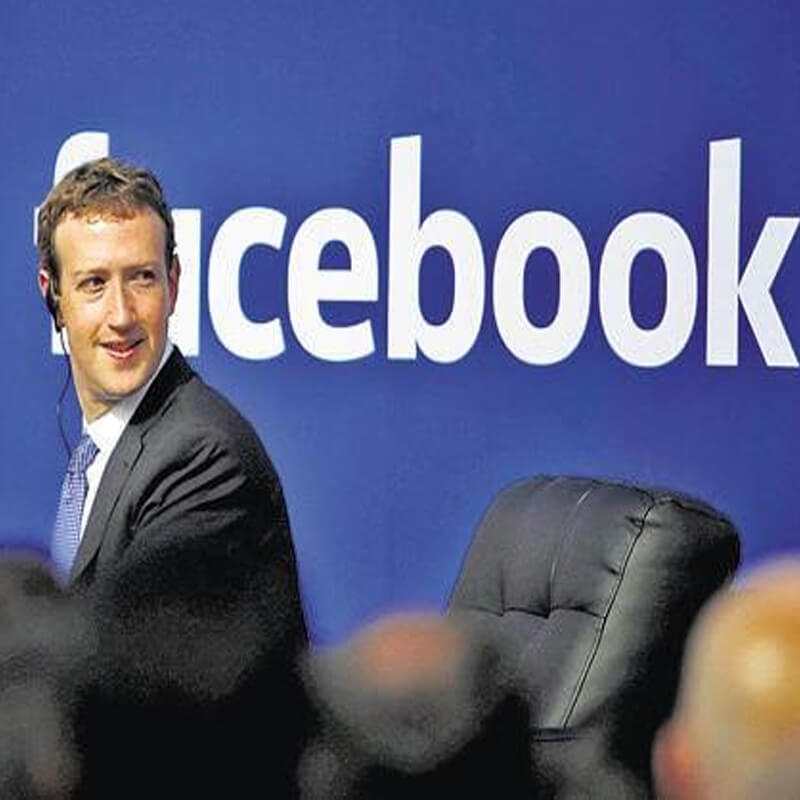
  • FB to make TV-style video app

    FB to make TV-style video app

    MUMBAI: Facebook is seeking publishers to make specific and niche content and also working on a TV-style video app. FB has no definite model of video programming except for live streams posted by its users and short video clips.

    The App is part of an initiative to own a video-first company – allowing for competition for TV advertising revenue. FB’s strategy to push more video content on the platform has been well prescribed, according to a report in WSJ.

    The report did not give details of attributes of the app, but said that the video programming content would last for around 10 minutes, from scripted shows to entertainment and sports.

    While there was no mention of which streaming boxes FB TV content will stream through, it may aim to start with Apple TV. 

    Also Read:

    Supreme Court flags privacy issues regarding WhatsApp, FB

    FB-WPP to nurture mobile-first creativity tools

  • FB to make TV-style video app

    FB to make TV-style video app

    MUMBAI: Facebook is seeking publishers to make specific and niche content and also working on a TV-style video app. FB has no definite model of video programming except for live streams posted by its users and short video clips.

    The App is part of an initiative to own a video-first company – allowing for competition for TV advertising revenue. FB’s strategy to push more video content on the platform has been well prescribed, according to a report in WSJ.

    The report did not give details of attributes of the app, but said that the video programming content would last for around 10 minutes, from scripted shows to entertainment and sports.

    While there was no mention of which streaming boxes FB TV content will stream through, it may aim to start with Apple TV. 

    Also Read:

    Supreme Court flags privacy issues regarding WhatsApp, FB

    FB-WPP to nurture mobile-first creativity tools