Category: iWorld

  • Swift TV & Hoichoi Partner to Redefine Regional Streaming

    Swift TV & Hoichoi Partner to Redefine Regional Streaming

    Swift TV, India’s rapidly growing Free Ad-Supported Streaming Television (FAST) platform, has partnered with Hoichoi, the leading destination for Bengali and Hindi entertainment, to deliver premium regional content absolutely free.

    With 800K+ downloads and 130+ live channels in 12+ languages, Swift TV offers an extensive catalog of movies, shows, and live entertainment. This collaboration brings Hoichoi’s acclaimed Bengali and Hindi originals, movies, and series directly to the Swift TV app, at no extra cost.

    A major highlight is the exclusive Hoichoi Live Channels—a first-of-its-kind innovation in FAST streaming. The Bengali Hoichoi Live Channel is available internationally (except India), while the Hindi channel is accessible worldwide, including India. This positions Swift TV as the go-to destination for regional entertainment across India, the US, and Canada.

    “We’re thrilled to bring Hoichoi’s exceptional content to our audiences,” said a Swift TV spokesperson. “Our bespoke Hoichoi Live Channels set new benchmarks for free, high-quality regional entertainment.”

    For Hoichoi, the partnership opens doors to the FAST ecosystem, expanding its reach beyond SVOD audiences while staying true to its mission of celebrating Bengali narratives.

    With top partners like Viacom18, Zee, Pitaara, Republic TV, and Bloomberg Originals, Swift TV continues to strengthen its premium content lineup.

    Download the Swift TV app today Swift Tv and enjoy Hoichoi’s world-class Bengali and Hindi entertainment—free, accessible, and tailored for every mood, in your language, on your terms. 
     

  • JioStar sparks ad revolution with Moment.AI that feels the right moment

    JioStar sparks ad revolution with Moment.AI that feels the right moment

    MUMBAI: When it comes to ads, timing really is everything and JioStar wants brands to nail the moment, not miss it. The company has unveiled Moment.AI, an advanced contextual advertising tool designed to catch viewers right when their emotions are at their peak.

    Built on the philosophy of own the feeling, own the moment, the tech marvel scans video content using artificial intelligence and machine learning to decode over 600 emotions and objects from smiles and celebrations to hugs and family scenes. Instead of clumsy interruptions, brands can now slip into stories exactly when the heartstrings are tugged or the laughter rolls.

    JioStar head of revenue for entertainment Mahesh Shetty called it a breakthrough: “Moment.AI integrates messaging at natural points of emotional impact, making campaigns more effective for brands and engaging for viewers.”

    The system is anchored on the R.A.C.E. framework reach, attention, connection, and effectiveness ensuring ads deliver more than just eyeballs. Early studies already show a 34 per cent uplift in advertising effectiveness compared to conventional placements.

    Moment.AI isn’t confined to one category. Whether it’s jewellery during a proposal, skincare in a mirror moment, or snacks at a family gathering, the platform is designed to work across sectors like handsets, gifting, food and beverages, home décor, fashion, and festivals making every placement feel native.

    Currently live across JioStar’s Entertainment network and gearing up to roll out on JioHotstar, the innovation is pitched as a new era for contextual advertising, blending technology with consumer insight.

    For brands, the message is simple: stop gate-crashing the moment start owning it.

  • Game on as BGMS playoffs set to heat up with Rs 1.5 crore prize pool

    Game on as BGMS playoffs set to heat up with Rs 1.5 crore prize pool

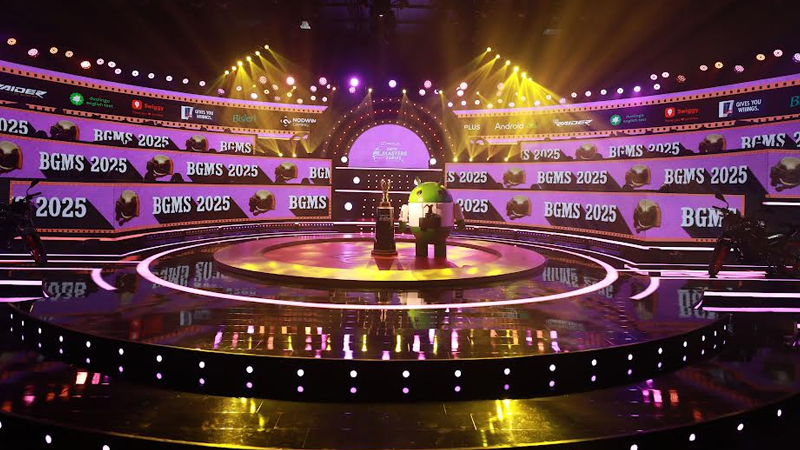
    MUMBAI: From campus underdogs to esports titans, India’s BGMI battleground is primed for its fiercest face-off yet. After 20 days of high-octane action, the league stages of the Oneplus Android Battlegrounds Mobile India Challenger Series (BGCS) 2025 and Masters Series (BGMS) 2025 have wrapped up, clearing the path for the Playoffs beginning 9 September.

    The BGCS league saw 16 teams clash, but it was Nebula Esports fresh from the Oneplus Campus Dominate qualifiers that stole the spotlight, finishing on top with 222 points. Hot on their heels were Sinewy Esports (213), Team Versatile (201) and Team H4K (163), all four securing a ticket to the BGMS Playoffs.

    Meanwhile, the BGMS league itself was a blockbuster. Across 56 matches each, 24 elite teams fought tooth and nail. Team Revenant XSpark emerged on top with 557 points, edging out fan favourites Team Soul (551), with Gods Reign (533) and Nonx Esports (529) rounding out the top four. These four have already booked their direct slots in the Grand Finals (12–14 September).

    The fight isn’t over yet. The bottom 12 BGMS teams will now enter the Playoffs alongside the top four from BGCS. From there, the top eight squads will progress to the Semi-Finals (10–11 September), joining the 5th–12th placed BGMS teams. Ultimately, 16 teams will battle for glory in the Grand Finals, chasing both the title and a hefty share of the Rs 1.5 crore prize pool.

    Nodwin Gaming co-founder & MD Akshat Rathee noted that BGCS has created a “structured pathway” for fresh gamers, adding: “It’s inspiring to see a collegiate qualifier like Nebula Esports now entering India’s premier BGMI stage.”

    Season 4 continues to flex serious sponsor power: Oneplus as Title Sponsor, Android as Co-Title Sponsor, TVS Motor in its third year, Red Bull in its second, and debuts from Duolingo English Test, Swiggy, and Bisleri.

    And in true prime-time fashion, the BGMS Playoffs (9–11 September, 5–8 pm) will go live on Star Sports Khel and JioHotstar, the only esports tournament in India to command a national TV slot.

    The stage is set, the points are tallied, and the stakes like the prize pool are sky-high. The only question left: who will rule India’s ultimate BGMI showdown?

  • Jiostar strikes gold at Gema India with 32 wins across categories

    Jiostar strikes gold at Gema India with 32 wins across categories

    MUMBAI: Jiostar didn’t just shine at this year’s Gema India Awards, it glittered. The entertainment marketing giant bagged an impressive 32 metals, including 15 golds and 17 silvers, making it one of the night’s biggest winners.

    The victories cut across every corner of the creative spectrum, from promos and video campaigns to craft, design, social media and branded partnerships. Whether it was MTV Beats’ cheeky Jassi and Rinku promo, the stylish Diwali Diya animations, or the thought-provoking One for Change series, Jiostar proved it could deliver work that entertains, inspires, and breaks the clutter.

    Formerly known as Promax, the global entertainment marketing academy of arts & sciences (Gema) has been celebrating cutting-edge TV and streaming marketing for 60 years. Winning at Gema is regarded as one of the highest accolades in entertainment marketing, and Jiostar’s haul cements its reputation as a creative powerhouse.

    “These awards underscore the firepower of our teams and JioStar’s leadership in entertainment marketing,” said a Jiostar spokesperson. “It is a strong testament to our ability to set new benchmarks and shape the future of entertainment storytelling.”

    From scripting (Showtime: kjo’s biopic) and sound design (Thunder thighs film festival) to bold key visuals (Lootere) and heartfelt social good campaigns, JioStar walked away with recognition across the board.


  • Amazon MX Player gets its K fix with 18 CJ ENM dramas streaming for free

    Amazon MX Player gets its K fix with 18 CJ ENM dramas streaming for free

    MUMBAI: K is clearly for kickstart, as Amazon MX Player dives into the Korean wave with its biggest drama drop yet, an exclusive 18-title content deal with CJ ENM, one of the world’s most influential entertainment companies. Following Amazon’s acquisition of MX Player earlier this year, this marks the first official content package between the two players in India, and it’s a love story scripted for the country’s ever-growing K-drama fandom.

    Leading the line-up is Lovely Runner, the breakout romance that set global K-pop hearts fluttering, premiering on 8 September 2025. But the marathon doesn’t end there. Over the next four quarters, Indian viewers can expect a steady stream of fan-favourite titles from My Lovely Liar and Twinkling Watermelon to Wedding Impossible and Delightfully Deceitful. Each will roll out free of cost, dubbed in Hindi, Tamil and Telugu, making them accessible to millions beyond the subtitle-savvy crowd.

    For MX Player, this is more than a content drop, it’s a sharp play in the AVOD streaming space, offering premium Korean dramas on a completely free model. “The demand for global content, especially K-dramas, has grown exponentially in India,” said Amazon MX Player director and head of content Amogh Dusad. “With 18 premium dramas many blockbusters now available in local languages, we’re thrilled to make these shows accessible at no cost.”

    CJ ENM, which has already proven its storytelling muscle worldwide, sees this as a milestone in K-content’s Indian journey. CJ ENM VP of international business Sebastian Kim called it a “very meaningful launch,” noting that the combination of strong casts, compelling narratives and high production values will strike a chord with Indian audiences.

    Viewers can catch the shows exclusively on Amazon MX Player across multiple touchpoints from the MX Player mobile and Connected TV app to Prime Video, Fire TV, Airtel Xtreme, and even the Amazon shopping app. With free access and familiar local languages, MX Player is betting that India’s growing K-drama community is ready to binge like never before.

    The partnership also underlines Amazon MX Player’s broader strategy: to blend global hits with local resonance, drawing new audiences through culturally adapted content. And with K-dramas now just a click away minus the subscription fee, the next big binge in India may well come with subtitles switched off and romance dialled up in Hindi, Tamil and Telugu.

  • AI dominates IFA’s ShowStoppers showcase

    AI dominates IFA’s ShowStoppers showcase

    BERLIN: Artificial intelligence was the undisputed headline act at ShowStoppers, IFA Berlin’s official press preview held on 4 September. Over 80 exhibitors packed the three-hour session, giving journalists and influencers an early glimpse of the products set to crowd Europe’s largest tech fair. While the categories stretched from household appliances to personal devices, one theme was inescapable: the wholesale integration of AI.

    Rugged garden mowers, once defined by brute force, now tout autonomous navigation and weather-proofing. Wet-and-dry vacuum cleaners use AI to map, learn and optimise cleaning routes. Gimbals offer intelligent tracking for creators on the go, while rugged smartphones double up as portable projectors. Energy-saving household devices market themselves as “self-learning”, promising to trim electricity bills through adaptive use.

    Hardware makers leaned on portability as well. A 14-inch laptop weighing a mere 800 grams drew attention, billed as a featherweight workhorse. Gesture-following mini-drones pitched themselves as toys and tools in equal measure. Even the stubbornly unpopular 3D tablet resurfaced—evidence that manufacturers, though faced with consumer apathy, remain unwilling to abandon the technology. A neat surprise came in the form of badge-shaped AI translators—clip-on devices priced for the mass market and small enough to stick onto the back of a phone.

    Phone translator

    But the boldest leap was not practical utility but companionship. One company showcased devices capable of generating anime-style characters that converse with their owners, others displayed cute little creatures sold as “digital friends.” The trend hints at a market where technology is less about solving chores and more about filling social and emotional gaps. AI-driven lighting systems and solar solutions underscored how deeply the technology has permeated the design ethos: AI is no longer a bolt-on, it is the organising principle.

    Beyond the gadgets themselves, the origins told their own story. By some estimates, nearly two-thirds of the exhibits could be traced back to China, with Shenzhen firms leading the charge. Their formula—affordable prices married to rapid product cycles and nimble manufacturing—has become hard to beat. For European consumer electronics firms, this dominance is a looming worry. Once the bastions of innovation, many now risk being outpriced and outpaced by their Chinese rivals.

    phones as projectors

    The prevalence of Chinese exhibitors at ShowStoppers reflects a wider shift in the global electronics market, where Asia increasingly dictates both the direction and the speed of innovation. The question for Europe is whether design and brand heritage can offset the brute force of Shenzhen’s cost efficiency.

    For IFA itself, the preview doubled as a stage for a strategic announcement. Organisers confirmed a fresh deal with Berlin authorities, extending the trade show’s stay in the city until 2034. That decision quells speculation that IFA might become a travelling exhibition, rotating between global capitals. Instead, Berlin remains the fair’s long-term anchor—a boon for the city’s tech ecosystem, hotels and conference economy.

    The main event kicks off on 5 September and runs until 9 September. If ShowStoppers was any guide, the halls will be thick with AI, from the mundane to the fantastical. 

  • Vidaa partners with RunnTV to launch free streaming service in India

    Vidaa partners with RunnTV to launch free streaming service in India

    MUMBAI: Vidaa, the global smart television operating system powering millions of connected devices worldwide, has struck a strategic partnership with India’s RunnTV to launch TV Channels, its free ad-supported streaming television (Fast) service, across the subcontinent this September.

    The collaboration marks Vidaa’s most significant push into one of the world’s fastest-expanding streaming markets, where ad-supported platforms are experiencing meteoric growth as viewers increasingly abandon traditional pay-television models in favour of free, on-demand content.

    TV Channels will offer Indian audiences an extensive lineup of premium international content alongside carefully curated regional programming spanning entertainment, films, music, lifestyle, children’s shows and infotainment—all delivered at zero cost to viewers through Vidaa-powered smart televisions.

    RunnTV, the streaming technology platform founded by Manish Sinha, brings crucial local market intelligence to the venture. The company will leverage its deep understanding of India’s complex linguistic and cultural landscape to help Vidaa localise its offering, secure partnerships with top regional content creators and maximise advertising revenues through sophisticated programmatic integrations and precision-targeted campaigns.

    The partnership extends far beyond simple content aggregation. Both companies will collaborate extensively on technology integration, distribution strategies and advanced monetisation models designed to capture and retain audiences in a market where free, advertiser-supported content is rapidly displacing subscription-based services.

    Industry observers note that India’s Fast ecosystem has reached an inflection point, with viewership patterns shifting dramatically as consumers embrace connected television experiences. The entry of established global players like Vidaa signals growing confidence in the market’s potential, particularly as smartphone penetration and affordable broadband access continue expanding across tier-two and tier-three cities.

    For advertisers, the platform promises unprecedented reach and sophisticated targeting capabilities, enabling brands to connect with specific demographic segments through data-driven campaign optimisation. Content creators and channel partners, meanwhile, gain access to new revenue streams through Vidaa’s established global advertising network.

    Viewers can expect a premium experience featuring seamless channel switching, intuitive navigation and high-quality streaming performance—all integrated directly into their smart television interface without requiring additional subscriptions or hardware investments.

    The launch comes as traditional broadcasting models face increasing pressure from streaming alternatives, with Fast services emerging as a compelling middle ground between expensive subscription platforms and conventional linear television. Industry analysts predict the segment could capture a substantial share of India’s entertainment consumption within the next two years, driven by rising data affordability and changing viewer preferences.

    Vidaa’s decision to partner with a local technology specialist rather than launching independently reflects the complexity of India’s media landscape, where success often depends on nuanced understanding of regional content preferences, regulatory requirements and advertiser expectations across diverse markets.

    The collaboration positions both companies to capitalise on what many consider the next major wave in India’s digital entertainment evolution, as millions of households transition from traditional cable and satellite services toward internet-connected viewing experiences that offer greater choice, convenience and cost savings.

  • Anker sets bold new course with AI, robotics and solar at IFA Berlin

    Anker sets bold new course with AI, robotics and solar at IFA Berlin

    BERLIN: Anker Innovations, the Chinese consumer-tech firm best known for power banks and chargers, is no longer content with cables and batteries. At IFA 2025 in Berlin, chief executive Steven Yang unveiled a sweeping new brand direction, positioning the group as a global leader in “smart hardware” and pledging to “ignite new possibilities through ultimate innovation.”

    The company will now operate under three unified marques: Anker for charging and energy, Eufy for home and security, and Soundcore for audio and entertainment. Yang told the audience that the pivot is rooted in three principles: break problems down to fundamentals, pursue higher standards rather than easy wins, and grow together with partners and users. The rhetoric, he said, would drive a “maker spirit” across the group — more workshop than corporate HQ.

    IFA saw the debut of the EufyMake UV Printer E1, marketed as the world’s first personal 3D-texture UV printer. Already the most funded Kickstarter hardware project ever — raising $46m from 17,000 backers — it ships to early adopters now and will reach retail in December at $2,499 / €2,499. Bundled with upgraded AI design tools, it promises to turn sketches or photos into textured prints on wood, leather or metal.

    Eufy’s Omni S2 robot vacuum introduced HydroJet 2.0 scrubbing and a 30kPa AeroTurbo cleaning system capable of deep-cleaning carpets and crossing five-centimetre obstacles. More eye-catching was Marswalker, a robotic carrier that lugs the S2 up and down stairs — a long-standing Achilles’ heel of robot vacuums. Marswalker will ship in the first half of 2026.

    In security, Eufy announced AI Core, a large-model agent running locally in the home to detect over 100 scenarios, from package deliveries to trespassers, while keeping data off the cloud. Its companion, the eufyCam S4, is a hybrid 4K/2K PTZ camera promising panoramic views and facial detail up to 15 metres.
    Soundcore meanwhile stretched from earbuds into wellness and theatre. The Sleep A30, a pair of ANC sleep buds already selling in the US, has reached Europe. They adaptively cancel noise and play AI-generated brainwave audio to tackle snoring and other disruptions.

    The brand also introduced a coin-sized wearable voice recorder with real-time transcription and 97 per cent accuracy across more than 100 languages, aimed at students, professionals and journalists.

    Perhaps the boldest move was absorbing Anker’s Nebula projector business, reborn as Soundcore Nebula. The flagship X1 Pro projector, launching on Kickstarter on 23 September, combines a 4K triple-laser engine with Dolby Vision video and Dolby Atmos multi-channel audio. Its detachable wireless speakers and powered subwoofers turn it into what Soundcore dubs the world’s first “mobile theatre station.”

    Anker’s own division doubled down on power. Its new Prime line adds AnkerSense View smart displays to show charging speeds and temperatures. The Prime 160W charger, Prime 300W power bank, Qi2 wireless charging station and triple-display docking station all pitch efficiency and compact design as their edge.

    The group’s energy arm, Anker Solix, launched the Solarbank Multisystem, a modular kit linking up to four Solarbank units with 14kW solar input and 4.8kW output. Targeted squarely at Europe’s high-tariff households, it promises up to 80 per cent savings on energy bills and a four-year payback period. Its semi-DIY installation is marketed as 85 per cent cheaper than conventional solar. Complementing it is the V1 Smart EV Charger with gesture-based control and tariff-synchronised charging. The starter kit begins at €1,898, with the EV charger priced at €499. Germany gets it first, with France and the Netherlands following on 11 September.

    The showcase in Berlin marked more than another tech fair launch. Anker is re-casting itself as a systems company, fusing AI, robotics and renewable energy into everyday hardware. If successful, Yang’s bet could move the firm up from niche accessories into the ranks of household consumer-tech giants. The risk is execution: a vacuum that climbs stairs and a solar charger that pays for itself in four years are promises the market will hold him to.

  • Samsung fires up IFA with Galaxy S25 FE and party-ready sound towers

    Samsung fires up IFA with Galaxy S25 FE and party-ready sound towers

    BERLIN: Samsung used its IFA stage in Berlin to show it is not done with surprises. Alongside a fresh midrange smartphone, the Galaxy S25 FE, it rolled out two hulking new sound towers — the ST50F and ST40F — aimed squarely at back-garden DJs and living-room party fiends.

    The Galaxy S25 FE, on sale now from $650, gives a lower-cost route into this year’s S25 line-up. It comes in four colours and runs on the firm’s new One UI 8 software — a step ahead of the S25, S25 Plus, S25 Ultra and ultra-slim S25 Edge, all of which debuted earlier in the year with One UI 7. The refresh brings a sleeker interface, smoother animations, tighter split-screen multitasking and more AI smarts baked in.

    Under the bonnet sits Samsung’s in-house Exynos 2400 processor, which lacks the punch of Qualcomm’s Snapdragon 8 Elite used in the pricier S25 models, but should hold its own. The handset features a 6.7-inch Amoled screen peaking at 1,900 nits, and a camera array built around a 50MP main sensor, with 12MP ultra-wide and 8MP telephoto lenses, plus a 12MP selfie snapper. Despite its mid-tier engine, the phone still runs Samsung’s full suite of Galaxy AI tools — including its Generative Edit photo wizardry and on-device assistant — making it the cheapest ticket into the AI-laced Galaxy ecosystem.

    If the phone is about keeping your life in order, the speakers are about blowing it apart. The flagship ST50F sound tower, priced around $700, delivers 240 watts of power, dual 165mm woofers with adjustable bass modes (Deep, Punchy or Gentle), and twin 25mm tweeters for crisp treble. It comes with four sound profiles — from “Standard” to “Stadium” — and can sync wirelessly with others for multi-speaker mayhem. Battery life stretches to 18 hours, the casing is splash-proof, and party lights — embedded in the tweeters, woofers, housing and even the handle — blink, pulse, or strobe in sync with the beat.

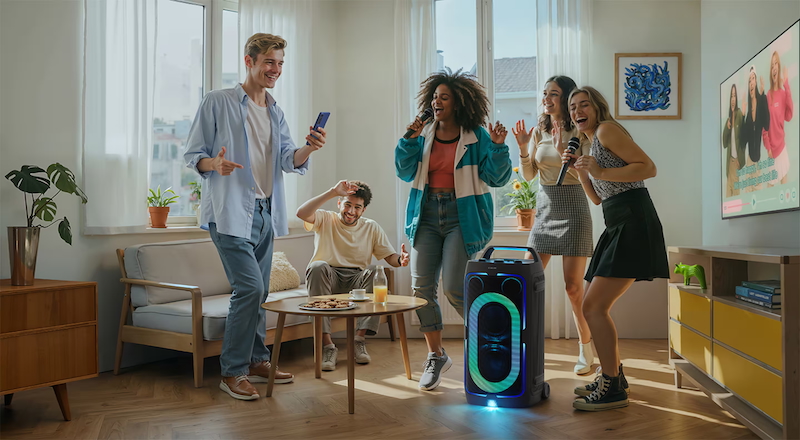
    The smaller ST40F, expected at $500, is built for patios and garden barbecues. It pushes 160 watts, carries dual 133mm woofers and 20mm tweeters, and offers up to 12 hours’ battery life. Both models have karaoke modes, guitar inputs, Bluetooth, USB and AUX ports, and replaceable batteries for those who fear the lights going out before the party does.

    With the S25 FE, Samsung is giving its smartphone base a cheaper AI-driven option. With the sound towers, it is giving them a reason never to sleep.

  • Samsung bets big on AI Home at IFA 2025

    Samsung bets big on AI Home at IFA 2025

    BERLIN: At Innovation For All (IFA) 2025, Samsung Electronics took centre stage with one message: artificial intelligence has moved out of the lab and into the living room. Under the banner “AI Home: Future Living, Now,” the South Korean conglomerate unveiled its vision of domestic life powered by adaptive technology — one that it claims is already attainable and accessible to millions.

    Executive vice president and head of digital appliances Cheolgi Kim framed the pitch as a shift in how technology should exist within human life. “At Samsung, we’re not just imagining the future of AI; we’re building it into everyday life,” he said. “This is the beginning of a new era — where technology supports your life in the background so that you can live it more fully.”

    The ambition is bold: move beyond the fragmented world of “smart” gadgets towards a seamless ecosystem that not only responds but anticipates. The stakes are equally high. With AI now the battleground for Big Tech and consumer electronics, Samsung is vying to prove that homes are where AI will have its most profound — and profitable — impact.

    Samsung’s SmartThings platform lies at the heart of this proposition. Once marketed as a connected-home app, it is now evolving into what the company describes as a “home operating system.” AI routines automate lighting, temperature and shading; blinds align with the weather forecast; heating systems learn daily habits; and appliances self-optimise without prompting.

    Consumer appetite, Samsung insists, is real. A global survey commissioned by the company shows two-thirds of respondents find the concept of an AI-enabled home appealing. Forty-four per cent cited streamlined chores, while 45 per cent liked the idea of controlling devices by phone or voice. More tellingly, 93 per cent described the home as a sanctuary, and 80 per cent saw it as a social hub — a place where technology should enhance human connection, not interfere with it.

    Samsung’s pitch, then, is about invisibility. The AI Home is not meant to dazzle with futuristic gimmicks but to fade into the background, adjusting conditions subtly to improve comfort and efficiency.

    The company knows that energy bills remain top of mind worldwide. According to its research, 66 per cent of consumers believe AI can help reduce costs. The SmartThings Energy service provides real-time monitoring, nudging households towards savings. Samsung claims it can cut washing-machine power use by up to 70 per cent — a figure it highlights repeatedly.

    AI SMART HOME BY Samsubng

    The emphasis on energy efficiency is strategic. Unlike voice assistants or robotic gadgets that risk being dismissed as novelties, tangible cost savings could be the lever that convinces consumers to invest in AI-enabled ecosystems. It also aligns with regulatory pressures in Europe, where energy performance standards are tightening.

    With smart homes comes a perennial concern: security. Four in ten consumers surveyed by Samsung expect AI to enhance home safety. The firm has responded with Knox Vault, a hardware-level data safeguard, and Knox Matrix, which provides cross-device protection across its ecosystem. The language here is deliberate: “vaults” and “matrices” are meant to signal seriousness, reassuring customers that AI will not become a Trojan horse for hackers.

    In a market where trust is fragile — particularly in Europe, where data privacy is heavily policed — Samsung’s ability to frame AI as safe as well as smart may determine adoption.

    Perhaps the most visible manifestation of Samsung’s AI strategy is its Bespoke AI appliance line. This year’s models showcase a shift from novelty to genuine utility:
    * Jet Bot Steam Ultra: now equipped with enhanced object recognition that can detect even transparent liquids — addressing one of the biggest challenges in robotic cleaning.
    * Bespoke AI Washer: featuring AI Wash+, it analyses fabric load and dirt levels to adjust cycles. It surpasses the threshold for Grade A energy efficiency by 65 per cent.
    * Bespoke AI Dishwasher: dynamically optimises cycles based on how dirty the dishes are, then pops its door open to accelerate drying.
    * Extractor Induction Hob: integrates the extractor into the hob itself, maximising kitchen space — a design nod to compact European apartments.

    These are not futuristic concept devices but commercial products. Samsung is betting that incremental intelligence built into everyday machines will persuade consumers to trade up.

    Samsung’s push is not confined to the kitchen or laundry. The company is embedding what it calls Vision AI Companion into larger displays, positioning it as a natural, almost human-like presence that can converse, guide and entertain. Unlike voice assistants locked into narrow commands, Vision AI is pitched as a trusted “companion” — a word chosen to evoke emotional connection.

    Hardware remains a showstopper. The 115-inch Micro RGB display delivers cinema-quality visuals with striking depth and vibrancy, while the Movingstyle TV, a portable touchscreen with a built-in battery, targets younger consumers with flexible living spaces. The Samsung Sound Tower, meanwhile, promises 18 hours of portable battery life, customisable lighting and app-controlled sound effects — signalling that AI is also about fun.

    Samsung’s AI story extends beyond the home and into its most recognisable product line: Galaxy smartphones. Having rolled out Galaxy AI to more than 200m devices in 2024, the firm now aims to double that reach, targeting 400m devices by end-2025.

    The company frames this as “democratising AI”. Features once reserved for flagships will trickle down to mid-range devices, creating a seamless experience across phones, tablets and wearables. With rivals from Apple to Huawei making similar plays, scale will be crucial.

    IFA, Europe’s premier consumer electronics show, is as much about theatre as technology. Samsung embraced the spectacle with a 50-metre-wide media art installation at Berlin’s CityCube entrance. Created with French digital artist Maotik, the piece visualises “wind” as flowing data waves — an abstract metaphor for AI’s invisible yet transformative role.

    The exhibition itself, running from 5–9 September, invites visitors to walk through fully staged AI Home environments. The message is clear: AI is not a far-off dream. It is a present-day reality to be touched, tested and bought.

    Why such a push now? First, competition. Apple, Amazon, and Chinese firms such as Xiaomi are all racing to dominate the home AI market. Google and Microsoft are extending their reach through partnerships and cloud AI services. For Samsung, whose strength lies in hardware, the opportunity is to integrate AI deeply into devices that already sit in millions of homes.

    Second, consumer economics. Global demand for white goods is relatively flat. By adding intelligence, Samsung hopes to revive upgrade cycles and command premium prices. Energy savings and convenience are framed as justifications for those higher upfront costs.

    Finally, brand positioning. By declaring that “AI is here”, Samsung differentiates itself from rivals still speaking of AI in aspirational terms. It wants to own the narrative that artificial intelligence is not just about chatbots or productivity tools, but about life’s most intimate space: the home.

    Samsung’s pitch is compelling but not without hurdles. Convincing sceptical consumers that AI is worth paying for will require more than glossy demos. Regulatory scrutiny around data will intensify. And rivals will not cede the living room easily.

    Yet if Samsung is right, the next frontier for AI is not in boardrooms or studios but kitchens and bedrooms. The company’s IFA showcase was a declaration of intent: to weave AI so seamlessly into daily life that, eventually, people may stop noticing it at all.

    For now, the AI Home is a vision Samsung insists you can live in today. The test will be whether the world believes it — and buys it.