Category: iWorld

  • NHK World TV live on Opera TV store app platform

    NHK World TV live on Opera TV store app platform

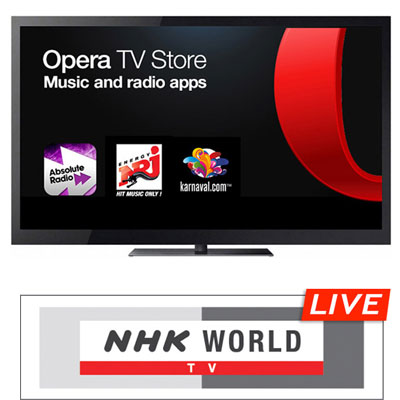
    NEW DELHI: NHK World TV, the 24/7 English-language channel for Japan’s largest broadcaster NHK, is now live on the Opera TV store app platform, enabling viewers to live-stream the station’s huge selection of entertainment content.

    From the free NHK World TV app on their connected TVs, audiences can reach news, documentaries, music, cooking programs, fashion trends, technology insights and much more from Japan, Asia and the rest of the globe.

    The Opera TV store, by Opera Software, brings viewers a rich variety of HTML5-based apps tailor-made for Smart TV. In addition to NHK World TV, the Opera TV store also offers apps for video, music, games, social media, news and utilities.

    “The world truly is flattening when premium regional broadcasters like NHK give viewers anywhere in the world more choice of exciting on-demand content,” said Opera Software TV & Devices senior vice-president Aneesh Rajaram. “NHK is extremely savvy with seeing the potential of early technology trends, and viewers will agree that its app adds even more engaging and entertaining content to the Opera TV Store.”

    The Opera TV Store is an HTML5-based app platform that gives users a rich selection of entertaining apps. It has already launched globally on Smart TVs and Blu-ray Disc players from Sony and TCL, and has also been selected by Humax, Hisense and MediaTek.

    The Opera ecosystem spans more than just the Opera TV Store, with the Opera browser and Opera Devices SDK powering the web experience on tens of millions of devices, including those made by Sony, Samsung, Philips, TCL, Sharp, Loewe, Boxee, Freesat+, Vestel and Altech.

  • Facebook prepares to insert video ads into users’ news feeds

    Facebook prepares to insert video ads into users’ news feeds

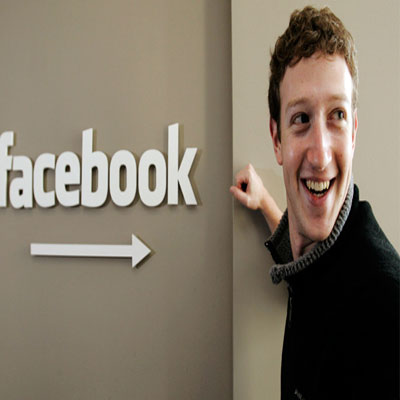
    MUMBAI: According to media reports the social network giant Facebook plans to let marketers insert 15-second video ads directly into people’s news feeds. This step needs to be taken with caution as it may not go down well with its users.

    Buyers could target the age and gender of the users who’d find the ads in their feeds reports claim citing “two people familiar with the matter.” Ads could sell for as much as $2.5 million a day depending on how many people watch them.

    Execs appear to appreciate the possibility of a backlash: CEO Mark Zuckerberg has delayed the plan “at least twice” as he considers ways to minimise user ire over the ads, for example by offering them in high-def and ensuring that people won’t see the same pitch more than three times a day. But the sales opportunity apparently is too lucrative to resist.

    Advertisers likely will spend nearly $64 billion in the US this year on TV ads vs $36 billion on the web. That’s why digital powers including Google, Yahoo, and AOL are gunning for TV advertising – including by staging their own NewFront sales pitches to ad buyers as they also gather for television networks’ upfront presentations.

    Last week Facebook COO Sheryl Sandberg told analysts that her company has “a massive and engaged audience around the world that brands can use to build awareness and drive sales. Every night 88 million to 100 million people are actively using Facebook during primetime TV hours in United States alone.” Nielsen has been working with Facebook to come up with ratings for online videos that would be similar to TV ratings.

  • Google plans device to bring Internet shows to your TV

    Google plans device to bring Internet shows to your TV

    MUMBAI: Making a new move into internet television, Google will start selling a $35 gadget that will plug into a high-definition TV and stream video from Netflix, YouTube and other sources.

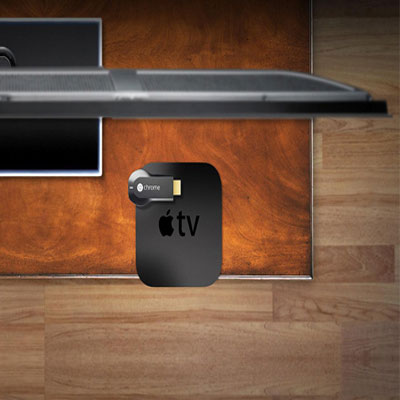
    The two-inch device, dubbed Chromecast, is aimed at replacing set-top boxes and can be controlled by both Android and Apple smartphones or computers. Google said it will also stream music or even show web pages from computers using the Google Chrome web browser.

    Analysts said the device could be a disruptive move by Google to compete with Apple and other tech companies that want to bring internet services to the television set. Forrester analyst Sarah Rotman Epps tweeted that it represents a “smaller, more elegant approach” compared with Google’s previously halting efforts at similar products.

    The new Chromecast gadget looks something like a USB memory stick but packs far more capabilities. When plugged into a TV set, Google said the gadget will connect both to a home wireless router and to other devices such as smartphones, tablets or laptop computers. Anyone in range can then use their smartphone or computer as the “remote control” – to select a video from YouTube or Netflix, for example.

    The Chromecast takes its cue from the selected device but then streams the video or other material directly from the internet, through the home router, so the smartphone’s battery doesn’t drain, Google representatives said.

  • Namo-the new android smartphone

    Namo-the new android smartphone

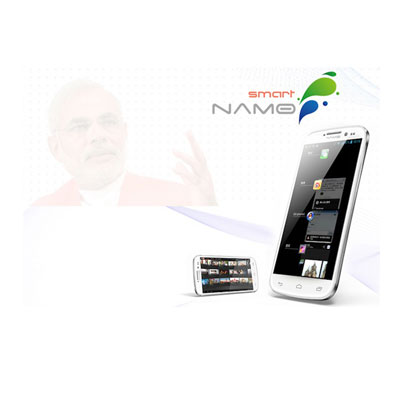
    MUMBAI: Naredra Modi fans seem to be going all the way to promote him on every platform as well as take advantage of his popularity. The latest is a smartphone called Namo android smartphone that has been created by a group of people who claim to be ‘independent body of fans of Narendra Modi’, the chief minister of Gujarat.

    Namo is the short form of the popular politician as well as an abbreviation of Next-generation Android Mobile Odyssey, the creator of this phone.

    The Facebook page for this already has over 3000 likes as well as coverage across many print and online spaces. The handset features are mentioned as follows on the website: 1 GB RAM + 16 GB ROM, 2 GB RAM + 16 GB ROM, 2 GB RAM + 32 GB ROM, 2 GB RAM + 64 GB ROM, 1.5 Ghz MT6589 Turbo Chipset, 13 MP Camera, Corning Glass 2, Screen 5 inches.

    The launch has already been carried out and the phone is expected to be released to the market soon. They are also looking at getting permission from Modi for using his signature for their ‘signature edition’ of the phones. The phones are said to be China made, which will be imported to India and branded with this name and then sold here at about Rs 15,000.

    The reliability of such phones will surely be under question. However, fans on their Facebook page seem to be keen to buy one. Preloaded videos and applications about the popular chief minister will also be available in the phones.

  • Vodafone India offers free Twitter access for three months

    Vodafone India offers free Twitter access for three months

    MUMBAI: Vodafone India is offering its prepaid and postpaid mobile subscribers free Twitter access for a period of three months starting today (29 July).

    Under the promotion, users will be able to access mobile.twitter.com or the Twitter Android app without incurring any data charges on the Vodafone network. The operator clarifies that access to mobile.twitter.com would be free only when the subscriber uses the native or default browser.

    It also adds that “the Eligible Subscriber would only be charged for connection setup, at 10p/10KB on 2G all circles except Uttar Pradesh (West), Madhya Pradesh and Karnataka and 2p/10KB on 3G and 2G in Uttar Pradesh (West), Madhya Pradesh and Karnataka in case he/she is subscribed to Pay As You Go Tariff at Prevailing Pack Tariff in case he/she has subscribed to any of the Vodafone India Mobile Internet Packs.”

    Free Twitter access is available only when the subscriber sets the APN to ‘www’ in the Internet data settings on the phone. The offer is not available to BlackBerry users.

    Vodafone is also running advertisement messages within the Android Twitter app showing promotional messages under individual tweets and pop-up messages when one tries to compose a tweet.

    It’s not the first time an Indian telecom operator has tied up with Twitter to offer free access. In April, Reliance Communications had also tied up with Twitter to offer a “Twitter Access” program for three months, wherein it offered its GSM subscribers access to Twitter’s mobile website and app without levying any extra data consumption charges.

  • DigiVive bags mobile streaming rights for Ind-Zim series

    DigiVive bags mobile streaming rights for Ind-Zim series

    NEW DELHI: DigiVive has bagged the mobile streaming rights for live and repeat ODI matches between India and Zimbabwe from Seven Sports.

    The master distributor of the India-Zimbabwe series is Taj sports. The five ODI match series scheduled to take place in Zimbabwe between 24 July and 3 August will be streamed on DigiVive’s mobile TV platform nexGTv. Over 14 million users of nexGTv and nexGTv HD will be able to enjoy the live matches right on their handsets.

    Also, users will be able to watch matches at their convenience by watching repeat matches under the Video-on-Demand section.

    DigiVive’s mobile TV service nexGTv is second only to YouTube in video streaming space on mobile experiencing over 30,000 downloads every day is what the mobile service claims. In the past also DigiVive had picked up rights to stream live events, especially cricket series like T20 World Cup, IPL 2013 and others, attracting huge audience on nexGTv.

    nexGTv’s continuous strive towards providing appropriate and desirable content like Indian cricket matches, live channels, short and full-length movies, premium content during festivals, etc. has made it the people’s choice for entertainment.

    nexGTv has maintained its top position on various online stores and on other app stores as it remains among top five apps in the entertainment category.

    DigiVive director G.D. Singh said, “Cricketing events on nexGTv help us to connect with masses at large because this is what they want to see and stay connected to.”

    “Cricket on mobile platform has become a popular phenomenon through nexGTv. Now people are not only watching live action on the move on nexGTv but it is becoming a second television at homes. We have been living to our commitment of offering all Indian cricket extravaganzas to our end users. This will enable them to watch entire five match series”, Singh added. 

  • Google’s North America web traffic bigger than FB, Netflix and Instagram combined

    Google’s North America web traffic bigger than FB, Netflix and Instagram combined

    MUMBAI: Search engine giant Google on an average day reportedly handles 25 per cent of web traffic running through North American internet service providers (ISPs) which makes it bigger than Facebook, Netflix and Instagram combined.

    Founder of Deepfield, the internet monitoring company, Craig Labovitz said that over the past year Google has become pervasive not just in Google data centers, but throughout the North American internet and 62 per cent of smartphones, tablets and other devices that tap into the internet from throughout North America connect to Google at least once a day. According to the report, Google’s lion share of the web traffic comes from YouTube and the growing traffic is the reason why Google is building data centers as fast as possible and has data centers on four continents.

    Google has added thousands of servers called Google Global Cache servers to ISPs around the world which store the most popular content from Google’s network and then serve it directly from the ISP’s data center, rather than streaming it all the way from Google’s data center.

    Labovitz said that Google and Netflix’s move into so many of the ISP network operation centers is likely to be followed by other internet giants like Apple and Facebook, the report added.

  • DTT households to double by 2018 according to Digital TV Research

    DTT households to double by 2018 according to Digital TV Research

    MUMBAI: The number of homes receiving DTT signals is forecast to more than double in the next five years, reaching 553 million, according to Digital TV Research.

    According to the Digital Terrestrial TV Forecasts report, the number of primary DTT homes – those not subscribing to cable, IPTV or satellite TV and using DTT on their main set – will also double between 2013 and 2018, reaching 280 million.

    This would mean that 173 million homes – which is 31 per cent of the DTT total – will only watch DTT signals on secondary sets by 2018. This is up from the 64 million at the end of 2012.

    By 2018, more than one-third of the world’s TV households will receive DTT signals; this figure was only 15 per cent at the end of 2012. Of this total, nearly one-quarter will be primary DTT homes by 2018, up from the one-tenth in 2012.

    Western Europe accounted for more than 40 per cent of the global total at the end of last year. The region, however, is poised to lose market share, contributing 19 per cent of the total by 2018. This is despite its total DTT household figure increasing by 20 per cent, to 105 million. Western Europe will be primarily losing its market share to the Asia Pacific, which is set to increase from 28 per cent of the global total in 2012 to 43 per cent by 2018.

    Even though the US has low DTT penetration, it still claimed the top spot in 2012 as the largest country by DTT households. These rankings are set to shift quite a bit over the next five years, though. China is expected to add 132 million DTT homes by 2018, becoming the largest DTT country by a wide margin. Brazil will add 30 million, taking second place, with number three Russia adding 19 million. India will have 15 million DTT homes by 2018, and it had none at end-2012.

  • Big Flix joins hand with Shemaroo Entertainment

    Big Flix joins hand with Shemaroo Entertainment

    MUMBAI: Reliance Entertainment Digital’s movie-on-demand service, Big Flix, has formed a licensing agreement with one of the leading content houses of the country – Shemaroo Entertainment. The alliance will allow users of Big Flix to stream a wide range of blockbusters movies by Shemaroo Entertainment – ranging from black and white films to some of the most recent releases.

    The catalogue offers an assortment of classics to latest hits with a blend of genres in multiple languages – Hindi, Marathi and Tamil. Few of the finest Hindi classics like the iconic film Mughal-E-Azam, Raj Kapoor’s Anari, Mithun’s Disco Dancer, Rajesh Khanna’s Roti to some of the contemporary films like Amitabh Bachchan’s Black, Aamir Khan’s Sarfarosh, Vidya Balan’s Ishqiya & The Dirty Picture and so on form the part of the list.

    The Marathi catalogue will feature key titles like Aaichcha Gondhal, Abhimanyu, Joshi ki Kamble and Juiley, while Tamil titles like Balam, Ivar, Mahesh Saranya Matrum Palar and Manja Velu will the add to the variety of the Shemaroo catalogue on Big Flix.

    Commenting on the association with Shemaroo Entertainment, Big Flix business head Shreyash Sigtia said, “There is a definite demand for classic films amongst movie enthusiasts and Shemaroo Entertainment is credited to have given Indian audiences some iconic and successful titles in Bollywood for decades now. We are delighted to partner with Shemaroo Entertainment to add an array of blockbusters from every decade to the existing catalogue on Big Flix. The multi-lingual catalogue will cater perfectly to the movie enthusiasts who desire an assortment of film entertainment anytime, anywhere. Also with this alliance, Big Flix continues to tie up with leading entertainment companies, thereby acquiring internet rights of some of the best titles of the industry.”

    Shemaroo Entertainment director Jai Maroo said, “We are glad to join hands with Big Flix as the association is in line with our strategy to be one of the major content providers across countries. Our vision is to be present on all devices, any time and on any connection. Big Flix being a prominent online platform in digital space will help us cater to wider range of audience across geographies. Shemaroo has turned into a one-stop-shop for many of the platforms where we not only provide the content but also manage it.”

  • Google joining other tech companies in race to launch pay television

    Google joining other tech companies in race to launch pay television

    NEW DELHI: Google is joining several other technology companies in the race to launch an online version of pay television and has recently approached media companies about licensing their content for an internet TV service that would stream traditional TV programming.

    A report in The Wall Street Journal quoted by CASBAA says if the Web giant goes ahead with the idea, it would join several other companies planning to offer services that deliver cable TV-style packages of channels over broadband connections.

    Intel Corp and Sony Corp are both working on similar offerings, while Apple has pitched various TV licensing ideas to media companies in the past couple of years.

    Google has made overtures to some programmers in recent months about the initiative, sources said.

    In at least one case, Google has provided a demonstration of the product, according to a person who saw the demonstration. Google did not immediately have a comment.

    If launched, the internet-TV services could have major implications for the traditional TV ecosystem, creating new competition for pay-TV operators that are already struggling to retain video subscribers.

    Existing online-video players like Netflix, Hulu and Amazon.com offer on-demand TV, but the latest efforts are aimed at offering conventional channels, allowing consumers to flip through channels just as they would on cable, as well as on-demand programming.

    There is no guarantee Google, or any of the technology companies, will be able to strike licensing deals.

    Media companies are nervous about undermining their lucrative arrangements with existing distributors by licensing to new online pay services.

    The media companies are more focused on expanding online and on-demand availability of their programming through current distributors, say media executives.

    While they are open to licensing their content, they generally give the best prices to the biggest distributors.

    To get decent rates for so-called over-the-top TV services, Google and other companies will almost certainly have to accept the standard programming bundles that cable and satellite operators pay for – packages that include highly popular and less popular channels.

    This is the second time Google has gone down this path. About two years ago Google had conversations with media companies about a similar service but the discussions did not get very far, it is learnt.

    Still, the environment has changed since then: not only are several other technology companies actively working on similar services but pay-TV providers are also asking entertainment companies for nation-wide streaming rights.

    While none of those other discussions has yet resulted in any new services that could soon change. Intel, which plans to launch its service by year-end, has had discussions with several media companies to acquire broadband-service rights for more than a year.

    It is unclear whether the company has yet struck any major programming deals. But it may at least have a name. Documents disclosed last week indicate that the company may call the service OnCue.

    The status of Sony’s plans is not clear either although one media executive said Sony could launch its service before Intel.

    As previously reported, Sony plans to beam its service over broadband connections to Sony-made devices, which include PlayStation gaming consoles, TV sets and Blu-ray players. A Sony spokesman declined to comment.

    Apple has met with resistance from media companies throughout negotiations to license content, said people familiar with the situation.

    All tech companies looking to launch a video service face a fundamental strategic challenge: If they can’t beat cable or satellite TV on pricing and offer the same lineup of channels, it is not clear why consumers would switch.

    One answer, backers say, is that the technology companies can develop far better interfaces to watch television than the clunky programming guides pay-TV operators offer now.
    Indeed, many media executives said they are impressed at the slickness of slick Intel’s set-top box and guide.

    Google has taken several other steps to expand in television and online video in recent years, including financing original programming for its online video site YouTube, launching regular cable service on its Google Fiber network in Kansas City, and developing a Google TV software to be installed on cable TV set-top boxes.