Category: iWorld

  • Disney and StarHub to launch mobile video streaming

    Disney and StarHub to launch mobile video streaming

    MUMBAI: Disney fans in Singapore can now watch all their favourite Disney programmes, including exclusive branded content, whenever and wherever they want.

     
    The Walt Disney Company Southeast Asia together with StarHub on 7 December will launch a new mobile video streaming service via a suite of three new innovative entertainment apps – WATCH Disney Channel, WATCH Disney XD, and WATCH Disney Junior.

    The WATCH Disney apps will provide authenticated StarHub TV customers with access to Disney’s existing live, television network streams, exclusive and first-hand content, as well as an extensive offering of premiere ‘on demand’ episodes.

    Disney fans can also view all popular television series such as Phineas and Ferb, Disney Junior’s Mickey Mouse Clubhouse and Disney XD’s Avengers Assemble on the go and will also be able to access new episodes of selected shows on the WATCH apps first before it launches on the TV channel.

    At the launch, the channel’s original animation Wander over Yonder, created by award-winning animator Craig McCracken, will be available first on the WATCH Disney Channel app before its television premiere. New live-action series Mighty Med, a Disney XD original series will be available exclusively on the WATCH Disney XD app from February 2014.

    The free WATCH Disney apps feature a fun and engaging online environment, designed around Disney characters and custom animation on a simple, child-friendly user interface. Apart from streaming of live TV channels and on-demand content, there’s also the episodes catch-up function. The app provides language options to the viewers.

    “We’re excited to offer Disney fans of all ages more opportunities to watch, interact, personalise and enjoy our Disney shows when and where they want it,” said TWDC SEA general manager, branded media content Natasha Malhotra in a release.

    “The WATCH Disney Channels apps are kid-friendly, easy to use and provide kids and families  access to the live streaming channels along with a robust selection of content ‘On Demand’  at home or ‘On-The-Go’ for authenticated StarHub subscribers,” she added.

    StarHub TV customers can stream the channel live on the multiscreen service ‘StarHub TV Anywhere’ which includes the WATCH Disney apps on iOS devices such as the iPhone, iPad and iPod Touch.

    “We are excited to be the only pay TV operator in Singapore to bring Disney’s signature content to viewers on multiple screens via the WATCH apps as part of our ‘StarHub TV Anywhere’ service offering. We are constantly working with brands such as Disney to find innovative ways to delight our customers and the WATCH apps exemplify our efforts to provide a ubiquitous viewing experience for them,” said StarHub head of home solutions Lin Shu Fen in the release.

  • Sony LIV releases app update for iOS7 compatibility

    Sony LIV releases app update for iOS7 compatibility

    NEW DELHI: Sony LIV, Multi Screen Media (MSM)’s video-on-demand service, has updated its application to be compatible with the recently launched iOS7. 

    On the all new iOS 7 platform, users can log in via Google + and can also share videos via WhatsApp. The innovative app experience matches the redesigned user interface and enhanced functionality of the new iOS mobile operating system.

    The Sony LIV app also recently featured as the best new application on the iPhone and iOS devices. 

    Sony Entertainment Network executive VP – new media, business development and digitalsyndication Nitesh Kripalani

    Speaking on the revamped version of the app and its success, Sony Entertainment Network executive VP – new media, business development and digital/syndication Nitesh Kripalani said, “This is indeed one more feather in the Sony LIV cap iPhone, undoubtedly is one of the most loved, sophisticated and successful mobile handsets today. The new iOS7 is visually as well as functionally very advanced and we have updated our app to match this high level of sophistication. We want to be available wherever our user is and being compatible with the iOS7 was a natural progression. To now also be featured as the best new application on iOS is undeniably a rewarding and very elating moment for us.”

    The Sony LIV application offers 18 years of rich and exclusive content from Sony Entertainment Television, covering genres including drama, comedy, thriller, reality shows and many more. It offers users their favourite current and archive shows from Sony, through a single log-in, seamless and engaging experience. The application also packs in features like multi-bitrate video streaming which provide users with better quality videos, based on their internet connection speed.

    Apart from being available on Apple iOS, this premier video-on-demand brand is available online, on Google Android, Java, Windows Phone 8, Windows 8 PCs and tablets. It offers an immersive user experience through various innovative features. Users can use the Mood Wheel on Sony LIV to watch their favourite video as per their mood/genre; they can create playlists of their choicest of shows through My Q and be rewarded as a LIV Guru, by consuming Sony LIV content.  In addition to original complete content, Sony LIV also offers short content formats like Catch-up episodes, Quickisodes and Short crunch episodes.

  • India fourth in phishing attacks

    India fourth in phishing attacks

    NEW DELHI: India has ranked fourth in phishing attacks in the third quarter of 2013, said RSA, a division of EMC.

    India received three per cent of the total attack volume, said  RSA  in a statement.
    Other countries targeted by phishing attacks were US (53 per cent), Germany (17 per cent), UK (eight per cent) and South Africa (three per cent). In top countries by attacked brands’ India ranked third with seven per cent of the total phishing volume worldwide. The US with 27 per cent and UK with 12 per cent topped the chart.

    RSA identified 46,119 phishing attacks in September globally with a rise in 36 per cent increase as compared to the month of August (33, 861). Phishing attacks in the month of September also mark the highest number of attacks in this quarter while July 2013 saw 45,232 numbers of attacks. Top countries to host these phishing attacks include US (42 per cent), Canada (nine per cent), Germany (five per cent) and UK (four per cent).

    The total amount of losses incurred in third Quarter of 2013 was $1.66 billion. 

    Brands in the US, UK, India, and Australia were targeted by almost 50 per cent of phishing attacks in Q3 2013.

    US remained the top country on the chart, targeted with 53 per cent of the total phishing volume in Q3 2013.

    US incurred a loss of over $882 million followed by Germany with $294 million and UK with $133 million.

    Meanwhile, cyber attack is likely to cost the average home user $418 in multimedia files, but a lot of this loss could be prevented if users purchase digital content after checking that the content is secure.

    Kaspersky Lab in a statement that users can lose files in a number of different ways: losing a device, having a device stolen, or falling victim to malicious users.

    According to the B2B International survey, 27 per cent of respondents encountered a cyber attack in the last one year. At the same time, over 60 per cent of users who were victims of malware that either damaged or destroyed data admitted that they had not been able to fully restore their files. During the same period, approximately 14 per cent of users dealt with the loss, theft or crash of their device.

    Respondents in the 16-24 age group would face an average loss of $670, while those in the 25-34 group would incur an average loss of $455; users aged 45 and older would lose an average of $227.

    Residents of China and Russia were likely to incur the highest average losses at $816 and $807 per user, respectively. This figure is considerably lower in Europe ($378) and North America ($342).

    In order to protect digital assets, users not only need to back up their data on a regular basis – they also need to secure their personal devices against malicious attacks designed to steal or extort data. Smartphones and tablets should also have additional tools to help locate a lost device or to mitigate the potential damages of device theft.

  • India fourth in phishing attacks

    India fourth in phishing attacks

    NEW DELHI: India has ranked fourth in phishing attacks in the third quarter of 2013, said RSA, a division of EMC.

    India received three per cent of the total attack volume, said  RSA  in a statement.

    Other countries targeted by phishing attacks were US (53 per cent), Germany (17 per cent), UK (eight per cent) and South Africa (three per cent). In top countries by attacked brands’ India ranked third with seven per cent of the total phishing volume worldwide. The US with 27 per cent and UK with 12 per cent topped the chart.

    RSA identified 46,119 phishing attacks in September globally with a rise in 36 per cent increase as compared to the month of August (33, 861). Phishing attacks in the month of September also mark the highest number of attacks in this quarter while July 2013 saw 45,232 numbers of attacks. Top countries to host these phishing attacks include US (42 per cent), Canada (nine per cent), Germany (five per cent) and UK (four per cent).

    The total amount of losses incurred in third Quarter of 2013 was $1.66 billion.
    Brands in the US, UK, India, and Australia were targeted by almost 50 per cent of phishing attacks in Q3 2013.

    US remained the top country on the chart, targeted with 53 per cent of the total phishing volume in Q3 2013.

    US incurred a loss of over $882 million followed by Germany with $294 million and UK with $133 million.

    Meanwhile, cyber attack is likely to cost the average home user $418 in multimedia files, but a lot of this loss could be prevented if users purchase digital content after checking that the content is secure.

    Kaspersky Lab in a statement that users can lose files in a number of different ways: losing a device, having a device stolen, or falling victim to malicious users.

    According to the B2B International survey, 27 per cent of respondents encountered a cyber attack in the last one year. At the same time, over 60 per cent of users who were victims of malware that either damaged or destroyed data admitted that they had not been able to fully restore their files. During the same period, approximately 14 per cent of users dealt with the loss, theft or crash of their device.

    Respondents in the 16-24 age group would face an average loss of $670, while those in the 25-34 group would incur an average loss of $455; users aged 45 and older would lose an average of $227.

    Residents of China and Russia were likely to incur the highest average losses at $816 and $807 per user, respectively. This figure is considerably lower in Europe ($378) and North America ($342).

    In order to protect digital assets, users not only need to back up their data on a regular basis – they also need to secure their personal devices against malicious attacks designed to steal or extort data. Smartphones and tablets should also have additional tools to help locate a lost device or to mitigate the potential damages of device theft.

  • Bing releases the top search trends of 2013

    Bing releases the top search trends of 2013

    MUMBAI: Women are on top, literally! The 2013 search trends released by Bing that includes search data from Australia, Brazil, Canada, China, France, Germany, India, Italy, Japan, Spain, the U.K. and the U.S, reveal that women ruled and were in the top searches. In eight of the 12 participating countries around the world, women were the most searched. Beyoncé reigned in the US, while Miley Cyrus’s highly publicised twerking made her the top-searched person in both Australia and Canada.

    Former flames Justin Bieber and Selena Gomez were the most-searched people in the U.K. and Germany, respectively. Actress and actors Bruna Marquezine, Wen Zhang and Salman Khan were the most-searched people in Brazil, China and India, while singers Rihanna and David Bisbal ranked at the top for France and Spain, and gorgeous TV personalities Danmitsu and Belen Rodriguez were favorites in Japan and Italy.

    It was also a year of American songs, superhero movies, Facebook love, high-end designer brands, controversial sports stars, European getaways and fierce women.

    Bing search trends, found at  www.BingTrends.com, indicate what has most captivated people around the world in 2013.

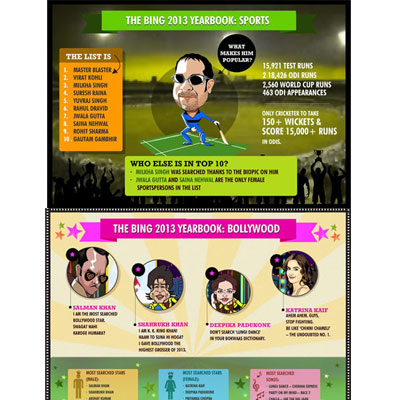
    However, when it came to the top searches in India, surprisingly, it was not the master blaster Sachin Tendulkar, who bid adieu to international cricket in 2013, who was searched the most. He was at number four, only after Salman Khan, Shah Rukh Khan and Katrina Kaif. 

    While he may have led the search among actors, Salman’s films did not feature in the top ten most searched films. The fast paced action flick Race 2 bagged top honours followed by Shahrukh starrer Chennai Express. And the surprise package among the top 10 Hindi movies was Nasha, starring Poonam Pandey. And Shah Rukh Khan may have missed top spot in the most searched actor and film, but his Lungi Dance from Chennai Express made it to the top of charts as the most searched song in India. This was followed by Party on My Mind from Race 2 and Challa from Jab Tak Hai Jaan.

    Sports stars too were popular. While Sachin Tendulkar was the most searched among sports stars, young and feisty Virat Kohli too made it to the top ten. However, the surprise entry was sprinter Milkha Singh, proving that the biopic on him did arouse curiosity about him in the country. Shuttlers Jwala Gutta and Saina Nehwal made sure that their sport was represented in the top ten dominated by cricketers.

  • Amazon brings instant video service to Japan

    Amazon brings instant video service to Japan

    MUMBAI: Amazon has started to offer its online video distribution service in Japan, allowing customers to purchase or rent films and TV shows from a selection of more than 26,000 titles.

    Shochiku and Toho as well as major broadcasters NHK, TBS and Fuji TV are among the content producers for Amazon Instant Video in Japan. The service offers video downloads for around 100 yen ($1) for rental and 1,000 yen ($10) for purchase.

    Hulu and Apple are both currently operating platforms in the region, adding to the competition that also includes local operators such as GyaO Corp, Tsutaya TV and NotTV. The Japanese cable network JCOM also offers a VOD service that allows for content to be downloaded on multiple devices. With Amazon Instant Video, titles can be streamed to two devices, but only downloaded to one. One of the devices linked with the service is Amazon’s own Kindle tablet.

  • Video on child prostitution goes viral

    Video on child prostitution goes viral

    MUMBAI: The truth, as they say, is stranger than fiction. So strange that often society chooses to look the other way despite knowing it.

    For instance, how many of us know that over 1.26 lakh cases of child trafficking were registered in India during 2011-12 or the fact that nearly forty girls under the age of fifteen are forced into prostitution every day in this country?

    And so we have a new video uploaded to YouTube by Delhi-based NGO, Bachpan Bachao Andolan (BBA), in collaboration with PaapiPet Pictures, which sends out a clear message to people, urging them not to ignore the inhuman things happening to innocent children around them.  
    Watch the video: #dontlookaway

    Aptly titled ‘Don’t look away’, the video, brings to the fore the grim reality of the flesh trade, and has gone viral, garnering a staggering 595,921 views within days of being uploaded.

    ‘Don’t look away’ rolls with a little girl, nicely dressed, standing by a busy road. The street is dark with just the traffic lights; evidently, it’s late in the evening. An old tailor eyes the girl from his shop across the street even as she fidgets, throwing nervous glances all around.

    While viewers are left guessing what next, she simply crosses the road and walks towards a car parked at the corner. She turns back to look at the old tailor and he just nods. The girl enters the car and the camera pans to the middle-aged man at the driving seat. An evil smile on his face, he tries to give her a chocolate which she isn’t too keen about receiving. The man then keeps the chocolate on her thighs… and his hands follow suit…

    BBA hopes that after watching this video, viewers won’t look away the next time they see something like this. According to Rajesh Sengar of BBA, the film is but a small effort to send across a message of righteousness. “One shouldn’t look away. In the last 33 years that we have been working for the cause, we have rescued 82,000 kids,” says he.

    The video is directed by Jaydeep Sarkar, who drew inspiration from two different personal experiences. The first instance, which he regrets he ignored which happened while he was stuck in a traffic jam at the Andheri highway. “I saw a little girl crossing the road, her eyes seeking help and still, I couldn’t do anything as I was stuck in traffic and helpless. Those eyes kept haunting me for days,” he recalls.

    The second incident – something a close relative experienced – which moved him deeply. “This couple had rescued a small girl in her early teenage years from the clutch of the sex business. They anticipated that something really wrong was cooking up in their neighbour’s house and when they dug deep, it was this horrific case that they discovered,” says Sarkar, who discovered while making the film that people don’t really want to be associated with such murky issues.

    Sarkar says they struggled even with finding a good song for the video as no music composer worth his melody wanted to be associated with a video on child-trafficking. “However, my producer Rheyan Johari made me listen to a song, These Streets by Scottish singer-songwriter Paolo Nutini, which not just touched my heart but also reflected the theme of the movie. We wrote to Warner Music, London that released the album and we soon got a go-ahead,” says Sarkar, concluding on the note the cause would find supporters not just in India but abroad as well.

  • McAfee says Indian tweens are potentially vulnerable to risky internet behaviour

    McAfee says Indian tweens are potentially vulnerable to risky internet behaviour

    MUMBAI: There is a growing trend of Indian tweens (kids between 8-12 years old) that are rapidly adopting internet through multiple devices and a variety of social networking platforms.

    McAfee unveiled its tweens and technology report 2013 which analyses the online behaviour of India’s next generation of digital natives.

    A few important highlights from the report are: On an average, Indian tweens are using between three and four devices that can be internet enabled, internet access is predominantly PC/laptop based (71 per cent and 76 per cent access the internet via these devices respectively), however 42 per cent access the internet via a mobile device.

    Almost half (45 per cent) of the online tweens access internet post 8:00 pm. They are regularly playing games (91 per cent) on tablet or chatting with friends on mobile (63 per cent). Tweens are widely using mobile/smartphones to access internet (68 per cent use mobile to access the internet). Despite the age eligibility for Facebook being 13 years, three in four (70 per cent) tweens admit to currently using Facebook.

    Online tweens are potentially vulnerable to risky behaviour on the internet as 36 per cent of online tweens have chatted to someone online that they didn’t know previously.

    The findings of McAfee’s Tweens & Technology Report 2013 were released at a panel discussion with McAfee consumer marketing director (APAC) Melanie Duca, McAfee India VP of engineering – consumer and mobile Venkat Krishnapur, McAfee Cybermum India Anindita Mishra, Dr. V. Jayanthini, M.D, D.P.M, leading psychiatrist and Meeta Sengupta, a veteran educationist and advisor to schools.  

    Speaking about the relevance of these new-age parenting challenges, McAfee Cybermum India Anindita Mishra said, “There is an increasing influence of the online world on children’s persona that cannot be undermined because of the emotional and developmental impact it has. The role of parents in delivering safe and positive cyber experience to their kids is significant than ever before. Having a genuine and transparent two-way communication with children is absolutely fundamental to establishing a safe and positive cyber experience.”

    “With malware writers mastering their craft, they continue to transfer their skills to new and popular mobile platforms in addition to PCs and laptops. The proliferation of multiple mobile device usage and this staggering increase in new malware will require Indian parents to recalibrate on how to arm their children with best online practices ensuring safe online experiences for them.” said McAfee India VP of engineering – consumer and mobile Venkat Krishnapur.

    McAfee consumer marketing director (APAC) Melanie Duca said, “As a company, McAfee is dedicated to making the internet safe by providing resources to help educate and protect families. Our Cybermum initiative and cyber education program in Indian schools reinforce commitment towards this cause.”

    Across APAC, McAfee has developed a cyber education program, which is delivered to school-aged children by McAfee employee volunteers. The initiative has now been rolled out in India whereby McAfee is reaching out to Indian schools and will scale up the program over the next one year.  

    McAfee’s tweens & technology report 2013 was conducted through a survey administered across Indian online tweens aged 8-12 years old comprising 572 male and 428 female respondents from Mumbai, Kolkata, Chennai, Bangalore, Hyderabad, Ahmedabad and Delhi.

  • Spotify valued at $4 billion

    Spotify valued at $4 billion

    MUMBAI: Spotify, the music streaming giant, could well be the latest startup to join the $4 billion valuation club.

    The company has reportedly secured $250 million in new financing, valuing it at more than $4 billion, according to The Wall Street Journal. Spotify previously raised $100 million almost exactly a year ago at a $3 billion valuation.

    An earlier report had suggested that Spotify was looking to raise a new round of funding at a more than $5 billion valuation, but clearly that was too bullish.

    While Spotify’s popularity and revenue has grown in recent years, it continues to lose money. Spotify reportedly doubled its revenues year-over-year in 2012 to nearly $600 million, but its net loss increased to $77 million. The extra funds may provide Spotify with more space to continue its rapid expansion even as it continues to bleed money.

    The $4 billion valuation mark seems to be the benchmark for tech startups right now. Pinterest was recently valued at just shy of $4 billion, Snapchat has reportedly turned down acquisition offers of up to $4 billion and Uber is closing in on that milestone as well.

  • Docomo to launch one-day international data service

    Docomo to launch one-day international data service

    MUMBAI: Docomo has announced that it will offer a one-day (24-hour) flat-rate data communications billing plan for customers traveling overseas beginning 2 December.
    The service, called “Global 1 day Pake,” will vary in cost (980 yen, 1,280 yen or 1,580 yen) depending on the country or region of use. For example, the cost will be 980 yen for South Korea, 1,280 yen for UK and 1,580 yen for the US mainland and Hawaii.


    The flat rate will apply to the 24-hour period that begins once the customer activates the service. Activation simply requires tapping a button on a dedicated app, or dialing a dedicated number. At the end of the 24-hour period, the packet communication feature in the user’s mobile device will automatically turn off to avoid unintended data usage, providing peace of mind to users concerned about using roaming services overseas.


    Customers can apply for the service at Docomo’s sales channels, including Docomo shops and Docomo information centers.


    Customers of Docomo’s existing international flat-rate data service, Global Pake-hodai, can flexibly use this service or the new service depending on their handset or other conditions.


    Docomo also plans to introduce a roaming service for LTE-based packet communication services outside of Japan by the end of March 2014.