Category: Over The Top Services

  • Netflix CFO David Wells to quit

    Netflix CFO David Wells to quit

    MUMBAI: After a 14-year stint in the company, Netflix chief financial officer David Wells plans to step down. Since 2010 Wells served as the CFO, at a time when Netflix started to see its growth. However, he will leave after helping the company choose his successor.

    The search for new CFO will include both internal and external candidates. In post-Netflix life, Wells intends to focus more on philanthropy.

    “After discussing my desire to make a change with Reed [Hastings, Netflix’s chairman and CEO], we agreed that with Netflix’s strong financial position and exciting growth plans, this is the right time for us to help identify the next financial leader for the company,” Wells said.

    He was one of the key members who helped Netflix during its aggressive international expansion as well as to up its $8billion content spend through a debt-fuelled fund. During his tenure Netflix’s subscriber numbers went up from 23.6 million during the first quarter of 2011 to more than 124 million as of the second quarter of 2018.

    “David has been a valuable partner to Netflix and to me. He skillfully managed our finances during a phase of dramatic growth that has allowed us to create and bring amazing entertainment to our members all over the world while also delivering outstanding returns to our investors,” Netflix CEO Reed Hastings said.

  • Higher production values of OTT content won’t put pressure on TV biz: Punit Goenka

    Higher production values of OTT content won’t put pressure on TV biz: Punit Goenka

    MUMBAI:  With the growth of OTT market, all the big four broadcasters in India have ramped up their investment in digital ventures. To woo the online viewers, OTT platforms are producing high cost shows especially when it comes to originals. While there have been concerns that higher production values of OTT content might affect the content cost of TV business, Zee Entertainment MD and CEO Punit Goenka does not foresee such a scenario in his case.

    Starting from Amazon Prime’s Inside Edge to Netflix’s Sacred Games, ZEEL’s digital venture ZEE5’s Karenjit Kaur, the star cast, and content quality clearly indicates the high budget of the shows, though the exact numbers have never been revealed.

    Speaking in an earnings call, Punit Goenka said,“In terms of quality, I think it’s comparable to what television quality is because we use the same equipment. It will not put pressure on the television part because the sheer volume of television content that is being produced and the economies of scale that is being achieved there versus what we are producing for digital, the delta is far apart.” But he agreed that the content being made for digital platforms is of higher production value because of outdoor shoots and bigger stars.

    Zee crates 500 hours of original content every week for broadcast while that is a mere 800 hours for the whole year on digital. “There is no per hour concept there, it is all story and concept-based content cost,” he added.

    After creating a buzz in the Indian market thanks to its regional content, ZEE5 is expected to be launched globally soon. Commenting on that, Goenka said the global rollout will be completed in a phased manner. By the end of this fiscal year (FY 19), it will be available globally.

    Goenka is very hopeful of Zee5’s international success.”If ZEE5 does cannibalise our existing subscription revenue in international markets I will be very happy with that because that’s a direct ownership of the customer that the company gets rather having it through a distributor. So that’s a good problem if it happens that way and that is one of the parts of our strategy of going global with ZEE5,” he said.

    With the technological disruptors, the entertainment industry is always in a flux. 10 years ago, the entry of DTH players changed the industry. Then the increasing internet consumption with the entry of Jio bought another disruption. Now, as Jio with its FTHH connection eyes at  50 to 100 million households, there could be some structural changes especially affecting the broadcasters. However, that possibility does not concern Goenka.

    “My view has always been, even when DTH came 10-11 years ago, that all technologies will coexist in a country of our size. So, cable will also coexist, DTH will coexist and even ZEE5 will work. So, it’s all going to be different services at different price points. For a content company like us, it doesn’t really matter because at the end all three are pipes. So, as long as my content is relevant, I will still get my value from consumer payout,” he said confidently.

    However, with a realistic view, he expects ZEE5 to break even in next five years in stark contrast to several players who expect to break even within two-three years. According to him not only ZEE5 but the industry is still now in investment mode and there isn’t a chance to breakeven in the first three years.

    Almost every OTT player has already struck deals with telecom players, but ZEE5 has not yet signed any telecom deal in India or overseas. Till the time it isn’t getting the right value of its content, there won’t be any such negotiation.

  • MX Player appoints Viraj Jit Singh as Revenue Head

    MX Player appoints Viraj Jit Singh as Revenue Head

    MUMBAI: MX Player, the world’s largest local video platform, today announced the appointment of Viraj Jit Singh as its SVP & Head – Revenue .Viraj brings with himself over 19 years of experience in sectors like broadcasting, entertainment and amusement parks.

    Prior to joining MX Player, Viraj was responsible for revenue generation, communication and marketing strategy for top brands like Viacom18 Media Pvt. Ltd., KidZania India, ESPN Star Sports and Reliance Broadcast Network.

    On his move to MX Player, Viraj Jit Singh said, “I am excited and looking forward to my new role in the MX Player family. The OTT space has witnessed tremendous growth in the past few years and I look forward to applying my diverse skill-set to strengthen MX Player’s position in the market.”

    Viraj further added, “The company has aggressive and exciting plans to reach out to a large consumer base and I am eager to working with the dynamic team and contribute to its rapid growth.”

    Commenting on Viraj’s appointment, Karan Bedi, CEO, MX Player said, “I am delighted to welcome Viraj to MX Player. He brings with him a rich tapestry of experience that will be a great asset for our venture. Viraj’s extensive leadership and expertise across markets make him a terrific addition to the growth and strategy of MX Player.”

    In India, over 350 million consumers have MX Player installed, and over 175 million consumers use it every month to watch video, a reach comparable to leading TV channels, and exceeding all other OTT platforms in India.

  • Matched! The first digital short film collaboration between India and Pakistan, presented by Arré and Teeli, on the occasion of Independence Day

    Matched! The first digital short film collaboration between India and Pakistan, presented by Arré and Teeli, on the occasion of Independence Day

    MUMBAI: India’s leading digital platform Arré has collaborated with Pakistan’s premier digital entertainment brand Teeli to co-produce, co-write, and co-create the first digital short filmed across Delhi and Karachi, to celebrate Independence Day for India on the 15thof August and for Pakistan, on the 14th of August. 

    The collaboration is an attempt at opening up dialogue in a purely creative field, far removed from political and diplomatic relations between the two countries. The idea is an experiment to engage with shared cultural values like food, language, and social relationships, rather than the politics that has shaped the current narrative. 

    The short film explores the possibility of a personal relationship between young peoplein these two countries and tries to ask the question: What would happen if one of us got a chance to befriend someone across the border? Would the countries’ political and social history come in the way? Is the sarhad more than just a geographicalconstruct demarcating territory? 

    Matched! captures the unlikely friendship between an Indian girl from Amritsar and a Pakistani boy from Lahore, made possible through a dating app. Lahore and Amritsar are only 50 kilometres apart – and yet, are separated by more than just geography. So what happens when two people who only associate India with Bollywood and Pakistan with Coke Studio, strike a conversation? A friendship evolves, similarities are discovered, differences are cast aside, and by the end of it, you’re left wondering what makes them so different from us.

    The video will be out on the Arré and Teeli platforms simultaneously on the 13th of August. Catch the teaser here https://youtu.be/-0Ga51UUVgI

    The film was a collaboration between Arré and Teeli in every sense of the word. From script, production, and post-production, teams on either side worked on Skype over a period of two months, with the sole purpose of exploring how we can overcome barriers with digital content. The film was simultaneously shot in in Karachi and New Delhi by members of the two teams and every attempt was made to deliver a film that is not one country’s version of the other, but a joint expression of two neighbours. Even though the crew and actors on both sides never met each other, the working relationship evolved smoothly over two months for a seamless film that does not feel divided in any way. 

    Sharan Saikumar, Creative Director Arré,said “Matched! is a product of the digital age. It suggests that even though our countries and politics may falter, as people we can always be true.”  

    Gul Zaib Shakeel, Head Writer, Teeli, said “Digital content has made borders irrelevant. It’s shown and shared the thrilling, mundane and honest things that our regular lives are all about. The fact that content from either side of the border resonates with the other is testament to how truly similar we are at the core. This is what the video is about. Teeli hasn’t worked on a collaboration of this nature before. Once the introductory phone calls with Arré were done, you’re essentially working as one unit… with a lot of distance between each other. From video calls that stretched for hours to last-minute phone calls from the set to confirm minute details, the journey from scripting to production to post has been an absolute delight.”

  • Hoichoi to bestow Haami  with World Digital Premiere!

    Hoichoi to bestow Haami with World Digital Premiere!

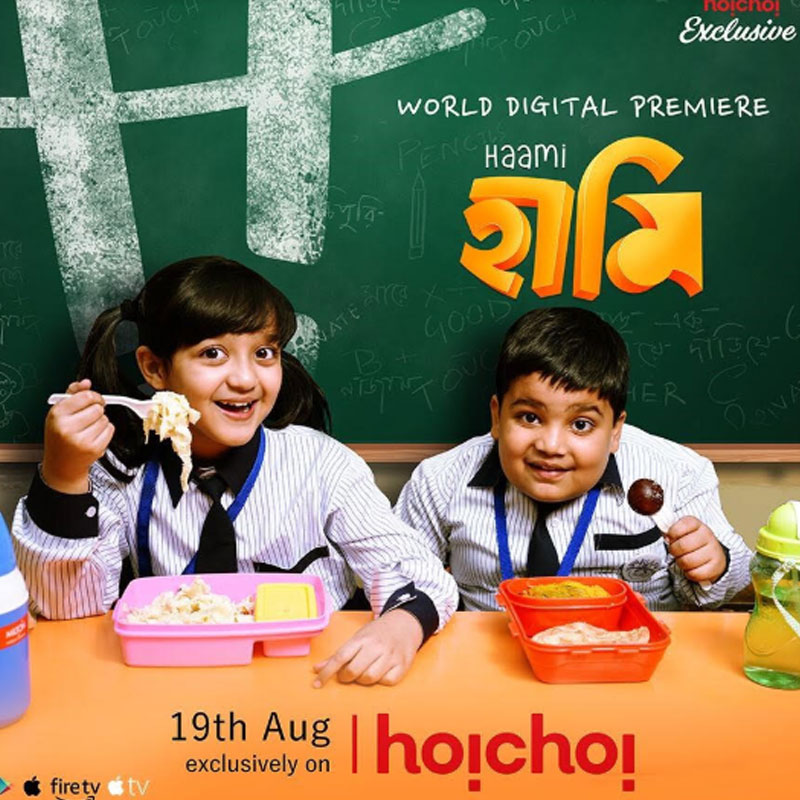
    MUMBAI: Hoichoi, the world’s largest digital Bengali entertainment content platform, has acquired the rights to present the World Digital Premiere of Haami, 2018’s most successful film at the box office. The film will be completing its 100 days run at the theatres on 18th August and 19th August it premieres on Hoichoi. This film, adds to Hoichoi’s impressive content tray of Hoichoi Exclusive movies – previously, Khoj, Paanch Adhyay, Room No 103, Ek Nadir Golpo, Bye Bye Bangkok, Accident, Posto, Prakton and Projapoti Biskut. 

    Hoichoi is adding two to three Original content for their viewers every month in the form of a web series, film or short. This acquisition will raise the commitment to their audience to be the top OTT platform for the Bengali diaspora. 

    Directed by popular director-duo Shiboprosad Mukherjee and Nandita Roy, Haami released on 11th May 2018 and has been critically acclaimed and also, commercially successful with raving reviews.  

    Haami is a story of two friends, Bhutu and Chini, who come from completely different background. Bhutu’s parents, Laltu and Mitali are rich furniture-shop owners who are more into popular culture and Chini’s parents, Srinjoy and Rina are academicians – elite and sophisticated. Inspite these differences Bhutu and Chini are best friends. As luck would have it, a situation occurs, where the parents of these two children separate them and put an end to their friendship. 

    However, the young vice-principal cum student counselor of their school, Arundhati tries to make them see reason. Starring Churni Ganguly, Gargi Roy Chowdhury, Shiboprasad, Aparajita Auddy, Kharaj Mukherjee, Koneenica Banerjee & others, Haami is a story that will take you down the memory lane of your childhood days of fun and friendship. 

    Shiboprosad Mukherjee, director of Haami said, “Hoichoi has previously given 3 of my films (2 directed by me and 1 under my production house) the World Digital Premieres and they have received massive response by the audience who watch content on the platform. I am hoping Haami will also do justice, especially to those who live outside Kolkata or India so they can watch Bengali films, anytime, anywhere.” 

  • WHAT IS A GHOUL

    WHAT IS A GHOUL

    MUMBAI: What is this mysterious creature? Is it a Ghost, a Werewolf, Vampire, Wizard or a Witch, none of the above? According to Arabic folklore, a Ghoul is a demonic phantom or an evil spirit that blends in right with humans. The Ghoul is flaccid and can take the shape of any human. A human can trade his/her soul to call upon the Ghoul! It is also considered a fiendish Jinn who dwells in your past guilt, feeds on it and makes you feel remorseful. The Ghoul thrives on finishing the task, finding the guilt and eating the flesh! Talk about psychological thriller meets horror meets the devil within!

    Taking this mythology and fables into a contemporary and modern-day setting, Ghoul is set in a covert detention center at which military officials question and often torture suspected terrorists. The series revolves around Nida, a newly-minted interrogator who turned in her own father as an anti-government activist. She arrives at the center to discover that some of these terrorists are not from this world, and she must fight for not just the truth, but for her survival as well. In her quest of finding the truth, she unmasks the demons within these corrupt officers at the military camp! Because, as they say, the demon is amongst us and within us. 

    Netflix is all set to send chills down your spine with the release of ‘Ghoul’ and venture into the Indian horror/thriller genre. The suspenseful and thrilling trailer of the series has managed to garner a lot of attention and has piqued the curiosity of audiences prior to its release. 

    While you wait  for Ghoul to release on Netflix on August 24, here’s a little sneak peek into a video from the series for you to know ‘What is a GHOUL?’  

  • Netflix, Amazon woo Indians with different business models

    Netflix, Amazon woo Indians with different business models

    MUMBAI: The vast scope of Indian OTT market is undeniable. Two global streaming giants Netflix and Amazon started their endeavour in India around the same time but the latter stands at a better position. Netflix is enriching its local content library in a great momentum hooking top faces from Bollywood. While the big bosses, Jeff Bezos and Reed Hastings, both have mentioned the Indian market as an important part of their long term strategy, they are approaching the market with entirely different business models.

    From the beginning Amazon Prime Video has caught the pulse of the market that being locally relevant is the necessity. Within one year of its rollout in India, it premiered its first Indian original series Inside Edge starring Richa Chada, Tanuj Virwani, Vivek Oberoi and Angad Bedi. The story revolves around a fictional T20 cricket team, Mumbai Mavericks. It continued its march in the local library with Breathe starring R Madhavan which was even dubbed in two local languages Tamil and Telugu.

    Despite starting with fiction it has not limited its variety. From music reality show to standup comedy, it has touched various genres which appeal to Indian audiences easily. While in The Remix celebrity judges Sunidhi Chauhan and Amit Trivedi were big bets to woo audiences, for Comicstaan it could gather India’s rising stars of the comedy scene – Tanmay Bhat, Biswa Kalyan Rath, Kanan Gill, Kenny Sebastian, Kaneez Surka, Naveen Richard and Sapan Verma as judges.

    On the other hand, while Netflix is a late entrant to the Indian original content segment, it is launching and announcing back to back originals in a short span as it did in the global market too. Starting from a romantic comedy like Love Per Square Foot to Lust Stories to its critically acclaimed first Indian original web series Sacred Games it has started offering Indian audiences high quality productions in good quantity. Netflix is also trying to tap mass audience genres including horror in Ghoul and cricket and corruption in Selection Day. “With the triplet of Raw Stories, Sacred Games, and Ghoul, we are really getting some nice momentum in our India growth,” Netflix CEO Reed Hastings said. Moreover, other than India, Sacred Games has been critically acclaimed outside the country also.

    “Netflix has started taking “made in India” content to a global audience, which is a good thing to happen for India. It is time India exported its fabulous storytelling abilities, and what better platforms than these?” media and entertainment advisory services partner at Ernst & Young Ashish Pherwani said.

    India, holding a vast cultural difference, makes the play tougher for international players. Only Hindi content will not be enough for the platforms to win over the streamers across the country. From this aspect, Amazon is ahead in the race not only did because of the launch of its first Amazon Exclusive in Telugu, Gang Star this June but also the library of regional movies. Even in terms of overall library of Indian movies Amazon’s streaming service is way better than Netflix. After its Q2 result, Netflix executives themselves admitted the need to scale up its regional content. “We’ve got a long way to go to expand languages and many other aspects to be able to cover the Indian market, to be a broad Indian product,” Netflix CEO commented. Especially at this moment while the next wave of OTT content consumption growth is coming from Tier II, Tier III cities, both the platforms highly needs to focus on regional content.

    The basic difference lies between the business models of these two honchos. Netflix is targeting the affluent households as well as the audience that adores quality content and is ready to pay for its high pricing model. While still now Netflix is running with a niche approach, Amazon has a larger play in the country with its e-commerce business. Amazon lures streamers with its Amazon Prime services. Netflix is still experimenting with its pricing models in the country while Amazon has introduced a new monthly subscription at Rs 129 other than its yearly model.

    “Both of them are trying to invest a lot in Indian market by doing two things one is obviously creating original Indian content but also getting content from overseas into India. From that perspective, as both of them are doing it from a different price point, you can never tell that one is way ahead of the other,” PricewaterhouseCoopers (PwC) partner and leader, media and entertainment Frank D’Souza said.

    “Amazon has the advantage because it is offering music, prime services, the whole game. For Amazon, it is about how to keep the customer on its platform as long as possible. Whether that helps in sales of products, video consumption, audio consumption their strategy is different. Netflix is a pure video play. Hence for Netflix, the question is that is original content enough to attract customers? The answer could be yes because the economies are different,” he added.

    Even so, their pricing is higher as compared to the rates offered by local DTH and cable operators who offer a huge array of channels at a low cost. For SVOD OTT platforms, a consumer has to pay for subscription on top of data prices.

    However, as data prices are reducing, the launch of FTTH service by Jio creates more opportunities for entire OTT market in India. “Indian OTT subscriber base is growing on the back of some of the lowest data charges in the world. In addition, the launch of Jio Fiber will enable consumption of digital content on the larger screens. This will bode well for subscribers of Netflix and Amazon Prime, and help them meet their growth targets. We estimate a 6x growth in regular OTT paid subscribers by 2020,” Pherwani commented.

    While ultimately content will be the king for both Netflix and Amazon, especially in a market where local players like Hotstar, ALTBalaji, Eros Now, ZEE5 are betting big with differentiated content including sports, regional and Bollywood movies, regional originals, partnerships like Amazon-Airtel, Netflix-Tata Sky will also help both the platforms for winning more market share in the country. However, along with the localised content, the charm of The Crown, House of Cards, Goliath never fades away!


  • Miss Malini Entertainment’s digital play with first long form video content

    Miss Malini Entertainment’s digital play with first long form video content

    MUMBAI: With data becoming cheaper and more affordable, Indian market saw a high jump in online video consumption. Millennial audience is especially craving for more digital video despite the emergence of several OTT players.

    MissMalini.com which started as a hobby blog by Malini Agarwal is currently a go-to-digital destination for Bollywood, fashion and lifestyle. It has now started a new innings in the digital video space. The in-house production The Girl Tribe is the first long-form show under new “MMTV” (MissMalini TV) banner. The 12-episode series is an extension of “Malini’s Girl Tribe”, a Facebook community where women of all ages participate in meaningful interactions.  Starting the journey with The Girl Tribe Miss Malini Entertainment is developing several new MMTV properties which will range in length anywhere from 5-20 minutes.

    In an interaction with Indiantelevision.com, Miss Malini Entertainment CEO Nowshad Rizwanullah spoke about their first venture, how they are marketing the show and future plans for long-form content production plan.

    While almost all of the digital platforms collaborate with brands for video content, you have produced The Girl Tribe independent of marketers. What’s the reason behind that?

    We love working with brands and regularly create content in collaboration with some great advertising partners. Sponsors not only generate revenue, but the funding they provide also allows producers like us to invest more into the show to make it bigger and better for our viewers. However, when a brand partner is involved, it can also impact messaging and creative control. The Girl Tribe is a deeply personal show for us, and one that comes from our convictions as a team and our values as a company that women in India need a safe space and platform to speak their truths. Given the timely nature of the show, we did receive significant advertiser interest but we took an early call to make our first season an independent production. This has allowed us to create the show entirely per our vision, without compromise on the message, which for us is our most important priority. It also helps us experiment more freely to try and determine how we can most effectively get the message out, and as you can see from this current season our episodes have been getting stronger and stronger over time. That said, there are many socially conscious brands in the market today and provided there is authentic alignment with our goals for this show, we are open to adding brand partners for future seasons to allow us to invest more in the show and take its message to wider audiences.

    What has been the initial response to the show? Can you tell us the viewership pattern from your own data measurement?

    We’ve been very happy with the show’s response till date. While we viewed season one as just the first step in a larger, long term movement, the response from our audience, guests, fans and the industry at large has been so positive that we have accelerated our plans for the property. To give you a sense of numbers, the first five episodes have already reached over 10 million people, generating more than 2.5 million views and half a million engagements. The comments and discussions on the episodes, in particular, are especially heartening, as we are seeing people sharing very thoughtful and detailed opinions indicating the show is really striking a chord. What is also very interesting is that the show is reaching a wide audience. While the largest consumption is from women 25-34 (~45 per cent), the 35-44 age group is sizeable as well (25 per cent). And about 15 per cent of our viewership is 45-65+. This kind of diversity is quite rare in today’s digital video space.

    Was it your in-house production? How big was the production team? How much have you invested in this project?

    Yes, this show was completely conceived and executed in-house. Even the set is based in our own brand new in-house studio. The complete production team including creative and production, numbers between 15-20 people including temporary resources. We don’t disclose production costs but suffice it to say we are producing this first season very cost effectively which leaves a lot of scope for expansion now that we have a successful proof of concept.

    Going forward, do you have any plan for other long-form content production this year?

    Yes! The Girl Tribe is the first long-form show we have created under our new “MMTV” (MissMalini TV) banner. We have several new MMTV properties under development and we will be filling out the library on a regular schedule. These will range in length anywhere from 5-20 minutes, both fiction and non-fiction, and will bring life to the themes and topics our audiences already love from our other formats. Outside MMTV, we have already produced five different seasons of terrestrial television content over the last several years, and have ongoing discussions for new upcoming shows.

    Has this series increased the number of viewers on your site?

    The Girl Tribe is a Facebook and YouTube property, and if you watch the show you will see that we have specifically stayed away from plugging our other content or assets there. This comes back to the reason we have not taken on any brand sponsors this season – because the message comes first. That said, we have seen a nice increase in our video viewership and subscriber metrics, and we ran a related campaign called #ItEndWithMe on our website on 18 July that tied together our various activities in support for the themes of the show which also received strong participation and attention.

    What’s your marketing strategy? How do you plan to promote the show?

    Once again, you have to be careful about how you market a show like this. We were very clear that our first priority was to create meaningful conversation and engagement around topics that are severely underrepresented and go unacknowledged. We didn’t want to cheapen or dilute that message by embarking on an overly aggrandised marketing push that would overshadow the show itself. Perception-wise there’s a fine line between promoting important issues versus promoting yourself and we didn’t want there to be any confusion on this, even though we obviously have the marketing machinery behind us to go very wide. Therefore we have mostly prioritised word-of-mouth marketing and have let our actions and intentions speak for themselves. We are doing some light PR around the show, and of course, we will not turn down any outside interest to learn more and spread the word. Future seasons will get a larger push now that we have established the show’s credibility. But for this season we wanted the show to be powered by the voices of those who felt a connection to the show’s mission, wanted to be a part of its success or were just moved enough to share and engage as a vote of confidence.

  • Spuul’s Bhojpuri bet for growth

    Spuul’s Bhojpuri bet for growth

    MUMBAI: Every over the top (OTT) platform is raging about India’s diverse market and untapped opportunity. While others are testing the water with Tamil, Telugu, Bengali and Marathi apart from the regular fanfare of English and Hind shows, Singapore based Spuul is going the Bhojpuri way as well.

    The platform already had some Bhojpuri content but about six to seven months ago, it felt the need to renew its attention towards this deprived market since rural audiences are warming up to video content now.

    Spuul content head Girish Dwibhashyam also thinks that as a high number of people from Bihar migrate to other parts of the country, Bhojpuri content has a market across the country as well as within the state. Cheaper data, affordable handsets have made the digital video space class agnostic. “Consumption from the hinterland has multiplied in the last one and half years. Bhojpuri has assured viewership not only in Bihar but also across India,” he says.

    Currently, the platform is only focusing on Bhojpuri movies starring popular actors like Dinesh Lal Yadav. Dwibhashyam claims that the movies they have are the most popular ones of recent past produced by renowned production houses. Aashik Aawara, Nirahua Chalal Sasural 2, Sangram, Rakhtbhoomi, Action Raaja, Nehle Pe Dehla, Muqabala, Jaanam are some of the most popular Bhojpuri movies streaming on Spuul. As the platform has a huge diaspora audience too, it might add catch-up content in certain markets. Initially, the platform has seen a lot of traction from tier II, tier III cities.

    “Right now our ultimate goal is to be a place where Bhojpuri speaking audience can come and watch videos, not only movies but also other kinds of content going forward. But at least when it comes to movies we want to be top for Bhojpuri speaking audience for the content in the language they speak,” he comments on the objective of revamping Bhojpuri library.

    When it comes to content curation, the team focuses both on external analysis and internal data. The popularity of stars, the popularity of the movie, box office collection are among the major factors which act as a catalyst for adding a movie to the catalogue.

    “Couple of years back we had Bhojpuri movies. We have some consumption numbers on the actors who have done well on our platforms. We keep improvising and regularly track which movies are being consumed in what way.  When we started out with the catalogue of Bhojpuri movies six-seven months back, first we did a lot of observation to which stars are doing well, which movies, what type of movies are doing well. Then accordingly, we have added new movies,” he adds.

    It has competition because ZEE5 and ALTBalaji are both foraying into this market as well. Moreover, content king YouTube has hundreds of viral Bhojpuri videos which get good traction. Hence, to cope with the upping competition in this market Spuul needs to update its library continuously.

    But Dwibhashyam believes the growing Bhojpuri market has scope for multiple players. In addition to that, differentiating content will also play a key role. According to him, the Bhojpuri OTT market has not reached that stage where competition will start affecting the players.

    For promoting its new catalogue, Spuul is primarily emphasising on digital marketing only. It has done a large number of digital ads targeting certain geographies and native speakers along with consumer PR. Other than digital, he claims Spuul has been mentioned in local newspapers recently which helped it to create a buzz in the local market.

    Dwibhashyam thinks it is in the right direction based on the promising initial response. In a bid to gain a stronger foothold across the country, the OTT platform will soon announce an important development for Bengali content too.

  • Govt withdraws plan for social media hub

    Govt withdraws plan for social media hub

    MUMBAI: The government on Friday told the Supreme Court that it was withdrawing its notification proposing to create a social media hub. Some had alleged that this could become a tool to monitor the online activities of the citizens.

    A bench, comprising justices AM Khanwilkar and DY Chandrachud and headed by chief justice of India Dipak Misra, considered the submission of attorney general KK Venugopal that the notification was being withdrawn, and disposed off petitions challenging it.

    Venugopal told the bench, that the social media policy would be reviewed completely by the government. The Bench was hearing a petition filed by Trinamool Congress MLA Mahua Moitra, who alleged that the government’s social media hub policy was to be used as a tool to monitor social media activities of citizens and sought the quashing of the same.

    The apex court, which agreed to hear the plea, asked the government whether its move to create such a hub was to tap people’s WhatsApp messages, and observed that it would be like creating a ‘surveillance state’.