Category: Over The Top Services

  • MX Player expands its content library and announces a two channel partnership with IN10 Media Network

    MX Player expands its content library and announces a two channel partnership with IN10 Media Network

    MUMBAI: Offering viewers “Everytainment” with its wide range of offerings, MX Player – India’s leading entertainment streaming platform has emerged as the preferred destination for all things entertainment.  Be it their multi genre MX originals, a vast library of 1,00,000 + hrs of online streaming content or its audio music collection, the brand has integrated all forms of entertainment on one common platform.

    Expanding its content library, MX Player today announced a two-channel partnership with IN10 Media Network for its infotainment channel EPIC and 24-hour free-to-air music channel ShowBox.  The partnership gives the MX Player user access to 24X7 live-streaming of EPIC and ShowBox’s content anytime, anywhere.

    The app will stream quality music content from ShowBox in Hindi, Punjabi and Haryanvi along with a range of innovative programming revolving around local music and independent musicians. Additionally, viewers can also enjoy curated music videos featuring well-known artists for all kinds of moods. With its brand proposition of ‘Apna Music Apna Swag’, Showbox celebrates India’s musical swag with a range of innovative programming content.

    Along with music, MX Player’s large audience base of 75 Mn Daily Active Users will now also get access to EPIC’s premium library of high-quality, India-centric content across mythology, food, travel, sports, and wildlife including new shows like Regiment Diaries, Tyohaar Ki Thaali, Raja Rasoi Aur Andaaz Anokha, Umeed India, and more.

    Commenting on the partnership, Mansi Shrivastav, Head Acquisitions – MX Player said, “We strive to offer viewers compelling content across varied genres, languages and formats. The association with EPIC Channel and ShowBox strengthens our existing library of content and is sure to appeal to diverse audience preferences across urban and rural India.”

    IN10 is at its heart a content engine, constantly endeavoring to cultivate and nurture an environment that provides for the development of great content – right from the germination of the idea-seed, to its flowering. IN10 Media covers every aspect of the content life-cycle across platforms, with its brands like EPIC TV, EPIC On, Juggernaut Productions, ShowBox, and DocuBay.

    Adita Jain, Head Syndication & Acquisitions for EPIC and ShowBox further added saying, “ShowBox and EPIC are two very unique offerings, each with a very well defined content proposition. The association is another step towards our focused endeavour to explore opportunities and expand our content footprint both nationally and globally.”

  • Mr. Mercedes Season 3 on SonyLIV is all set to take you on a thrilling ride

    Mr. Mercedes Season 3 on SonyLIV is all set to take you on a thrilling ride

    MUMBAI: Unexpected plots, mysterious twists and turns, nail biting revelations – if detective stories excite you and wrack your brains around the how and why of a story, then this award-winning show is perfect for you! With the festive season around the corner, how about some dose of thrill and edge of the seat drama to add up to your holiday binge? SonyLIV, India’s first premium video on demand (VOD) service, has a treat for all crime drama aficionados! The platform is all set to exclusively bring the third season of the famous American crime drama series, Mr. Mercedes streaming 9th October 2019 onwards.

    Based on the best-selling Bill Hodges trilogy by Stephen King, Mr. Mercedes entails the trials and tribulations of a retired police officer, who is tormented with the strange actions of a demented, serial killer, as he taunts the detective through a series of unpleasant letters and emails. The chase game between the detective and the evil maniac keeps you hooked, wanting for more! Starring popular actor Brendan Gleeson in the role of Bill Hodges, Mr. Mercedes S3 takes you to the current life of detective Bill Hodges, who sets out to track down the killer of beloved local author John Rothstein, who is found murdered under mysterious circumstances. While the last season left the audience with the exceptionally brave and unexpected move of Brady Hartsfield aka Mr. Mercedes’s murder, it will be interesting to see how the gripping narrative of Season 3 unfolds for its fans. The series also stars actors Justine Lupe, Jharrel Jerome, Breeda Wool, Max Hernandez, Gabriel Ebert, Rarmian Newton, Holland Taylor, Bruce Dern, Kate Mulgrew and Brett Gelman in pivotal roles.

    Mr. Mercedes, which has a series of nominations and awards to its credit, such as Satellite Awards, Irish Film and Television Awards 2018 and Saturn Award to name a few, is now back with its third instalment, promising to be another exciting watch on SonyLIV. The launch of Mr. Mercedes Season 3 will further build onto the English content catalogue of SonyLIV, which is home to some of the top rated and quality shows like Power, The Good Doctor, Unforgettable, The Handmaid’s Tale, Community, Counterpart, Riviera amongst many others.

    Mr. Mercedes S3 will be available for viewing under the premium umbrella of SonyLIV for INR 99/- per month or INR 499/- per year.

  • Telcos are great partners for OTT discoverability and monetisation

    Telcos are great partners for OTT discoverability and monetisation

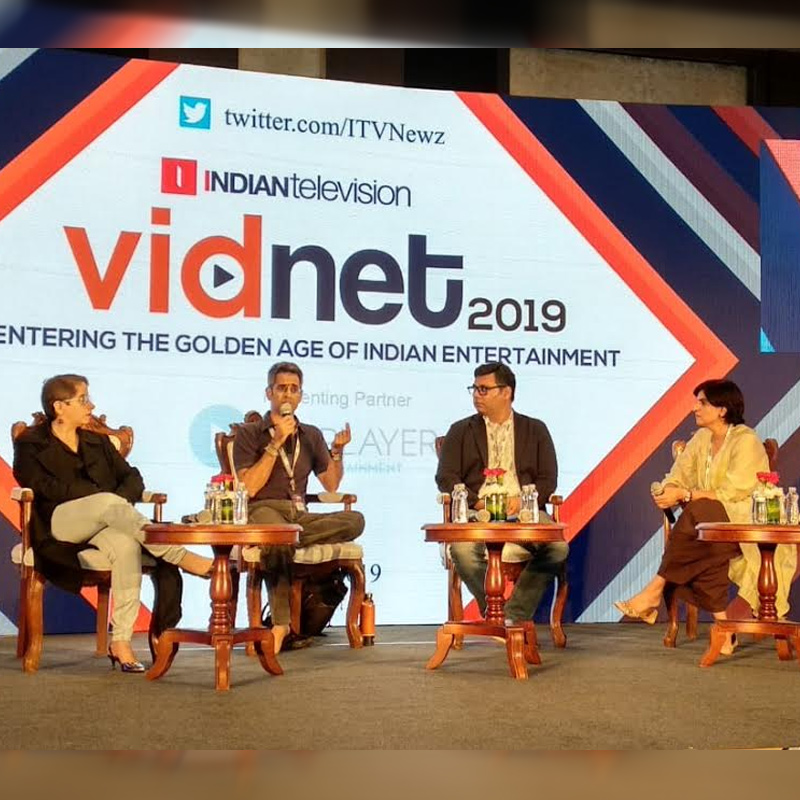
    MUMBAI: With an explosion in the smartphone market and rise in the number of OTT channels operating in India, telco-OTT partnerships are well-strategised and the most beneficial for content platforms to gain eyeballs and drive monetisation asserted a panel speaking on the topic of “Captive Audiences of the Telecom Trace” at the recently concluded Business and Tech Track of Indiantelevision.com Vidnet 2019 summit.

    Sitting on the panel, moderated by Elara Capital VP – research analyst (Media) Karan Taurani, were ZEE5 Global chief business officer Archana Anand, IndiaCast Media Distribution group CEO Anuj Gandhi, Apalya Technologies founder & CEO Vamshi Reddy, Lionsgate South Asia MD Rohit Jain, Shemaroo Entertainment COO digital Zubin Dubash, and Hungama Digital COO Siddhartha Roy.

    Roy mentioned that as aggregators, telecom companies are greatly positioned as single payment option for most of the OTT channels and Zubin Dubash vouched for the ability of telco partners to get greater traction on content sites and drive up numbers.

    Taking the example of Ditto TV, the VOD service from ZEE, Archana Anand shared that partnerships with telecom companies have always been fruitful for the ZEE network’s OTT offerings, for both consumer acquisition and marketing.

    She said, “I think, back then, we were the first ones to go across and do partnerships with the telcos and we created quite a stir in the market because of the lovely sachet pricing we were offering. The telecom partners ensured that they are paying on behalf of the consumers and it gave us brilliant traction. I believe, we managed to get the highest subscriber base in those days.”

    Anand added that there can’t be a better distribution network than telcos as it also translates into a ‘fantastic payment mechanism’. “With all the hesitancy around credit card payment, etc., the direct carrier billing is something that the consumer can be confident about and adapt easily.”

    Vamshi Reddy seconded her thoughts as he quipped that telcos can become the easiest ways for the industry to build a monetisation model around the whole content consumption. He noted that with fragmentation happening in the OTT space, the telecom partners can provide a universal experience to users in a seamless manner.

    Gandhi, however, highlighted that in the long run, the issue of ownership of the consumer can arise. “This challenge will take some time to settle, but from a pure bundling perspective, the discoverability on TV is extremely easy, and that is something that the OTT platforms are struggling with. Telcos can help in solving that.”

    To this, Anand noted that today there is a great symbiotic relationship between the OTT platforms and the telcos as the former wants to own the content and the latter, the consumer. But the platforms need to be mindful of the fact that it gets constant data from its partners and also keeps on communicating with the consumers through in-app notifications to ensure scalability of the partnerships in the long run.

    Jain added another dimension to the conversation as he noted that while telecoms are great in helping the OTT content reach the smaller screen, there is a wide array of opportunities lying in the big-screen space, which the OEMs can latch on to.

    He said, “In some ways, this is life coming to a full circle as all of these (telcos, OEMs, etc.) are actually (equivalent to) DTH and cable companies. All we need now is an ecosystem to emerge and thrive and whoever does a good job of aggregating content will eventually become the winner.”

  • hoichoi is now available on PatchWall on Mi TVs

    hoichoi is now available on PatchWall on Mi TVs

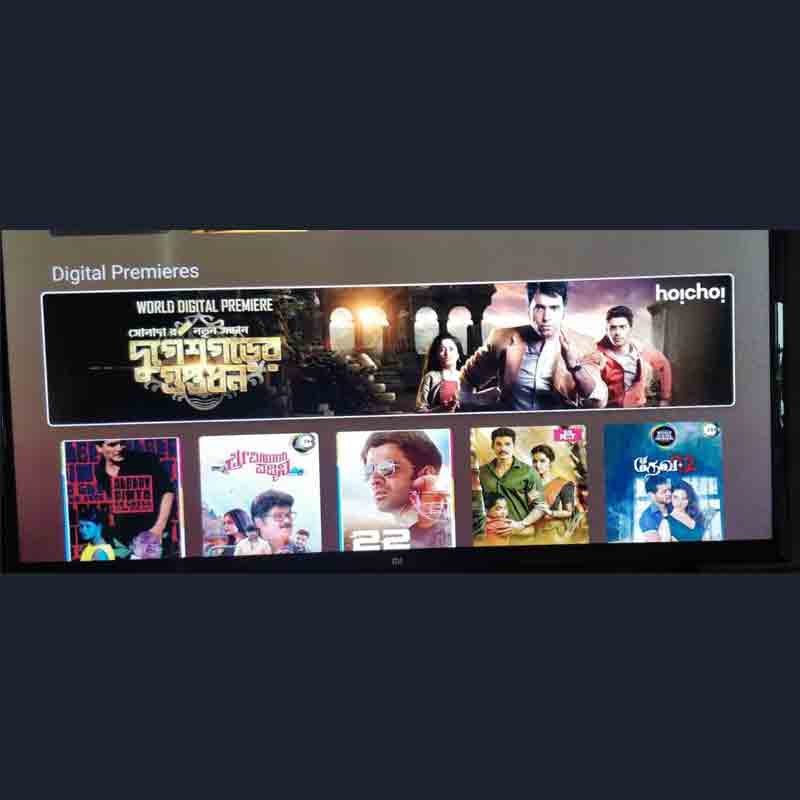
    MUMBAI: hoichoi, a leading Bengali entertainment platform with over 2,000+ hours of content, is now available on PatchWall on Mi TV, India’s number 1 Smart TV brand by Xiaomi. 

    This partnership was announced earlier this month along with four Mi TV 4X series ahead of hoichoi’s 2-year completion in the industry. Since then, Hoichoi has been rolled out to all Patchwall users across India. All Mi TV customers across India can access their favourite content on hoichoi which offers a variety of Movies, Classics, recently released Films (as World Digital Premieres), Original Series, Music Videos and much more. hoichoi will be providing Bengali content to over 2 million customer-base of Mi TV being the sole Bengali (regional) platform on PatchWall currently. 

    The new Mi TV 4X (65) is the flagbearer of the new Mi TV 4X series, with a large 163.9cm HDR LED display with Xiaomi’s in-house VPE (Vivid Picture Engine), and more. The Mi TV 4X series has been announced with an aim to bring 4K for everyone; it comprises of its flagship Mi TV 4X (65) along with Mi TV 4X (50), Mi TV 4X (43). The series is also the first in the world to come with Google’s Data Saver Mode.  The new generation of Mi TVs are powered by a new and refined version of PatchWall based on Android 9 Pie, designed specifically for the Indian market while retaining support for Google Assistant thus enabling universal voice search, PatchWall now provides a large selection of latest content: 700,000+ hours of digital content across 18 different content partners. 

    As hoichoi completes two years of Business Operations, one of the focus points for the 3rd year is ensuring seamless availability of hoichoi content on multiple devices, especially on TV screens. hoichoi is already available on Amazon Fire TV, Apple TV, Android TV, and Roku App. Mi TV is a recent addition to their repertoire.

    Commenting on the partnership, Vishnu Mohta, Co-Founder of hoichoi, said: “PatchWall allows seamless integration of hoichoi on all Mi TVs where users can choose the interface (English or Bengali) to watch their preferred content. As hoichoi is an audience-first platform and we believe in delivering not only the content of their choice but also the devices they prefer, Mi TV comes as a wonderful addition to our library of devices which will keep growing according to the needs of our consumers.” 

    Eshwar Nilakantan, Category Lead – MiTV, Xiaomi India said, “With our content first philosophy, we hope to bring each Mi TV user a unique experience with a personalised interface. All this and much more is possible with PatchWall inbuilt into each Mi TV. hoichoi has been synonymous with ground-breaking regional content for the digital medium in the East and we are extremely proud to have brought them on-board with their high-quality immersive content offerings for all our Mi Fans. We hope to build great properties together. Mi TV offers over 700,000 hours of content and hoichoi is a very important partner who share similar brand philosophies as Xiaomi in terms of disrupting respective industries.” 

  • Every platform needs a centrality to its content: VOOT’s Gourav Rakshit at Vidnet 2019

    Every platform needs a centrality to its content: VOOT’s Gourav Rakshit at Vidnet 2019

    MUMBAI: Viacom18’s digital venture VOOT is set to expand the horizon of its business with new moves such as the upcoming launch of its subscription-based model in this calendar year and the full-fledged commercial launch of VOOT Kids. While it will maintain equal focus on the advertising-led platform, Viacom18 Digital Ventures COO Gourav Rakshit thinks it is an opportune time to enter the SVOD play.

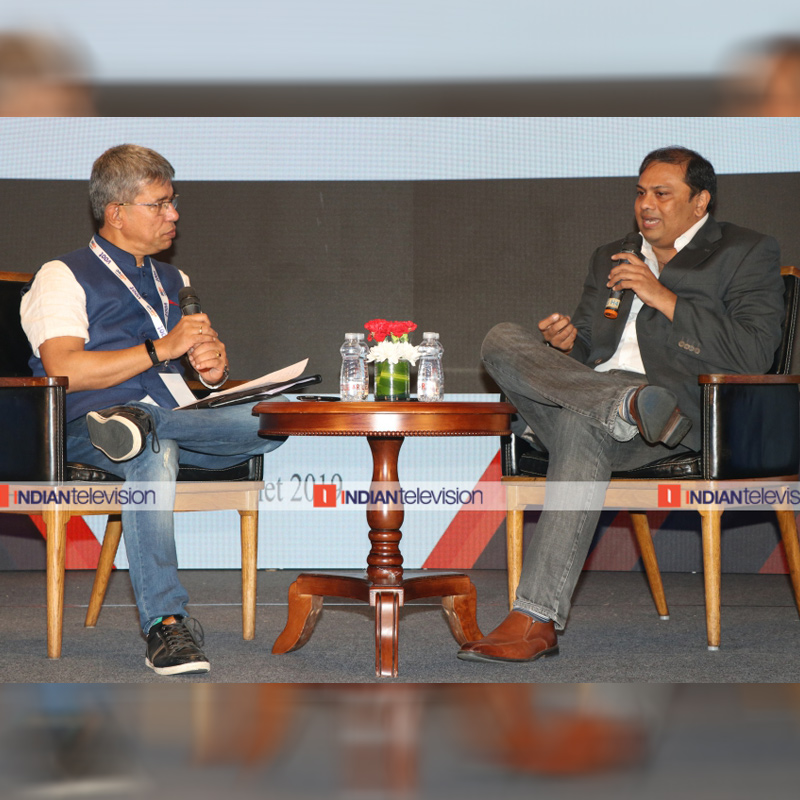
    At Indiantelevision.com’s Vidnet 2019, Rakshit spoke on industry issues as well as VOOT’s content strategy going forward in a candid fireside chat with Indiantelevision.com founder, CEO and editor-in-chief Anil Wanvari. Wanvari set the tone of the discussion by asking his lessons from Shaadi.com and his view on the industry as an outsider.

    Rakshit said that Shaadi.com was obviously a fascinating journey for him as he gained more insights on the history of India and communities of the country. It also helped him to touch India at a very core level while they signed up about 10-15k people every day which largely represents middle-class India.

    “I think from a learning point of view one of the things I can definitely bring is data science and AI models being used in match-making. They are very advanced. People talk about recommendations on OTT space. So, the order of magnitude of the algorithm on Shaadi is much higher than you have to in this space. Another thing is we ran the entire business on subscription model creating sufficient value to reach premium customers.”

    However, he also shed light on the new things he had to face as he switched industries. “I did underestimate the long-gestation period of content between concept, and execution or original launch. At Shaadi.com we were one week away from the idea of execution. This industry has to think where the ball will be one year from now. So, it definitely has a layer of complexity,” he added further.

    The other challenge is the supply-demand quotient. There has been a sudden burst of appetite but the growth in content creators can’t keep pace. However, he believes this is a short-term problem.

    According to him, the OTT industry is still finding its footing. The industry also has to discover the right price points. “As you start to move from the extremely western psychological demographic to what we call India, then Bharat, the nature of the content that we produce and we are going to put on these platforms needs to be fundamentally different. There, I think the broadcast industry, which has sharpened over years of understanding what these consumers want, is going to have an edge both by virtue of the library of content and understanding the sensibilities of the users. In the near term, clearly, the highest disposable income is with people that have a westernised psychography,” he said.

    He also added that every platform needs a centrality to its content that people want to consume and pay for. “We do daily digital soaps which are only available online and do exceedingly well. We have a base of extremely loyal people. In fact, we just concluded a season a few months ago. It is called Silsila and that had a massive fandom. So appointment-driven viewing on the internet as opposed to the only premise we are able to which is binge-watch is where we see a compelling case,” he also noted.

    Rakshit noted that the one thing that digital offers but television is unable to provide is on-demand viewing. According to him, if consumers are able to choose when they want to watch something then they can choose what and how they want to watch, and then they will be looking for something which is closer to their own liking. Hence, there has to be an understanding of writing what these new-age consumers are looking for.

    According to Rakshit, VOOT has an interesting content line up that is ready to hit the market. Moreover, the entry of fibre-to-home services will also help the platform at an ecosystem level. He also mentioned that as the industry progressed, the price discovery of subscription-based services would also be helpful for the platform.

    Speaking on VOOT’s kids’ strategy, he said, “It’s a departure from pure-play video streaming and primarily because we recognise that the target group in that is in the age group of 4-8 years and they are not using their own phones. They are using the device of their parents with their explicit permission. As a form of engagement, we got multiple-choice questions, audiobooks sort of narrative as well as large-format books which people can read in electronic media. Our early indications are that parents like that.”

  • Indian content creators must find out right stories to reach global audiences

    Indian content creators must find out right stories to reach global audiences

    MUMBAI: Over the top platforms have opened up the doors for content creators to share their creativity across the world. Despite the influx of major companies such as Netflix and Amazon Prime Video in India, content creators are still figuring out how to make their stories go global.

    At the stage of Indiantelevision.com’s Vidnet 2019 summit, some of the successful creators spilt the beans on their strategies. The creators of Delhi Crime, Lunch Box and Bard of Blood believe that stories that resonate and connect emotionally with the global audiences do travel. 

    The panel discussion ‘Making Indian Stories Travel’ in the creators’ track was moderated by BookMyShow VP content and strategy Manisha Singh Katial and the panellists were MUBI India content advisor Guneet Munga, Delhi Crime creator, director and writer Richie Mehta, and Red Chillies Entertainment chief revenue officer Gaurav Verma. 

    Katial opened the discussion by stating, “Yes, stories that are good do travel. But they also have to be culturally connected and I think that also becomes the challenge. Something that culturally connects with you resonates more, and something that connects with you emotionally, definitely works. I do feel making stories that travel is a challenge because it depends on the content that one is creating.”

    Katial asked Mehta to share the feedback he received on Delhi Crime. “The feedback for Delhi Crime is global. I have been hearing that the story has travelled quite far, and seems to have resonated with people all over the world. I knew this when I was conceiving the project.”

    He further elaborated, “I was in Delhi when the crime happened. So I reacted to it as somebody in India would. Then I left and went to Toronto and there I realised that this wasn’t just an ‘Indian’ thing, this was a humanitarian issue for the planet’s citizen. When I pieced together my work I figured out that it could have deep meaning for the Indian audience.”

    Mehta’s aim was to show a positive representation of India through his story. “It is the worst thing that has ever happened in this country and if you can spin that around to make a story of the extreme positive environment, especially for somebody outside with no knowledge and understanding about India, I certainly want to make it like that,” he said.

    Monga, the creator of Lunch Box, also expressed that content creators have tried to represent Indian beyond Bollywood’s depiction. Distribution has been the challenge previously. She said, “Across the world there are different sets of distribution, buyers and strategies. So it was not the same release day of films worldwide. Lunch Box released over two years around the world. And it is important for us to understand there are many layers to this.”

    Monga said that films can travel either because of its content or because of the choice of distribution partners. Sometimes a really good film is unable to travel because it does not have the right access. “So having the right access and having that distribution division, which is not just diaspora, is important. I feel with Netflix coming in India the lines are merging and now people will be able to see what India is with all its languages and colours, all its type of filmmaking and storytelling.”

    Katial commented that while having partners like Amazon and Netflix is great, it is also necessary to think internationally. To this, Verma added that one should not try to attempt an international story with the pressure that one has to appeal to seven billion consumers because emotional stories will connect to people. The best way to dazzle the audience is through content and script. Verma also opined that the industry is facing the issue of lack of talent. OTT platforms need writers who can understand the audiences’ need. 

    The panellists also said that apart from appealing stories and subjects, subtitles and dubbing of the content in different languages are also extremely pivotal in reaching global audiences.

  • Why effective media asset management and watermarking are crucial for pay-TV operators and content owners

    Why effective media asset management and watermarking are crucial for pay-TV operators and content owners

    Today’s pay-TV landscape is a dream for content consumers; we’ve never been so spoilt for choice when it comes to the entertainment on our screens.

    But this superabundance is proving a tricky task for pay-TV operators and content owners. The sheer complexity of the current content distribution chain is driving up costs and creating challenges.

    Consider just some of the issues the media value chain currently faces; there are the numerous content vendors and sources, the vast amount of VOD and SVOD assets, the huge file sizes and different transfer protocols. There are also other factors like storage capacity and version control, the different transcoding and file delivery formats, as well as security leaks and tracing of content.

    And as we know, these aren’t the only complications facing operators and content owners. They also have to think about the increasingly fragmented content distribution market – meanwhile, the lines between production, aggregation, distribution and indeed consumption, continue to blur.

    Throw in the numerous technological hurdles to boot and what do we have? Low-quality content that leaves owners and producers frustrated with an apparent mishandling of their valuable property, and operators faced with a hard sell of content that doesn’t exactly stand up to the promise of a modern viewing experience.

    Why does this happen? There are, as ever, a variety of factors – the poor quality of a video asset (even up to seventh-generation copies), not using video optimised transcoders, incomplete or faulty metadata, a lack of quality control on the part of vendors, and increasingly tight production lead-times which are bound to lead to mistakes and late launches. And last but not least, there is the issue of not achieving the full potential of cloud-based services.

    So, how can pay-TV providers and content owners address these challenges?

    First, by implementing effective media asset management which offers simplified and automated workflow for VOD content, great video quality, advanced audio and subtitling features, secure storage and distribution, as well as quick-start VOD services.

    Second, side by side with effective media asset management is ensuring proper security for high-value content. With the rapidly evolving threat of modern content piracy, watermarking has become an invaluable component to protect content delivery across the entire premium content lifecycle, covering pre-release distribution, early release content, 4K premium VOD and even operator-specific watermarking.

    Secure storage in particular, combined with effective content encryption, forensic watermarking and anti-piracy services offers a robust approach as content leaks can be identified at the source along the content value chain – a must-have given today’s rapidly evolving piracy ecosystem.

    Ultimately, as VOD and SVOD catalogues expand all over the world and viewer expectations continue to rise, operators and content owners will continue to face relentless cost, complexity, video quality and security challenges.

    It’s crucial, therefore, that operators seek expert help – after all, this isn’t a job that they can do alone.

    NAGRA’s DVnor Media Asset Management solution, for example, is designed to give operators a simplified and automated workflow for VOD content, as well as delivering immaculate video quality, advanced audio and subtitling features, secure storage and distribution, and quick-start VOD services. Integrated with NexGuard watermarking, it allows both operators and content owners to store and distribute film and TV assets for worldwide distribution with the peace of mind that valuable content remains secure at every step.

    But as the distribution market continues to fragment and tech hiccups continue to frustrate, effective media asset management will surely prove a vital component to the delivery of high-quality content to subscribers and the future success of pay-TV operators and content owners.

    (The author is Nagra Solution Expert. The views expressed are his own and Indiantelevision.com may not subscribe to them.)

  • OTT scriptwriters share how to make headway in the industry at Vidnet 2019 Masterclasses

    OTT scriptwriters share how to make headway in the industry at Vidnet 2019 Masterclasses

    MUMBAI: The first-ever writers Masterclasses conducted by Indiantelevision.com as a part of the fourth edition of its Vidnet summit saw some of the best writers from the world of TV, cinema, and OTT in presence. The varied sessions were graced by writers of series like Sacred Games, Little Things, and Mirzapur.

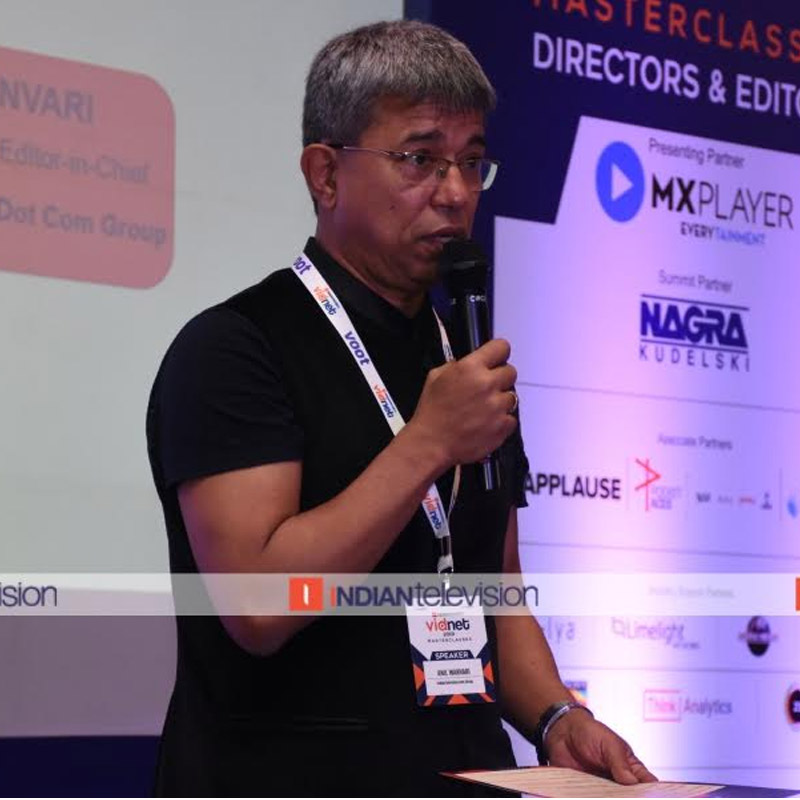
    The proceedings of the day were opened by Indiantelevision.com founder, CEO, and editor-in-chief Anil Wanvari, also an avid writer, who motivated the community of creators in the room to work on their craft continuously despite the rejections that come their way. He said a good writer is the one who never gives up. Wanvari also promised the audience a Masterclasses on the legal aspects of writing and selling stories in the coming months.

    Post that, the first session was conducted by Jaya Misra, who has written shows like Cold Lassi Aur Chicken Masala, and Kehne Ko Humsafar Hain. She briefed the audience about the process of writing stories and screenplays for web. She noted that it is important to develop characters to make a story compelling. Speaking about the pitching process, Misra said that it is important to network and make cold calls.
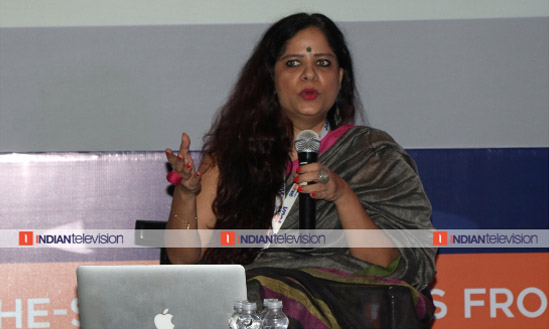
    She also revealed that her debut book Kama, which is based on the life of Kamasutra’s writer Vatsyayana, is being converted into an international web series.

    The next speaker was Mirzapur and Inside Edge writer Puneet Krishna who shared his journey of coming out with a show like Mirzapur. He revealed that he wrote the first 40-page long draft of the first season in just three days as the story was living in him since he was a child.

    About the craft of writing, he also insisted that the differentiator of a good story is the characters, which need to be written elaborately. He added that it is equally important to cast the right faces for the characters and the writers should fight with the producers, if need be, to get the right names on-board.

    Next on stage was Mayur Puri, the talented and versatile screenwriter, lyricist, and filmmaker who entertained the audience with an informative and light-hearted chat. He started his session by saying that there is not a concept of value for money in the OTT space right now and that needs to be developed.

    Puri also said, “When it comes to animated content, we have a colonial mindset. But we need to get rid of it. We will have to respect stories from within the country. That will happen but it will take some time.”

    About the pitching process, he said that one needs to be a compelling narrator along with a sharp script-writer to sell the concepts. He said that the script should be as detailed as it can be for better adaptations on screen.  “There is little art in scriptwriting but a lot of craft. It is not like writing novels. It is like an instruction manual. You should know your grammar because the better you can explain, the better the film or show will come out.”

    After lunch, the sessions commenced with Rangbaaz writer Siddharth Mishra who elaborated on the complete process of writing the show, right from the stage of the inception of the concept, to writing, to development, to production. He shared that the first season of the series was created in less than three months.

    He said, “My first pitch to the producers of Rangbaaz was ‘I want to make a gangster drama but I want to show the human side of gangsters. It is not to humanise them but to show that gangsters become gangsters for a reason.”

    He also added that he had planned to show 9 different stories in one season but on the demand of the producers and the platform he had to expand each episode in a 9-episode series.

    “This helped me in developing better characters and writing for them. It was beneficial as it made the protagonist look more real and not fictional,” he stated.

    Speaking about the right length of the episodes on OTT, Mishra said, “According to me 30-35 minutes is the perfect binge-watch timing. After that, the audience starts feeling that could have been edited.”

    Next up was Little Things and Adulting writer/actor Dhruv Mishra who stated that the first step to be a good screenwriter is to write good screenplays. He also focused on the importance of developing defined character arcs to get the platforms as well as the audiences interested.
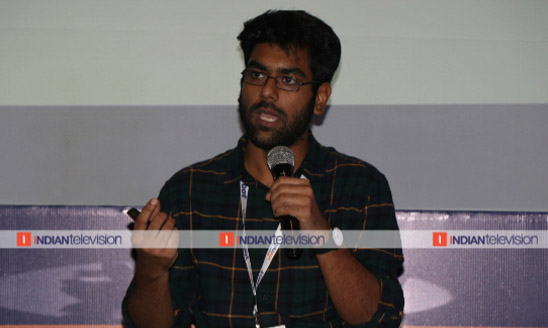
    Following it was a panel discussion between Thinkistan producer & creative producer Rajnish Lall and writer-director N Padmakumar, moderated by TVF founder and promoter and author-in-progress Arunabh Kumar.

    The Thinkistan team talked about the story and the production values and the planning for a show. They communicated that the inspiration of the show came from the decades that they had spent working as advertising professionals.

    The final session was conducted by the young writers from Sacred Games 2 writer room, Dhruv Narang, Pooja Tolani, and Nihit Bhave.

    The trio elaborated on the basic structure of a newsroom, how Varun Grover led them with the writing of Sacred Games season 2, and what role do the agents play in the life and career of a writer.

    The day was well-received by the audience who praised the effort and interacted with the creators in free-wheeling chat sessions. A parallel directors & editors Masterclasses was also conducted.

  • OTT series’ directors, editors share experiences, learning at Vidnet 2019’s Masterclasses

    OTT series’ directors, editors share experiences, learning at Vidnet 2019’s Masterclasses

    MUMBAI: Indiantelevision.com’s Vidnet 2019, for the first time, conducted Masterclasses for aspiring directors and editors of the OTT space. Masterclasses brought directors and editors of successful series like Ghoul, Gullak, Rangbaaz, Kota Factory, It’s Not That Simple, Criminal Justice and Delhi Crime to share their experiences and learning as creators.

    The initiative is an attempt to help the audience learn from the OTT industry’s best creators on creating successful web series. In the opening remark, Indiatelevision.com founder and CEO Anil Wanvari said, “This is the first time that we have organised Masterclasses and our vision is to create a platform and to build a community for aspiring creators."

    The first Masterclass was held by the makers of Netflix’s Ghoul. Creator, writer and director Patrick Graham shared insights on the process of making Ghoul which was initially written as a film and later converted to three-episode original premium content for Netflix. Graham also revealed that he took six months to write and research on the script of Ghoul and the post-production took three to four months. He said that horror is the most untapped genre in India and the concept of military horror was never attempted. Ghoul editor Nitin Baid briefed the audience on how he started working on the psychological horror-thriller and his experience while working with Graham on the project.

    The next Masterclass was conducted by Sachin Pathak, director of Rangbaaz S-2 who shared his experience on how he started his journey in the industry and how he got the opportunity to direct Rangbaaz S-2 for ZEE5. Pathak said that experience is the best teacher on shooting-related challenges.

    Another interesting Masterclass was on SonyLIV’s Gullak. Amrit Raj Gupta who directed Gullak began his journey in 2013 as an intern in TVF. He also directed TVF Bachelors season one and two. Amit Kulkarni editor of Gullak, Tripling S-2 and TVF Bachelors shared his two pence with the audiences. The duo said that the major challenge while creating content for OTT is to deliver satisfactory shots within a limited time span.

    Kota Factory director Raghav Subbu and editor Gourav Gopal Jha enlightened the audience on their recent success. TVF's Kota Factory premiered on YouTube this year and the show grabbed attention for being the first black and white web series. Subbu revealed that the idea of doing black and white web series hit him two weeks before the shoot and the team was slightly sceptical about it. They shot the show with two cameras- one for black and white series and another for colour series so that they have a backup if the concept didn’t work. They also explained motives behind having excessive aerial shots in the show and creating characters which resonate with the viewers. Subbu said that it is the responsibility of the director to turn the script into live characters on the screen. He said, “I follow the thought which says there is no good or bad film, there is a good or bad director and I come from that school. It’s important that the association with the script and directors works well.”

    At the Masterclass, Danish Aslam who directed It’s Not That Simple for VOOT touched the practical aspect of directing a show for an OTT platform. He explained the differences between shooting a film and a web series. He said, “The storytelling format is a crucial differentiating factor – episodic versus long-form storytelling. India has more daily soaps which stretch beyond 100 episodes. The concept of seasons is completely new in our country.”

    Aslam also explained how to keep the spark alive between episodes. He also gave some examples from his experience in addressing the challenges one faces while working on the limited budget and time constraints on OTT platforms.

    Vishal Furia, director of Criminal Justice and Lapachhapi, a Marathi Film, threw light on the concept and making of Criminal Justice and the research he conducted to bring the actual story from paper to screen. He too commented that the horror genre is not so evolved in India.

    The last and the most interesting Masterclass was taken by Delhi Crime’s writer, director and creator Richie Mehta who informed that he took four years to research on the subject and connected with most of the characters to understand their views. Mehta answered the audience's questions like how much fiction was added to the show, realism of the scene, deciding the point to start and stop the story, and psychological impact while researching and writing for Delhi Crime.

  • SonyLIV business head Uday Sodhi decides to move on

    SonyLIV business head Uday Sodhi decides to move on

    MUMBAI: Uday Sodhi, Business Head of SonyLIV, has decided to move on, after building up the digital business of Sony Pictures Networks (SPN) for almost five years. Uday will now pursue his entrepreneurial passion in the start-up space.

    SonyLIV is the pioneer in the OTT space in India. During  his stint, Uday was responsible for the introduction of its subscription model, SonyLIV's relaunch and the international launch of SonyLIV subscriptions, among many others. Under his leadership sport tournaments like Euro
    2016, FIFA World Cup 2018 and India Australia  series 2018 saw phenomenal success in terms of digital viewership.

    With Uday's movement, the mantle  of SonyLIV will now be shouldered by Danish Khan as the newly appointed business head of SPN's digital business. This will be in addition to Danish's responsibilities as Business Head of Sony Entertainment Television (SET) and Studio NEXT.

    In a career  spanning over two decades, Danish  has successfully managed teams across marketing and programming having worked with Sony MAX, SET and Star Plus in his previous avatars. Under  his leadership as business  head for SET, the channel has become the #1 Hindi General Entertainment Channel (GEC) in the country. He has brought marquee properties like Kaun Banega Crorepati and The Kapil Sharma Show to SET and created our own IPs with unique shows  like Super Dancer and Superstar Singer, which have received widespread recognition across the industry. Danish has also been instrumental in launching and nurturing the Studio NEXT business, armed with the ambition of making SPN a content leader in the M&E industry.

    Both, Danish and Uday will work on a transition plan over the next month, in consultation and partnership with relevant stakeholders. Uday's last working day at SPN will be 15 November
    2019.

    On behalf of everyone at SPN, we wish Uday success in his future endeavours and continued success to Danish in his expanded responsibilities.