Category: Over The Top Services

  • Innovation-led technology platform to streamline video production

    Innovation-led technology platform to streamline video production

    New Delhi: Videos have become the go-to tool that brands worldwide are turning to. India is no exception in this case. Brands, in their quest for higher customer engagement, are rooting for videos. Marketers, too, are seeing the positive results of video performance when it comes to higher volume conversions.

    Globally, media consumption is increasing on various platforms, especially digital. And the volumes are only going through the roof.

    Plan2shoot is a unique technology-driven video creation platform. It weaves a creative web of ideas, and organises all the bits and pieces into coherent and innovative video content. 

    Plan2shoot allows creative and innovative ideas to prosper and, through this, it effectively mixes human ideation with state-of-the-art technology to develop a cutting-edge approach to video aggregation.

    Plan2shoot’s co-founder and CEO Vikas Sardana says their video platform is a synonym for trust. “During my two-decade-long career in the media Industry, I realised that there were too many issues faced by brands and creators. The market was huge yet unorganised and trust was seriously missing,” he says.

    Plan2shoot realised the potential in the video space and thought of introducing technology wherein every step of video creation could be streamlined, irrespective of the location. Plan2Shoot is hosted on robust cloud technology platform with main emphasis on media security and availability. The technology ensures fast upload of media files by creators using multipart technology and enables fast downloads for verification by brands.

    The tech part ensures that all parts are transparent to both, creators, and brands to verify every step of development phase and enable both creators and brands have smooth experience in sharing media. This, says Sardana, makes the entire process transparent. 

    “The validation of our platform during the Covid-19 pandemic has further strengthened our location-agnostic belief. We have been able to get our work done even from remote areas without even stepping out and endangering ourselves,” Sardana adds. 

    Plan2shoot strongly believes in and already has implemented a structured process of video creation. Every piece of content created is carefully examined and, through a step-by-step process, the idea is fashioned into a well-defined narrative on the product. 

    Plan2shoot strictly follows due diligence while screening video talent and always makes it a point to deliver creative content. Client satisfaction is our top priority, says Sardana.

    “Our videos give the impression of a solid quality product, “ says Ishan Bhattacharjee, co-founder, Plan2shoot. In the digital space, the platform, he elaborates, replaces chaos with superb quality, and always adds an extra zing to the marketing process. 

    “We churn out awesome content – visually pleasing, polished and loaded with innovative ideas. Our clients love and share our work,” says Bhattacharjee. 

    Plan2shoot endeavours to make everyone a winner. “We go all out to bring a lot of synergy between creators and brands. And by constantly doing this we create a happy and buzzing marketplace,” Bhattacharjee adds.

  • Eros Now partners with Visa to expand consumer offering

    Eros Now partners with Visa to expand consumer offering

    MUMBAI: OTT platform Eros Now has partnered with Visa, which allows Visa debit and credit card users in India to avail Eros Now’s massive content library. This includes 12,000-plus movie titles, original shows, music videos, short format content, Quickies, at a discount to the annual Eros Now subscription price.

    This partnership will offer Visa cardholders a discount of 50 per cent on their annual subscription to Eros Now and access to a plethora of entertainment from cult Bollywood movies such as Maine Pyaar Kiya, Rangeela, Hum Dil De Chuke Sanaam to Love Aaj Kal, Tanu Weds Manu, Manmarziyaan, amongst others. The library also entails originals from the house of Eros Now that caters to varied genres such as drama, thriller, comedy, to name a few.  

    According to a 2019 report by Eros Now and KPMG, more Indians are consuming content across an array of digital formats and platforms. The average time an Indian consumer spends on OTT platform is 70 minutes, and the average frequency of access is 12.5 times a week. The average single session duration is 40 minutes. This data thus shows that consumers are spending considerable time watching online content. This partnership with Visa will further enable consumers to choose from varied entertainment options that will help in boosting viewership. 

    Eros Now’s collaboration with Visa will strengthen the payment integration for Eros Now that provides high-quality digital video experiences. At a time when there is unparalleled growth in online payment and digital video streaming platforms, the partnership, exclusive to Visa consumers, will offer a wider range of payment options that they can pay for seamless access to unlimited and superior entertainment content.

    Eros Now CEO Ali Hussein said: “Eros Now is known to entertain audience, since generations and an association such as this with Visa helps in further strengthening our promise of offering consumers with the best of entertainment. Visa, a leader in payments technology around the world, has been offering a great value proposition to Indian consumers. Therefore, this association will help in further boosting the viewership by offering them easy access to the vast content catalogue of Eros Now.”

    Arvind Ronta, head of products, Visa India & South Asia, says; “Today, there is an uptick in the consumption of digital entertainment through OTT platforms by consumers. We are happy to partner with Eros Now to give its customers the option of paying for subscriptions through Visa cards, that too at a special rate.  This offer will enable more users to avail of the vast Eros Now library to watch superior content and pay for it securely and seamlessly through existing Visa credit and debit cards.”

  • Shemaroo Entertainment launches animated kids series

    Shemaroo Entertainment launches animated kids series

    Mumbai: Shemaroo Entertainment has launched three animated series which are now available on Netflix worldwide. The three series will bring Indian characters and traditions alive for kids across borders and geographies. The original animated series are produced and created by Shemaroo and are immensely popular amongst Indian kids. 

    Shemaroo is a pioneer in original content creation of animated movies, series and digital content in the Indian Animation and Media and Entertainment industry with popular characters like Bal Ganesh, Ghatothkach and other homegrown characters.

    Spread across 13 exciting episodes of half an hour each, the three series uniquely not only entertain the kids but are also a treat for the entire family and with a focus on values, fun and learning.

    'Bal Ganesh' is one of the most loved and popular characters from the house of Shemaroo. The young and mighty elephant-headed God, also known as the God of knowledge and wisdom, is the son of Lord Shiva and Goddess Parvati. The stories centre around Lord Ganesh's childhood antics along with his friends Mooshak, Nandi, Bhringi, Aggam-Baggam and their adventures. 

    While the evergreen Akbar Birbal series showcases the camaraderie between the ruler and his minister, the legendary characters greatly influenced one and all and became the most loved characters in Indian folklore. Tales of Akbar & Birbal are full of quick wit and humour – a treat for the entire family. The series shows Birbal using his intelligence and presence of mind to provide justice to the people who come to Akbar seeking for his help. He also uses his intellect to amuse the emperor or calm him down when he is angry. 

    The famous Tree House Tales entails the story of neighbourhood friends Jack, Shelly, Mandy and Roonie, who meet up at their tree house, to discuss issues that they encounter and learn to adapt to the fast-changing world around them, something that every kid identifies and grapples with on a day-to-day basis.

    All the three animated series can be enjoyed by audiences available exclusively on Netflix.


  • Helo announces in-app edutainment property “HeloLivePeMilo”

    Helo announces in-app edutainment property “HeloLivePeMilo”

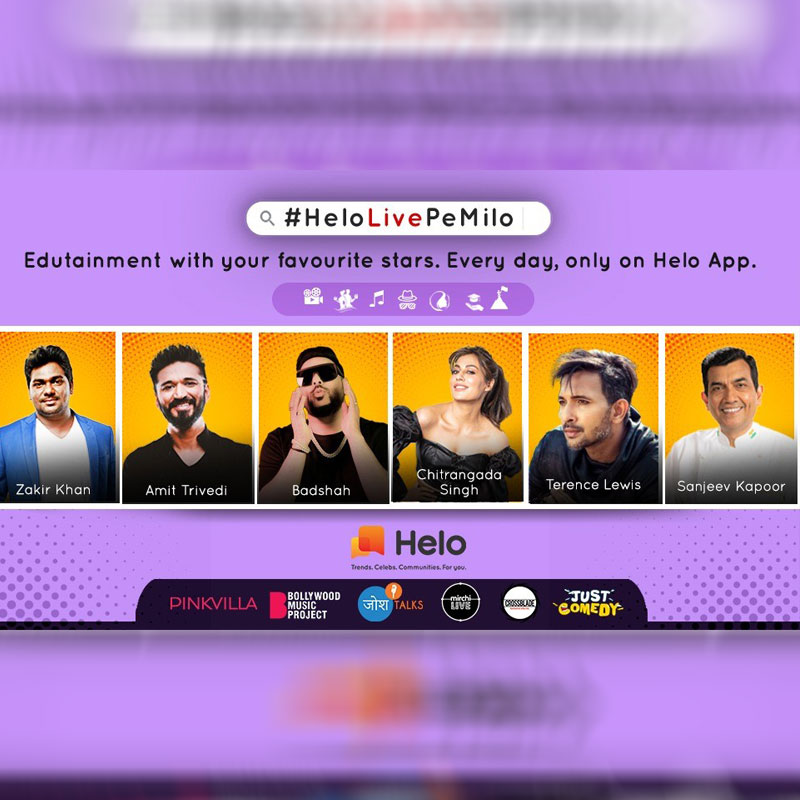
    MUMBAI: Facilitating closer engagement between stars and fans through interactive mediums, Helo launched Helo Live Pe Milo", a first-of-its-kind in-app property, in the edutainment category, wherein the platform will provide users with a plethora of entertaining and educative / learning initiatives in 15 different languages through exclusive partnerships across industries. 

    The property, #HeloLivePeMilo, has been conceptualised to be the one-stop destination for users to directly engage with the celebrities, influencers, and creators across genres including food, comedy, music, education, fitness, etc. To enjoy any upcoming live session Helo, users can simply subscribe to any listed session of their interest on #HeloLivePeMilo page in their preferred language offered by the platform.

    Currently, the #HeloLivePeMilo page is buzzing with enthusiasm from users around: 'Just Comedy Festival, Zomato's popular food carnival 'Zomaland' hosting exclusive sessions with celebrity chefs and Josh Talks conducting motivation sessions in Hindi and Marathi. 

    While there are food lovers who are polishing their kitchen gears to cook alongside six of the popular chefs including Vicky Ratnani, Shivesh Bhatia, Mirvaan Vinayak, Ajay Chopra, Kabita Singh and Pankaj Bhadouria with Zomaland by Zomato; there are other users awaiting to gain knowledge insights from accomplished Indian public speakers which includes Shiv Khera, Abhinay Sharma and Anand Bansode with Josh Talks. For comedy fans, live performances during the Just Comedy Festival by India's popular stand-up comics like Zakir Khan, Atul Khatri and Rahul Dua are at the top of the chart.

    Commenting on the launch of #HeloLivePeMilo, Helo head of entertainment Chhandita Nambiar said, "At Helo, it is our constant endeavour to bring fans closer to their favourite stars, and offer them exclusive content. #HeloLivePeMilo is a strategic initiative in that direction that aims to further elevate the user experience by providing professionally generated – entertaining and knowledgeable content through interactive live sessions. Through this initiative we are also encouraging people to ‘Get together on Helo’ for an exciting experience of multilingual content by their favourite celebrities and influencers across categories of their interest."

    Many stars including Badshah, Chitrangada Singh, Esha Gupta, Amit Trivedi, Vishal Bhardwaj, Nupur Sanon and stalwarts from their respective talent fields like Terence Lewis, Sanjeev Kapoor, Zakir Khan, Vidyut Jammwal, Mandira Bedi, Mickey Mehta and many more were seen performing and having live interactive sessions with their fans through #HeloLivePeMilo. Many of them actively engage with their Helo fans, keeping them updated around useful insights, including from their personal life. During his live session, Badshah revealed that his stage name was inspired by one of Shah Rukh Khan's iconic movie whereas Terrance Lewis shared his love for the live feature on Helo and how he is loving engaging with his fans. 

    #HeloLivePeMilo has received overwhelming response during the recent live sessions on the platform in partnership with CrossBlade, Mirchi Live, Pinkvilla, Bollywood Music Project and more. The partnership featured various celebrities and artists across languages and content categories going live on the platform to engage with their fans.

    Follow Tellychakkar for the consumer facing news & entertainment

  • Acast partners with JioSaavn to expand podcast network to South Asia

    Acast partners with JioSaavn to expand podcast network to South Asia

    MUMBAI: Global podcast giant Acast has partnered with JioSaavn, South Asia’s largest audio streaming platform, to enable it to leverage Acast’s extensive global network of shows. The partnership expands JioSaavn’s content offering exponentially, providing access to Acast’s infrastructure and the latest advances in podcast technology.

    The clear appetite for audio in South Asia — shown through JioSaavn’s existing 104 million+ Monthly Active User (MAU) base — is paramount to Acast’s understanding of the huge opportunity for podcasts in the market. And Acast and JioSaavn will align on one central mission: to popularize podcasts in South Asia.

    The companies’ aim is to educate listeners on both the merits of podcasts — including the flexibility to listen anywhere at any time — and the opportunity they provide to share culturally diverse, compelling content with global voices.

    Speaking of the partnership, AcaAcast partners with JioSaavn to expand podcast network to South Asiat’s Chief Business and Strategy Officer Leandro Saucedo said: “It’s Acast’s mission to bring podcasts to all ears, all over the world. We’ve been aware of the changing audio landscape in India for some time and, in JioSaavn, we’ve found the biggest and most impactful audio streaming platform in the region — dynamic, bold and ready to push boundaries, and the perfect partner to share our podcasts with.

     “There’s an audience hungry for audio in India, and we want to help give these listeners access to the extraordinary content emerging from all corners of the world, from incredible podcasting talent and recognized publishers.”

    In light of the partnership with Acast, Ishani Dasgupta, Lead – Podcast Partnerships at JioSaavn, said: “Podcasting is still largely nascent to consumers in the Indian market, with momentum growing quickly. The ability to grow and build new audiences, new shows, and establish pathways for brands to access both is really just the beginning for our 1.3 billion potential consumer market. As the leading podcast company globally, Acast recognizes this opportunity.”

    “We’re thrilled to be partnering to integrate its robust catalogue and unique vision for content development and acquisition in India and beyond. We look forward to working closely with Acast to grow overall podcast engagement among listeners in India, as well as to join creative forces on future content that speaks to India’s diverse cultural palette.”

    The infrastructure of the partnership provides a platform for Indian voices, enabling new independent podcasters to produce content, and connects JioSaavn with Acast’s large collection of global publishers including The Guardian, The Economist, Financial Times, BBC, VICE, PBS NewsHour, The Times and many more.

    Acast and JioSaavn believe connecting South Asia to this content in particular – already generating 200+ million listens on a monthly basis in Europe and North America alone – will help both expand such content beyond borders, and encourage and provide publishers with the opportunity to reach new audiences and create bespoke content with them in mind.

    Over the next two months the full effect of Acast and JioSaavn’s partnership will be visible, with Acast’s content appearing in full through JioSaavn.

  • Genelec helps MotionComposer turn movement into music

    Genelec helps MotionComposer turn movement into music

    MUMBAI: MotionComposer is an artistic and therapeutic tool that turns motion into music – and the company has recently chosen Genelec loudspeakers to partner its revolutionary new technology. It is created by Robert Wechsler in collaboration with therapists, artists and people with other abilities.

    The roots of MotionComposer stretch back to 2010 when Wechsler – a choreographer and interactive dance pioneer – was contacted by Alicia Peñalba, a Spanish music therapist with the idea of working with disabled children. This led to the concept of a device that would let everyone, regardless of ability, control sounds through movement. Years of development and workshops followed to refine the concept into something that would be simple to set up and use, allowing therapists to focus on their work, not the technicalities.

    The resulting MotionComposer 3.0 is based on passive stereovision – featuring two cameras but no laser or IR projector – to understand the positioning of a human body in a 3D environment. With this information the device can recognise even the smallest movements of the body, such as the blink of an eye, and convert them into a range of sounds which are then reproduced via a pair of white Genelec 8020D active studio loudspeakers.

    “There were several reasons we chose Genelec,” says Wechsler. “The first is the quality of the sound. Some of the interactive musical environments we put people in are not playing music, but rather natural sounds, like rustling leaves or insects. We work with people with very limited movement and so a very small movement, like a blink of the eye, might make a small sound like a twig snapping. So we don’t just want speakers that play music, we want speakers that let you hear and wake your ears up to the full range of what sound can be. We liked the fact that Genelec speakers really let you experience every tiny little thing that might be there for your ears to hear.

    That is also therapeutically important because if you want people to focus on the sense of hearing, one very good way to do it is to get into the world of little delicate sounds – and that perks up your aural capacity. The dynamic range of the speaker is therefore very important, so you get the delicacy, but you also get quite a strong kick out of them.”

    Other factors that were important in the selection of Genelec loudspeakers also included their robust nature, aesthetic design and the ethics of Genelec as a company. “The company has a good social ethic,” notes Wechsler. “I like that the factory is energy neutral. That social ethic belongs to our conscience too. It seems like a good fit.”

    With MotionComposer 3.0 hitting the market this Spring, the company is already looking forward to offering more to its users. “Once we prove our concept to the world, then we have lots of ways we want to expand,” says Wechsler. “We’d like to expand it musically and in terms of features like jumping. We philosophically believe that people with other abilities should get good stuff. They might not be able to move much, so it becomes even more important if you are limited in some ways that you have access to the best kind of experience.

    “Music and dance play a deep role in our sense of well-being, and even what it means to be human,” he concludes. “This is true for everyone – persons with and without disabilities – and with the right technology, everyone can take part.”

    Since the founding of Genelec in 1978, professional audio monitoring has been at the core of the business. An unrivalled commitment to research and development has resulted in a number of industry firsts and established Genelec as the industry leader in active monitors.

  • Covid2019 cuts back customer acquisition costs

    Covid2019 cuts back customer acquisition costs

    MUMBAI: Covid2019 has plummeted what was a skyrocketing cost of customer acquisition, according to a report that delves deep into the correlation between the pandemic and the entertainment industry. According to the special report, Navigating Covid-19, by Parrot Analytics, this is exciting for platforms launching in the middle of pandemic such as Quibi, HBOMax, and Peacock. Yet, as time stretches on, OTTs may lose subscribers whose free trials end or who churn due to the recession. After the lockdown, the demand for content may be even more important as out-of-home activities will pose greater competition.

    Under stay-at-home orders, OTTs are gaining subscribers due to consumers’ heightened perceived value of their catalogue offerings.  

    The report says that the global lockdowns, forcing everyone to be home, have led to increased content consumption (viewership, ratings, etc.). Yet, this increased consumption has been accompanied by the unique challenges of satisfying audiences while production of key tentpoles has been halted and delayed. Broadcasters and cable (Pay-TV) have additional hurdles compared to OTTs. They must also cope with reduced ad revenue within the industry, making their ability to optimize their airing schedules and to fill content gaps even more crucial. Nonetheless, OTTs and Broadcasters alike are looking to solve their challenges by acquiring and producing virus-proof content.

    Meanwhile, distributors have an opportunity to revisit and leverage their reserve of content. They can offer unique packages of titles that will allow platforms and channels to retain their viewers and subscribers. Producers are challenged with finding innovative ideas and formats as well as adapting existing ideas to new restrictions placed during and post-lockdown. Simultaneously marketers are left searching for fragmented and dispersed audiences, recalculating and holding on allocating budget.

    Pay TV

    In the short-term, Pay TV has similarly seen a surge in viewership and ratings. Yet, as industry analyst Rich Green- field points out, this bump has been underwhelming. Greenfield is not alone; many analysts expect networks to feel more repercussions due to their losses of advertising, their reliance on live TV, and their battle for a digitally orient- ed key audience: those between 18-24. When consumers are faced with hard choices, Covid2019’s impact long-term may accelerate cord-cutting, contributing to Pay TV’s decline. However, broadcasters can avoid this by capitalizing on audiences who are tuning in now.

    What qualities have created opportunity under stay-at-home measures?

    According to the report, there are a few characteristics of SVODs that have been advantageous during the lockdowns.

    •           Size of catalogue:  The lockdown conditions have temporarily increased the value of all content, making it easier to reach the threshold of demand needed to acquire a customer. Thus, the larger the catalogue the greater the likelihood of customer acquisition at the moment.

    •           Supply of originals:  As stay-at-home orders continue, boredom and loneliness is on the horizon for many consumers. This makes original content that connects people more important than ever.

    •           Flexible viewing: With families, roommates, and others forced to share living spaces, SVOD content avail- ability on multiple screens is an advantage. The flexibility to watch on TVs, laptops, and phones allows consumers to watch their preferred content wherever they want and with whomever they want.

    •           Ad-free: Declining revenue from advertising poses a unique challenge at the moment; many companies have cut their marketing teams, frozen budgets, and are limited in ad-production capabilities. Thus, SVOD’s diminished reliance on ad-revenue is beneficial.

    Netflix

    Consider Netflix. Its large catalogue, supply of diverse original content, flexible availability and lack of ad-reliance allows it to thrive at this moment. The crisis has also temporarily reverted Netflix to an earlier phase in OTT life-cycles, in which total demand for content dictates subscriber growth and retention.

    Netflix is not alone, Disney+ also exhibits similar qualities. Although it has a limited supply of originals, its flexible access, ad-free platform, and large catalogue of premium children’s and family-friendly IP support its ability to thrive. Amazon Prime Video and Hulu are also well positioned with large catalogues, many originals, and flexible viewership.

    For Pay-TV, channels with large catalogues of family-friendly content, such as Discovery and Disney, are fulfilling increased demand from kids who are home due to school closures. Other broadcasters which are experiencing holes in programming are employing repeats or flashbacks of favourite episodes, searching for foreign acquisitions, and considering moving exclusive content from their OTT platforms back

    The key for producers and distributors is therefore to capitalize on this need for a larger catalogue and greater supply of originals. They can solve the pains of an aching industry with innovative content that fulfils and attracts the audiences that platforms, networks, and marketers are seeking to find.

    What can the industry do to thrive moving forward?

    In the midst of uncertainty, data allows decision-makers to be agile, says the report.

    Covid-2019’s effects on the global TV industry have likely just begun to unfold. As new consequences emerge, the industry will need to adapt swiftly by combining the art of storytelling with the science of human behaviour.

    Content preferences

    Audience content preferences have shifted due to Covid2019, these include a desire for original content, especially content that fills holes left by cancellations or delays.

    OTTs have an opportunity for growth due to increased streaming volume, but in order to prevent churn they must optimize their release schedules and content acquisitions.

    Broadcasters are challenged with holes in programming schedules, but can adapt by reinvigorating fandoms and finding replacement titles that will attract target audiences.

    Distributors should optimize their content packages for broadcasters and OTTs in need.

    Producers, despite shutdowns, can be resilient by prioritizing projects that fulfil audiences’ shifting demand and finding new formats to create fresh content.

    Marketers may need to pivot their channel spends, but can find ways to maximize their audience reach and tap into emerging preferences.

    OTT solutions
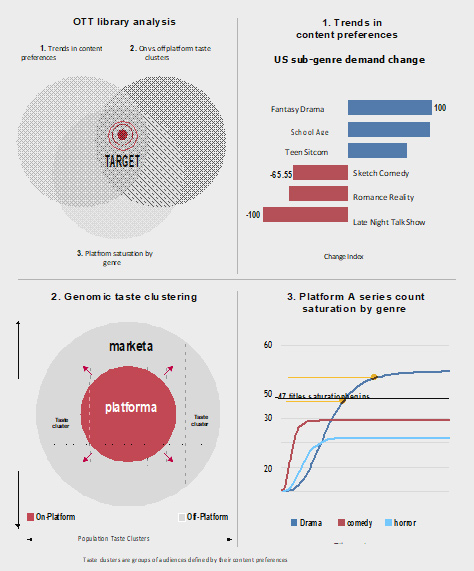
    Capture shifting preferences: By examining trends in content preferences, OTTs can prioritize speeding up releases or acquiring titles that may appeal to audiences’ shifting needs.

    Acquire vs. retain subscribers: Platforms must evaluate whether titles fulfil the preferences of existing subscribers or those yet to be acquired. Depending on an OTT’s goals, they may choose to prioritize a title that targets retention or to prioritize a title that targets acquisition.

    Ensure audiences are satisfied, but not overloaded:  Saturation is another term for diminishing marginal returns. Based on past data, OTTs can derive an optimal point or a point of saturation. To ensure audiences are not over- whelmed, OTTs should evaluate if there is headroom before speeding up releases or acquiring titles. Otherwise, due to genre saturation, titles may underperform.

  • Global streaming viewership skyrockets 57% in Q1 2020

    Global streaming viewership skyrockets 57% in Q1 2020

    MUMBAI: Streaming viewership saw rapid increase in the first quarter of the year with time spent up by 57 per cent globally year over year. On-demand content drove the lion’s share of this growth, as per a report from Conviva. Moreover, March proved a turning point in the acceleration of streaming, as stay-at-home orders rolled out in countries and regions around the world.

    “On demand content carried the lion’s share of growth, up 79 per cent and capturing 72 per cent share of viewing time in Q1, up from 63 per cent share in Q1 2019. Live programming grew more modestly, up just 19 per cent overall and lost market share to 28 per cent from 37 per cent the previous Q1,” the report said.

    Growth was led by Europe, up 70 per cent, and the Americas, up 57 per cent, while Asia and Africa saw 30 per cent and 25 per cent viewing growth respectively.

    The report also stated that as viewers stayed home in March, consumption habits shifted rapidly. In the span of a single month, comparing February 2020 to March 2020, overall time spent streaming grew a stunning 20 per cent with on demand viewing up 28 per cent.

    However, missed ad opportunities rose up to 26.9 per cent in Q1 as compared to Q4 of 2019 in the wake of Covid2019 pandemic. For 46.3 per cent of missed streaming ad opportunities, the most common issue was the lack of ad demand. While the report predicted that advertising will continue to be dampened by the evolving situation, it will return with fervor in 2021 and beyond. The advertising data included in the report is based on an analysis of 12.5 billion ad attempts in Q1.

  • SonyLIV selects Intertrust’s cloud-based multi-DRM service

    SonyLIV selects Intertrust’s cloud-based multi-DRM service

    MUMBAI: Intertrust’s cloud-based multi-DRM service, ExpressPlay DRM, has been selected by SonyLIV in India to protect content streaming and downloads including both online and offline playback on all devices.

    The partnership covers all channels and entertainment programming on the SonyLIV platform, including over-the-top (OTT) live and on-demand streaming of TV, premium shows, movies, and sports events.

    Owned by Sony Pictures Networks India Pvt. Ltd., SonyLIV is one of the top five OTT services in India. It houses more than 40,000 hours of VOD programming across five languages—Hindi, English, Marathi, Tamil, and Telugu—coupled with more than 24 years of content from channels of Sony Pictures Networks India. Last year, the service launched in the Middle East and has plans to expand its complete bouquet of services in several Southeast Asian countries.

    “Riding on its compelling stories and diverse content catalogue, SonyLIV has garnered a record growth in MAUs, engagement, and subscriptions over the last year,” said Manish Verma, head of technology, SonyLIV. “The content protection service enabled by the ExpressPlay DRM is key to our ability to gear up for even more traction in the year ahead. ExpressPlay DRM will be key to augmenting our phenomenal success with live sports which has triggered a doubling of overall consumption growth over the last year alone.”

    Intertrust’s technology will protect both live and on-demand OTT sports streaming on SonyLIV, which achieved a landmark viewership of 70 million for the FIFA World Cup 2018, the highest-ever for football in India. Last year, the broadcasting of the Indian cricket team’s overseas tour of Australia and England commanded a viewership of 50 million and 30 million respectively, accounting for a five-fold jump in time spent on the platform.

    “The forces of technology and competition continue to erode media silos. Protecting both content creators and service operators is essential to remaining agile as streaming services look to offer up the best viewing experience,” said Talal G. Shamoon, CEO at Intertrust. “The ExpressPlay DRM service lets OTT providers protect and control media consumption across any mobile or smart device, allowing viewers to enjoy a personalized selection of channels, live entertainment, and sports enabled by a world-class streaming app like SonyLIV.”

    The market-leading Intertrust ExpressPlay multi-DRM service, which supports all streaming platforms, DRM, and media formats, now protects OTT content for one-quarter of the world’s population. It is the only multi-DRM cloud service that supports Apple FairPlay Streaming, Google Widevine, Adobe Access, Microsoft PlayReady, and the open-standard Marlin DRM. It is a complementary solution to ExpressPlay XCA, which provides seamless interoperability for hybrid TV operators on mobile, web, smart TVs, and set-top boxes. The ExpressPlay content security suite offers forensic watermarking and anti-piracy services (powered by Friend MTS) to protect live and premium 4K/UHD content.

  • Synamedia’s Media Edge Gateway equips video service providers with the anchor for a full cloud evolution

    Synamedia’s Media Edge Gateway equips video service providers with the anchor for a full cloud evolution

    MUMBAI: Synamedia, the world’s largest independent video software provider, has announced its Media Edge Gateway, a software-based integrated receiver/decoder (IRD) that opens new routes to monetization, software-as-a-service (SaaS)-based business models, hybrid deployments and much more.

    Based on Synamedia’s award-winning virtualized Digital Content Manager (DCM) architecture and its PowerVu IRD technologies, the new Media Edge Gateway is ideal for video service providers that are deploying in hybrid environments, looking to test out new channels or launching point-in-time updates such as for natural disasters, and events. This new service enables cost-effectiveness, flexibility and adaptability in creating new application-specific edge gateways including an ATSC 3.0 receiver and SMPTE 2110 decoder with further commercial, function, positioning and form adaptations to be added in the future.

    The Media Edge Gateway can reduce go-to-market schedules from weeks to mere minutes using automation, the resulting benefit of its software-based architecture . This approach creates more value for end customers while offering video service providers new monetization paths.  Additionally, it enables customers to experiment or launch varying business models including SaaS options and subscription-based packages.

    Synamedia’s best-of-breed management systems like the Video Network Service Manager (VSM) and PowerVu Network Control (PNC) allow for fast and accurate analytics, control, monitoring and deployment. The Media Edge Gateway further helps Synamedia customers along their journey to all-IP delivery with hybrid deployments, combining on-premise and public cloud distribution.

    “Never before has there been a stronger need for cost efficient delivery of the high quality viewers expect, and never before has it been as simple to do as it is with our new Media Edge Gateway,” said Julien Signes, senior VP and GM, Video Network at Synamedia. “By adding our newest edge gateway to the mix, video service providers can truly optimize every single part of their network, and do so while being more efficient in today’s software-driven world.”

    Synamedia’s video network portfolio powers premium quality broadcast and broadband video for more than 1,000 operators worldwide and 100 million daily viewers. Its video distribution, processing and delivery services and solutions create compelling live multi-screen experiences, enable software-defined video processing and unify operations. The award-winning portfolio also touts a cloud-ready, converged broadcast and broadband end-to-end ATSC 3.0 offering and low latency solutions for live video. Its virtualized Digital Content Manager (DCM) features live transcoding to multiple bit rates and formats, scalable video functions and best-in-class video quality all aimed to deliver infinite entertainment.