Category: Over The Top Services

  • Times Internet rolls back pay cuts as business picks up

    Times Internet rolls back pay cuts as business picks up

    KOLKATA: As media companies start seeing a rebound in business after the initial shock of the Covid2019 crisis, many of the biggies have begun rolling back pay cuts. The latest addition to the list is Times Internet Limited (TIL).

    In a virtual fireside chat hosted by Indiantelevision.com, TIL COO Puneet Gupt said that employee salaries are back to the original levels and variables have been paid as well. While many media organisations are reducing team sizes, TIL has started selective hiring. In fact, TIL has seen gradual growth in last four-five months as market forces gain equilibrium, Gupt said.

    Recently, New Delhi Television Ltd (NDTV) also said that it has ended salary cuts imposed on employees in the wake of the pandemic. According to media reports, major broadcasters like ZeeL, Viacom18, Star & Disney India also ended pay cuts starting from end September.

  • SonyLIV ramps up content portfolio with live sports, dubbed regional show

    SonyLIV ramps up content portfolio with live sports, dubbed regional show

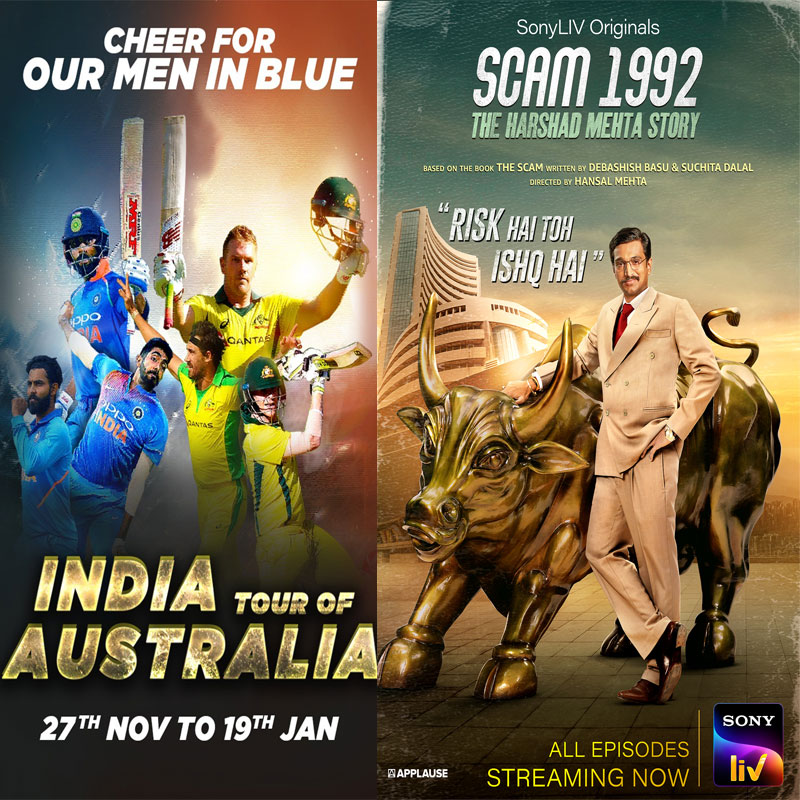
    KOLKATA: After months of waiting to see Team India in action, SonyLIV is here with a breather for all cricket lovers. The much-hyped India Tour of Australia will go live on the platform starting 27 November. In one of the most high-octane series in international cricket, Kohli’s Men in Blue will take on the Aussies for three ODI’s, three T20’s and four test matches on their home turf till 15 January 2021. With simultaneous feeds across four languages, the much-anticipated tour will be available for viewing to SonyLIV’s premium subscribers.

    Post a successful period of quarantine, the teams are now set to lock horns this Friday onwards across venues in Brisbane, Adelaide, Sydney, and Melbourne. Team India will begin with a slight edge over the hosts in the ODI’s, with a 12-10 win-loss record against them in the recent past. However, Australia, who recently defeated world champions England on their home turf, will look to replicate the victory, led by Aaron Finch. Premium subscribers will get access to the live feed without any delay.

    There’s a lot to rejoice for soccer fans as well on SonyLIV with the popular UEFA Champions League 2020-21, the 66th season of Europe's premier club football tournament along with UEFA Europa League and Serie A matches going live on the platform. 2021 brings another sporting spectacle – Australian Open with Rafael Nadal headlining the event next year in Melbourne.

    And there’s more in store for SonyLIV’s patrons. Following its stupendous success amongst audience and critics, Scam 1992 – The Harshad Mehta Story will now be available for regional audiences with dubbed versions in Tamil, Telugu, Malayalam and Kannada; along with a host of other titles like Avrodh: The Siege Within, Your Honor, Undekhi, and more.

    In addition to this, the platform has recently launched titles like Uncommonsense by Saloni, Daan Sthapana hosted by author and speaker Devdutt Pattnaik and Mahabharat- Ant ya Aarambh, an 11-episode animation series.  Highly acclaimed English shows like The Good Doctor S4 and For Life S2 are also up for viewing for the Indian audience. So, whether you are a cricket lover or a football enthusiast, an ardent fan of stand-up comedy or a devout believer in mythology, SonyLIV is the place to be.

  • This generation will witness shift from linear TV to OTT: Sameer Nair

    This generation will witness shift from linear TV to OTT: Sameer Nair

    MUMBAI: Ever since the Covid2019 pandemic cast its shadow over the world, the consumption pattern of audiences has altered drastically. The entertainment industry, for one, has witnessed radical changes as the shutdown of theatres led to viewers taking to smartphones to keep themselves engaged. This shift has further prodded the digital landscape to pick up the pace and the streaming platforms across the world to acquire a fresh audience base. To bring these changes to light and platform an in-depth discussion, the Asia Society in southern California held a  webinar on ‘Cinemas to Smartphones: Streaming Wars and the Future of Bollywood and India Content’.

    The discussion was a part of the eleventh US-Asia Entertainment Summit, and the country in focus was one of the largest consumer markets in the world – India. To represent the country on a global scale, Applause Entertainment CEO Sameer Nair shared his insightful perspective on the topic. Other panellists included filmmaker Shekhar Kapur and entertainment lawyer Gowree Gokhale.

    On OTT landscape in India

    Nair began by highlighting the impact of Covid2019 on the streaming industry in India, the future of television, and the big opportunities that await in a nation of content-hungry viewers.

    The current state of the OTT landscape in India is a lot like the early days of television, related Nair. Just like in the ‘90s when a whole bunch of TV channels emerged from a number of players and investors, a similar trend is at play in the streaming business now. “In India we have a potential of 500 million-strong audience base and the streaming platforms have touched around 20 million, so it is a long way to go. India is a large market connected with smartphones and broadband connectivity, cheapest data in the world, already savvy with television and film. This is a growth phase where there will be a lot of investment as we essentially move audiences from television to streaming,” said Nair.

    He went on to add that theatrical revenue is a very important income stream –

    Those who draw a comparison between 9,000 theatrical screens versus 900 million smartphone screens miss the fact that the 900 million smartphones are not going to generate the sort of revenue compared to what the country can potentially generate theatrically. “So, taking the theatrical experience off the market translates to a significant economic change and you are also leaving a great chunk of retail revenue on the table. I think streaming platforms can compensate for those $80-100 billion to offset the theatrical revenue loss.”

    On the other hand, film Director and producer Shekhar Kapur quipped that there is no competition between theatre and OTT platforms. The success of any content, be it on television or OTT platform, largely depends on the technology as well. Every new technology creates a new culture of content creation and a new culture of content consumption. Therefore, he finds Netflix and Amazon as technology companies rather than content companies who, in the end, took advantage of technology to deliver content. But due to Covid2019, people are very comfortable watching content while sitting at home, and so it becomes very difficult for theatres to bring audiences back, mused Kapur.

    On the future of television in India

    The linear television industry in India has reached 197 million TV and cable satellite homes. There is about 10-15 million more to go and it is now scraping the bottom of the barrel. As every content platform and every technology creates a content habit, TV was the classic talking to the consumer technology and it told you to watch your favourite shows at specific time slots so you had to reorder your life accordingly.

    But then came the streaming platforms, which made content available to you whenever you want it, thereby precipitating one of the biggest changes in consumer habits. Nair theorised that it won’t be long before traditional TV viewing becomes completely obsolete. Said he: “The way TV is progressing, dependent on advertising and subscribers, it has reached its scale. This is a decade where we will be able to see a gradual transitioning out of typical linear television to streaming platforms and then moving on to even more dramatic technological advancements.”

    On the success of Scam 1992: The Harshad Mehta Story

    One of the platform’s latest offerings, Scam 1992: The Harshad Mehta Story, has become the talk of the town. It is currently the highest rated show on IMDB in India (9.6) and #16 amongst the top 50 television shows globally. With phenomenal ratings and record-breaking performance, the show has made it to the list of the top five OTT shows for the last week of October, according to a streaming tracker by Ormax Media.

    This is a clear indication of the demand for differentiated content and the need to cater to the audience in this regard.

    “People watch programmes, not channels. And in a way how people watch movies and go to theatres because of the ambience, similarly now with platforms or with any form of content, people are more drawn to individual experiences and a collection of that content makes a platform,” Nair said.

    He noted that for a platform to succeed, its offerings have to be much larger and deeper, as eventually they depend on a subscription model or they want their customers to come back again and again.

  • Cosmos-Maya secures global digital distribution deals

    Cosmos-Maya secures global digital distribution deals

    MUMBAI: Singapore-based animation studio Cosmos-Maya has secured three key digital distribution deals which will see its original content made available across 120 platforms globally, including Amazon Fire TV, Apple iTunes, Hulu, ROKU and Vudu.

    US-based OTT Studio has picked up four Cosmos-Maya titles – Vir The Robot Boy, Motu Patlu, Tik Tak Tail, and Chacha Bhatija – for its own Cartoon Plus channel which sits on both Roku and Amazon Fire TV.

    In a separate deal, Cosmos-Maya has secured a far-reaching agreement with Binge! Networks which sees the same four original titles air on over 100 platforms across North America and globally (excluding India and the Indian subcontinent).

    In addition, Cosmos-Maya’s own digital channel WowKidz is available on Roku and Amazon Fire TV under the terms of the Binge! Networks agreement. Cosmos-Maya’s WowKidz channel airs animated shows from around the world as well as the animator’s own original series. WowKidz gives children 24/7 streaming access to multiple popular kids’ programs like Motu Patlu, Vir The Robot Boy, Chacha Bhatija, and Tik Tak Tail.

    Cosmos-Maya CEO Anish Mehta said, “The syndication of our content across digital platforms is a strategic focus for our global growth. We are delighted that through these three agreements, our content and channel are now available on over 120 platforms across the world – starting with North America which is a key territory for our expansion. We look forward to a whole new international audience for our entertaining and unique collection of shows.”

  • Swati Mohan quits Netflix India

    Swati Mohan quits Netflix India

    KOLKATA: Netflix India marketing director Swati Mohan has moved on from the organisation. She spearheaded the streaming giant’s marketing strategy at a very crucial time and led several big campaigns.

    She spent over two years at the organisation.

    Back in 2018, Mohan resigned from her position at Nat Geo and Fox Networks Group as India country head to join Netflix 

    (http://www.indiantelevision.com/television/tv-channels/people/swati-mohan-quits-nat-geo-to-join-netflix-180508).

    Under her leadership, National Geographic too underwent a rebranding exercise in 2016. This was a part of a global exercise that took place.

    Mohan has over 18 years of experience in the industry, with a wide spectrum of work across companies, including Group M, O&M, FBC Media and Endemol.

  • Puneet Gupt on Times Internet’s performance post-Covid

    Puneet Gupt on Times Internet’s performance post-Covid

    KOLKATA: Given the sudden uncertainties, digital publishers were fretting about the downturn in business at the beginning of Covid2019 crisis. Anticipating a very troublesome period, the publishers prepared to counter the worst situation. Fortunately, the industry has witnessed a better-than-expected state of business post Covid, Times Internet Ltd (TIL) COO Puneet Gupt said.

    In a virtual fireside chat with Indiantelevision.com founder, CEO and editor-in-chief Anil Wanvari, Gupt spoke about the overall sentiment in the industry which is turning out to be brighter with each passing month. According to him, TIL, as well as other publications, are now gaining momentum across all metrics. While there was a huge slump in ad spend in the first couple of months when physical movements were curtailed and the market was down, there has been a gradual growth month-on-month basis since things have started opening up, especially in the last four-five months.

     “As I say, it is a culmination of sequential growth that we are seeing month-on-month in our businesses. Maybe from July onwards revenue has picked up. I would be slightly worried about Q4 but at least with Diwali and going up to December I see that there is possible traction to build,” Gupt said.

    Despite the pessimism around festive spend in the industry, TIL has witnessed good business during Diwali compared to the last year. Categories like ed-tech, OTT, gaming and digital-only products were the big spenders this festive season. These categories have picked up the overall ad spend, leading the way while other categories are following.

    Amid the Covid crisis, several brands have moved their budgets to digital. Gupt acknowledged that the re-allocation of funds has helped them. “I personally think it’s a short term move and will be more even for a slight shift on digital and not the 30-40 per cent shift that we are seeing right now. But it may stay back at 10 per cent higher shift and rest goes back to the mediums where it came from,” Gupt noted. He added that TIL has witnessed significant growth in native advertising and video segment but display advertising has stayed under pressure.

    “We are doubling down on what we are doing. As an organisation, we have always said that programmatic is good as it gets us revenue and gives transparency to the buyer, but a one-on-one relationship with the buyer is important. Hence, we have a large sales team when some of the publishers were scaling down their sales teams and doubling programmatic. We were saying that we welcome programmatic but we want to double down on our sales team, relationships, people-to-people connect,” Gupt elaborated on the measures that have helped TIL to stay on the growth track.

    In terms of user engagement, there has been a huge spike on MX Player. The over-the-top (OTT) platform has seen 5X growth on time spent post-Covid. But the audio segment has not been to catch up with the growth of the video segment. TIL’s news properties have seen 40-50 per cent growth both in terms of engagement and visitors.

    While TIL has built a strong business on the back of ad revenue over the years, it still has a long way to go on subscription side, with a base of two million subscribers. “I don't think that 2 million subscribers is a challenge. It is a big success. We started this journey a few years ago and it’s something that all of us are learning. We are experimenting, learning and building it out. I think the next level of growth is just ahead of us. We think that in four-five years of time, about three-five per cent of our users would be paying in some form or the other. We are building for the long haul and creating consumer products across the ecosystem,” Gupt commented. He hopes TIL to maintain an average revenue per user between Rs 500-1000 per annum for that large subscriber base.”

  • Netflix India draws ire over a scene in A Suitable Boy

    Netflix India draws ire over a scene in A Suitable Boy

    KOLKATA: Netflix India has landed in yet another controversy – this time, over a kissing scene in the series A Suitable Boy. The sequence depicting a Hindu girl kissing a Muslim boy against the backdrop of a Hindu temple seems to have offended a section of viewers as well as right-wing political leaders.

    The outrage is not limited to #boycott anymore. Bharatiya Janata Party’s youth wing leader Gaurav Tiwari filed a police complaint about the drama for “shooting kissing scenes under temple premises.” The complaint named Netflix India VP content Monica Shergill and public policy director Ambika Khurana. According to Tiwari, the show encourages ‘love jihad’.

    Narottam Mishra, the minister of home affairs in the government of Madhya Pradesh, also said on Twitter that he has asked the police to examine this controversial content. "This has extremely objectionable content which hurts the sentiments of people of a particular religion,"  Mishra commented.

    A Suitable Boy is based on a 1993 novel by Vikram Seth and revolves around a young Hindu woman struggling with her mother's edict that she must soon be wed. The six-part series, originally produced by the BBC, is directed by acclaimed filmmaker Mira Nair, who is known for her big screen ventures like The Namesake, Queen of Katwe, and Monsoon Wedding.

    This isn’t the first time the streaming giant has found itself in hot water with Indian audiences. Calls of #BoycottNetflix did the rounds on social media over the Telugu film Krishna and His Leela, apparently for associating the names of Hindu deities with erotic content. Deepa Mehta’s web-series Leila also stoked controversy, with naysayers claiming the show was propagating ‘Hinduphobia’. More recently, it was embroiled in a legal tussle over its documentary Bad Boy Billionaires when the fugitive moguls featured in the series challenged its broadcast in court.

    The timing of the outcry is also to be noted, coming on the back of a recent government notification bringing content on OTT platforms under the regulatory ambit of the ministry of information and broadcasting.

  • Meet Tooter, the ‘swadeshi’ alternative to Twitter

    Meet Tooter, the ‘swadeshi’ alternative to Twitter

    NEW DELHI: As the ‘Vocal for Local’ initiative putters on and gathers steam, some enterprising individuals have seized the chance to create a swadeshi alternative to Twitter, one of the most popular microblogging platforms in India. Named Tooter (sound familiar?), the social network calls itself the “Swadeshi Andolan 2.0.” In look and feel, it appears to be modelled after Twitter and follows the same mechanics as its source of inspiration.

    Just like one shoots off tweets on Twitter, users of Tooter can post ‘toots’. Users have a profile, can make lists, scroll down a news feed, follow people, and be followed back. Even the colour palette and app icon – a blue conch shell – bear a striking resemblance to Jack Dorsey’s brainchild.

    In its Terms of Service, Tooter stresses that it has been created for 'free speech'. The platform declared it will make the best efforts to ensure that all content moderation decisions and enforcement of terms of service "does not punish users for exercising their god-given right to speak freely."

    Tooter can be used on web browsers, and it has an Android app on the Google Play store, but is missing from the App Store for iOS devices as of now.

    What's more, Tooter is already home to a number of high-profile faces. Prime minister Narendra Modi is already there with a verified account; home minister Amit Shah, Amitabh Bachchan, Virat Kohli, Sadhguru, and the Bharatiya Janata Party are also on the platform. It seems the site has been live since July 2020, but it’s only recently that Tooter went viral on Twitter, the social network it’s hoping to give a run for its money.

    So it should come as no surprise that Tooter’s sudden popularity has catalysed Twitterati to do what they’re the best at – making memes. Some pointed out, tongue-in-cheek, the uncanny similarities between Twitter and Tooter…


    …Others wondered if certain noisy elements will leave the US-based platform in favour of the Swadeshi alternative:


    Though it’s perhaps this person who summed it up best:


    While it will be interesting to see whether Tooter makes it in the long run, or fizzles out like Kimboh, the desi counterpart to WhatsApp, for the moment it has succeeded in creating a buzz.

  • MX Player’s super-app format offers advertisers a well-rounded opportunity: Karan Bedi

    MX Player’s super-app format offers advertisers a well-rounded opportunity: Karan Bedi

    KOLKATA: Indian audiences have acquired a taste for premium originals offered by the over-the-top (OTT) platforms in recent times, and their appetite has only grown stronger in the wake of the Covid 2019 crisis. Exploiting the huge opportunity, MX Player has witnessed 5X increase in engagement during this period, thanks to its library of originals. The user and engagement growth has translated into monetisation, with at least 150 new brands coming to the platform, MX Player CEO Karan Bedi said.

    Bedi is pleased with the platform’s performance this year across all metrics. But he mentioned that when Covid2019 swept the country initially, high anxiety was prevalent in the market. However, stakeholders soon saw the silver lining in terms of users and engagement, with the platform registering significant uptick on the revenue front within a few weeks, overcoming the concern of decline in ad-spend.

    “We have had a lot of retention of users. Along with high growth, users stuck with us because of the content we were putting out. We had a very large set of users returning to watch more and more content. Initial concern was users may come and go away but that has not played out with MX Player,” Bedi shared.

    Read more news on MX Player

    Bedi noted that the pandemic has brought about an unprecedented acceptance of OTT services. Viewers are now experimenting with previously unexplored genres and languages, especially with online content that has become the new mainstream. MX Player majorly caters to audiences in the 18–24 age bracket, followed by the 25-34 years group, with a sharp focus on tier-2 and tier-3 markets going beyond the metros.

    MX Player has added new features to the platform in recent times including music streaming and casual gaming. Bedi highlighted that they have always maintained MX player is not only a video OTT platform, but it also aims to address the different needs of users – more precisely, all entertainment needs. Hence, the experiment around new features has yielded positive results in terms of engagement and revenue, he claimed.

    It’s also worth pointing out that MX Player forayed into the short video space within a week after TikTok was banned. MX TakaTak was built entirely from scratch in the space of one week. While two-three smaller players tried to bridge the huge void, Bedi claimed that MX TakaTak had the highest growth owing to its scale, content, and technology.

    “Our super-app format promises all forms of entertainment to the user and allows us to offer our advertisers a well-rounded opportunity to suit their marketing goals – including impact, reach and engagement. We have been successfully catering to categories like FMCGs, F&B, mobile handsets, gaming, e-commerce, SMB, social media and service apps, auto and BFSI,” Bedi stated.

    “To give you an example, one of our most seamless branded content solutions was with Smule on our flagship music reality series – Times of Music. On the live streaming front, we’ve had associations with Blenders Pride Fashion Week, Oneplus TV + 8T launches. We’ve hosted content for brands like Skoda and Oppo, among others, and for gaming sponsorship, we had Duracell. We’re also looking at scaling monetisation for our recently launched short format video platform – MX TakaTak,” he added.

    MX Player has a unique positioning in the market, being the only platform with premium originals not locked behind a paywall, which could be lucrative to many brands. Bedi is quite pleased with the AVod business model that MX Player is based on as it has scaled up courtesy of its swelling user base; he has no intention to abandon it for the subscription. He pointed out that the key factors behind a successful AVoD service are scale and technology.

    Additionally, the platform is deepening its library in regional languages. It is now seeing a lot of action happening in other regional markets like Punjabi, Bhojpuri, Bengali along with the core ones like Tamil, Telugu, Punjabi and Marathi. It is also making its presence stronger on the international stage, with a higher focus on the Middle East market.

  • HuffPost India to no longer publish content

    HuffPost India to no longer publish content

    KOLKATA: HuffPost India said on Tuesday that it would no longer publish content and redirected readers to parent site, HuffPost.com.

    “As of November 24, HuffPost India will no longer be publishing content. For more great global content, please visit HuffPost.com. We thank you for your support and readership,” it said.

    The news outlet which covers everything from politics, media and entertainment to technology, religion and lifestyle entered India back in 2014. 

    While The Huffington Post launched in the country on the back of a content partnership with The Times Of India, the partnership collapsed after three years.