Category: Over The Top Services

  • Aha partners with Oak Entertainment to launch the first look of ‘Dance Ikon’

    Aha partners with Oak Entertainment to launch the first look of ‘Dance Ikon’

    Mumbai: Aha, in collaboration with Oak Entertainment, has launched the first look of the dance show Dance Ikon.

    Following the huge success of Telugu Indian Idol, aha is gearing up to showcase talented dancers from across India and give them the opportunity to be a part of the show.

    The show will be hosted by anchor and producer Ohmkar, and it will air very soon.

    Dance Ikon producer Ohmkar said, “I was excited about my debut when I was offered this opportunity, which was an absolute delight. I have designed many dance shows previously, but this dance show will be unique and I am confident that it will be an iconic show. Therefore, we have titled the show Dance Ikon.”

    He further added, “We have designed it so that this show will turn the lives of the choreographers and the participants. The winner’s choreographer would get to choreograph a song for Tollywood’s top hero, and that would be something we would announce at the finale.”

    aha, launched the show’s first look on 20 August 2022.

  • GUEST ARTICLE: How virtual reality (VR) is changing the dynamics of the content industry

    GUEST ARTICLE: How virtual reality (VR) is changing the dynamics of the content industry

    Mumbai: By offering a vivid, immersive, and interactive experience, virtual reality is changing the very face of the content industry by allowing users to be at the centre of all the action.

    The concept of virtual reality (VR) has sprung into prominence in the last couple of years. Although the technology has existed since as early as the 1990s, its applications were quite limited and confined only to high-tech, expensive gaming consoles. However, in the early years of the 2010s, VR started getting attention from wider sections of the industry, and consequently, the technology started reaching the doorsteps of potential customers. Going forward, VR has evolved significantly and has now established itself as one of the fastest and most cutting-edge technologies of the 21st century.

    While VR has applications in a number of different business domains, it is proving particularly beneficial for the content industry. With the help of VR, creators can produce far more engaging and immersive content that can prove instrumental in enhancing user experiences. In fact, it won’t be an exaggeration to say that VR is significantly uplifting the creative abilities of creators and helping them to take their engagement with audiences to a different level.

    With the help of VR-enabled content, users can experience the world like never before. Using specific headsets and devices, VR allows audiences to be there right in the middle of the action and experience the surroundings in immersive 3D formats. Just like we interact with our friends and colleagues on social media platforms, VR-enabled content takes this experience to another level through its immersive 3D experience. This captivating experience elevates the users’ experience and helps the creators strengthen their relationship with the target audience. No wonder, big tech giants such as Microsoft, Google, Amazon, and Facebook are betting big on the potential of VR and investing heavily to capture the imagination of the masses faster and better than others.

    Before specifically elaborating on the role of VR in content creation, it’s important to put things in perspective. Let’s take the example of news, one of the cornerstone pillars of the content industry. Not long ago, we used to rely on television, newspapers, and radio to get our daily dose of news. While in the morning, newspapers were the primary source of information, news channels and radios were used to dish out the hot and happenings of the world in the daytime. However, fast forward to today, and the scenario is completely different. Digital media is leading the revolution in the news industry, and more than channels or publication houses, social networks such as Facebook, Twitter, WhatsApp, and Instagram have become our primary sources of news and information.

    In the backdrop of such altered realities, the content industry is now making a tectonic shift. To strengthen their user base and elevate the customer experience, many creators today offer their viewers the opportunity to experience the content in a completely immersive manner with the help of VR technology. Media outlets such as The Guardian, the BBC, and the New York Times are offering VR-enabled content that puts the viewers right in the “middle of the action”. It feels so real and engaging, as if you’re present at the venue and experiencing things as they are unfolding on a real-time basis. This unprecedented level of engagement that has never been completely unseen and unheard of before has become possible today only with the help of VR-enabled content.

    One of the most popular ways in which VR manifests its utility in content creation is through the 360-degree video formats. These formats, coupled with augmented reality (AR), capture scenes from every possible direction and help evoke a more passionate response from viewers. Especially in the background of falling sales in the print media, content creators are now banking on these surrounding videos to widen their appeal among new sets of customers while strengthening their current viewer base. Along with video formats, computer-generated graphics for a vivid interactive experience are also part of the VR technology that is used to offer a more immersive experience to users.

    Of course, there are many challenges that VR-enabled content has to overcome, with the high cost and gouging customers’ appetite for new-age technologies being the primary issues confronting the industry currently. To find satisfactory solutions, content creators, including the broadcasting studios mentioned above, are collaborating with leading VR players and other stakeholders in the industry, including policymakers, among others. The idea behind this coming together is to offer audiences a vivid perspective and a greater sense of understanding through VR-enabled content within the realistic boundaries of cost and resources.

    With the help of VR, content creators allow users to experience venues and situations first-hand. This is particularly beneficial for increasing engagement with viewers and strengthening the relationship between content creators and their target audiences. VR-enabled content with the help of certain gadgets and devices can create a sense of “belongingness” and take the engagement experience to a different level altogether. The use of immersive, 3D technologies is proving immensely beneficial for all stakeholders in the content industry, and if the costs of VR headsets rationalise further, the enormous potential of VR-enabled content can be realised in no time. In sum, while the segment of content creation has always remained dynamic and evolving, the latest change in the form of VR integration is changing the face of the industry like never before.

    The author of the article is Interality founder and CEO Farheen Ahmad.

  • DNEG appoints Academy Award, Bafta winner Janek Sirrs as visual effects supervisor

    DNEG appoints Academy Award, Bafta winner Janek Sirrs as visual effects supervisor

    Sirrs’ list of production VFX supervisor credits to his name includes Marvel movies like “Doctor Strange in the Multiverse of Madness” (2022), “Spider-Man: Far from Home” (2019), “Spider-Man: Homecoming” (2017), “The Avengers” (2012), and “Iron Man 2” (2010). Other client-side VFX supervisor credits in his filmography include “Terminator Genisys” (2015), “The Hunger Games: Catching Fire” (2013), and “Batman Begins” (2005).

    In 2000, Sirrs received the Academy Award and the Bafta Award for Best Special Visual Effects for his work on “The Matrix” (1999). He has subsequently received two additional Academy Award nominations, for his work on “The Avengers” and “Iron Man 2,” and two additional Bafta nominations, for his work on “The Avengers” and “Batman Begins.”

    “I am proud to announce that Janek Sirrs is joining DNEG’s creative leadership team. I have admired Janek’s work for many years, and he is a truly outstanding creative leader who pushes the boundaries of what is possible on all of his projects. There are huge opportunities ahead for DNEG, as we drive our company forward in a world of technological advancement and new creative possibilities, and I am delighted that Janek is onboard as an important part of the DNEG creative team that is helping to lead that charge,” said DNEG chairman and CEO Namit Malhotra.

    Sirrs said, “As a client-side supervisor, I have worked with DNEG for more than twenty years, all the way back to Batman Begins and Mission: Impossible II. I am a big fan of the company’s work and its ethos. This new extension of my relationship with DNEG is incredibly exciting for me, as it allows even closer collaboration with DNEG’s talented teams, and the opportunity to develop groundbreaking and unconventional ideas, concepts, and approaches. One of my goals in designing and world-building for movies is to create something that has never been seen before, and I am looking forward to working with interesting and esoteric filmmakers to help bring a different take and a unique approach to the craft of storytelling.”

  • PlayerzPot ropes in actress Rashmika Mandanna as brand ambassador

    PlayerzPot ropes in actress Rashmika Mandanna as brand ambassador

    Mumbai: The fantasy sports and casual games platform PlayerzPot has just turned seven! Celebrating the milestone, the brand has announced actress Rashmika Mandanna as the brand ambassador.

    PlayerzPot has engaged gamers across demographics in India with over 15+ games such as Ludo, Carrom, Snakes & Ladders, Fruit Slice, Sheep Fight, Poker, and Call Break. Taking it from the top will be Rashmika, an online gamer herself, who will be the face of the campaign by PlayerzPot across traditional and social media platforms. “The Pushpa: The Rise” actor will also boost PlayerzPot’s position by promoting their expanding catalogue of games.

    PlayerzPot CEO Sunil Yadav said, “PlayerzPot has grown from strength to strength in these seven years, while entertaining gamers across the country. Day in and out, we gain new insights to serve gamers better, and our 7th anniversary is perfect for announcing none other than the ravishing Rashmika Mandanna as a brand ambassador. We are sure that Rashmika will take PlayerzPot to new heights with her energetic and lively persona. Skill-based gaming is attracting a large number of Indian gamers online. Rashmika’s presence will boost that interest and help PlayerzPot reach niche markets across India.”

    Mandanna said, “I can go on and on about how excited my family members used to be, just about a game of Snakes and Ladders! The love for such games stands the test of time, and PlayerzPot has redefined that love by recreating the board game fever for active mobile players today. One can log in and compete with other gamers anytime, anywhere, in scores of exciting casual games. I’m excited to be part of PlayerzPot’s mission of becoming a one-stop gaming destination for all.”

    Through this engagement, PlayerzPot is expecting more enthusiasm among users to login and enjoy casual games with friends and family online. The platform said that with its games it offers excitement, fun, and complete security of users’ data, thus effectively tackling cyber fraud when everything has moved to digital.

  • Tata Play Binge service now offers content from Planet Marathi, Namma Flix and Chaupal

    Tata Play Binge service now offers content from Planet Marathi, Namma Flix and Chaupal

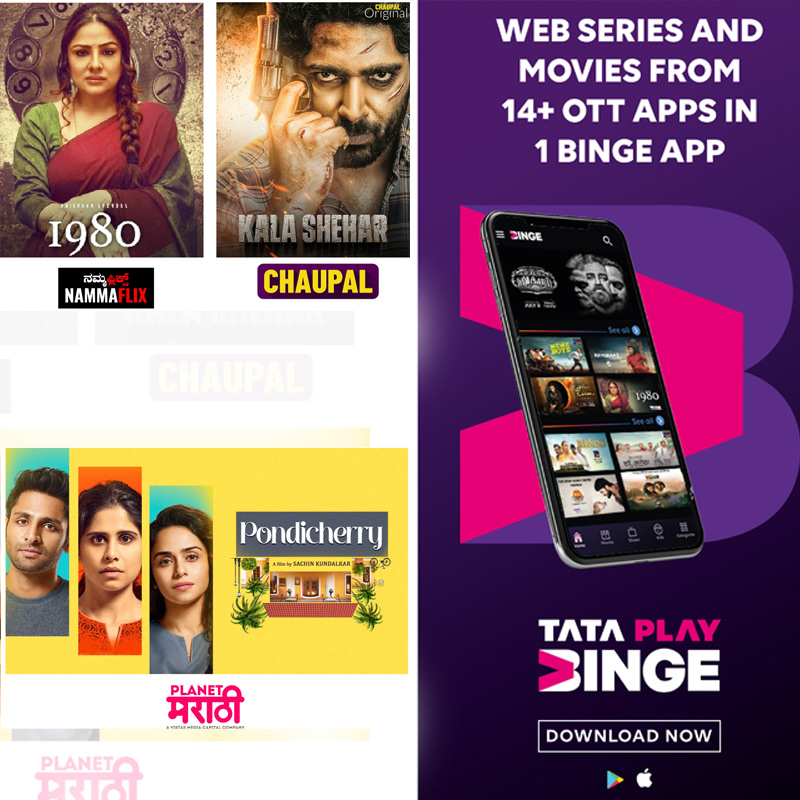
    Mumbai: Tata Play has added three new OTT platforms—Planet Marathi, Namma Flix, and Chaupal—to its Tata Play Binge offering. The platform now offers 16 OTT platforms in one app with diverse content across languages, catering to a pan-Indian audience.

    Chaupal, Planet Marathi, and Namma Flix will bring stories from the world of Kannada, Punjabi, Haryanvi, Bhojpuri, and Marathi entertainment.

    The service can be accessed via the Tata Play Binge mobile app or Tata Play Binge+ Android set-top-box (STB).

    Tata Play’s chief commercial and content officer Pallavi Puri, said, “Carrying forward Tata Play Binge’s objective of bringing the best of entertainment to viewers, we are proud to partner with Namma Flix, Planet Marathi, and Chaupal. The addition of these three new OTT platforms to Binge’s existing partnership with 13 other platforms will enable a wider audience to enjoy stories in their own languages. This will significantly boost content discovery and exploration for Indian consumers, making Tata Play Binge the one-stop solution for all OTT entertainment.”

    “We are very excited to partner with Tata Play Binge to reach a wider audience base. Our vast content library of retro movies and the latest ones will now be available to the Tata Play Binge audience. We are also working towards releasing two new movies every month and aspire to launch some web series as well. We believe in increasing our footprint through our partners and are putting in our best efforts to keep Kannadigas across the country entertained,” said NammaFlix founder & CEO Vijayaprakash R.

    Planet Marathi OTT founder Akshay Bardapurkar said, “We are committed to introducing the power of Marathi content to as many viewers as possible. Our exclusivity and forte lie in the power of creating content of varied genres, through web series, films, non-fiction content, and much more. We have always been the first movers and game changers when it comes to the Marathi industry, and this collaboration is also a step towards the same. Through this association, we will be able to reach out to new users as well as loyal ones through a new channel. We want to aid discoverability, affordability, and accessibility through various media and meet our audience in various convenient ways. We are confident we will be able to merge our strength in content with Tata Play’s prowess in distribution to create a robust viewer community.”

    Chaupal managing director Sandeep Bansal, said, “Chaupal signifies entertainment beyond boundaries, where regional languages and cultures interact, giving a glimpse of the Indian panorama. At Chaupal, we always believed in giving a wealth of choice to our subscribers in terms of new content offerings in their mother tongues—Punjabi, Haryanvi, and Bhojpuri, to begin with. Since its launch, Chaupal has witnessed a huge surge in content consumption on large screens and connected devices. We are hopeful that the partnership with Tata Play will further boost Chaupal’s engagement and help its content traverse all barriers of region and language. We are thrilled about the collaboration between both brands.”

    Tata Play Binge service offers OTT platforms such as hoichoi, Disney+ Hotstar, ZEE5, SonyLIV, Voot Select, SunNxt, Hungama Play, Eros Now, ShemarooMe, Voot Kids, CuriosityStream, EPIC ON and DocuBay. Content from all these platforms is available to the viewers of Tata Play Binge through a single subscription and single user interface.

  • GUEST COLUMN: The role of AI and ML in the media industry

    GUEST COLUMN: The role of AI and ML in the media industry

    Mumbai: There is truly no such thing as “show business!” We have seen the world of entertainment and media shape shift over the last few years, and more dramatically ever since the world around us changed in the wake of the pandemic. The entertainment industry showed a massive fillip during the lockdown years, but not in the way that was expected. The new age of media and social media platforms have transformed the way entertainment is consumed today, and the role of technology has become far more intrinsic along the way too. Everything from how we create, publish, and share textual, audio, and video content to the increasing accessibility of production technologies such as high-resolution cameras, content development software, and smartphones is changing. The landscape is burgeoning with tech-driven innovation both from the delivery and consumption ends of the spectrum.

    With revenue expected to exceed $9.5 billion in 2022 when video ad tech is taken into account, the importance of AI and ML in the media and entertainment sector can no longer be dismissed. While it may not have been an obvious use case earlier, today, harnessing AI and ML to better target homes with advertisements, automate more operations, and secure the operators’ content and services is only the tip of the iceberg. AI has already demonstrated its promise in the music business by producing beautiful tunes and in the world of art with a strong aesthetic influence. It will be interesting to see how AI in entertainment is likely going to have a marked influence on how people interact with movies, television shows, videos, sports, and games.

    Glimpses of this shift are already apparent today. Media firms realise the growing competition they face with new players in the market, right from OTT platforms to social media platforms, vying for the consumer’s attention. There is a swelling urgency to not only produce more content more rapidly but also ensure that the quality and intrigue of the content produced remains top-notch.

    Enter AI and ML.

    There are myriad applications for these two cutting edge technologies, to enable a massive uptick for media and entertainment businesses, right from beta testing of content to gauge interest to creating interactive content to even assessing the right platform for maximum success and viewership. There is a role for AI and ML to play the hero that saves the day at every juncture.

    Some of the emerging areas of application for AI and ML are:

    Knowing your audience: With increased choices comes the problem of plenty too. Audiences that were previously limited to a few platforms for satiating their entertainment appetite are inundated with a plethora of choices. In such a landscape, knowing audience preferences becomes business critical, and media companies that can harness the power of machine learning to understand their audiences more keenly are going to have a definite advantage as we move ahead by being able to provide relevant and engaging content to each individual every single time.

    Feel with your audiences: It’s not enough to just know who your audience is. A step up from the data intelligence that AI and ML provide is understanding how audiences feel each time they view content that is produced by you. Testing your audience’s emotions can help you dive deeper into how the content was consumed and perceived in order to make future bets that are likely to help you win viewer share and also ensure stickiness in an era when customer/viewer acquisition costs are only climbing up.

    Deliver to your audiences: How many times have you heard the phrase “right place, wrong time”? Marketing leaders understand the critical importance of timing in reaching out to customers. The same content that finds resonance at a particular time can have a diametrically opposite response when you catch the consumer at the wrong hour. Emotion AI can help you not only understand how much of the content delivered is falling on the right side of the scale to ensure better results for your targeted campaigns. Retiring the spray and pray approach could be very possible if advertisers and marketers can tap into the hidden potential that emotion AI helps unlock for all the video content that is being produced for their brands’ success currently.

    Engage your audience: If only we could read the minds of our users to know exactly what they have understood and where the gap remains, all our efforts to produce better content in any context would be multiplied. This function is offered by all major corporations, like YouTube, Netflix, Spotify, etc., to improve the dependability and usability of their services.

    AI is also capable of adjusting video quality for internet speed. AI can analyse the internet connections of various viewers in various regions to handle this issue, and it can compress videos without sacrificing their quality to provide a buffer-free streaming experience.

    Advertising and the media

    Advertising, design, and content promotion are just a few of the marketing and trade applications of artificial intelligence in the entertainment industry. The greatest AI algorithms to use when developing solutions for advertising and marketing that are results-driven. With the use of AI-driven marketing software apps, companies may address the needs and preferences of their audience, develop marketing plans, and create efficient customer-centric digital solutions. For instance, AI in the media sector may quickly produce hundreds of eye-catching graphic designs for advertising. Thanks to such cutting-edge and revolutionary technology, manual labour has been substantially reduced, and productivity has increased. Using emotion AI, the advertiser can understand the best demographic to pinpoint their campaign towards to get maximum output.

    For example, if the emotion AI indicates that a person gets the feelings of passion and attachment while watching a football match, it can help the sportswear company understand that this particular audience and this medium work best to reach them through their campaign. By checking the pre-launch creative intelligence output and post-launch creative intelligence output, the campaigns will become more focused.

    Development of AR/VR

    As we are already seeing with the usage of AR in advertising, it’s important to note that in addition to the fundamental use of AI in entertainment, AR and VR app development will also make this area more compelling and immersive. We will be able to watch events from all angles, enabling us to have experiences that are richer and better. AI will assist us in comprehending the sensation of the actual, live event. AI may, however, be used to produce interactive content for AR and VR. With a set of goggles and AI technology, the entertainment sector may work miracles and produce magnificent scenes.

    Consumer interest is naturally drawn to the creation of virtual reality content for cooking shows, reality shows, and live events and programmes based on artificial intelligence. Watching television and movies with true emotional effects won’t be a pipe dream with all these modern technological advancements; it will certainly become a reality. To make this a reality and to understand the concrete effect of the content, Emotion AI will be a tool that will be pathbreaking and extremely important for advancements in terms of what kind of content would be precise for different pieces and scenarios.

    Harnessing Emotion AI

    For any piece of content to succeed, gaining and sustaining the attention of the audience in question is key. If the audience isn’t engaged from the beginning, one has already lost the plot. It, therefore, becomes imperative that the industry puts its best foot forward by testing creatives before the final launch—it helps to gauge the potential. Pre-testing content using Emotion AI helps empower the creators to better understand how pre-launch video creative intelligence can help drive better business outcomes. Emotion AI testing with a pre-defined target audience helps content creators ascertain whether the content is evoking the right kind of reciprocal emotional response. It empowers the creators to understand zones of high and low engagement and modify content for maximum engagement. The organisations can have the emotional AI response outputs mapped to multiple variables of age, gender, geography, time of day, etc., ensuring that the content is never out of flavour.

    Subtitles and automatic transcription

    International media companies should provide material that is relevant to audiences in different locations. As a result, businesses must offer precise and appealing multilingual subtitles for their video content platforms. It may take thousands of hours and effort to hand write subtitles for several films and TV series in a variety of languages. Additionally, finding the ideal applicant to accurately translate text into several languages is challenging.

    Thus, to bridge this existing gap, the powers of AI-based technologies like deep learning and machine learning are harnessed for natural language processing to transcribe movies, music videos, and TV episodes into many languages. To reach a larger audience and foster user engagement, the voice of the movie is translated into several languages with subtitles and audio commentaries.

    For instance, YouTube’s artificial intelligence helps its publishers easily access their material by automatically generating closed captions for videos posted to the platform.

    Metadata tagging

    With the huge amount of content being created every minute, making this content visible to viewers can be an unnerving task for media and entertainment companies. Distributors and media producers like CBS Interactive are utilising artificial intelligence-based video intelligence technologies to thoroughly analyse the footage by detecting and framing things in order to add appropriate tags in order to carry out this task on a wide scale. As a result, any content held by media firms is easily discoverable, regardless of its bulk.

    Due to the intense rivalry and the changing nature of the market, the economic and business models needed to flourish in the digital world are difficult and call for a considerable change in mentality and approach. Customers are the core of the media industry because they are now more powerful than ever. Organisations all across the world are realising that the customer is really the king and cannot be disregarded. By unravelling and experimenting with AI and ML, media and entertainment houses are maximising their business performance and enhancing the user experience and entertainment value with greater efficiency.

    The author of the article is Lightbulb.ai co-founder and CPO Vishal Soni.

  • Aha plans to expand in Tamil market; observes potential business opportunities in Avod model

    Aha plans to expand in Tamil market; observes potential business opportunities in Avod model

    Mumbai: Launched in 2020, video-on-demand streaming service Aha, which provides 100 percent Telugu content, has created its own space in the minds of audiences. Aha, which was dependent on the subscription video on demand (SVOD) model for revenue, has decided to go ‘hybrid’. Subscribers will now decide if they want to watch more ads or in limited numbers.

    After establishing its dominance in Telugu (regional) content, the company is ready to galore opportunities and expand to the Tamil market. In Telugu alone, the company has been able to create more than 1,000 hours of programming on the platform.

    Opportunities in AVOD model

    The advertising-based video on demand is a fast growing market where subscribers access free content. Moreover, the platform leverages advertising revenues to support the service. Speaking in this context during a round table virtual conference recently, Aha senior vice president, content & non-subscription revenue business Vaasudev Koppineni said, “The next big opportunity for growth comes from these AVOD consumers, which is 10x or more than what the paying subscription market is, so it also opens gateways to a great opportunity for a platform to run into profitability as well.”

    The two major focuses that Aha keeps in mind are that they don’t want their audience to have any bad experiences while watching the content, and they don’t want to bombard their customers with 10 or 20 different ads in a short period of time.

    Aha is giving the consumer the choice to select whether to go for an ad-free plan or to go for an ad-based plan. Aha’s vice president and head of non-subscription revenue, Nitin Burman said that they understand that there will be a certain set of users who are ready to pay a premium and get an ad-free experience on their content.

    Adding further, Nitin said, “We also want to come up with live commerce. There, by watching content, you will be able to buy a specific item. We will have that technology where you can click on those shows and directly buy them from an e-commerce partner. We will be offering all those to our consumers as well as to the advertisers to reach out to engage with the consumers.”

    The company has 10 million monthly active subscribers and an overall of 30 million downloads of the company’s app. They also have two million YouTube subscribers as well.

    Focus on advertisers  

    Aha currently has 50 advertisers, including FMCG players like Sprite, Dabar, ITC, HUL, etc., and technology players like Instagram, Zepto, Swiggy including others. Some advertisers such as Sprite, MTR Masala, and Himalaya are integrating advertising into shows.The company anticipates an ad revenue contribution of 15-20 per cent.

    Nitin explained how it will work from an advertisers’ point of view and how regional ads are working for them: “Advertisers also want to reach out to the regional audiences,” he said.

    He expressed that the buying capacity and the market are not just located in the top eight cities but also beyond that. “That’s where the focus has shifted from just going to the urban audience but also to the regional platforms to reach out to these regional audiences,” he said.

    Nitin further added, “This itself has given us the confidence to go on a hybrid future model. Today, what has happened is that after the success of two years and getting two million plus paid users, it has opened eyes for a lot of competitions to actually start targeting Telugu and Tamil audiences as well on all their platforms.”

    Future of OTT

    Nitin believes that the future of OTT in India is definitely a hybrid because, at the end of the day, every business has to break even and has to profit to become profitable as well. “Clearly, the future is hybrid. And with 5G coming, the consumer base is going to increase in this market. So to reach out to that consumer base, the wallet is limited to what they are spending right now. So to get that share, each player is going to come up with a hybrid model where they will want to reach out to premium users as well as to entry-level users with both offerings,” said Nitin.

    Vaasudev added, “You have to give the consumer the convenience in the room who wants to continue to watch content that somebody wants to add to the experience. They should pay for an upgraded experience. If somebody wants to watch the content with a premium, you should be able to go and give it to them in the way they want to, and if there is a consumer who doesn’t want to pay that premium, but wants to consume content with ads, then you should technically go ahead and do that. So, I think it is all about the convenience of the consumer.”

  • OTTplay launches quirky campaign to woo audiences across India

    OTTplay launches quirky campaign to woo audiences across India

    New Delhi:  OTTplay has rolled out a new campaign ‘Maze Karo Multiply’, introducing a one-of-its-kind proposition for the fast-growing OTT audience in India. 

    The campaign takes inspiration from the power of content in bringing together & connecting people hailing from different cultures, backgrounds and demographics. The video ad focuses on the blockbuster content library, which includes availability of 20,000 shows and movies on OTTplay platform, coining the ‘Har Din Kucch Naya Dekho’ catchphrase.

    OTTplay has introduced five curated subscription packs for the OTT audiences, from the ‘Power Play Pack’, which includes all 12 OTTs in one pack to the ‘Jhakaas Pack’ that offers ‘masaaledaar’ blockbuster Bollywood content. The other subscription packages include ‘Simply South Pack’ offering curated regional content, whereas the ‘Chota Pataka Pack’ and ‘Totally Sorted Pack’ brings together an assorted mix of Premium OTT platforms. With these packs starting at Rs 50 per month, the nominal pricing provides access to around 65,000 titles, which are currently available to stream on the OTTplay platform with ultra HD streaming quality.

    Talking about the #MazeKaroMultiply campaign, OTTplay co-founder & CEO  Avinash Mudaliar, “We are delighted to announce the launch of our inaugural ad campaign, as we introduce the brand’s ‘Maze Karo Multiply’ positioning to OTT audiences across India in a quirky way. As category-creators, we strive to provide an exceptionally personalised viewing experience to our subscribers, by enabling audiences to consume relevant content from across genres, languages and platforms. Further, our extensive content library provides subscribers with world-class movies, web series and shows to consume basis their distinctive moods.”

  • Amazon miniTV friendship day campaign creates buzz amongst brands

    Amazon miniTV friendship day campaign creates buzz amongst brands

    Mumbai: Amazon miniTV friendship day campaign #CaseTohBantaHai has marked a new milestone in creating content-led entertaining experiences for its audiences. Interestingly, brands across the vertical started participating in the campaign. 

    When the campaign was unveiled, the streaming service opened the floor to the audiences to put forth an Atrangi Ilzaam on their friends, which is the unifying theme of their tentpole comedy reality show Case Toh Banta Hai. 

    The 360-degree integrated campaign started with Twitterati making funny and outlandish accusations against their friends. Along with that, a barrage of relatable memes inspired by the show also started pouring in. 

    Soon enough, brands jumped onto this bandwagon and #CaseTohBantaHai took over the internet. Over twenty brands including Swiggy, Pizza Hut, Noise, Tinder, Durex, Domino’s Pizza, Baskin-Robbins, Shemaroo, Dunzo, Shaadi.com, Gold’s Gym, PharmEasy, Mad Over Donuts, and Cleartrip joined the digital jest. The brands used this opportunity to poke fun at their customers’ traits, thus leaving the digital-first generation in splits.

    Some of these hilarious ‘cases’ are given below:

    Domino’s

    Swiggy

    Tinder

    Durex

    Pizza Hut

    Baskin-Robbins

    This campaign also coincided with the “Case Toh Banta Hai Celeb 2.0” reveal, which announced a stellar line-up of celebrities who will appear on the show. Concurrently, the celebrities slated to appear on “Case Toh Banta Hai” turned the excitement up a notch higher. Abhishek Bachchan, Shahid Kapoor, Ananya Panday, Chunky Panday, Sonakshi Sinha, Sanjay Dutt, and Pankaj Tripathi, amongst others, took to their social media to answer their summons to the katghara. These posts got people talking and amplified the buzz around #CaseTohBantaHai and also the anticipation for the show.

    “Case Toh Banta Hai,” a one-of-its-kind courtroom comedy reality show, features Riteish Deshmukh, Varun Sharma, and Kusha Kapila in the roles of Janta Ka Lawyer, Defense Lawyer, and Judge, respectively. Each week, a new celebrity appears on the show, facing hilarious accusations and having to defend themselves. Produced by Banijay Asia, Case Toh Banta Hai is the perfect blend of sketches, talk shows, and impromptu comedy. Viewers can enjoy new episodes every Friday for free, exclusively on Amazon miniTV, which you can find on Amazon’s shopping app and Fire TV.

  • Amagi records over 100% revenue growth (YoY) for Q1 FY23

    Amagi records over 100% revenue growth (YoY) for Q1 FY23

    Mumbai: Amagi, a cloud-based SaaS technology for broadcast and connected TV, has reported a revenue increase of more than 100 per cent year on year in Q1 FY23.The company mentioned that the global surge in demand for connected TV devices, as well as the free ad-supported streaming TV (FAST) viewing experience, fueled it. Amagi’s growth accelerated in Q1 FY23, fueled by increased customer acquisition, ad impressions, and employee headcount investment.

    The company said, “The company’s strong all-around performance is a result of impressive traction for its innovative streaming TV solutions. As the rise of CTV and FAST streaming channels alter the TV landscape with FAST penetration among households having more than doubled year over year in 2021.”

    Amagi has kept shifting viewership patterns at the forefront of its innovations, reducing the cost of broadcast workflow and fostering the growth of the FAST phenomenon.

    Amagi has the most extensive FAST TV platform partnerships worldwide, allowing content owners and advertisers to reach new audiences through expanded distribution.

    The company has added new clients, including Cox Media Group and Banjiay Rights. Also, Amagi has expanded its growing global operations and entered new regions — most recently, South Korea and Australia.

    The company has seen increased demand for its products in the United States, resulting in a significant increase in US sales. Amagi has invested in sales, account management, and customer support teams to better serve customers in these regions, adding more than 50 employees to its workforce in the United States alone.

    Amagi recently hired industry veterans James Smith as EVP of Global Ads Sales and Programmatic, Daniel Marshall as EVP of Global SaaS sales, Marco Di Giacomo as chief marketing officer, and Prasad Menon as chief people officer.

    Amagi Live, the company’s premium live orchestration platform, has been updated, allowing content owners to orchestrate broadcast-quality live events on the go.

    Amagi Planner, its content planning and scheduling platform, now has new automation and AI-driven personalization capabilities.

    Amagi CEO and co-founder Baskar Subramanian said, “Amagi’s strong performance this quarter reflects our ability to stay ahead of the technological curve, enabling our customers to capture viewer attention and grow their audience in this ever-evolving market.”

    He further said, “With CTV and FAST clearly becoming the future for the streaming industry, Amagi will continue to build cutting-edge solutions to harness this rising consumer demand and power growth opportunities for content owners, advertisers, and streamers throughout the TV ecosystem.”

    Amagi offers a comprehensive suite of solutions for content creation, distribution, and monetization, and is a pioneer in enabling content distribution to free ad-supported streaming TV (FAST) platforms worldwide.

    Amagi currently has over 50 premium brand platform partners, including The Roku Channel, Samsung TV Plus, VIZIO, LG Channels, Tubi, TCL, Sling TV, Rakuten TV, and others.

    In addition, the company has a cutting-edge cloud broadcast operations centre that can support 1,000+ live linear channels. Amagi clients include content and media companies like ABS-CBN, A+E Networks UK, beIN Sports, CuriosityStream, Discovery Networks, Fox Networks, Fremantle, Gusto TV, NBCUniversal, Tastemade, Tegna, USA Today, Vice Media, and Warner Media, among others.