Category: Gaming

  • GEMS: How talent agencies help young streamers grow & stay relevant

    GEMS: How talent agencies help young streamers grow & stay relevant

    KOLKATA: Shagufta Iqbal aka Xyaa, a young YouTube game caster, quit her job as a computer engineer to stream full-time. Iqbal mainly focuses on Call of Duty but makes sure her streams are a mixed bag. She described herself as more of an entertainment streamer. During a panel discussion at GEMS 2020, Iqbal joked: “I don’t know what to do if streaming fails.” However, she has a back-up plan, which involves branching into vlogging and podcasts.

    Another YouTuber, Ketan Patel, has amassed a following of 7 lakh plus gaming enthusiasts on his K18 gaming channel. Patel rose to prominence with the casting of PUBG tournaments before the game got banned in India. Now, the 22-year-old has ventured into vlogging too. “I am more of an entertainment gamer,” Patel said.

    Clearly, instances of millennials like Iqbal giving up a traditional career to make a living out of gaming are on the rise. According to a KMPG report, the number of online gamers in India was nearing the 400 million mark as of July 2020. It’s a testament to the popularity of online gaming and streaming in the country.

    Both Iqbal and Patel stated the importance of having a positive headspace in order to click with viewers. “You need to have a positive personality for your audiences. It does not to be too fancy but they should get something positive out of it,” added Patel.

    While streaming, gamers can’t let their emotions run away with them either. Iqbal said she doesn’t use expletives and always maintains proper language since there are many minors who tune in to watch.

    Young Indians are earning thousands by turning video games into a spectator sport. Yet, at the outset, many remain unaware of the obstacles they may encounter down the line; or after a certain point, they may flounder to stay relevant.

    Now, these emerging stars are turning to talent agencies to help them work towards their goals. Loco VP operations Firasat Durrani said that the streaming platform is aiming at creating a better product for millions of new gamers. “We have had a huge inrush of casters for the last few months. We have also seen people who were not big on any other platform on social media or had never live-streamed on any other platform actually match up to the number of live streamers who are big on other platforms. We are not just offering a service but also trying to create a level playing field,” he claimed.

    “At the start, no content creator knows that he/she will be a success right from the get-go; everyone starts from zero. And, the idea that you will be prepared to manage expectations is something like a dream and a vision at the beginning. This is one of the hardest parts of the job that we as managers have to do,” added Durrani.

    Trinity Gaming India managing director Abhishek Aggarwal termed his job as “streaming or gaming a viable career for talents”. He went on to say how the industry has grown multi-fold in just two years. Back in 2018 when Aggarwal started his career, there were only two or three live streamers. Now, platforms like Loco alone have a database of 300-400 live streamers. Hence, it is important to keep the talents financially motivated to make them stay in the industry for a long time.

    Talking about the role of talent management agencies, he said that they work as enablers. “We make them do what they want to do. We provide them with whatever facilities they need like creative support, design support, social media manager. We have an in-house business development team that goes out and pitch brands for the talents to help with connections and partnerships,” he explained.

    “Currently, we have 21  partners who are streaming through Loco. We are looking after their KPIs whatever provided by Loco. We are helping them deliver a minimum number of streaming hours, social media shoutcasting, social media partnerships, etc.” Aggarwal added.

    Agreeing with him, Loco’s Durrani cited an example. A streamer from Nepal wanted to get on board with Loco. Since Loco never had a streamer from abroad, the team was full of doubts and questions. The streamer lacked knowledge on how to make money in such a situation. Aggarwal’s agency mediated to help both the creator and the platform.

  • GEMS: How to make e-sports attractive for non-gamers

    GEMS: How to make e-sports attractive for non-gamers

    NEW DELHI: E-sports and virtual gaming in India is no longer limited to one-player play-to-win matches or personal entertainment without any benefits. It is now getting players recognised and driving immense monetisation across the spectrum. A fully-fledged industry now, it is supported by a larger play of schemes: from planning to development, production to play, and broadcast to post-broadcast content. And what has been at the centre of this evolution is quality content. 

    E-sports and gaming content production has come up as a separate genre of its own attracting technicians, creators, influencers, and publishers on board. Although the industry is still in its nascent stage, there is a wide scope for it to grow and flourish. To discuss current trends and the way ahead for the same, an elaborate panel of leading industry experts came virtually together for the Esports Production: Going Remote panel of Games, E-sports & More Summit (GEMS) presented by indiantelevision.com and AnimationXpress.com, co-powered by Tata Communications. The panel was supported by associate partner CapeTitans Games and support partner Loco by Pocket Aces. 

    Moderated by GoLive Games Studio founder and CEO Ravi Kiran, the panel was led by Anand Pimprikar (Tata Communications head sales BD – India, media and entertainment services), gaming/e-sports veteran Anurag Khurana, LXG director e-sports and broadcasting Kiran Noojibail, ESPL CEO Michael Broda, MPL VP-devops and reliability engineering Mukta Aphale, Playtonia Esports co-founder Sanupam Samantray, and Sky esports founder and CEO Shiva Nandy. 

    The speakers unanimously agreed that e-sports and gaming content is not just limited to live streams and India hosts a great pool of talent – be it technicians or players, or content creators who can take it a notch higher. 

    Hailing the role of content in popularising the category, Pimprikar noted: “Content drives viewership and that drives role models (for the upcoming generation of players). Therefore, it is very important to improve the quality of production, say like IPL, on both linear and essential channels.” 

    Multiplayer: The more, the merrier

    On the sporting level, the panellists pointed out that to improve the quality of content in any e-sport or game, it is essential to make it multiplayer and interactive. 

    Broda said on the subject: “What I think about e-sports beside it being skill-based and competitive, it must be multiplayer. In fact, it is important for any sport to be successful. One-on-one games are good for play-to-win, real money-making challenges, but on an overall industry perspective, it is very important to go multiplayer.”

    What makes multiplayer fun, added Noojbail, is that it shows glimpses of players playing the game live, making it interactive for people who are playing as well as those who are watching. “Interactivity plays a key part as unlike other games, you cannot see the player directly while playing e-sports. The entire e-sports perception eventually revolves around what the end-user gets to see and that’s where the value of e-sports content becomes even stronger,” he explained.

    Read more news on the gaming industry

    Beyond game-over

    Noojbail also insisted that there is a dire need to curate good post-content, which goes live after the matches to keep the audience hooked. Aphale pointed out that currently, only the audience that wants to better their own game is watching the e-sports and gaming streams and broadcasts, unlike the tier-1 offline sports. This needs to be changed. 

    Going forward, there are two major aspects that content producers must keep in mind: how to separate the production control rooms (PCR) from the site and then how to virtualise the whole PCR, said Pimprikar.  

    To this end, Aphale suggested that the technology needs to focus on making the mobiles lighter so a player doesn’t have to download a lot of gaming-related programmes, and then let the cloud servers do the entire processing. 

    E-sports a big hit in small towns

    Additionally, the panellists pressed upon the need to take e-sports to grassroots levels in India and equipping the game applications with technology and content support in regional languages. 

    Of the 6 crore active users on MPL, about 83 per cent of the gamers come from tier-2 and tier-3 cities, signifying that the format is already very popular there, Aphale pointed out. Therefore, they are looking for more game developers, technicians, and talents to drive the next leg of growth. 

    Nandy said that his aim is to further expand the presence of e-sports and gaming in every nook and corner of the country. In fact, he has already started providing streaming services in all major south-Indian languages. 

    Training is key to success in global arena

    According to Khurana, the Indian e-sports and gaming ecosystem also requires a strong backend support system in the forms of coaches and trainers. 

    “I feel we have great players when it comes to the domestic circuit but we fail when we go international. It is because we are not focussing on organisation and skill development within the sector. There is a great need for psychologists, coaches, and the whole supporting sports staff within the esports ecosystem,” he explained. 

    Samantray seconded the thought and shared that with Playtonia, the team is already working on these lines. “We are actually working at the grassroots level and are planning to bring a certification as well as a university dedicated to e-sports.” 

  • Game on: Finding balance between user experience and security

    Game on: Finding balance between user experience and security

    KOLKATA: A few years ago, online gaming was regarded as a mere recreational activity in India. With the digital ecosystem reaching a new pinnacle, the gaming industry has observed rapid expansion in terms of users as well as investment. To keep users hooked and grow the existing base, the industry is shifting its focus to quality user experience. Alongside that, the stakeholders are increasing investment in security too.

    In a panel discussion at GEMS 2020, ‘Building a robust backend and infrastructure network’, moderated by indiantelevision.com founder, CEO and editor-in-chief Anil Wanvari, industry experts weighed in on factors that should be considered for user engagement and platform security.

    Name of the game is user experience

    With India being one of the top five mobile gaming markets in the world, Indian players are acquainted with buttery-smooth gameplay and immersive user interface, courtesy global giants like Tencent, Activision etc. If an app is in any way inferior to this golden standard, the consumers would reject it, said GOQII founder and CEO Vishal Gondal. Loco VP engineering Viral Mehta added that keeping users engaged outside of the core game should be of top priority.

    Tata Communications media and entertainment services sales BD head Anand Pimprikar underscored that equal importance be accorded to pre-game and end-game experience. To this end, the use of multi-CDN and the good peering relation of delivery networks can benefit gaming platforms. Moreover, since bandwidth issue has always been a stumbling block in the Indian market, platforms should actively monitor the network to track performance and direct traffic accordingly, he said.

    “Serving things through CDN helps a lot and I think a major part is that you have to write some really good fall back mechanisms. Let’s say your user has a really good 4G network and he is travelling and keeps going from 2G to 3G to 4G, you need to have a really good fallback on your backend and client both. And you render less information on his screen when he is on a lower network to make sure the critical part is always there to give him the experience of playing, ” POCKET52 co-founder and chief technology officer Satyam Verma elaborated.

    Enhancing security: A work in progress

    When there are more fish in the sea, the sharks gather to feast. DDoS attacks are par for the course, but attackers are becoming more and more sophisticated, said Verma. According to him, they read patterns to discover vulnerabilities; in fact, attackers are able to identify and exploit threats even before platforms flag them.

    Read more news on the Gaming industry

    “Hence, you are the best judge for yourself to decide what is healthy traffic. You can identify these are my healthy URLs, healthy traffic, the patterns of traffic. If something is crossing that, it goes into the bad cluster, then we can put some restrictions,” Verma advised.

    GAMES24X7 chief technology officer Sandeep Agarwal said there has been not a day without DDoS attack. Agarwal said that his team protects the platform at all levels using advanced software tools. Hosting an open source software on the cloud service provider has greatly helped the company. Overall, the security situation is steadily improving, Agarwal assured.

    The strength of a program’s security depends on the ignorance of the user. But pirates are smart, enterprising and persistent. They cannot be eliminated, but that doesn’t mean developers are about to throw up their hands in despair.

    “We keep analysing what sort of threat and attacks could come our way and the infrastructure we need to put in place in order to safeguard ourselves. We have third party services keeping those threats away. We have a team that keeps analysing those threats. It’s a continuous development,” Winzo lead backend developer Rahul Sharma said.

    ‘Social media and security risks go hand-in-hand’

    The industry is more concerned about attackers resorting to social media networks to orchestrate security breach, GOQII’s Gondal said. Using social media, attackers can hack user credentials, compromise computers and smartphones with malware, and use phishing tactics to steal credit card, banking and other sensitive information.

    Moreover, fake apps are mushrooming as well. Already, over 500 copycat Fauji apps have popped up on the Android and Apple app stores.

    “We are massively struggling to get that down. These platforms don’t take any of these requests seriously. Also, there are several accounts on Instagram, Facebook, Twitter that sell you fake ids. At one end, while there is the whole server-side security, the bigger security risk is on the social network side where people are getting fooled. Frauds are happening in real money gaming also through passwords, OTPs,” he added.

    The need for cybersecurity in gaming

    Online gaming has a unique kind of duality when it comes to cybersecurity. A gamer is a software user just like any other; he or she is subject to the same security risks and threats as any other user. The same security principles are just as effective and important. However, each threat also involves a unique twist, adding a complication that isn’t seen in any other field.

    As security threats pose a grave challenge for all parties involved, Supercric co-founder and CEO Arvind Sivdas finds that it is better to formulate a security plan while development is in the nascent stages.

    Often, gaming companies tend to overlook security aspects at the initial juncture due to funding concerns, but following the Fortnite fiasco in 2018, they should know better. Even if they cannot fix the threats at that stage, conversations such as this panel at GEMS today may direct them in the proper direction.

    “When you understand a pattern of threat, attackers will come up with a new pattern. You can’t overdesign security,” Pimprikar added.

    Today, attackers have more options to compromise a player’s security at their disposal than ever before. By knowing which aspects of security are the same and which are different, game companies and their customers can protect themselves, and stay safe in a way of life that’s “just for fun” while avoiding potential for real loss.

  • The world of Indian e-sports, according to Nodwin Gaming’s Akshat Rathee

    The world of Indian e-sports, according to Nodwin Gaming’s Akshat Rathee

    MUMBAI: Perhaps because people have been stuck in their homes due to the Covid2019 pandemic, the e-sports industry is bigger and bolder than ever before. For many gaming platforms, user engagement was at an all-time high during the lockdown and even now, the revenues are continuing to pour in.

    Nodwin Gaming MD Akshat Rathee, an avid e-athlete himself has revolutionized the e-sports industry in India and has almost single-handedly expanded the company to the middle east and south Africa. In a virtual fireside chat with indiantelevision.com founder, CEO and editor-in-chief Anil Wanvari, Rathee spoke at length about e-sports in India and the international market and the challenges faced by the industry.

    Online games have three key segments: casual games, e-sports, and real money games (RMG) that are basically skill-based online games played for stakes. However, Rathee said that there is no clear bifurcation between games in India, anything that is digital and has competition is termed as e-sports by people. This is not the case in the US or UK.

    He also highlighted that outside India, the law is clearer on what constitutes gambling, skill-based games and real money gaming. He explained: “In terms of practical implications, an American or European customer is worth far more than the Indian one. But during the pandemic, physical events were cancelled and that impacted the value of sponsorship more in the western world.”

    In India online viewership counts for a lot, said Rathee, citing PUBG live streams that millions tune into. “Even after the ban, the entire segment has grown… In the 45 days since the downfall of PUBG in India, a lot of other games have cropped up,” he observed.

    According to Rathee, game publishers did really well during the Covid2019 pandemic. “New games were being discovered, games like The Fall Guy started becoming very popular. Apart from this, game casters benefited a lot but the algorithms did not favour the smaller players in the market,” he added.

    Read more news on Gaming Industry

    Answering Wanvari’s question on how to clear the clutter and mess that has mucked up the e-sports and gaming ecosystem, Rathee opined that bringing in clear and well-defined regulatory measures is the only option.

    “Having a differentiated definition of the word e-sports that is as per Indian regulation and doesn’t apply to the rest of the world will not work. E-sports is a speed competition. Just because a person has more money doesn’t mean he can play twice. The e-sports game needs to be fair as well so that everyone gets equal opportunity to win the competition,” he explained.

    Rathee defined e-sports as something that has physicality of results. It is the physicality of moves and actions that is the differentiator between the results of the participants. For instance, chess.com clearly mentions that chess is not a sport but a game. He further added, 

    “E-sports are and need to be dependent on publishers. We are the world’s first sports category that is owned by someone from the very beginning. Owner of Kings belongs to Tencent, Bluehole owns PUBG, while Call of Duty is an Activision entity. So it is someone’s property – everything about the game, from the IP, data, rules, players and to the systems belongs to them,” he clarifies.

    Rathee went on to say: “Another important thing is to understand the business of sports. The question arises – is e-sports a B2C business anywhere in the world without the publisher?” In his opinion, e-sports has always been a B2B business, for the simple reason that a sports organization is making money from sponsorship and media rights.

    The gaming industry is at a watershed moment where the youth, information and technology, finance and IT ministry are actively making plans to regulate the sector. But there exists the roadblock of censorship and data privacy. The gaming industry is also stuck between the state and central government over GST issues. Rathee asserted that while the gaming industry is valued at less than Rs 10,000 crores, it’s like the goose with the golden egg for the government – precisely because it holds sway over the millennials and Gen Z, as well as the future of social media.  

    Rathee argued that it is not easy to remove one country from the ecosystem. China also has a regulatory body that makes it mandatory for companies to license the games.

    “China is in a position to ban many e-sports and games because they run the ecosystem. China already has a regulatory body which could say that you have to license games through us without which we won’t let you do it. Due to the fragmentation of the internet, the Middle East is raising concern over their cultural sensibilities. So, it is a very thin line if you put a regulatory framework in place that can be exploitative,” he shared.

    At the end, the question raised is whose interest you are working for. “It is important to have a proper regulatory body in place so that the industry grows,” he emphasised.

    It is high time the industry developed a strident voice of its own, declared Rathee, because most of the world outside India often looks at mobile gaming and mobile e-sports as second-class citizens to the e-sports ecosystem.   

  • GEMS | Monetisation, improved experiences required to level-up e-gaming in India: Dhaval Ponda

    GEMS | Monetisation, improved experiences required to level-up e-gaming in India: Dhaval Ponda

    NEW DELHI: Gaming and e-sports is swiftly going mainstream in India and for the industry, it’s only onward and upwards from here. PUBG ban not withstanding, the sector is giving stiff competition to major sporting events while simultaneously attracting broadcasters, aggregators, players, and viewers – all the markers of a robust ecosystem of growth and success. 

    However, there are still certain areas that need work in order to fully tap into the industry’s potential. At the first Gaming, E-sports, and More Summit (GEMS), presented by indiantelevision.com and AnimationXpress.com, co-powered by Tata Communications, this hot-button issue was taken up and thoroughly examined by industry experts.

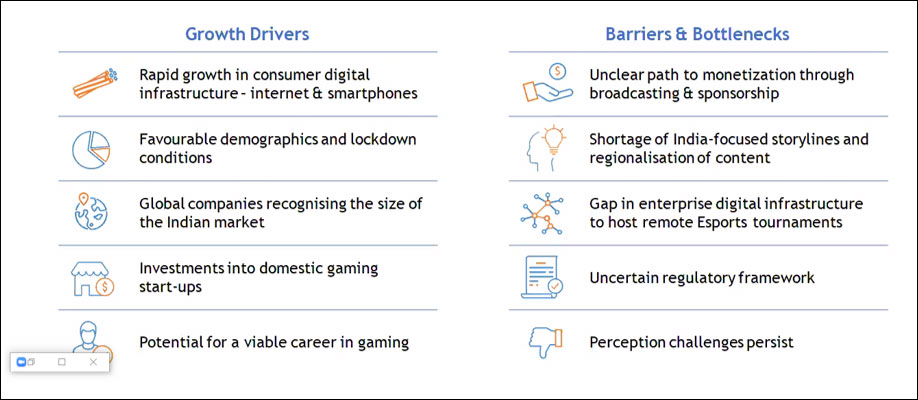
    Opening the two-day-long virtual summit with his keynote address, Tata Communications global head media and entertainment Dhaval Ponda shed light on the emerging trends, growth drivers, and barriers impacting the Indian e-sports and gaming industry. 

    Read more news on gaming industry

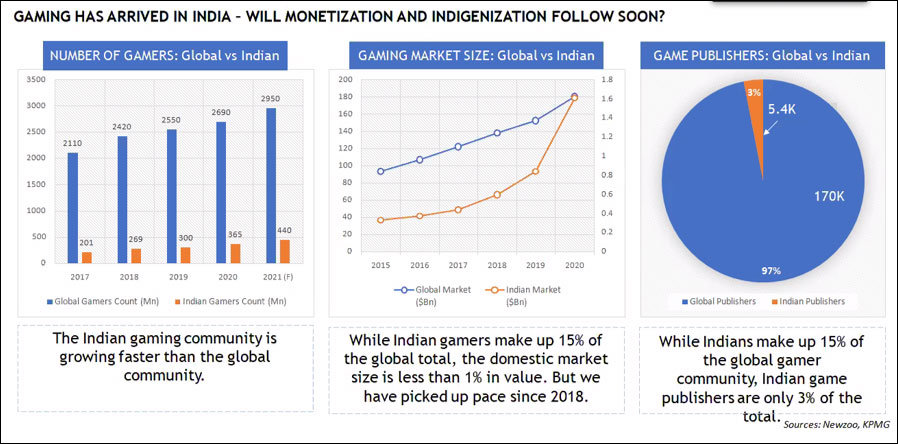
    While the Indian gaming crowd is growing at a faster click than the global community, it is still not getting the right monetisation and publishing support within the country, says Ponda. Indian gamers today make for 15 per cent of the global total but the domestic market size is less than 1 per cent in value. Indian game publishers are only 3 per cent of the global value. 

    Though he insisted that things have started improving since 2018, there is still a lot of work that needs to be done in the sector of broadcasting and monetisation.  

    “We are seeing that e-sports gaming content is now being treated by these broadcasters as good as tier-1 traditional sports, and is being watched by millions of viewers. So, you (broadcasters) are also going to attract the same rights-holding fee that you would charge from tier-1 sports, like cricket and football,” stated Ponda.

    Broadcasts will not only be crucial to gauge interest and get tongues wagging about e-sports,but also sustain andreinforce the community, he explained.

    He added that the platforms also need to consider what else they can do beside streaming e-sports live to grab eyeballs, and make it an wholesome experience for viewers as well as the gaming community. “If you are investing, try and understand how you can be unique in your content. Ask yourself if you can have content outside of just gaming,” said Ponda. To drive his point home, he added: “For example, the way you document the NBA champions. Everyone knows where the player was born, what their history is.”

    Read more news on Tata Communications

    Ponda insisted that a similar culture needs to be developed for players in e-sports and gaming categories too. “People want to know who they (the players) are and where they are coming from. It is the sort of content that also sustains engagement and active viewership.” 

    User-experience is also going to be a crucial factor in promoting and supporting the community. “The digital infrastructure needs to grow leaps and bounds in terms of broadband and mobile internet availability. Furthermore, a sound cloud architecture, transcoding infrastructure and CDN infrastructure is required to have a good viewing experience,” he said.

    Artistic and technical talent for the game development side is quite crucial too, Ponda pointed out, and suggested that the industry take inspiration from gaming studios in LA, London, and south Korea to finetune the culture within India. 

  • PUBG Ban In India: What’s next to fill the void?

    PUBG Ban In India: What’s next to fill the void?

    KOLKATA: The Indian government’s move to pull the plug on PUBG mobile along with other 117 Chinese apps may have come as a rude shock for game aficionado. But gamers aren’t losing sleep over it. Many are quickly reskilling themselves to train guns, strategies, and experiment on other applications. However, it has also left a question for the brands which were investing on these platforms to target younger consumers, media planners seem less worried about the void. The game is banned on mobile, however the desktop version is still available.

    Tech giant Tencent has lost nearly $34 billion of its market value within two days after the news surfaced. According to a report from Sensor Tower, PUBG has more than 175 million installations from India alone which accounts for 24 per cent of the total installations worldwide. The estimates clearly indicate that India was a huge market for the multiplayer battle royale game.

    “The PUBG ban in India is a great opportunity for Indian and international game developers to win some ground. This is an opportune time for the developers of Fortnite, Call Of Duty, and on local soils, Rogue Heist to ramp up their infrastructure so that they can handle the surge of new users that they will start seeing,” Zoo Media CTO and Noesis.Tech founder Siddharth Bhansali says.

    Dentsu Webchutney associate creative director Zubin Jauhari also speaks about the games like Call of Duty. “For brands that are exclusively seeking gaming collaborations, there are games like Call of Duty that they could look to along with some Indian brands as well, he opines. The immediate reach in terms of audience and other engagement metrics will naturally be lower, for the near future,” he opines.

    India has a huge potential for esports. As per the recent industry reports, the industry was pegged at Rs 6,200 crore in 2019 and is slated to cross Rs 25,000 crore by 2022. Experts are witnessing a four-fold growth in the coming days in this sector which clearly indicates a huge opportunity.

    “I believe this move affects Tencent more than anyone else, with several reports on how Tencent’s market value dropped right after the ban was announced. PUBG had a massive following in India, but this move will affect the e-sports industry only momentarily. It opens up the doors for competitor apps to try and capture the market and is a fantastic opportunity for the Indian gaming industry to try and fill the void,” Jauhari adds.

    As soon as the news of the ban on PUBG mobile was announced, Bollywood actor Akshay Kumar announced the launch of a multi-player action game called ‘Fearless And United-Guards’ or FAU-G. The game has been developed by nCore, a mobile games and interactive entertainment company, based out of Bengaluru. It is expected to by out by October end.

    The industry appears to be upbeat about the homegrown apps as it sees a great opportunity. Several reports suggest that the number of people playing online games is set to cross 300 million. The number has grown on the back of affordable internet and members joining from tier 2 & 3 cities.

    “Currently, India is the no.1 country in terms of game downloads, but when it comes to revenue, a significant portion of this revenue is going outside the country. When we talk about digital goods, it is very easy for gaming companies which are settled abroad to add India to their market strategy, there is not much additional infrastructure that they need to invest in. However, if the gaming industry in India was to be dominated by homegrown apps, you can imagine the kind of ecosystem and the employment opportunities that it could generate,” Hitwicket VP-growth & co-founder Keerti Singh says.

    While many experts are drawing similarity with TikTok’s ban as there are hardly any homegrown mobile gaming apps in India unlike short-video platforms. The names emerging as alternatives are Call of Duty(COD) Mobile, Free Fire, Fortnite, Valorant, however, none of them is developed by Indian organisations.

    On the other hand, influential gamers of PUBG are probably busy developing their skills and building followers for their craft on these alternative platforms. Bhansali is of the view that brands need to act quickly to tap into gamers who are building a name for themselves on these alternative battle royale style online multiplayer games so that they can continue engaging this lucrative demographic.

    “Streamers now will shift to other games. The only one that can replace PUBG mobile is Call of Duty mobile and that everyone is playing right now, all the big creators. Free Fire is also an option but the quality of gameplay is very bad for Free Fire. It’s basically a bit childish game. Conversions will definitely go to Call of Duty Mobile,” Trinity Gaming India founder COO Shivam Rao says.

    TSM Entity team manager Sid Joshi also brings up an important point. According to him, banning PUBG mobile will not substantially help other games to grow other than of the same genre. It is barely going to help PC or console gaming as “a Cricket fanatic does not turn into Football enthusiast overnight.” However, Joshi adds that the gamers between the age of 19 to 25 will keep experimenting with similar games as many of them are stuck at home.

    LXG e-sports and broadcasting director Kiran Noojibail also thinks on similar lines. “PC and console games are not going to have any significant impact as PUBG Mobile’s main audience were smartphone users,” opines Noojibail. However, he does not see any alternative yet in similar genre also.

    Against the backdrop of a sinking economy, it is going to be very difficult as shifting to other game needs re-skilling. At the time of TikTok ban, influencers could land on another similar platform with the same set of skills.

    No one can presume exact losses. “Obviously the move will impact the streamer community but as far as the people we manage are concerned, they are not complaining about it, as the decision is in the larger national interest. Everyone is in support of that. As far as brand integrations and partnerships are concerned, we are assuming that they will take a hit but it is still too early to say how big the losses would be,” Rao says.

    He further adds that the major impact will be on the e-sports industry including the tournament organisers, people who are interested in lineups, boot camps and others who had tie-ups with the teams. “Those concerned groups also have to pay salaries to their players. Along with that, platforms and startups like Loco, Rio will be the worst impacted,” Rao mentions.

    Noojibail also shared the same thought. He says, “A number of tournaments were also lined up which would affect the organisers’ revenue badly. Even sponsors have to re-strategise their plans. It will take at least take a couple of months before the storm calms a bit. It is a very substantial loss for the industry”.

    (With inputs from Mansi Sharma)

  • “Esports content consumption will grow 3x by 2021”: Nodwin Gaming’s Lalita Nayak

    “Esports content consumption will grow 3x by 2021”: Nodwin Gaming’s Lalita Nayak

    After her degree in English Literature from Ramnarain Ruia College, Lalita Nayak went on to work with some of the biggest brands including Times Group and JP Morgan for brand strategies and advertising, sponsorship and more.

    As she mentions, she has been a marketer for a large portion of her career and has driven operations at some respected positions. Having seen the axiomatic paradigm shift with the advent of digital, she is a seasoned marketer with valuable experience. A few months back, the marketing veteran joined NODWIN Gaming as the head of sales and marketing to drive the brand to further success after a stint of almost six years with CNBC-TV18 as the head of marketing (west).

    Esports being a fairly new industry is already turning heads. According to a market research report, the global esports market is expected to grow from $1.09 billion in 2019 to $1.11 billion in 2020 at a growth rate of 2.16 per cent. The slow growth in 2020 is mainly due to the economic slowdown across countries owing to the COVID2019 outbreak and the measures to contain it. The market is then expected to grow and reach $2.11 billion in 2023 at CAGR of 23.82 per cent. North America was the largest region in the esports market in 2019. The Asia Pacific is expected to be the fastest-growing region in the forecast period.

    Indiantelevision.com group’s Krishanu Ghosal spoke to Lalita Nayak to get an idea on what to expect out the market and NODWIN Gaming. She was precise and insightful about best marketing practices and her newfound love for the gaming and esports industry.

    Edited excerpts:

    Let’s talk esports, this is your foray into esports, what do you feel about the transition?

    You’re right. I’ve not worked with the esports industry before. Earlier I used to work for television and news and I’ve worked with a few renowned media houses. In both places, the audiences were very mature and evolved. Gaming or esports has a very different audience. The audience is diametrically opposite. The consumption of esports-related content is mostly done by an age group and almost 60 per cent of our audience is in that specific age bracket. I won’t say they are mostly but they are primarily in the 16 to 24 age group.

    If you could elaborate a little more on that?

    Today’s 11 to 24-year-old age group hardly watch TV; they are all on OTT platforms they are all consuming digital content. The generation after that I am not even sure, they will be even more specific, I think. So, my audience majorly stays on a platform like YouTube. It provides interactive entertainment. You are sitting and watching stuff on YouTube and reacting to it live. Esports has grown over the past few years in India. It’s not just about active views but about active interaction with the game. They are no longer sitting and watching they are actually commenting on it.

    What about the audience?

    This audience has a mind of its own, this audience believes that they understand the world and they also want to change the world. So, there is a big difference and this is, of course, connected to the next generation, the future. The next set of entertainment sport will be coming from this sector is what I believe.
    .
    What are your views on the Indian esports scenario as opposed to the southeast Asian or the western counterparts?

    The southeast Asian (SEA) counterparts have developed a lot. So, in places like Thailand, the Philippines, they have an evolved set of audience. There is a vast difference in the scenario between SEA and India because their audiences consume far more digital entertainment. We have other issues such as huge parts of our country surviving on 2G network.

    What do you think can be done to make Indian esports much more lucrative for brands?

    Firstly, it is the comparison that the marketers make between traditional activation of a brand vs esports. Esports is a very niche industry where we need specific branding to people who understand gaming and are strategy-oriented. This consumer base has a very stoked up interest and they have very particular preferences. So, our first interaction is to make them understand the fan base.

    The second thing about esports is that there is a lack of standardisation. For example, when the tournaments arrive, everybody proclaims that they are the largest tournament in the world. Is that really true? So, those things create an imbalance in the market because the contradiction is there.

    What about the shift in marketing paradigm?

    Most marketers need immediate results and in esports that cannot be. It will take time. That doesn’t mean it will take two decades but it is a bus that nobody should miss. When I started my career around 2013-14, digital was something that didn’t exist. It was two or three per cent of the marketing budget. Today in esports it is almost 100 per cent. For other brands from 30 per cent in March, it has gone to 80 per cent. Esports is something you don’t want to live without. It is a bit more complicated with much more novelty. It is an industry full of people with a lot of passion, who love challenges and gaming. I am talking about people who are not just a part of this industry, I’m talking about people who are actually viewing and playing.

    Let’s talk about viewership.

    Our viewership has gone up by 50 per cent in the last four months. In fact, recently I was talking to one brand and it was astonishing. They told me that there is a group of people of a particular age group about 14 to 24. They were either studying or playing games. They were not even watching a lot of content because there was no new content coming out on OTT platforms. Recently in the last month, we’ve started posting fresh content. Every day we were streaming live for three to four hours over the last three months.

    So, the pandemic has been kind of a boost for you as well?

    Well, yes, there has been a massive reach for us. Let me put it this way, it has been a catalyst. So, what may have happened a year later has happened a year earlier. See, what happens is when you’re involved in work or you’re going to the office, you think there is a schedule. But when you’re sitting at home and you’ve watched every new thing that has come on OTT platforms and your child is playing a game, you would like to join.

    What according to you should be the role of an esports marketer catering to the Indian market?

    Esports marketer is a combination of a conflict manager and a community manager. You should provide the right brand solutions and ensure that you speak regularly with your consumers. My audience has very less tolerance level but I will say that their tolerance for inefficiency is very low. They could judge you as inefficient so you have to ensure that you put out the right content every time.

    Do you see more brands coming into the Indian esports ecosystem in the next one year? 

    I see that if a brand is not a part of this yet, they will inevitably be curious about it.

    How is the market in terms of languages, the regional ones?

    Our viewership in Hindi far exceeds English. It is no longer an elitist game and that’s why there has been an upsurge in Hindi shoutcasting as well. We have started getting branches from our service providers that we need to put out content in other languages. So, we are now branching out in other languages like Hindi and Tamil as well.

    How do you tackle the challenges for the stakeholders of the industry?

    I am extremely proud to tell you that our teams are evolved and evolving a lot. They have very smart mechanisms and knack to ensure that such problems are not created. We have ensured that we value a particular rule. As I mentioned, there is a lack of standardisation. So, every time it brings in new challenges, we are learning and evolving. We craft a smart enough solution and we solve it first. We try to solve them before things get out of hand. To answer your question, there is a standardisation issue but most of it is often smoothened out by our teams.

    Taking everything into account, the pandemic, user count increasing, participation, more deals for everybody, where do you see Indian esports in the next two years?

    The industry is evolving so quickly that we are trying to catch our breath. Inevitably right now, the digital content space is taking up a major percentage of the nation’s content consumption. I have a feeling that the percentage right now that is esports occupied is going to double or triple go higher in the following year. The viewership, which is perhaps right now huge, will only grow. Live streaming something is yet to be recognised by a lot of marketers and is something we need to engage with.

    (The article is sourced from https://www.animationxpress.com) 
  • Nippon TV’s hit smart phone game “Hunter × Hunter” expands to Taiwan, Hong Kong and Macau

    Nippon TV’s hit smart phone game “Hunter × Hunter” expands to Taiwan, Hong Kong and Macau

    MUMBAI: Nippon Television Network Corporation (Nippon TV), Japan’s multi-platform entertainment company, has announced that it has expanded the territories of its hit smart phone game arising from the highly popular animation IP HUNTER × HUNTER. The game is developed by Lantu Games and had been released in China on Tencent Platform to overwhelming success in December 2019. Answering to the many requests for its release from fans in Taiwan, Hong Kong and Macau, the game was officially published today by MoreFun Game in the regions. With over 800,000 pre-registered players to date, the game is already attracting high attention.

    HUNTER × HUNTER is originally a manga written by Yoshihiro Togashi on “Weekly Jump”, a weekly manga magazine with over 50 years of success in the competitive industry. Nippon TV created the animation version that started airing in 2011 to immediate success in Japan and was also sold to almost 200 territories globally.

    HUNTER × HUNTER continues to be a very popular IP, and its business has expanded from the original manga to animation and feature film (created, aired/streamed and distributed by Nippon TV, which is a member of the Production Committee), to many other fruitful businesses that span from multiple successful merchandize realizations to even cafes, and now digital games.

    “After the global success of the animation series and a hit game enjoyed by anime and game fans on China’s Tencent platform, we immediately started talks on expanding the HUNTER x HUNTER smart phone game to other territories,” said Nippon TV international business development sales and licensing head Sho Shimada.

    “We were able to work with an enthusiastic publisher and are happy to release this in such a short time. The game took several years to develop, and we are confident that it will bring much fun and excitement to fans in Taiwan, Hong Kong and Macau. We are also in the developing stages of other games based on the exciting story of HUNTER × HUNTER and are strategizing to further strengthen this magnificent IP,” added Shimada.

    Follow Tellychakkar for the consumer facing news & entertainment

  • Pocket Aces’ Loco, Fnatic enter into long-term, multi-pronged strategic alliance

    Pocket Aces’ Loco, Fnatic enter into long-term, multi-pronged strategic alliance

    NEW DELHI: Leading live game streaming app- Loco announced a long-term partnership with global esports organisation, Fnatic, in a first-of-its-kind partnership for the Indian gaming ecosystem.

    Fnatic is one of the world’s preeminent esports organisations and has an unrivalled decade-long legacy in a variety of games like League of Legends, Counter-Strike, Dota 2, and more. The company is now pioneering the PUBG Mobile esports space with its squad-based out of India.

    As part of the partnership, Loco will onboard Fnatic India’s entire roster onto the app (which include some of India’s leading streamers and gamers) who will broadcast exclusive content on Loco.

    Loco and Fnatic will also co-create unique esports content together. This includes multiple tournaments and non-fiction shows. The two companies believe that esports content is in a nascent stage and the coming together of two organisations with a strong content pedigree will deliver unparalleled entertainment to gaming fans in India.

    Pocket Aces founders Anirudh Pandita and Ashwin Suresh said, “Fnatic and Pocket Aces share a common vision of building a sustainable esports ecosystem in India. We want to provide Indian esports and gaming fans, world-class gaming entertainment across formats and this partnership will ensure that this shared vision is realised very soon. Fnatic has made a strong commitment to Indian gaming and as the home of Indian gaming, we are delighted to welcome them!”

    Fnatic lead India Nimish Raut said, “At Fnatic, we are dedicated to entertaining our fans through content and new formats of gaming. We believe that esports has the potential to be the top form of entertainment in this country and these shared thoughts make Pocket Aces and Loco the perfect partner as we seek to level-up the content play in India. As a pioneer in the digital content space, Pocket Aces has a history of building entertainment channels from scratch and working with one of the best talents. We are thrilled to be working with Loco to build the future of esports and entertainment together."

    In the last few months, Loco has seen a surge in streamer signups which has been ~ 50x more than expected. Recently, Loco also hosted an exclusive partnership with another esports giant – Skyesports for a ‘Grandslam Tournament’ across five game titles. The association between Fnatic and Loco started early April this year, for a PUBG Mobile charity tournament called #GamingForGood that witnessed a total viewership of 5.8 million.

  • NODWIN Gaming and Airtel announce partnership to take e-sports in India to the next level

    NODWIN Gaming and Airtel announce partnership to take e-sports in India to the next level

    MUMBAI: NODWIN Gaming, South Asia’s leading e-sports company, announced a partnership with Bharti Airtel to further grow e-sports in India. The partnership has been kicked off with the launch of Airtel India ESPORTS TOUR, which is the first and largest property of its kind in this segment.

    Airtel India ESPORTS TOUR will also have a national ranking and awarding system for Indian e-sports players based on their year-long performance across top tournaments, and this will be used as a base to create a points table for all participants, an official press statement states.

    Airtel India ESPORTS TOUR will initially cover all NODWIN tournaments across gaming titles of PUBG Mobile, CS:GO, Clash of Clans, FIFA, etc. The coverage will extend to all iconic NODWIN tournaments such as the India Premiership by NODWIN, DreamHack India, The Northeast Cup, KO Fight Nights, and PAN Fest. This will also cover NODWIN operated tournaments such as the PUBG Mobile Pro league in India.

    NODWIN Gaming founder and managing director Akshat Rathee says, “NODWIN Gaming believes that by binding the elements of independent tournaments into a single storyline we will give rise to a new culture in the competitive world of Indian e-sports. The teams and players will now look up to perform throughout the year rather than focusing on a few big standalone tournaments in a year.”

    At the end of the annual tour, the final leader-board across games will be presented to recognise and reward the winners at an award show celebrating the key players in the ecosystem, the e-sports athletes, the teams, the talent, the best plays, etc. 

    The broadcast of the Airtel India ESPORTS TOUR will be available on Airtel’s digital platforms and help with taking this emerging format to newer audiences.

    Bharti Airtel chief product officer Adarsh Nair says: “We are thrilled to partner with NODWIN to unlock the potential of e-sports in India. Airtel is an enabler of digital lifestyles in emerging India and youth are at the core of our brand proposition. We look forward to a deep and long term collaboration with NODWIN as we embark on this exciting digital journey.”

    Initially, the Airtel India ESPORTS TOUR will be seeded by NODWIN in its extensive tournament network and will aspire to be a platform where all tournaments will carry an agreed weightage independent of the organizer. The ecosystem will allow the flexibility of choice for players to play what they want and when they want.