Category: Gaming

  • Fantasy Sports is integral to sports growth in India

    Fantasy Sports is integral to sports growth in India

    New Delhi: During a fireside chat at the 10th Global Sports Summit: FICCI 'TURF' 2020, Harsh Jain, CEO & Co-Founder, Dream11 & Dream Sports, discussed how fantasy sports is a digital sports engagement platform that has a direct impact on sports and Indian economy, both in terms of growth and innovation. 

    On the growth of Indian Fantasy Sports, in his inaugural speech, Shri. Kiren Rijiju, Hon'ble Minister of Youth Affairs and Sports said, “I also see how fantasy sports is fuelling sports consumption. It is very important. Online fantasy sports is very instrumental in revolutionizing the manner in which sports enthusiasts engage with their respective favourite sports.” 

    When asked about the impact of fantasy sports in the sports industry, Harsh Jain, CEO and Co-Founder, Dream11 & Dream Sports said, “India is a pretty big market with a billion sports fans, and so we cannot be a one-sport nation. The problem is that sports as an industry is built as top-down, meaning, it is all about mass and scale. We want to build it bottoms-up, and so, we want to focus on other sports that have pockets of users, and in India, even pockets can be lakhs of people. Fantasy Sports changes the way you consume sports – you don't just follow the top team or the team you like; you follow everyone to see the value picks, research, knowledge, chemistry for every player, and sports consumption goes through the roof. It's based on the actual sports match, and on real-life events and it's not available 24×7.” 

    Talking about the potential of fantasy sports in India, Dr Sangita Reddy, President, FICCI, and Joint MD, Apollo Hospitals Group, said, “Online Fantasy Sports industry is actively working to develop and strengthen, and provide meaningful impetus to the entire sports ecosystem and is committed to creating impact dual partnerships for the government and other organisations to help realise the true potential of sports. The industry is committing a corpus of INR 20 crores in FY 2020-21 and will be deploying an additional INR 50 crores in FY 2021-22 to aid and facilitate the development of sports in the sports ecosystem in the country.” 

    Online Fantasy Sports (OFS) is a digital sports engagement platform that is dependent entirely on real-life sports. It has become one of the primary sources of sports engagement for avid fans and mature users. Sports fans create virtual teams on a fantasy sports platform, for an upcoming live sporting event based on their sports knowledge and skill. They compete against other teams based on the statistics generated by the on-field player's performance. Participating in fantasy sports platforms increases sports consumption as a sports fan follows the matches, teams, players, venue conditions etc. more closely to be able to create a successful fantasy sports team. 

    Some key insights shared by Harsh Jain on OFS during his session: 

         The format of Online Fantasy Sports ensures that sports enthusiasts follow the game more keenly, and this directly results in increased focus and attention towards sports. Fantasy Sports users watch 60% more sports 
         OFS provides sports fans with a transparent, non-addictive form of engagement 
         The majority of time spent by a fantasy sports user is on sports research, analysis and following the underlying real-world match, with fantasy sports participation being only a small and episodic fraction of the time         spent by the user in relation to the activity 
        OFS increases sports viewership, and this symbiotic relationship between OFS and real-life sports ensures that the interest of fans does not waver, especially at a time when physical presence in stadiums is not possible
        The emergence of these services has opened up new avenues for economic growth, investment and employment 
        OFS to contribute INR 13,500 Crores in taxes to the Indian government in the next five years
        Fantasy Sports industry to generate FDI more than INR 10,000 Crores in the next few years
        FS to create 12,000 additional jobs via direct & indirect employment   
     

  • Mobile games are the next big advertising frontier: GreedyGame’s Arpit Jain

    Mobile games are the next big advertising frontier: GreedyGame’s Arpit Jain

    NEW DELHI: Digital entertainment formats have become hugely popular across India, with the Covid2019 pandemic further accelerating the shift to online modes of pleasurable pastime. One of the prime beneficiaries has been the mobile gaming ecosystem. It is already amongst the top five globally and as per Statista, will be worth about $2.4 billion in 2020, up from $600 million in 2017. However, despite the marvellous growth it has been witnessing, there is still a lot of grey-space to be filled when it comes to advertising revenues. That’s where GreedyGame comes into the picture. Headquartered in Bengaluru, GreedyGame is a mobile-first native ads platform that helps app and game publishers monetise better and help acquire genuine users globally. 

    Founded by IIT Ropar alumnus Arpit Jain in October 2013, GreedyGame is solving the fundamental problem for mobile publishers and advertisers – how to run ads without disrupting the user experience.  

    With the backing of renowned investor institutions such as Times Internet and angel investors including Ankit Nagori from Curefit, Sujeet Kumar from Udaan, Ravi Garikipati from Davinta, Anuj Choudhary from Aalgro, etc, GreedyGame has been growing 100 per cent YoY since its inception in 2013, and has reportedly clocked more than 4X in this FY. It is currently helping more than 200 app/game publishers to monetise higher and acquire quality users across the globe, including Dream11. 

    Jain tells Indiantelevision.com, “We started GreedyGame with a mission to empower mobile developers to develop world-changing apps and build the most engaging games without constantly worrying about revenue. Hence, we created an end-to-end implementation, mediation and optimisation platform for ads.”

    With its unique software development kit (SDK), GreedyGame enables app developers to run native ad units customised for their app experiences. It also helps app and game publishers increase their users globally by helping them with the right user acquisition strategies and optimising their campaigns on multiple mediums including Google and Facebook ads.

    “Our strategy is simple, to first study the app in order to understand better and come up with an app-specific monetisation strategy. GreedyGame SDK, which is enabled with the ‘smart refresh’ feature, picks the best model for app monetisation customising to the developer’s needs. Our AI-enabled recommendation of dynamic ad unit templates also helps publishers of all sizes to implement native ads effortlessly. The cross-format support enables developers to try a variety of ad formats like banner, interstitial and native in single ad space and modify the ad format as they like. We help publishers implement native ads in their apps in a hassle-free manner, making sure that their revenues are optimised, without any policy violations, and also keeping the users happy,” he elaborates. 

    GreedyGame also has a dedicated team of marketers who run Google, Facebook, and other media campaigns for app publishers. “Currently, we are managing 50+ publishers Google Ad accounts. We are able to generate approximately three million+ installs at an optimum CPI,” he adds. 

    Jain notes that the Covid2019 pandemic has further created a flourishing environment for online and mobile gaming ecosystem and that has pushed more and more brands to utilise the space for advertising. 

    “Online gaming, primarily on mobile devices, has become massively popular in India. 50 per cent of mobile app users play games, second only to social media and communications apps in terms of time spent. During the months of lockdown, people spent significantly more time on their phones and there was a surge in the downloads of popular games such as Ludo King, PUBG, etc. If we look at the data, taking an example of IPL-related gaming apps, 88 per cent of audience profiles were playing on these apps during the recent IPL season. So, when the user base is that huge it definitely is something that lures the advertisers. Brands have started working on independent budgets for capturing gaming users and big brands like Oppo, Flipkart, Amazon are increasingly opting for mobile advertising considering the reach,” he shares.

    Jain illustrates this with an example: streaming giant Netflix recently claimed that Fortnite, a popular multiplayer shooter game, is a bigger competitor than rival streaming platforms like HBO in the US. “Big brands like Cadbury, Tesco, Heineken, Flipkart, Amazon etc believe that it is easy and the ROI in gaming ads is higher. Brands like Unilever, Coca-Cola, and Ford invest heavily in mobile gaming, and many of the early-adopting brands look at mobile gaming as the new social media in terms of the opportunity to engage with consumers at scale. Molson Coors is another example of a brand advertiser that has been ramping its media investment in gaming and e-sports for many of its most popular brands like Miller Lite and Coors Lite.”

    Today, ads are a major source of revenue for game publishers as only 0.25 per cent of total users pay for IAPs (In-App Purchases) in India, remarks Jain. “Rewarded ads are the biggest ad revenue-generating format in games. India is among the lowest eCPM (effective cost per thousand impressions) countries in the world, so LTVs are very low. Hence, the user base needs to be high to make sustainable revenues from ads and games need to generate organic traffic. Most successful games are localised – for example Ludo, cricket, card games etc – which is why they get organic traffic and are able to generate sustainable revenues.”

    He believes that there await a plethora of opportunities in the in-game advertising industry and he is willing to capitalise on that, helping the publishers and advertisers alike to generate maximum ROI.

    “GreedyGame intends to work with app/game publishers who are making money via ads and maximise their revenue through our SDK. Our plan is to become the market leader in the genre of mobile-first advertising through native ad formats. We aim to work with 1000+ publishers by the end of next year,” he signs off. 

  • Lumikai & Loco partner to host Game Night on 26 Nov

    Lumikai & Loco partner to host Game Night on 26 Nov

    New Delhi: Gaming has emerged as one of the extremely promising categories of the future and is entering into the mainstream. Starting from equipment manufacturers to game creators and gamers, the industry is expanding rapidly with every passing day. Youth is now beginning to opt for gaming as a full-time career and agencies are now working very closely with brands and game developers to create a synergy.

    The category has created a lot of excitement in the marketing community. Multiple brands across categories are now utilizing games as a medium to connect with their audiences as they understand that people, especially youth, are spending their time gaming. The category is slowly catching up pace in the media mix of a brand.

    In the last few years, India has emerged as one of the top five gaming countries and most of the players prefer mobile over a personal computer. Interestingly, India is a mobile-first gaming market. Today, gamers include both males and females. Several experts have also suggested that the average age of a gamer in India is less than 20 years. There is a lot of younger audience and it is the freemium model that is leading to the growth in India.

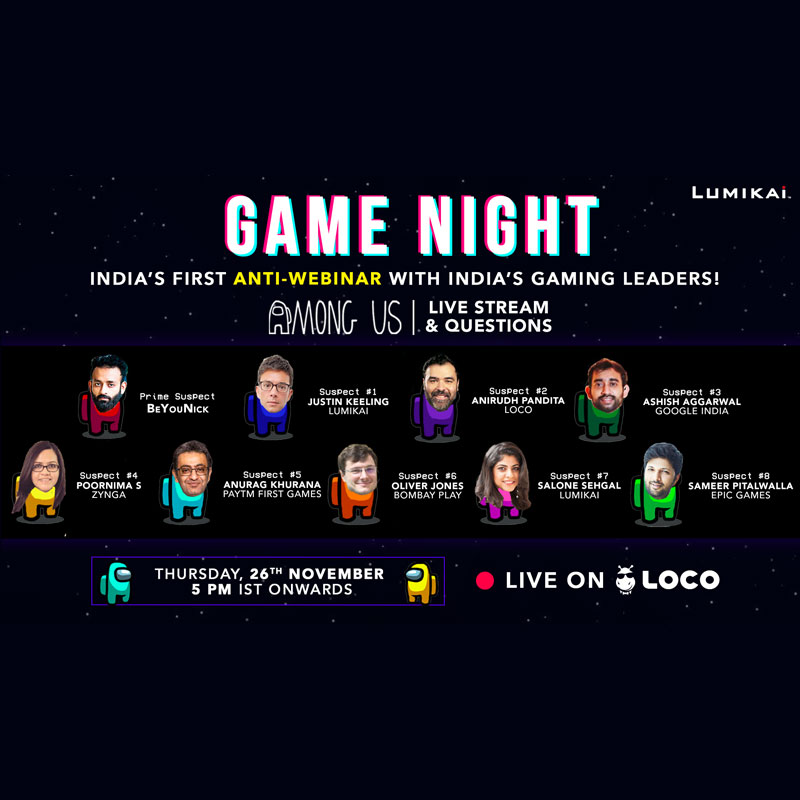
    With an idea to expand the gaming ecosystem, Lumikai and Loco have organized a Game Night on 25 Nov for gamers, start-up founders, indie studios, and creators for a chat about gaming, entrepreneurship, building content and India’s growing games ecosystem  

    The night is hosted by BeYouNick (YouTuber) along with Justin Keeling and Salone Sehgal (Lumikai), Anirudh Pandita (Loco), Ashish Aggarwal (Google India), Sameer Pitalwala (Epic Games), Anurag Khurana (PayTm First Games), Poornima.S (Zynga), and Oliver Jones (Bombay Play). 

    Tune in live on Loco on 26 November at 5 pm. 

  • TORF extends support to online gaming regulation

    TORF extends support to online gaming regulation

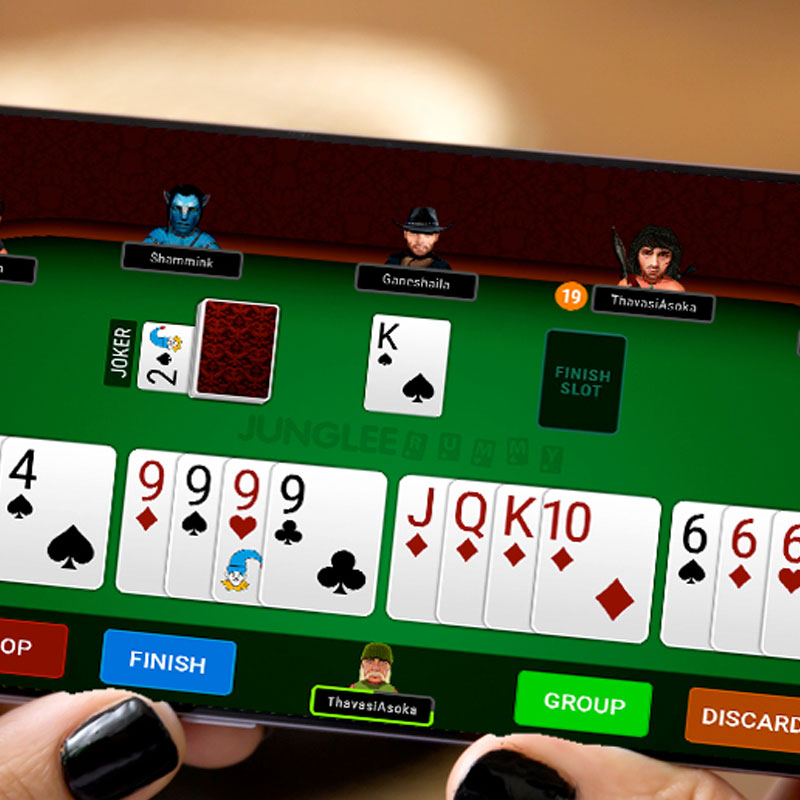
    NEW DELHI: With the Tamil Nadu government taking an increasingly hard line on online gambling, The Online Rummy Federation (TORF) has stated that it welcomes the move to regulate the sector. At the same time, it wants to ensure that any new regulation is not prohibitive and builds in protections for consumers and operations of legitimate operators. 

    The statement comes in the wake of additional advocate general Sricharan Rangarajan informing the Madurai Bench of the Madras high court that the state government was actively considering regulating the online skill gaming sector.

     “The government is worried about the recent suicide reports related to online gaming. These recent events are of grave concern to TORF and its members. Over the last two years, TORF members have taken extraordinary and voluntary steps to self-regulate and give players the tools to play responsibly,” the federation said in a press note.

    The key areas of consideration will include: KYC verification; minimum age; player protection requirements; mandatory responsible playing features like setting daily monthly limits, self-exclusion etc; advertising guidelines; no BOTS on sites; SSL level encryption; and other such requirements to ensure player experience is safe, fair and enables responsible gaming.

    The federation added, “We strongly feel that the government should regulate this sector to ensure only legitimate, legal operators who follow strict protocols are allowed to operate and a clear distinction drawn from those who try and operate above the law. Tens of thousands of players from Tamil Nadu enjoy playing online rummy safely and responsibly. Effective regulation will let the vast majority of the players who play responsibly continue to enjoy the game, protect the players that are vulnerable, and lead to substantial additional revenues for the government.”

    It also suggested that the government of Tamil Nadu should set up a committee to review, discuss and propose a regulatory framework for games of skill, similar to Nagaland and Sikkim. A discussion for a proposal to regulate this industry can address many concerns including the following key points: setting time and monetary limits for players on a daily/weekly/monthly basis; stronger KYC checks and social profiling of users to ensure that players are financially stable adults; strict advertising standards to promote gaming as entertainment and not a way to earn money; an annual license fee and a player support contribution to help vulnerable players. 

    “TORF is committed to providing its full support to the government in creating a safe and responsible gaming industry. We have already made an official representation to the chief minister to kindly consider regulating the sector as a win-win solution,” promised CEO Sameer Barde. 

  • GEMS 2020: Indie game developers continue to rise and shine!

    GEMS 2020: Indie game developers continue to rise and shine!

    MUMBAI: When compared to the gaming scene in the U.S. and Europe, India's indie game development space is taking baby steps. But indie creators are making headway and getting noticed. 

    During the “Make in India: Indie Game Developers Speak" session at GEMS 2020, industry experts discussed various aspects of their indie game journey; right from their struggles during the Covid2019 pandemic to successfully launching games on various platforms while working from home. Apart from that, they gave insights on how to build a game from ideation to execution.

    The concluding session of GEMS 2020, “included and game designer Avichal Singh, Xigma Games co-founder Manwani, Underdogs Studio founder and CEO, Lucid Labs founder Chirag Chopra, , CapeTitans Games co-founder and CEO Kayal and was moderated by Photon Tadpole studios founder and CEO Hrishi Oberoi.

    Watch the session here:

    The challenges that Indie game developers face are many. For one, they put double the effort as compared to any large-scale gaming company. Two, they work with limited resources. But through sheer talent, grit and passion – they are making a mark.

    Take for instance Raji: An Ancient Epic which came out on Nintendo Switch and Steam and became a runaway hit. Nodding Heads Games co-founder Avichal Singh, the lead designer behind the game, shared how the team managed to collaborate on work in the middle of a lockdown.

    “When the pandemic started, we had our deadline and we knew we had a crunch. We met our milestone and did not let go of the opportunity. Earlier, the programming team was in one room. But when the lockdown was imposed, we shifted our operations online to launch. That is when we realised how it has slowed down the entire process. Pandemic took a toll on the game’s development,” Singh rued.

    Himanshu Manwani, whose Xigma Games recently released The Bonfire 2: Unchartered, experienced the same troubles. The process took double the time while working from home and doing quality analysis was very challenging. “The pandemic hit exactly at the time when we were about to launch the game when we actually needed to sit in one room and discuss. The quality of the game suffered,” he admitted.

    Consequently, the game’s initial launch was met with its fair share of negative reactions from users who noticed the glitches during gameplay. However, Manwani continued to work on the issues, the team released a patch which perfected the wonky areas, and now they are getting positive feedback.

    Watch more news on games: CapeTitans Games on bridging the gaps in game creation

    Debasis Kayal is not a game developer but his company, CapeTitans, works closely with indie creators by investing money in their projects. He noted that the pandemic has given a lot of opportunities to the overall gaming industry. Many new companies were formed during this time. During the lockdown, more people got into gaming, and developers also got the time to explore creative fields.

    “For indie game developers, influence or love has mapped towards creation. Some like mythology, ancient history, some like strategy, and accordingly they channelize their interests and passion through their work. The very first attempt that they did to roll out their game was out of love or being influenced by something,” said Vaibhav Chavan.

    The Underdogs Studio founder stated that innovative ideas are the driving force behind this industry. He quipped: “Being indie is being artistic. Most of the ideas are already there in the market in some form or the other. It is the independent developers who with their artistic mind transform it into a game.”

    Once you have your game conceptualised and developed, what comes next? Publishing a game doesn’t happen in a vacuum, developers need to study the current trends and determine the product’s marketability first, Chavan added.

    Watch more news on games: GEMS: Experts on the future of live streaming in India

    Because it all comes to naught if a developer’s labour of love flops in the market. Financial success is the stepping stone to other, bigger projects; so it’s important to keep the game’s commercial bankability in mind. Having said that, what drives an indie creator’s work is emotional validation, explained Chopra.

    “We want users to have fun while playing our game. Ideas are mechanical stuff. For me, when the first idea hits, I try to work on the prototype and try to get feedback from my close peers. If the mechanics are fun at the early stage then there is a point of going ahead. The idea is to get beyond the mobile game developer,” he said

    Ogre Head Studio founder and CEO Zainuddin Fahad joined the gaming industry when he was 19 years old. Cut to five years later, and he still wants to create a game that he can enjoy. Explaining his perspective, Fahad said: “My view is that the game should have a reflection of you and the developer should do whatever they wanted to do. The important question is whether you are happy enough while building the game or not and whether you have enjoyed it while developing the game.”

  • CapeTitans Games on bridging the gaps in game creation

    CapeTitans Games on bridging the gaps in game creation

    KOLKATA: The online gaming ecosystem is evolving rapidly in India. While many aspirant game developers are trying to make their mark on the industry, there is a gap when it comes to conceptualizing a game on the drawing board and selling it in the market. CapeTitans Games is trying to bridge that schism.

    According to co-founder and CEO Debasis Kayal, CapeTitans Games is not just another game publishing platform but an incubation centre for talented game designers, developers and indie-game companies. Speaking at GEMS 2020, Kayal said that their aim is to mentor and help thinkers grow.

    “We need to create an ecosystem where people can showcase their products, they can concentrate on the development part. We are here for strategic partnership, promoting, funding, giving them insights. Game development requires so many techniques, talents, artwork, so does marketing and promotion,” he stated.

    The company touts itself as a launchpad for those who don’t just aim to make it to the store, but want to make revenue from strategic promotion. It so often happens that talented indie game developers with brilliant vision, creativity and skills have no choice but to work with limited resources. This is where CapeTitans steps in, and those who team up with them get the support they need – right from the innovation stage, to product development, and all the way to game’s roll out and marketing.

    Read more news on Gaming Industry

    Kayal also elaborated on his philosophy of the ID3R model – a template for the gaming industry to emulate. He explained that 'I' stands for an idea, 'D' for develop and design, 'R' for release, revenue and relax. Once someone develops a new game, they do not need to worry about sales, promotion, or even how to make money for the next game, he

    “Our real USP lies in the fact that we don’t just invest in promising games, our approach is human-centric. We want to partner with real talents who can prove themselves given adequate support and hand-holding,” said Kayal.

    And it’s not just professional game developers who benefit, but students too. CapeTitans has partnered with Backstage Pass Institute of Gaming and Technology, and Kayal described it as their “solid knowledge foundation.” Founded in 2010, Backstage Pass is among the pioneers of gaming education in India, with a Forbes article saying it “provides international standards of gaming education for game enthusiasts of all socio-economic backgrounds.”

    Tags: CapeTitans Games, Game Developer, Online Gaming, Game Publishing platform

  • GEMS: Psyche of Indian gamer

    GEMS: Psyche of Indian gamer

    KOLKATA: With a spurt in consumption during the lockdown, gaming is projected to only grow further. Although the gamers are majorly young and male till now, the users are gradually emerging across demographics.

    While a story of the rapid surge in online gaming is playing out, there are certain areas which need to be looked at more carefully. Google Play India business development manager Sharan Tulsiani shared insights on the ecosystem to fill the gaps in understanding.

    Who are the gamers? How they discover content?

    It is a cliché but the rapid expansion in smartphone adaptation, mobile broadband has definitely led the industry to maturation. At the same time, 70 per cent of users with devices with more than two gb ram, sharp fall in data cost, higher usage of UPI payment methods have also played a major role, Tulsani elaborated.

    Citing a survey conducted by Google, he added that 62 per cent of Indian gamers are of 18-25 years age group, 64 per cent are male, 65 per cent are single and 45 per cent are students. The demographic ratio is almost similar for the game buyers. 18-24 years age group accounts for 67 per cent and males account for 72 per cent of buyers.

    Read more about Gaming industry

    For the discovery of new games, Tulsiani stated that the play store has emerged as the most important source for users, YouTube social media networks being other important channels. The users go to the play store for ratings, reviews and access videos on YouTube to understand graphics. However, Indians prefer to watch local influencer videos rather than global ones.  Word of mouth is also a very strong source as Indian games are far younger compared to other parts of the world and hence more impressionable.

    “Consumers are hungry for quality content. They also look at gaming as aspirational recreation. Thus when it comes to the functional reason behind gaming, the storyline, game design, graphics are super important for selection,” he added.

    Moreover, building social experiences and community management is critical to retaining users as well. He said that social experience needs to be part of core UX. Along with plain multiplayer experience, leaderboards and asynchronous multiplayer allow interaction too. He also added that audio and video chat while playing are very popular in India.

    Developers also need to take note of the barriers to payments. 63 per cent payment related issues are caused by lack of awareness, concerns over personal information sharing. As a solution to this, Tulsiani suggested that simple measures like a visual guide for users on how to make payments. He further added that simple in-game or social media banners go help in closing the awareness gap.

    However, the awareness gap is not the only reason to prevent gamers from paying for games. 57 per cent of users lack value perception, which stood out as another reason. Some of them are worried about spending more money than the planned budget, many others want to want for a discount or sale. More significantly few gamers feel it is not worthy to spend money on.  

    According to Tulsiani, lowering the price point is not sufficient enough to convert them as paid users. As Indian consumers are value-sensitive, creating clear value for in-game items and the economy is a necessity. In addition to that, the primary aim should be converting “never spenders”.

  • GEMS2020: Gaming & e-sports making its way into the mainstream

    GEMS2020: Gaming & e-sports making its way into the mainstream

    MUMBAI: Thanks to the 4G mobile data boom, the cult of e-sports and gaming is going mainstream. The Indian online gaming industry is growing at an exponential rate year upon year, and is expected to be worth $1.1 billion by 2021. During GEMS, there was a growing consensus among experts and industry leaders that yes, gaming is indeed “Getting Into The Mainstream”.

    Moderated by GroupM ESP business head Vinit Karnik, the panelists included ITC Foods  business division digital strategy and media head Anushree Ghosh, Parle Products senior category head – marketing Krishnarao S.Buddha, Airtel Media VP Archana Aggarwal, MSI regional marketing manager Green Chang-Ching Lin, NVIDIA South Asia  consumer marketing head Pawan Awasthi.

    Karnik started the session by setting up the context for the audiences from a marketing point of view. He highlighted that India is among the top five gaming countries and most of the players prefer mobile over personal computer, making India a predominantly mobile-first market.

    The experts shared their insights on how families need to understand that being a gamer and an e-sports player can be viable career options. Also, the world of gaming and e-sports is no longer taboo – more and more brands and media organizations have seized upon its potential, and have been reaching out to gamers, and through them, to their sizeable audience and followers.

    Watch the session here:

    Awasthi touched upon various factors that have substantiated the growth of gaming. He said: “Globally there are close to two billion gamers. When we talk to gamers, 60 percent of them game on the PC as a platform, not mobile. Worldwide, the average age is 30 plus. In India, it is less than 20 years, so it follows that our audience is of an equally young age; this is possible because of the hardware and the platform which mobile provides. It is the freemium model which is leading to the growth in India.”

    For instance, game casters Dynamo and Scout, who love to play on mobile, have a following of around nine million subscribers. And there are many such players in the country.

    As India has rapidly emerged as one of the most lucrative markets comprising over 300 million gamers, Taiwanese gaming laptop giant MSI is looking to move into the Indian e-sports landscape in a big way.

    “We’ve been working on gaming laptops and talking to the community. India is one of the world’s fastest-growing markets. So especially for a mobile gamer, there’s a huge growth and so they’re also looking for a better device to enjoy their gameplay,” said Chang-Chin Lin, adding that India will continue to be a key focus market where MSI is looking to expand its footprints.

    Talking about Indian players’ preference for mobile gaming, Chang-Chin Lin shared that during major e-sports tournaments that take place here, the majority turns up for PC gaming, but mobile gaming is certainly not to be discounted. In the gaming market, there are 160 PDM and the mobile market takes 50 per cent of it. There will be an uptick in mobile tournaments happening in India in the coming years, he predicted. Already, the success of the Mobile Premier League (the platform recently raised $90 million in financing) is testimony to this fact.

    Read more news on Gaming Industry

    Aggarwal agreed that the e-sports landscape is booming with the influx of players and corporate investment, but there is a need for a platform where streamers or gamers can professionally play tournaments. She asserted, “Earlier, the structure was unorganized but now I am seeing a lot of media houses and companies organizing tournaments. I believe that is when the brands will start following it.”

    On the marketeers side, both Buddha and Ghosh pointed out that although there is a captive audience which is playing a game, the challenge is how engaging and brand-safe it is. Hence, gaming is still two per cent of the media mix. While they see a huge scope in the gaming and e-sports space, they still need more information, proof-points, research, validation and case studies to understand how it can be a profitable investment.

    “Being the household brand with a whole lot of large CPG brands, we kind of traverse in terms of the target audience that one wants to reach out to,” said Ghosh.

    Elaborating on the challenges they face as marketeers, Ghosh explained: “To begin with, to advertise on gaming (and we do advertise on gaming) there are brands that talk to that 15-30 age group – whether it is a snack brand or a confectionary brand – and we are consistently reaching out to these audiences.”

    Young viewers in the e-sports industry demand authentic brand interactions. As brands attempt to analyse this space, there are qualms as to whether the gaming audience will like the interruptions, given the engaged nature of the platform.

    “Our question is whether interruption-based communication becomes annoying especially when audiences are engaged and suddenly there is an advertisement. We also have questions around the efficacy of media advertising. Because these are extremely engaged platforms and the consumer is actually paying to get rid of advertising. Given the nature of the platform, its effectiveness also needs to be established,” added Ghosh.

    With marketeers expressing reservations on how to seamlessly integrate branded content with online gaming, there seems to be a huge question mark looming over the e-sports sector. But given the pace at which it is growing, we’re certain that in the not-so-distant future, brands would be engaging with this medium with much more enthusiasm.

  • GEMS: Experts on the future of live streaming in India

    GEMS: Experts on the future of live streaming in India

    MUMBAI: Live streaming technology has come a long way since its inception, and live stream viewers in India are on the rise. From conventional mainstream sports to e-sports, gaming, and online entertainment, live streaming has been used successfully in India in order to bridge the gap between new technology and traditional formats. There are about two dozen streaming services in India like Twitch, Mixer, YouTube Gaming and Hitbox, to name a few; digital subscriptions had risen by 50 per cent to Rs 3.9 billion in 2017, and are expected to hit Rs 20 billion by 2020.

    Watch the session here:

    During GEMS 2020, industry leaders and experts – Pocket Aces founder Anirudh Pandita, Rooter Sports Tech founder & CEO Piyush Kumar, game caster Raman Chopra and The E-sports Club co-founder Ishan Arya – discussed the future of live streaming in India.

    The rise of live casting

    Live streaming took off when Hotstar began streaming the IPL live in 2016. It has quickly gained ground since then, with the rise of popular game casters like Dynamo, CarryMinati, ScoutOP, and others. What started as a hobby for these YouTubers soon helped them rack up millions of followers, while also spreading the live streaming bug far and wide.

    Raman Chopra started doing live streams by watching gamers on YouTube and Twitch. From being on the platform just two days a week, he started playing games every day. Initially, the gamer had a minuscule audience but it grew quickly and today, he has over 2 lakh 74 thousand followers. Just like Chopra, there are many gamers in India who have made live streaming a fully-fledged career.

    With the growing popularity of live streaming, digital entertainment companies like Pocket Aces are helping streamers build their careers and make a profit. Founder Anirudh Pandita said the company has witnessed a whole new breed of content creators cropping up. For instance, there has been a marked rise in the number of game casters on YouTube in the last few years.

    To cater to this segment, they’re focusing on building interactivity between gamers, streamers, and audiences through their digital streaming platform Loco. The challenges are many, but so are the rewards, and the team’s developing features and tools around it, said Pandita.

    Read more stories from GEMS

    “We know talent very well; we have built some of the biggest live streams on our platform. We also know how to monetize the content, that is how we have built Pocket Aces. It was a very natural offering that we could provide to game streamers,” he further added.

    Boosting viewership and scaling

    In the live streaming industry, tournament organisers play a big part when it comes to promoting competitive multiplayers. E-sports platform The E-sports Club believes in building an ecosystem where gaming is conducted in a sustainable and scalable manner that is ideal for both sponsors and players.

    The Esports Club co-founder Ishaan Arya highlighted that the viewership and excitement level around game casting has increased. As an e-sports organizer, Arya found out that the only way to encourage gamers to participate is by giving them real-life experiences. The company has grown from one event at a time to organising events on a daily, weekly and monthly basis.

    Arya said: “The daily-weekly engagement for our content is growing massively. For instance, a campaign we did six months ago fetched us over half-a million views, and on the other hand, for another campaign that we did three weeks ago, we have already touched a million views.”

    ‘Live streaming next best option to real-life experience’

    On similar grounds, Rooter Sports Tech is a social platform that connects sports fans and engages them during live sporting events. It launched its audio and video feature with the start of IPL and world cup matches in 2019. And for the company, the streaming business has been building up for the past 18 months.

    Read more stories on Gaming Industry

    Rooter Sports Tech founder & CEO Piyush Kumar said 2019 was a challenging year as the company was deciding to move into sports content. He focussed on building a technology that works in real-time and streaming appeared to be the best option. The reaction of fans that happens in real-time is altogether a different experience because the maximum reaction comes when the match is live. 

    “YouTubers and Instagrammers used to do commentary here and there to develop some audio-video content so they reached out to us. We built a set up where there are ten languages and different sets of commentators, which has now grown to 100 current commentators while the match is ongoing. It all happened with the help of UGC (User Generated Content),” he explained.

    The Covid2019 pandemic led Kumar to think that the logical extension of this product would be to get into the gaming content. He pointed out that 70 to 80 per cent of content in gaming comes through streaming. He built the entire technology in the month of June, and in the last three months, it has scaled massively. The company has added 1.5 million users on its app on a monthly basis. 

    Monetising content: Experts debate

    In Kumar’s opinion, streaming has a well-developed monetisation model. 90 per cent of the revenue made by all the key players is through monetization and the rest 10 per cent is through advertising.

    “The system works by paying good publishers to create content for your platform. Firstly, we monetise through advertising which we started last year. So, we have a certain pipeline, brands and partnerships. Post this you provide them the distribution model; it could be on both apps and websites. Like Paytm and Samsung are some of your partners so we decide how to distribute them there. Eventually, take them to a level where they can monetise their content,” he said.

    He went on to say that though YouTube has lots of features, it is not customized for Indian audiences.

    Reports state that in the next three years, streaming will become 10 to 15 percent of revenue share of the overall gaming market. But more than monetisation, it is important to create engagement that attracts advertisers, put in Pandita.

    In a similar vein, Arya said that he believes it is about giving value to sponsors who are investing money. In fact, he has increased the prize money of players by 33 per cent to motivate them.

    The panellists came to a common conclusion: that e-sports and gaming is completely different from entertainment, where content could be published weekly. But when it comes to live streaming, the content needs to be created on a daily basis.

  • How Tata Communications is growing India’s e-sports market

    How Tata Communications is growing India’s e-sports market

    NEW DELHI: Heightened internet penetration and increasing base of smartphone users has helped generate a positive hype fore-sports and gaming in India. Amounting to 15 per cent of the global total, Indian gamers are leading the change in how gaming and tournaments are perceived in the country. The process has been further accelerated by the Covid2019 pandemic, which has drawn a significant chunk of Indian players and viewers online.

    Technology is playing a key role in this process and Tata Communications has been at the forefront of enabling these technical interventions. Elaborating on how the company is leading the next generation of e-sports and gaming community into the future with its robust systems, global head media and entertainment Dhaval Ponda addressed the audience on the day one of the first Games, E-sports & More Summit (GEMS), organised by Indiantelevision.com and AnimationXpress.com.

    He said, “We have the experience of working within the industry in the US, South Korea, and Europe. And we have worked with not only publishers but also technology platforms to individual gamers. We are looking at the gaming sector to evaluate the monetisation opportunities to give us a significantly better industry and significantly better experience as a community.”

    Tata Communications is now striving to provide technical support to the Indian e-sports and gaming community across three key areas: digital infrastructure, streaming platforms, and production and broadcasting.

    “Digital Infrastructure is something that is very close to us. The global submarine cable infrastructure is owned and operated by the Tata group. Currently, one-third of the internet infrastructure, from a consumption standpoint, is supported and managed by Tata Group and this can be the vehicle for every single aspect of viewing interaction; whether it’s streaming, or playing on mobile/iPad/PC and posting the content – the nearest CDN server will be able to do it. Also, these streams are in real-time,” he elaborated on the first aspect.

    He added that their servers are running on low latency that gives a niche experience to the viewers without any lag in video quality.

    Earlier this year, Tata Communication had also announced the launch of a 100G media backbone in collaboration with Swedish communication equipment maker, Net Insight, to enable broadcasters, sports organizations, OTT companies, and E-sports businesses to offer streams with up to 4K UHD resolution. Ponda promised to take it up to 8K UHD quality.

    The conglomerate is already involved in remote production of some of the biggest e-sports and gaming tournaments, from completely virtualising the production to getting it on cloud servers.

    “These are the points for people to consider where they can deliver a unique experience. An ultra-low-latency delivery is something that is absolutely vital for e-sports and gaming and this is something that will become a core component of the viewing experience. So by ultra-low latency, we are talking about a second or two-second delay between the event actually taking place and consuming it on a platform or video stream that we put live anywhere in the world,” he said.

    Additionally, Tata Communications has set its sights on creating an exceptional pre-game and in-game experience for players. “Our comprehensively managed security service also includes DDoS attack detection and mitigation along with web application firewall and unified threat management. It is very important for the publishers too because one DDoS attack in a big event will mean people going somewhere else,” he said.

     Ponda signed off by saying that things are looking pretty exciting when it comes to e-sports in India. “We’re attempting to take it mainstream, which means at par with tier-1 sports, whether it be football or rugby, or cricket.”