Category: eNews

  • Google, MS agree to crack down on online content piracy site

    NEW DELHI: A global war on content piracy, including in India, just got a leg up. For the first time, global tech giants Google and Microsoft have agreed to tighten up their search engines as part of a crackdown on content piracy websites illegally streaming events and films with the UK regulator Ofcom backing it.

    Google and Microsoft’s search engine Bing have signed up to a voluntary code of practice and will ensure offending websites are demoted in their search results, according to a PTI report from London, which goes on to state that he entertainment industry reached the agreement with the tech giants after talks brokered by the UK government.

    The initiative will run in parallel with existing anti-piracy measures, which includes initiatives by PIPCU or the Police Intellectual Property Crime Unit (PIPCU), which is a specialist national police unit dedicated to protecting the UK industries that produce legitimate, high quality, physical goods and online and digital content from intellectual property crime.

    PIPCU operationally independent and launched in September 2013 with £2.56million funding from the Intellectual Property Office (IPO) of the UK until June 2015, got additional funding from the IPO in October 2014 till 2017. The unit is dedicated to tackling serious and organized intellectual property crime (counterfeit and piracy) affecting physical and digital goods (with the exception of pharmaceutical goods) with a focus on offences committed using an online platform.

    The PTI report, quoting BBC and dwelling on Google and MS moves, stated that the code said to be the first of its kind in the world is expected to be in operation by the middle of this year.

    Jo Johnson, the UK’s minister for universities, science, research and innovation, was quoted in the report as saying that the search engines’ “relationships with our world leading creative industries needs to be collaborative”. He added: “It is essential that (consumers) are presented with links to legitimate websites and services, not provided with links to pirate sites.”

    Google has indicated that the effort would provide a way to check that its existing anti-piracy efforts were effective, rather than committing it to adding new measures. “Google has been an active partner for many years in the fight against piracy online. We remain committed to tackling this issue and look forward to further partnership with rights holders,” a Google spokesperson was quoted by PTI as saying.

    The UK’s Intellectual Property Office (IPO) led the discussions, with the assistance of the Department for Culture, Media and Sport. Britain’s communications watchdog, Ofcom, supported the talks by exploring techniques that could be used to ensure internet users avoid coming across illegal content.

    Trade body Alliance for Intellectual Property director-general Eddy Leviten told the BBC, according to the PTI report, “Sometimes people will search for something and they will end up unwittingly being taken to a pirated piece of content. What we want to ensure is that the results at the top of the search engines are the genuine ones. It is about protecting people who use the internet, but also protecting the creators of that material too.”

    Besides demoting copyright infringing sites, search engine auto-complete functions, a time-saving feature that suggests what users may be looking for, are also expected to remove terms that may lead to pirated websites. Compliance with the code will be monitored by the IPO over the next few months.

  • Digital, sports & events co GSC to make Aus, NZ buys, receives funds

    MUMBAI: Global Sports Commerce (GSC) and its affiliate Techfront International, a supplier of in-stadium LED screens, as well as integrated sponsorship and digital solutions for sports and media events, has received funding to support acquisitions of Screencorp in Australia and Oled & Carniegie in New Zealand.

    BlackRock’s Private Credit team arranged sole financing for the combined transaction.

    The intended acquisitions will enable GSC to deepen penetration of the Australian and New Zealand digital sporting solutions markets, while entering the fast-growing digital billboard sector. Techfront Australia, a subsidiary of Techfront International, enjoys market leadership in Australia and New Zealand as partner to the AFL, All Blacks, NZ Cricket and in association with MKTG for Cricket Australia & Big Bash League.

    GSC CEO M S Muralidharan said, “These acquisitions will facilitate deep engagement with sports for GSC and Techfront and amounts to a template for replicating a successful model throughout Europe and North America. BlackRock’s support provides Techfront with greater impetus, and contributes to the consolidation of sports commerce worldwide via use of technology such as Commerce Optimiser.”

    Techfront Australia CEO Neil Maxwell said, “The addition of these companies provides TFA with an unparalleled scale in the Australian and New Zealand markets. We are now able to cater to an increased number of sports and in the process, provide broader offerings along with an enhanced level of service.”

    BlackRock head of Asian credit Neeraj Seth commented, “GSC and Techfront’s dominant position in key cricket markets, plus growing involvement in football, rugby, tennis and other sports, make it an attractive investment opportunity. Private credit has become an important source of flexible capital for mid-market companies at a time when banks are being constrained from providing financing to Asian companies.”

    He added, “BlackRock is well-positioned to provide companies such as GSC and Techfront with capital throughout multiple Asian jurisdictions. This enables such organizations to expand at the same time as allowing us to equip our investors with diverse sources of investment return.”

    GSC provides dynamic solutions, along with sponsorship & commercial management and premier consultancy. It’s affiliated units work with sports organisations such as FIFA, ICC, BBCI, UEFA, IAAF, EPL, IPL, Bundesliga, IPL and AFL, all via various subsidiaries and partners.

    Techfront continues to be at the forefront of LED innovation, by developing the proprietary Go-Green Technology, the world’s first Ultra High-definition 4K HD and being the first globally compliant LED technology company as certified by FIFA and the UEFA.

    BlackRock, a global leader in investment management, risk management and advisory services with AUM US$5.1 trillion, helps with a range of products that include separate accounts, mutual funds, iShares® (exchange-traded funds), and other pooled investment vehicles.

  • CA Tech, iValue to drive digital transformation in India & Saarc region

    MUMBAI: CA Technologies has announced it has appointed iValue InfoSolutions as a Value Added Distributor (VAD) for India and the South Asian Association for Regional Cooperation (SAARC) region to grow the mid-market segment and address customers’ needs in their digital transformation journey.

    iValue InfoSolutions (iValue) is a leading technology enabler that provides compelling and complementary offerings in the areas of digital asset protection and data, network & application management. As part of this agreement, iValue is authorized to promote, sell and support CA Technologies’ software solutions through its extensive network of resellers in the region.

    CA Technologies senior director Saivijay Khanagav said: “Partners are an important part of our growth strategy for India & SAARC. iValue with its technical skills, expertise and wide distribution network in the mid-market segment complements CA’s technology leadership in digital transformation. We are delighted to partner with iValue and look forward to a mutually beneficial relationship that delivers even greater value to our customers.”

    “iValue is very excited about this partnership. CA Technologies is a strategic technology leader. CA helps thousands of customers shape their future from planning to development to management to security to respond to the challenges of the application economy,” said iValue InfoSolutions director of alliances Subodh Anchan. “With digital at the core of the application economy, partnering with CA Technologies, we will effectively address the digital transformation needs of customers in the mid-market. We are confident that this partnership will be a win-win for both parties,” he added.

  • IPR: DIPP allocation increased after copyright shift from HRD

    NEW DELHI: With the entire bogey relating to copyright having shifted to it, the budget for intellectual property in the allocation for the Department of Industrial Policy and Planning has jumped up to Rs 1,700 million from Rs 1,112 million in 2016-17.

    After the announcement made in early April last year that copyright issues would be dealt with by DIPP, revised estimates for 2016-17 had shown a jump to 1550 million, necessitating a higher budget for this sector.

    Consequently, the allocation for Human Resource Development which had until now been primarily responsible for this sector shows a blank and the budgetary document says this is because the sector has moved to DIPP.

    Of the total allocation, the highest share has been allocated for modernization and strengthening of Intellectual Property office – Rs 757.8 million, followed by Rs 520.1 million for the Controller General of Patent Designs and Trademarks.

    Several offices have been allocated budgets for the first time: Semi-conductor Integrated Circuit Layout Design Registry (Rs 10 million), Semi-Conductor Integrated Circuit Layout Design Board (Rs One million), Cell for Promotion of Intellectual Property and Management (CIPAM) with Rs 109.9 million, Copyright Office (Rs 36.5 million), Copyright Board (Rs 33.5 million, and  Promotion of copyrights and IPR (Rs 60 million).

    Of these, the last three had been given some allocation in the revised budget. Interestingly, there is no explanatory for these six departments in the budget document.

    In addition to the IP budget, there is an allocation of Rs 6.5 million for the World Intellectual Property Organization (WIPO) as part of support to autonomous organizations.

    It had been announced early in the financial year 2016-17 that issues of copyright had been shifted to the DIPP of the Commerce and Industry Ministry, which became the nodal department to deal with all issues related to copyright in the country.

    (Copyright had until then been the preserve of the Human Resource Development Ministry and the film, music and television industries had always grudged this as they felt it should be with the Information and Broadcasting Ministry.)

    Also Read: 

    Tariff order: Don’t notify without SC nod, TRAI told; Madras HC case to continue

    Copyright Force finally here to fight online piracy

  • Media services’ enhanced delivery: Tata teams up with DataMiner

    MUMBAI: Tata Communications has collaborated with Skyline Communications to use the latter’s DataMiner platform as the end-to-end network, service, SLA, and operational support system for its global media services.

    Tata owns one of the world’s largest wholly-owned fiber optic network, and Skyline leads globally in end-to-end multi-vendor network management and OSS software solutions for the broadcast, satellite, cable, telecom and mobile industry.

    Skyline regional account manager Pramod Gupta said, “The DataMiner multi-vendor platform monitors and orchestrates services across any technology, regardless of vendor or type of technology, end to end. The platform is fully agnostic to specific technologies, and as such has the unique capability to book, reserve and activate services truly end to end.”

    Tata general manager Brian Morris said, “It is our constant endeavor to ensure that we keep our service offerings ahead of the curve to ensure top-notch quality to be able to deliver a world-class customer experience”.

    Skyline CEO, Ben Vandenberghe said, “Our market-leading platform provides end-to-end visibility and dashboards on the quality, performance and availability of the network, the services and the customer experience,”

    The new DataMiner Service and Resource Manager (SRM) is the foundation of any dynamic media network. DataMiner SRM is introduced technology which truly links service and resource management with the network itself  an operator can only book and activate resources that are effectively available for use.

    Also Read:

    Content piracy making b’casters invest in good tech for security: Tata Communications VP Brian Morris

    BSNL-Tata tie up; 44 million hotspots available abroad

  • Convergence ’17: Planetcast plans virtualised broadcast, Cyient lauds JAM

    MUMBAI: Convergence India 2017 presented a complete picture of the current industry landscape and emerging technologies in the ICT, broadcast and digital media sectors. The inspiring keynotes and tech workshops on timely topics, led by industry experts encourage innovative thinking.

    Every year technology czars and startups alike descend on New Delhi to either showcase the amazing products and solutions or to clinch deals behind the scene at Convergence India. Planetcast, a leading provider of technical services and solutions in the Indian broadcasting sector, will soon roll out virtualised broadcast services to provide seamless and secure remote access to customers so that they can monitor and control processes wherever they are.

    Covering a broad set of topics, starting from ‘Digital India campaign’ to ‘How Internet of Things is Transforming Business for Enterprises’ to ‘Why Adoption of Cloud Technology is Important’ to ‘5G-The Next Big Step in Mobile Communication Technologies and How It will Revolutionise the Customer Experience’ to ‘Digitisation Challenges in India’ to ‘Next Gen TV’, the sessions engage in discussions crucial to the advancement of the ICT, broadcast and digital media sectors.

    ‘Digital India’ discussions focused on the Digital India 2020 priorities and building a successful digital service ecosystem.

    Cyient India founder & executive chairman BVR Mohan Reddy said, “One of the biggest examples of Digital India is JAM, i.e. Jandhan , Adhaar and Mobile connectivity. With such initiatives, we can see direct benefit being transferred to the end user. The biggest challenge in India is a lack of quality education and therefore many people still cannot use any of the digital platforms. Additionally, there is an urgent need to address cyber security issues.”

    Stating that the three pillars of the Digital India campaign include vision of the government, policy matters, and user behaviour, CISCO India & SAARC MD Sanjay Kaul said, “Digitisation will impact all industries and it may seem as a disruption in the beginning, but at the end it will be valuable for the progress of the country.”

    The session, ‘Mobile Phone Industry – Torch bearer of the Make in India and the Digital India initiatives,’ witnessed discussions aimed at strengthening the Indian mobile phone manufacturing ecosystem in sync with Prime Minister Narendra Modi’s ‘Make in India’ and ‘Digital India’ initiatives.

    Intex India senior advisor Ramesh Vasvani said, “Mobile phones have created a great success story in India and are a boon to our economy. The mobile handset manufacturing industry has emerged as a platform for schemes like Make in India and Digital India, which has helped in increased transactions through e-wallets.”

    Xolo India business head Sunil Raina added, “One of the greatest advantages is that most of the software for mobile phones is created in India.”

    Elemental, an Amazon Web Services Company, empowers media companies to deliver premium video experiences to consumers. At the booth, visitors learned about how the company provides media organisations with a family of on-premises, hybrid, and cloud-based solutions for Internet-based video delivery.

    The ‘open’ part of the new platform will allow data owners, developers and others to add, mix, and manipulate data for themselves. Content providers to the platform might be car manufacturers, business owners, transit authorities, government agencies, and more.

    The latest innovative and ground-breaking release of Skyline Communications’ global leading end-to-end network management platform DataMiner makes it possible to manage operations more easily and efficiently. DataMiner 9.5 provides unprecedented visibility on user experience, and enables unrivaled orchestration in the most complex and versatile technology ecosystems.

    At the Centre for Development of Telematics (C-DOT) booth, see how C-DOT’s GPON (Gigabit Passive Optical Network) solution is fueling the backbone of BharatNet, the prestigious nationwide optical fibre based network connecting 2.5 lakh Panchayats in the nation with high speed broadband. C-DOT’s unflinching determination towards promotion of “Digital Literacy” is well reflected in its unique innovation, GyanSetu, that is capable of extending the benefits of Internet to the illiterate populace of India including the specially abled in an easy and convenient manner thus spurring the socio-economic growth.

    Verimatrix, which specialises in securing and enhancing revenue for multi-network, multi-screen digital TV services around the globe, showcases the Verimatrix Verspective™ Intelligence Center that offers a cloud-based security platform.

    UNLIMIT, the first dedicated business unit, is completely focused on providing Internet of Things (IoT) services to enterprise customers throughout India. The company is working on some very interesting new products which will be rolled out as services.

    LaCie, the premium brand from Seagate Technology plc, announced the LaCie® 12big Thunderbolt 3 and 6big Thunderbolt 3, aimed at helping video professionals excel with ultra high-resolution footage. With up to 120TB of massive capacity, the breakthrough performance of Thunderbolt 3 and RAID 5/6, the LaCie 12big and the LaCie 6big help video professionals meet the data demands of 4/5/6K cameras.

    AJA Video Systems introduced the Ki Pro Ultra – a next generation file-based 4K/UltraHD and 2K/HD video recorder and player with a built-in HD LCD monitor. Ki Pro Ultra is capable of capturing edit-ready 4K (4096 x 2160), UltraHD (3840 x 2160), 2K (2048 x 1080) and HD (1920 x 1080) Apple ProRes files. Ki Pro Ultra also supports a range of video formats and frame rates up to 4K 60p, and offers flexible input and output connectivity.

  • Recordable optical disc market may reach 4,224m units by ’25: Report

    MUMBAI: The recordable optical disc market is expected to demonstrate a CAGR of -5.6 per cent during the forecast period and reach 4,224 Mn units by 2025. Wide-ranging product types such as CD, DVD and Blu-Ray Disc are products that cater to large data storage demands across numerous industries thus generating a desirable market for recordable optical discs.

    This is according to Future Market Insights (FMI)’s latest report titled, “Recordable Optical Disc Market: Global Industry Analysis and Opportunity Assessment 2015 – 2025”.

    Key market participants covered in the report include Sony Corporation, Fujifilm Holdings Corporation, Taiyo Yuden Co., Ltd., Hitachi Maxell Ltd., Imation Corp., CMC Magnetics Corporation, RITEK Corporation, Moser Baer India Limited, Falcon Technologies International L.L.C. and Singulus Technologies.

    Globally, demand for recordable optical discs is declining at a rapid rate; however, cutting-edge innovation along with increasing awareness about data security and storage are expected to boost the demand for advanced optical discs in the near future.

    According to an FMI analyst, “Global demand for optical storage disc market is declining due to the rapid adoption of new technologies such as cloud storage, Internet of Things (IoT) and Video on Demand (VOD). However, globally, increasing demand for archival solutions and positive outlook for the media and entertainment industry is expected to create significant demand for recordable optical discs in the near future.” The analyst added that major players in the recordable optical disc market are dedicated to invest into research and development (R&D) activities. This investment is majorly focused on product advancement that can be used for storing large amounts of data for longer durations. From a regional perspective, North America was the largest market for recordable optical disc, accounting for 41.4% market share in 2014. This region continues to dominate the market and the trend is expected to continue over the forecast period. Among countries, Japan and China are projected to play important roles due to the presence of key players. From end-user perspective, the media industry is projected to show a CAGR of -4.3% in terms of volume, during the forecast period. Increasing demand for archival solutions, the media and entertainment industry presents a positive market opportunity for the recordable optical discs.

    Factors driving the recordable optical disc market are increasing consumer inclination towards recording HD broadcasts, growing demand for content protection and widening applications of the optical discs. However, stiff competition from other media storage devices and cloud-based storage services and high raw material costs restrain the growth of this market.

    The global recordable optical disc market is segmented on the basis of region, product type and end-users. Product type includes CD, DVD and BD. CD is further sub-segmented into CD-R (audio type and data type) and CD-RW.

    On the basis of end-users, the market is segmented into media industry, healthcare, educational institutes and others (manufacturing industry, telecom, BFSI, etc.). Key regions covered in the report include North America, Latin America, Western Europe (EU5), Eastern Europe, APEJ, Japan and the Middle East & Africa.

  • 66pc Indians polled access pirated content, consumer education vital: Irdeto

    66pc Indians polled access pirated content, consumer education vital: Irdeto

    MUMBAI: A new online consumer survey from Irdeto, the world leader in digital platform security, found that 71% of Indian consumers polled are aware that producing or sharing pirated video content is illegal, and 64% know that streaming or downloading pirated content is illegal. Despite this high level of awareness, 66% of respondents still choose to watch pirated content. However, the survey also found that over half (56%) of Indian consumers who watch pirated content could be convinced to pirate less, or even stop watching, when told that piracy could hinder studio investment and cause a drop in the quality of content. The online research was conducted in partnership with YouGov and polled over 500 Indian adults aged 18+.

    The research found that one in three consumers (30%) who watch pirated content in India are most interested in watching movies that are currently being shown in the cinema, followed by TV series (23%), and live sports (13%) and Blu-ray edition of movies (13%). Interestingly, only 6% of consumers who watch pirated content are interested in viewing digital service movies or TV programmes from content providers like Netflix, Hulu, etc. This reflects the state of video consumption in India, which is still rooted in a preference for local content but increasingly demonstrating an appetite for Hollywood content and more regional films.

    “India’s OTT market holds huge potential for operators and content providers, especially with the rise of 129 million urban mass consumers who will drive India’s consumer story. Demand for content on any device will only grow – but so will piracy if it is not adequately addressed,” said Irdeto country manager – India Sanjiv Kainth. “Piracy not only damages revenue streams, but also deters content creators from investing in new content. It impacts the creative process and could provide consumers with less choice. It is important that consumers are aware of the long term impact of this behavior, and that content providers have a 360-degree approach to security and anti-piracy that can prevent pirates from stealing additional market share.”

    In regard to the most popular devices used to consume pirated video content, Irdeto’s survey found that 48% of Indian consumers who watch pirate content use their laptops and computers most to watch this content while 25% use their smartphones. Streaming sites and devices were among the least popular channels to watch pirated content, standing at 1% each, while smart TVs, Google Chromecast and Android set-top boxes are used by a mere 3-4% of consumers, among those who watch pirated content.

    “Pirate businesses will continue to capitalize on increased demand for content, but innovative operators are making headway in the fight against piracy,” said Irdeto vice president of services Rory O’Connor. “Consumer education, a compelling legal video service and a robust security and anti-piracy program are the best ways to mitigate online and streaming piracy. A comprehensive anti-piracy strategy that includes watermarking, detection and enforcement can prevent pirates from stealing market share.”

    Methodology

    The research was commissioned by Irdeto and conducted online from January 11, 2017 – January 18, 2017 by YouGov. Total sample size was 502 Indian adults (aged 18+). The figures have been weighted and are representative of the urban population of adults in India (aged 18+).


  • Google takes down 1.7 bn. ads for violating policies

    Google takes down 1.7 bn. ads for violating policies

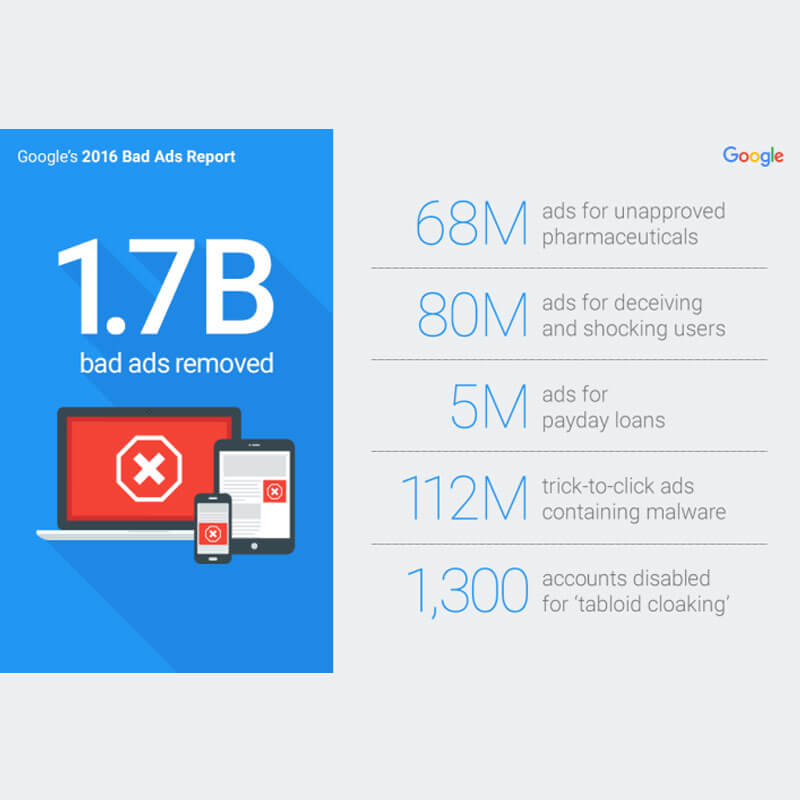
    MUMBAI: In 2016, Google took down 1.7 billion ads that violated its advertising policies, more than double the amount of bad ads it took down in 2015, according to the latest ‘Better Ads Report’ for 2016 released by the company.

    “A free and open web is a vital resource for people and businesses around the world. And ads play a key role in ensuring you have access to accurate, quality information online. But bad ads can ruin the online experience for everyone. They promote illegal products and unrealistic offers. They can trick people into sharing personal information and infect devices with harmful software. Ultimately, bad ads pose a threat to users, Google’s partners, and the sustainability of the open web itself,” said Sustainable Ads Product Management director Scott Spencer.

    Last year, Google did two key things to take down more bad ads. First, it expanded the company’s policies to better protect users from misleading and making predatory offers. For example, in July it introduced a policy to ban ads for payday loans, which often result in unaffordable payments and high default rates for users. In the six months since launching this policy, Google disabled more than five million payday loan ads.

    Second, it beefed up its technology to spot and disable bad ads even faster. For example, “trick to click” ads often appear as system warnings to deceive users into clicking on them, not realizing they are often downloading harmful software or malware. In 2016, Google detected and disabled a total of 112 million ads for “trick to click,” 6X more than in 2015.

    According to the report, most common inappropriate online ads were those for illegal products. Google disabled more than 68 million bad ads for healthcare violations and 17 million ads for illegal gambling violations in 2016.

    Protecting consumers against misleading ads that try to drive clicks and views by intentionally misleading people with false information like asking `Are you at risk for this rare, skin-eating disease?’ or offering miracle cures like a pill that will help people lose 50 pounds in three days without lifting a finger, Google took down nearly 80 million bad ads for deceiving, misleading and shocking users in 2016.

    As for ads developed exclusively for the mobile web, Google’s systems detected and disabled over 23,000 ‘self-clicking ads’ on its platforms as compared to only having to disable a few thousand of these bad ads last year. Similarly, the report highlighted a dramatic increase in scamming activity in 2016 and approximately 7 million bad ads were disabled for intentionally attempting to trick the Google detection systems.

    2016 also saw rise of a new type of scammers called `tabloid cloakers’ that take advantage of current trends and hot topics: a government election or a trending news story or a well-known celebrity. The ads used by these scammers may look like headlines for real articles on a news website but when clicked upon, consumers are redirected to a site selling weight loss products. In 2016, Google suspended over 1,300 accounts for `tabloid cloaking’. In December alone, Google took down 22 `cloakers’ that were responsible for ads seen over 20 million times by people online in a single week.

    Over the years, Google has been working to find ads that violate its policies and blocks the ad or the advertiser, depending on the violation. In 2016, it took action on 47,000 sites for promoting content and products related to weight-loss scams. It also took action on more than 15,000 sites for unwanted software and disabled 900,000 ads for containing malware. Around 6,000 sites and 6,000 accounts were suspended for attempting to advertise counterfeit goods, like imitation designer watches.

    In order to keep Google’s content and search networks safe and clean, Google has introduced stricter policies, including the new AdSense mis-representative content policy. The policy update introduced in November 2016, enables the company to take action against website owners misrepresenting who they were and deceiving users with their content.

  • Google takes down 1.7 bn. ads for violating policies

    Google takes down 1.7 bn. ads for violating policies

    MUMBAI: In 2016, Google took down 1.7 billion ads that violated its advertising policies, more than double the amount of bad ads it took down in 2015, according to the latest ‘Better Ads Report’ for 2016 released by the company.

    “A free and open web is a vital resource for people and businesses around the world. And ads play a key role in ensuring you have access to accurate, quality information online. But bad ads can ruin the online experience for everyone. They promote illegal products and unrealistic offers. They can trick people into sharing personal information and infect devices with harmful software. Ultimately, bad ads pose a threat to users, Google’s partners, and the sustainability of the open web itself,” said Sustainable Ads Product Management director Scott Spencer.

    Last year, Google did two key things to take down more bad ads. First, it expanded the company’s policies to better protect users from misleading and making predatory offers. For example, in July it introduced a policy to ban ads for payday loans, which often result in unaffordable payments and high default rates for users. In the six months since launching this policy, Google disabled more than five million payday loan ads.

    Second, it beefed up its technology to spot and disable bad ads even faster. For example, “trick to click” ads often appear as system warnings to deceive users into clicking on them, not realizing they are often downloading harmful software or malware. In 2016, Google detected and disabled a total of 112 million ads for “trick to click,” 6X more than in 2015.

    According to the report, most common inappropriate online ads were those for illegal products. Google disabled more than 68 million bad ads for healthcare violations and 17 million ads for illegal gambling violations in 2016.

    Protecting consumers against misleading ads that try to drive clicks and views by intentionally misleading people with false information like asking `Are you at risk for this rare, skin-eating disease?’ or offering miracle cures like a pill that will help people lose 50 pounds in three days without lifting a finger, Google took down nearly 80 million bad ads for deceiving, misleading and shocking users in 2016.

    As for ads developed exclusively for the mobile web, Google’s systems detected and disabled over 23,000 ‘self-clicking ads’ on its platforms as compared to only having to disable a few thousand of these bad ads last year. Similarly, the report highlighted a dramatic increase in scamming activity in 2016 and approximately 7 million bad ads were disabled for intentionally attempting to trick the Google detection systems.

    2016 also saw rise of a new type of scammers called `tabloid cloakers’ that take advantage of current trends and hot topics: a government election or a trending news story or a well-known celebrity. The ads used by these scammers may look like headlines for real articles on a news website but when clicked upon, consumers are redirected to a site selling weight loss products. In 2016, Google suspended over 1,300 accounts for `tabloid cloaking’. In December alone, Google took down 22 `cloakers’ that were responsible for ads seen over 20 million times by people online in a single week.

    Over the years, Google has been working to find ads that violate its policies and blocks the ad or the advertiser, depending on the violation. In 2016, it took action on 47,000 sites for promoting content and products related to weight-loss scams. It also took action on more than 15,000 sites for unwanted software and disabled 900,000 ads for containing malware. Around 6,000 sites and 6,000 accounts were suspended for attempting to advertise counterfeit goods, like imitation designer watches.

    In order to keep Google’s content and search networks safe and clean, Google has introduced stricter policies, including the new AdSense mis-representative content policy. The policy update introduced in November 2016, enables the company to take action against website owners misrepresenting who they were and deceiving users with their content.