Category: Broadband

  • McAfee says Indian tweens are potentially vulnerable to risky internet behaviour

    McAfee says Indian tweens are potentially vulnerable to risky internet behaviour

    MUMBAI: There is a growing trend of Indian tweens (kids between 8-12 years old) that are rapidly adopting internet through multiple devices and a variety of social networking platforms.

    McAfee unveiled its tweens and technology report 2013 which analyses the online behaviour of India’s next generation of digital natives.

    A few important highlights from the report are: On an average, Indian tweens are using between three and four devices that can be internet enabled, internet access is predominantly PC/laptop based (71 per cent and 76 per cent access the internet via these devices respectively), however 42 per cent access the internet via a mobile device.

    Almost half (45 per cent) of the online tweens access internet post 8:00 pm. They are regularly playing games (91 per cent) on tablet or chatting with friends on mobile (63 per cent). Tweens are widely using mobile/smartphones to access internet (68 per cent use mobile to access the internet). Despite the age eligibility for Facebook being 13 years, three in four (70 per cent) tweens admit to currently using Facebook.

    Online tweens are potentially vulnerable to risky behaviour on the internet as 36 per cent of online tweens have chatted to someone online that they didn’t know previously.

    The findings of McAfee’s Tweens & Technology Report 2013 were released at a panel discussion with McAfee consumer marketing director (APAC) Melanie Duca, McAfee India VP of engineering – consumer and mobile Venkat Krishnapur, McAfee Cybermum India Anindita Mishra, Dr. V. Jayanthini, M.D, D.P.M, leading psychiatrist and Meeta Sengupta, a veteran educationist and advisor to schools.  

    Speaking about the relevance of these new-age parenting challenges, McAfee Cybermum India Anindita Mishra said, “There is an increasing influence of the online world on children’s persona that cannot be undermined because of the emotional and developmental impact it has. The role of parents in delivering safe and positive cyber experience to their kids is significant than ever before. Having a genuine and transparent two-way communication with children is absolutely fundamental to establishing a safe and positive cyber experience.”

    “With malware writers mastering their craft, they continue to transfer their skills to new and popular mobile platforms in addition to PCs and laptops. The proliferation of multiple mobile device usage and this staggering increase in new malware will require Indian parents to recalibrate on how to arm their children with best online practices ensuring safe online experiences for them.” said McAfee India VP of engineering – consumer and mobile Venkat Krishnapur.

    McAfee consumer marketing director (APAC) Melanie Duca said, “As a company, McAfee is dedicated to making the internet safe by providing resources to help educate and protect families. Our Cybermum initiative and cyber education program in Indian schools reinforce commitment towards this cause.”

    Across APAC, McAfee has developed a cyber education program, which is delivered to school-aged children by McAfee employee volunteers. The initiative has now been rolled out in India whereby McAfee is reaching out to Indian schools and will scale up the program over the next one year.  

    McAfee’s tweens & technology report 2013 was conducted through a survey administered across Indian online tweens aged 8-12 years old comprising 572 male and 428 female respondents from Mumbai, Kolkata, Chennai, Bangalore, Hyderabad, Ahmedabad and Delhi.

  • Indian businesses leading Asia Pacific on cyber risk

    Indian businesses leading Asia Pacific on cyber risk

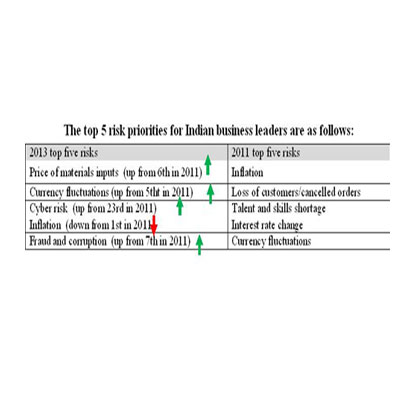
    MUMBAI: Business leaders in India are increasingly waking up to the threat of cyber-crime according to the third Lloyd’s Risk Index conducted by Ipsos.

    Ipsos surveyed over 500 of the world’s most senior business leaders for the Risk Index, which shows that cyber risk has become a key concern among Indian businesses, soaring up the Index from the 23rd highest priority in 2011 to 3rd this year.

    The findings show that Indian businesses are taking cyber security more seriously than their Asia-Pac counterparts; prioritising cyber risk five places higher than the Asia-Pac average of eighth place.

    While prioritisation of cyber risk is high, business leaders feel less prepared to cope with the threat of an incident, rating cyber just 14th in terms of the risks they are most prepared to deal with.

    The increased awareness of cyber risk comes at a time when research has shown the average annualised cost of cyber breaches has sharply increased. For 56 benchmarked organisations the average cost was $ 8.9 million a year, up from $ 8.4 million in 2011, and ranging from $ 1.4 million to $ 46 million per year, per company.

    Lloyd’s head of Asia-Pacific Kent Chaplin said: “It’s encouraging to see Indian businesses increasingly leading the way when it comes to recognising the threat of cyber incidents. As recent high profile events have shown, cyber-breaches are only getting more sophisticated and it seems business leaders are beginning to acknowledge that.”

    “However, the risks faced by Indian businesses go far beyond cyber and leaders must ensure they are responding to the challenges they face today and evolving to meet the emerging risks of tomorrow. With the timetable for global economic recovery likely to be much longer than we hoped, effective risk management should be a priority for boards across the world,” added Chaplin.

  • India short of trained manpower to tackle cyber crime

    India short of trained manpower to tackle cyber crime

    NEW DELHI: Even as India ranks third in terms of the highest number of internet users in the world after US and China and the number is projected to grow six-fold between 2012 and 2017 with a compound annual growth rate of 44 per cent, it is among the top 10 spam-sending countries in the world alongside the United States.

    According to a whitepaper launched by ASSOCHAM-KPMG, highlighted that India has a huge shortage of cyber security specialists with the number of trained manpower only accounting for 556 compared to 1.25 lakh in China and 91,080 in the US. This is despite the fact that cyber crime cases in the country registered under the Information Technology Act last year rose by about 61 per cent to 2,876 with Maharashtra recording the most number of cases.

    To check cyber crime and hacking of systems, the government launched the National Cyber Security Policy of India (NCSP) followed by the release of guidelines by the National Critical Information Infrastructure Protection Centre of the National Technical Research Organization (NTRO) in July this year.

    One of the key agendas of the National Cyber Security Policy of India is to create a taskforce of 500,000 cyber security professionals in the next five years. Public and private sector partnership (PPP) is also seen as a key step to counter cyber crime.

    The whitepaper asserts that there is need for enterprises, SMEs and the government bodies to not only adopt the various guidelines and advisories issued by the security agencies but also to regularly review the implementation of the same. There needs to be a timely review of the IT act to keep pace with the developments and sophistications in cyber crime.

    Apart from consulting private sectors and cyber security equipment manufacturers, international coordination is also something that India needs to consider in the days to come to counter cyber attacks more effectively and efficiently. The implementation of all these aspects together will be a challenge that needs to be dealt with precision to secure the critical infrastructure of the country.

  • Broadband optical fiber access solution to be launched for cable ops by Alcatel-Lucent

    Broadband optical fiber access solution to be launched for cable ops by Alcatel-Lucent

    NEW DELHI: A new broadband optical fiber access solution is being launched soon by Alcatel-Lucent for cable multiple-system operators (MSOs).

    The Ethernet Passive Optical Networking (EPON), solution can be integrated into existing cable access networks to deliver greater capacity to more businesses at a lower cost. This will enable MSOs, particularly those in North America, to expand their service offerings to meet the growing data bandwidth needs of businesses.

    Bright House Networks, the sixth largest owner and operator of cable systems in the US has selected Alcatel-Lucent’s EPON solution for its commercial services network, Alcatel-Lucent said in a statement.

    “Compared with competing alternatives, EPON has clear advantages in capital efficiency, vendor interoperability, bandwidth scalability and standardised provisioning,” said Bright House Networks, Network Engineering/Operations & Enterprise Solutions – SVP Craig Cowden.

    North American businesses are estimated to spend over $140 billion per year in total on communications services, yet MSOs are currently only capturing a small percentage of this market.

    “The business communications market segment is growing rapidly and cable operators in North America have a real opportunity to address it,” said Alcatel-Lucent Fixed Networks head Federico Guillen.

    Revenue from fixed broadband services providing connections between 100 megabits-per-second (100Mbps) and 1 gigabit-per-second (1Gbps) is predicted to more than double between 2013 and 2017.

    Alcatel-Lucent’s EPON solution for MSOs is based on the highest capacity fiber platform on the market – the Alcatel-Lucent 7360 ISAM FX with 1G EPON and 10G EPON linecards.

    The solution supports DOCSIS provisioning of EPON (DPoE), EPON Small Form-factor Pluggable (SFP) Optical Network Units (ONU), and a 10G EPON ONU. This enables it to integrate smoothly with existing networks, provisioning systems, and customer premises equipment, allowing MSOs to provision new services.
    EPON delivers more bandwidth (up to 1G or 10G upload and download speeds) than today’s DOCSIS networks and supports three to four times the number of customers per fiber as existing point-to-point coarse wavelength division multiplexing (CWDM) solutions.

  • Cyber Security violations should be dealt with: Sibal

    Cyber Security violations should be dealt with: Sibal

     NEW DELHI: Even as National Security Adviser Shivshankar Menon feels that the issue needs to be settled in international law, Communications and IT Minister Kapil Sibal said Indian authorities should have the jurisdiction to deal with cyber attacks against the country irrespective of their source.

    Sibal said that there should be “accountability and responsibility” in the cyber space. “If there is a cyber space violation and the subject matter is India because it impacts India, then India should have jurisdiction. For example, if I have an embassy in New York, then anything that happens in that embassy is Indian territory and there applies Indian Law.

    “If the impact of such a violation is on India, then Indian courts must have the jurisdiction. That should apply across the world,” he said.

    When it was pointed out at an Observer Research Foundation seminar on cyber security that the American National Security Agency was accused of spying on Indian and other missions there, Sibal said, “Do not trivialise the issue.”

    Menon said, “It is not a settled issue in international laws. That is why you need an agreement and consensus on it.”

    Sibal said: “The issue of identity in cyber space is of enormous importance. There must be accountability and responsibility in the cyber space.”

    He said the government believed in complete freedom of cyber space. “Freedom of expression is central to our ideological stand on cyber space but at the same time, there should be a de facto recognition of threats that are there in cyber space.”

    “We need to deal with those threats locally and globally. We need a consensus on those. What we don’t need is a governed space. I think governance in cyber space is oxymoron,” he said.

  • Broadband base up in July, with monthly growth at rate of 0.33%

    Broadband base up in July, with monthly growth at rate of 0.33%

    NEW DELHI: The total Broadband subscriber base in the country has increased from 15.19 million at the end of June 2013 to 15.24 million at the end of July 2013. This is a monthly growth of 0.33 per cent. The yearly growth in broadband subscribers is 3.79 per cent during the last one year (July 2012 to July 2013).

    The top five internet service providers in terms of market share (based on subscriber base) are: BSNL (9.97 million), Bharti Airtel (1.43 million), MTNL (1.10 million), Hathway (0.37 million) and You Broadband (0.32 million).

    According to the latest telecom subscription data as on 31 July 2013 released by the Telecom Regulatory Authority of India, there are 161 internet service providers (ISPs) which are providing broadband services in the country. Out of these, 121 ISPs (having 98.48 per cent market share) have provided broadband subscription data for the month of July 2013, for the rest of the ISPs data from previous month has been retained.

    Meanwhile, Indian rural telecom has faced downturn – despite service providers’ special packages – as mobile user base declined by two million in July 2013. TRAI said net mobile additions declined 0.57 per cent or by 2 million to 349.09 million from 351.10 million in June.

    In July – according to TRAI data – Indian urban mobile user base increased by 3.52 million or 0.67 per cent to 525.78 million from 522.27 million in June.

    The share of urban wireless subscribers has increased from 59.80 per cent to 60.10 per cent whereas share of rural wireless subscribers has decreased from 40.20 per cent to 39.90 per cent.

    TRAI statistics says total wireless subscriber base increased from 873.36 million in June to 874.88 million in July 2013, registering a monthly growth of 0.17 per cent. The overall wireless Teledensity in India has reached 71.13 per cent in July from 71.08 per cent of previous month. Wireless subscription in urban areas increased to 525.78 million in July.

    The urban wireless teledensity has increased from 139.16 to 139.87 whereas rural teledensity has decreased from 41.14 per cent to 40.88 per cent.

    Wireline subscriber base declined from 29.73 million in June 2013 to 29.58 million in July. The net reduction in wireline subscriber base was 0.15 million at the rate of 0.50 per cent.

    The share of urban subscribers has decreased from 78.11 per cent to 78.0 per cent whereas share of rural subscribers has increased from 21.89 per cent to 22.0 per cent. The overall wireline Teledensity has decreased from 2.42 per cent in June 2013 to 2.40 per cent in July 2013, with urban and rural Teledensity being 6.14 per cent and 0.76 per cent respectively.

    BSNL and MTNL, the two PSU operators hold 78.65 per cent of the Wireline market share.

  • United Online to expand NetZero DSL broadband

    United Online to expand NetZero DSL broadband

    MUMBAI: United Online, Inc, a provider of consumer internet and media services, and Covad Communications Group, Inc. a provider of integrated voice and data communications, have entered into an agreement. Under this, United Online would expand its NetZero DSL broadband internet service offering using Covad’s network.

    United Online recently launched NetZero Digital Subscriber Line (DSL) to provide its customers with an opportunity to upgrade to broadband.

    United Online chairman and CEO Mark R. Goldston said, “Through this agreement, United Online has the opportunity to benefit from access to Covad’s network and their expertise in broadband. We believe it will enable us to expand our NetZero DSL broadband offering and give more of our NetZero customers who want a broadband experience the ability to easily upgrade from dial-up while keeping their NetZero email address.”

    Covad president and chief executive officer Charles Hoffman said, “We are pleased to partner with United Online to provide its customers with high-speed Internet service and look forward to creating a successful partnership. As the leading independent provider of next-generation broadband services, we welcome the opportunity to increase our wholesale business through this agreement.”

    United Online intends to launch this expansion of its NetZero DSL service near the end of the first quarter of 2007. In addition to NetZero’s current regional DSL coverage, this agreement with Covad allows United Online to offer NetZero broadband services to DSL-eligible customers within Covad’s service area.

    United Online currently estimates that, following the addition of NetZero DSL services in Covad’s service area and when combined with NetZero’s existing coverage, NetZero will be able to offer broadband services to approximately 30 per cent to 35 per cent of United Online’s current ISP customer base, although the percentage could vary significantly based on a variety of factors.

    The pricing and other terms of services will be made available closer to the time of launch and may vary based on geographic locations, the company said.

  • BSNL to speed up broadband up to 2 MB at Rs 250 per month

    BSNL to speed up broadband up to 2 MB at Rs 250 per month

    MUMBAI: State-owned Bharat Sanchar Nigam Ltd. (BSNL) is planning to give a major push to broadband. The telecom major has decided to increase the speed by almost eight times, providing broadband up to 2 mb at Rs 250 per month.

    The download has been increased by 2.5 times at almost half the cost, the company said. Till now the minimum bandwidth available to broadband customers was 256 Kbps. BSNL has now decided that all the home and business plans will offer data rates up to 2 Mbps, subject to technical feasibility.

    “Under the new plan all the existing 820,000 customers are also being upgraded for the speed up to 2 Mbps, depending upon technical feasibility,” BSNL said.

    The following changes in broadband data rates and downloading limits will come into effect from 1 January. BSNL is going to add the five million port capacity to the existing network of one million ports. “We at present have a 44 per cent market share in this segment. We also hold the prime position as the largest internet service provider of the country,” the company said.

    The downloading limits in home 250 and business 700 plans have been enhanced to 1 GB and 4 GB from 400 MB and 2 GB respectively. The limits in other plans have been suitably enhanced. With the increase in downloading limit, a Plan 250 customer will get a benefit of Rs 840 per month for 1 GB limit and Business Plan 700 customer will get a benefit of Rs 2400 per month for limits up to 4GB.

    BSNL has also decided to bring down the per MB downloading rates from Rs 1.40 per MB to Rs.0.90 per MB in Home 250 plan and the rates have also been lowered in other plans. The BSNL broadband service is available in 597 cities and towns.

    The fixed monthly charges from ADSL modems has been reduced from Rs 100 to Rs 60 per month with effect from 1 December. This will benefit about 800000 customers of BSNL.

    BSNL is already in the process of launching triple play services over broadband in Pune and subsequently in Chennai and Bangalore. It plans to start online gaming services over broadband soon under two categories, Standard and Premium packages, with monthly fixed charges of Rs 100 and Rs 200 respectively.

  • Times Broadband ready with content delivery network for IPTV

    Times Broadband ready with content delivery network for IPTV

    NEW DELHI: Times Broadband Services Pvt Ltd (TBSPL) has expressed its preparedness with a content delivery network for IPTV which it wants to offer to telecom and cable TV operators.

    “We are ready with 100 TV channels and have set up an agnostic platform,” said Times Broadband CEO Sujata Dev.

    TBSPL had tied up with MTNL to offer IPTV on the telecom major’s network. Now it is also looking at going with other telecom operators as well.

    The company expects 500 channels would come on board their platform for IPTV. TBSPL has already signed up with a few content providers which includes Time Media, IMI, Film and Television Producers’ Guild, Globecast and Star TV. “I cannot disclose the names of many others because IPTV would need a little more clarity as far as regulations are concerned and that would decide on the tariff of pay channels,” Dev said.

    Many broadcasters are hesitant to sign in as content providers because they are uncertain whether the service would be controlled by the Cas rules or treated under telecom or IT rules.

    “IPTV is a value-added service for a telecom operator and we hope that it would be dictated by telecom laws and regulations,” Dev said.

    The formal launch was done by minister of state for urban development and poverty alleviation, Ajay Maken, who declared this (IPTV technology) as an unthinkable revolution.

    Dev in her presentation said that TBSPL would aggregate content from multiple sources and provide the content delivery platform to telecom operators. The company has partners in Hewlett Packard, Optibase, Verimatrix, Kassena and Amino.

    Dev said that at the moment TBSPL is offering 100 TV channels, FTA, and list of pay channels as second tier; 10 feature films through video on demand with fast forward, rewind and pause features; 10 hours of music cutting across genres; 10 hours of interactive games, 10 hours of browsing and 100 TV-to-TV SMS. Later, there would come premium offerings, which will include video telephony on TV with plug-in camera; T-Banking, T-information; T-time shift TV, etc.

    The operation is intended as a conduit between the telecom operators and content producers and providers in the convergence space “In convergence technology there is always some discrepancy against one of the players, and this is where we play the role of the conduit,” Dev said.

  • Metalink’s chipset enables wireless distribution of digital entertainment throughout the home

    Metalink’s chipset enables wireless distribution of digital entertainment throughout the home

    MUMBAI: Israel based Metalink, which provides wireless and wireline broadband communication silicon solutions, has unveiled the second generation of its WLanPlus chip-set. Designed to enable high-throughput, rich-content, quality-critical applications, WLANPlus provides the foundation for a full-coverage wireless home entertainment network.

    Metalink’s WLanPlus 802.11n chip-set family is optimised to go beyond previous solutions that are designed primarily to transport data, and addresses the far more rigorous needs of the consumer electronics market. As such, it supports the most demanding optional specifications of the 802.11n standard with functionality that is critical for the streaming of high-quality High-Definition Television (HDTV) video throughout the home (three MPEG2 HDTV streams at 60Mbps with whole-home coverage at 60 feet).

    The company adds that first-generation WLANPlus technology has already been integrated by consumer electronics manufacturers into a broad range of products, including Residential Gateways, Digital Televisions, HDTVs, Set-Top Boxes (STB), Media Adaptors and Digital Video Recorders (DVR).