Category: Events

  • “I don’t see a revenue stream from digital for 2-3 years”: Kartikeya Sharma

    “I don’t see a revenue stream from digital for 2-3 years”: Kartikeya Sharma

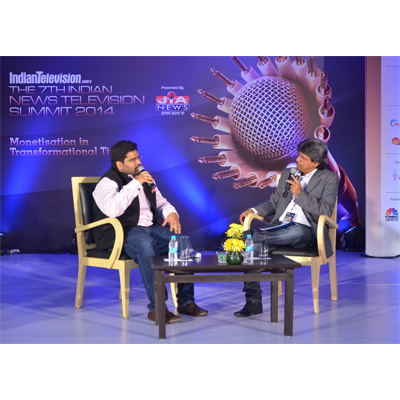
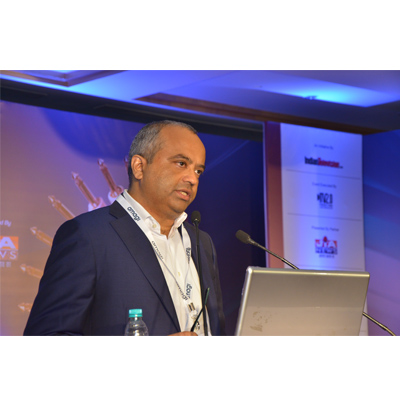
    MUMBAI: At the Seventh Indian News Television Summit, ITV Network managing director Kartikeya Sharma took the stage to speak about the success of his network and the future plans. Hailing from a political family, Sharma was adamant that he did not want to get into politics.


    It was while he was studying in London that he got attracted to the media industry. “When I was studying, the only way of being in touch with home was television with the first channel that came on Sky. That drew me into the space,” he said while speaking to indiantelevison.com founder, CEO and editor in chief Anil Wanvari. He added that what affected him was the rise of primetime during 2004-05 and the way India was reacting to the world while it was fresh off the boat.


    On being asked about the difference in running his hospitality business vis a vis media business, he said that the two cannot be compared. “News is definitely a tough business and there isn’t any particular revenue model that works well. You have to improvise. Circumstances are also important. So at what point a channel is being launched and the policies at that time is crucial,” he said.


    Speaking about the growth of his Hindi News channel, India News, Sharma said that the initial projected benchmark was 6-7 per cent market space but it actually went to 11 per cent within a span of six to eight months. “We don’t fight for filling ad slots on the channel anymore,” he said.


    The growth of the ITV Network has been a combination of both internal accruals and external debt. It will be going after a few more acquisitions and product launches in the regional space in the coming months. “By 2016 we want to be the largest and most profitable news network in the country,” he added.


    Responding to Wanvari’s question about whether syndication of news was an alternative means of revenue for sustaining the business, Sharma said that surely that will bring in a new source of revenue. “There is enough content floating around with 400 channels but the true value of syndication is debatable and I don’t think you can look at it vis-?-vis subscription or ad sales,” he said.


    While digital is touted as the ‘next big thing’, according to Sharma it is still too early to predict its fate. “In foreign countries, people aren’t able to monetise the digital platform as expected. There has been very little work done in research and development. I am not very optimistic about a revenue stream coming out of digital for the next two-three years,” he said adding that there is a need to look at digital as a synergy between evolution of content and technology.


    According to him, evolution of digital does not mean the old world will end. “I am a big fan of digital myself but we are being bullish when we talk of this medium. It is a matter of fact that it is the future but the timing is important. We have made huge errors of calculating that in the past and we are doing the same again,” he said.


    Talking about his tenure as Association of Regional TV Broadcasters (ARTB) president, Sharma said that the main aim was to help regional broadcasters since he realised that they needed a voice. “I managed to get 40 per cent of revenue for broadcasters from the government,” he stated.


    For the industry to progress, Sharma said that unity was necessary but collective decision doesn’t last long. “DD Freedish has pushed up its rates from Rs 50 lakh to Rs 5 crore in five years because of GECs wanting to get onto it. We all decided that we won’t go on the platform but then some of us ended up breaking that decision,” he shared with the audience.


    While the news space was cluttered, he believes that there is space and chance to be a number one in news.
  • The 7th Indian News Television Summit a roaring success

    The 7th Indian News Television Summit a roaring success

    NOIDA: The 7th Indian News Television Summit that was held at The Radisson in Noida, was a huge success with some of the big names in the industry attending the conference.


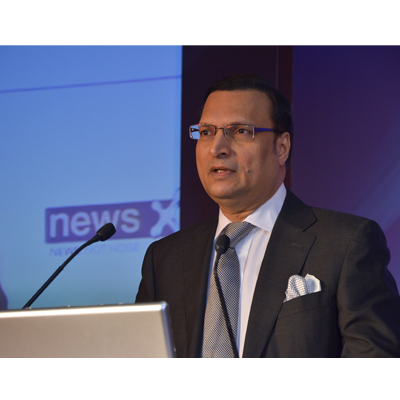
    The day began with a keynote by India TV chairman and editor in chief and the News Broadcasters Association president Rajat Sharma wherein he spoke about the changing face of news and how content as well as ad sales is under pressure and for things to improve, the industry has to get together and find solutions.


    He lamented on the horror of having to pay huge carriage fees along with the burden of the ad cap which the NBA is vociferously fighting. According to him, the TV news industry has changed in the last three years with more responsibility having crept into the veins of channels.


    This was followed by a one on one with ITV Network MD Kartikeya Sharma wherein he discussed about why he got into the news business, the aim of his news network and its future roadmap to being the biggest news company in the country.


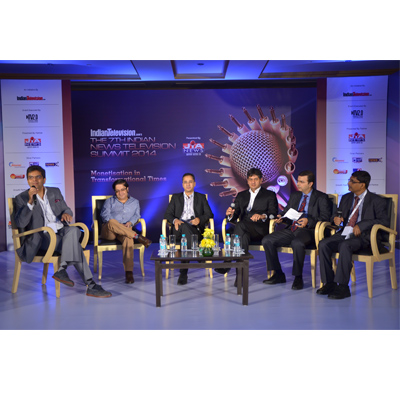
    The first session saw NDTV Group CEO Vikram Chandra, TV Today CEO Ashish Bagga, IBN18 CEO Avinash Kaul, Focus News Network group CEO Neeraj Sanan and Doordarshan ADG news Mayank Agrawal speak on the various modes of revenue generation through traditional and digital mediums. Executives highlighted that it was too soon to depend heavily on the digital medium for revenue which will work as a compliment to television but not replace it.


    This was followed by a keynote from GroupM south Asia CEO CVL Srinivas who highlighted what brands were looking for in news networks and how the genre is growing year on year. According to Srinivas, news broadcasters need to keep in mind a few things for the future-co creating socially responsible agendas with brands, invest more in digital, new metrics such as consumer sentiment, social buzz, social impact, viewers’ profile and getting into big data.


    Following this was a discussion on finding innovative ways for revenue generation that saw Zee Sangam national sales head Harsha Vardhan Dwivedi, India TV senior VP and country head ad sales Sudipto Chowdhuri, CNN-IBN and IBN7 national revenue head Vishal Bhatnagar, IPG Mediabrands CEO initiatives Anamika Mehta and Times Television Network senior VP and business head for branded content Hemant Arora.


    An informative presentation by Amagi co-founder KA Srinivasan enlightened the audience about utilising geo-targetting to increase revenue for various channels of a network and also more focused reach for a brand.


    The day concluded with an editorial session that discussed how much editors are willing to allow ad sales to interfere with content for higher revenue. ITV Network editor in chief Deepak Chaurasia, senior columnist QW Naqvi and Mi Marathi consultant Nikhil Wagle discussed on how much an editor can mix with the ad sales team and how much of interference by them is acceptable.


    With the belief that the discussions between the various stakeholders of the industry will propel better returns for the community as a whole, we look forward to the Indian News Television Summit 2015.

  • Share of news channels in total AdEx is encouraging: CVL Srinivas

    Share of news channels in total AdEx is encouraging: CVL Srinivas

    NOIDA: “Indian news industry is as vibrant as the different cultures of India,” said GroupM south Asia CVL Srinivas as he presented the keynote on Innovations in news selling at the 7th Indian News Television Summit.


    Srinivas, sharing a media agency’s perspective on news and brands, added that the news industry today needs a lot of balance especially in terms of reportage, content for different audiences across platforms. 


    As for the AdEx, he informed that in the country the advertising expenditure for television stood at Rs 16,000 crore. “The news channels take 13 per cent share of the pie which is encouraging as the viewership of news channels stood at 10 per cent,” he stressed upon.


    Talking about the ad spend growth in the country, he informed that the television medium was growing at a rate of 14 per cent overall. The Hindi news genre was growing at 15 per cent, closely followed by regional news at 10 per cent while English news genre stood at seven per cent.


    Moving then onto brand research, Srinivas felt that today brand research is undergoing a radical change and old measurement methods are being questioned. Throwing some light on GroupM’s one such initiative, Social Command Centre, he said, “It is a virtual conference room that monitors the digital space and provides rich insights about consumers and brands.” And stated the example of Nestle which uses the tool to monitor chatter and gather buzz around the brand digitally. 


    Honda using the popular comedian Kapil Sharma to launch a series of campaign online, which garnered 1.5 million hits, was another example, he highlighted upon. He went on to say that cause-based marketing should be initiated and brands should ask themselves, how do we evolve ourselves to become more meaningful entities?  “Once brands are able to answer the same, there will be a lot of headroom for improvement and growth,” he opined. Providing another example, he said an agency called Crayon Data was able to come up with tastegraphs that showed the purchasing and behavioural pattern of different audiences in well-segmented clusters.


    He further went on to add that the evolving Indian digital space sees 220 million Indians active on the digital front spending  almost 200 minutes a day online either checking mails or watching videos. “This implies that the new medium cannot be ignored,” he informed.


    According to Srinivas, news broadcasters need to keep in mind a few things for the future such as co creating socially responsible agendas with brands, invest more in digital, adopt new metrics such as consumer sentiment, social buzz, social impact, viewers’ profile and lastly getting into big data.


    In his closing remarks, he said that while the upcoming digital environment has caused a big disruption to some it will provide a huge opportunity to the news industry and sky is the limit.

  • Television and online medium need different approach for revenue making

    Television and online medium need different approach for revenue making

    NOIDA: The news television space is burdened with cash crunch. And addressing this core issue were the news industry giants at the 7th News Television Summit organised by indiantelevision.com. The Summit which began with a session on ‘Content monetisation through conventional and digital platforms of news channel’ was moderated by Provocateur Advisory principal Paritosh Joshi and attended by NDTV Group CEO Vikram Chandra, TV Today Network CEO Ashish Bagga, IBN18 Network CEO Avinash Kaul, Doordarshan ADG news Mayank Agarwal and Focus News Network group CEO Neeraj Sanan.


    Joshi began the session by asking Chandra how viewership data has changed since NDTV raised its voice against the alleged faulty ratings three years ago. Chandra said that they weren’t getting correct ratings and when they talked about it to others they were told to either swim with the tide or do something different which would get the TRPs. Soon after, they were joined by other broadcasters as well.


    Joshi then asked Bagga the secret behind Aaj Tak’s dominance in the genre for the last 10 years. Bagga highlighted that it was not easy to sustain its position given the tough environment. “There was reluctance from various quarters so it was necessary to push that credibility,” he said. He added that the network had grown 25 per cent since last year and while others were growing at just two to five per cent.


    Talking about the ad rates, Bagga said that the price for a slot on news channels, unlike the GECs is pitiable. However, TV Today has put its business on a sustainable model of 20 per cent y-o-y growth. “This has been done by quality, resource, building perception and getting the required numbers,” he said.


    Doordarshan, on being asked about its transformation, said that it had done a good revamp to maintain norms and standards. “People may feel that we put out the news stories a little later than the others, but that’s not the case. We are alert,” said Agrawal.


    He however agreed that a lot is still left to be done apart from the new programmes and the new look it has given to its anchors. “We have also set up new teams in order to cover news better and are also focusing on our online medium,” informed Agrawal.  


    Joshi also highlighted the fact that there is little differentiation in content between the news channels. Disagreeing with the observation, Kaul said that though it could be true, the approach of each channel for a story is different. “You can cater the news to different age groups and segment it differently,” he opined.


    Kaul is optimistic about the new rating system that will be brought out by BARC India. “This will bring in change to the type of content being produced,” he said.


    Joshi also brought out the common criticism that the news industry has to deal with. “Various quarters have said that while the news broadcasters crib about the bad business, the genre still sees new players getting into it every now and then. Is it the political money that is going into it?” questioned Joshi.


     Sanan at this point said that the reason for this was the fact that people see a lot of potential in news because of its ever growing consumption. “If all news channels give same content then that means there is a need for someone to come and stand out. If people are willing to pay and if you can package your content well then there is no reason why one cannot get into it,” he said.


    While digital is a growing platform, Joshi asked whether the algorithm that it follows is trustworthy with regards to journalism. Chandra highlighted the fact that even today the brand of an anchor is important. “When people come to the online medium, they want to come to trustworthy sources rather than a layman giving information,” he opined.


    Kaul said that with BARC India bringing in meters in the rural areas, the genre will have to strengthen its coverage in those areas as well. “With 4G and broadband making in-roads, we will be in a better state,” he said.


    Chandra stated that it was not right to replicate the TV business model for online and that digital was growing at a CAGR of 40 per cent.

  • “The news industry is fighting amongst itself”: Rajat Sharma

    “The news industry is fighting amongst itself”: Rajat Sharma

    NOIDA:  He is one of the most well known faces of the Indian media industry. Rajat Sharma, the host of popular talk show, Aap Ki Adalat, has added responsibilities on his shoulders. He is not only the chairman and editor in chief of India TV, but also represents the industry as the new president of the News Broadcasters Association as well as the vice president of strategic affairs of the Indian Broadcasting Foundation (IBF).

    Sharma, who was addressing the 7th Indian News Television Summit 2014 organised by indiantelevision.com as a keynote speaker highlighted the evolution of the news industry as well as listed the three biggest challenges that lie ahead.

    He began by saying that three years ago the news channel industry was very different from what it is today. “There has been a change in perception in the way news is seen,” Sharma said adding that news no longer is considered to be negative.

    Substantiating the evolution in terms of changing perception, Sharma gave the example of the 26/11 terror attack when reporters did 24X7 reportage and were blamed for aiding the terrorists and their handlers in Pakistan. “News channels also suffered commercial losses during the attacks as ad breaks were restricted,” he informed. According to Sharma, while news channels earlier were perceived as being a platform that telecasted frivolous events to garner eyeballs, things today have changed. “News is back,” he announced.

    He pointed out that the space has seen drastic changes.  “The society has evolved and the media has played a great role in it especially during events like the Lokpal Bill, the Delhi gang rape and the tirade against corruption,” he said.

     “Today even if Shah Rukh Khan or Salman Khan want to promote their films or emerging sports like Kabaddi wants to garner attention, news channels have a role to play in that as well,” he opined.

    Sharma while praising the social commitments of the news industry said that the space as a whole is not healthy. “The biggest problem for the industry is its revenue model,” he said while pointing out that though this year the balance sheets of the industry looks good due to elections, but, as a whole, the model is not sustainable.

    Listing the three main challenges for the genre, Sharma said that carriage fee was the biggest concern. “A few years ago, people expected news channels to be a loss making property since carriage fees were high and when broadcasters spoke to the multi system operators (MSOs) they said it was a problem of demand and supply. When digitisation kickstarted, we thought that consumers will get better quality channels and carriage fees will disappear. For the MSOs, it is the carriage fee from the news channels that helps them sustain, since they pay the GEC’s huge sums for getting their programming on their platform,” he said.

    He informed that the industry had 20-25 meetings with the previous TRAI chairman to discuss the issue of carriage fees.  While it was expected that digitisation would bring down carriage fees, something unexpected happened. Two days before the former TRAI chairman could retire he signed the ad cap. “When we were trying to improve the content and trying to solve one issue we were burdened with another one.”

    “Ad cap ensured we received 50 per cent less advertising. Death was certain now for the news channels,” he added.

    While the then Union Minister Ambika Soni said she will look into the matter, the broadcasters decided to fight the case in TDSAT. “News channels have managed to get a stay and therefore are surviving,” he said while giving the example of the newspaper industry, which has no such restriction. “We want the same for the broadcasting industry,” he opined.

    He also mentioned that the industry needs a better rating system and the TAM currency will be replaced by BARC India, which is an incorruptible agency.  “Therefore today the biggest challenge for the industry is the ad cap, the rating system and carriage fees,” he informed.

    In his closing remarks he said the whole industry including the IBF and the NBA should work together to resolve these issues. “The news industry as a whole cannot fight the MSOs as we are fighting amongst ourselves. While, we come together during a board room meeting, once we are out there will be one or two who would go against the same,” he lamented. 

  • MIPCOM 2014: Toonz Animation looks at international co-productions

    MIPCOM 2014: Toonz Animation looks at international co-productions

    MUMBAI: From the creation of India’s first 2D animated TV series and 2D feature film, to India’s first 3D stereoscopic theatrical- Toonz Animation has indeed emerged as one of the biggest and the most admired animation production houses in South Asia.


    With an established clientele of the likes of Walt Disney, Turner, Nickelodeon, Sony, Universal, BBC, Paramount, Marvel and Hallmark, Toonz Animation, which is celebrating 15 years of animation journey, has emerged the preferred destination for major European and North American media conglomerates.


    Providing an integrated value chain in conceptualisation, production and distribution of content and services across diverse media platforms, the company is all set to attend MIPCOM, the largest conglomeration of the entertainment industry, to showcase its new products and library.


    Participating for over a decade now, it tags itself as the flag-bearer of the Indian animation industry at MIPCOM. Toonz Animation CEO P. Jayakumar believes that MIPCOM is a platform that serves an opportunity to meet all such stakeholders who can make a difference to selling of the content produced by Toonz. “MIPCOM provides the platform to meet the producers, financers, distributors and important stakeholders, who can buy our content or collaborate with Toonz to produce content.”


    This year, Toonz is specifically looking at buying content in the action comedy adventure genre which Jayakumar feels has a huge demand in the Indian market. “But we are also looking at expanding in the Asia Pacific region and hence, will look at content that will work in general with such regions as well,” he adds.


    He further reveals that this year it is planning to tap into the Indian and Asian markets with focus on broadcast, VOD and digital platforms.


    Moreover, it is launching a new show called ‘HTDT’, a 52 x 11 minutes series. The show which is created by live shots and produced and distributed by Toonz, is currently in pre-sale.


    So what does the company expect from MIPCOM this year? “We’re hoping to have maximum exposure and opportunities to meet with those interested in our library of content, which has, Wolverine, Magic beyond Words and FreeFonix series.”


    Jayakumar hopes to get a few international co-productions kick started and meet with international producers interested in producing content, for which the company can get Indian rights. 

  • GoQuest Media Ventures readies for MIPCOM

    GoQuest Media Ventures readies for MIPCOM

    MUMBAI: The stage is set for the world’s biggest market for content, MIPCOM 2014, which will see distributors and broadcasters meet and exchange ideas/concepts.


    Though participating companies (both buyers and exhibitors) all over the world are still busy with their last minute preparations, GoQuest Media Ventures managing director Vivek Lath has packed all his bags and ready to leave.


    The company, which tags itself as the content distributors for the new age, will be attending the exhibition for the third year in a row.


    So what is the company looking at buying at this year’s MIPCOM? Its main focus will be to buy foreign content like Turkish dramas and Hollywood content to sell in India and sell Indian content like Iss Pyaar Ko Kya Naam Du from Star Plus, Kesariya Balam Aavo Hamare Des on Sahara One and many more to the international markets.


    The company has already sold more than 2000 hours of Indian television soaps in Africa, Middle East, South East Asia and Europe. Concentrating not only on television, it also helps the content reach across the world and makes most amount of money from video platforms through digital distribution.


    The company acts more like distributor as it has partnered with broadcasters like Sahara One, Sony Entertainment Television (SET), Zoom, NDTV Lifestyle and many more.


    Lath reveals that this year it is planning to once again tap into markets like Eastern Europe, Africa, South East Asia, Middle East and Russia.


    The firm will concentrate on electronic media, specifically television, IPTV and VOD platforms. “We are very focused on selling in these areas. That is our strength,” states Lath. Lath believes that the MIPCOM this year for the company will be all about 50 per cent of re-connecting and 50 per cent of making connections with the new markets and platforms and digital is one of them.


    “This year we do expect to meet some interesting VOD players. MIPCOM has always been like a yearly pilgrimage where you have to go and meet people from the industry,” signs off Lath.

  • IDOS 2014: SureWaves all set for the big digitised wave

    IDOS 2014: SureWaves all set for the big digitised wave

    GOA: Localisation is the new mantra, which businesses across the world are adopting to survive the highly competitive market scenario. Who would have thought of a paneer burger from the house of KFC?


    Taking a cue from that, national advertisers are increasing their spending on local cable television channels as it garners high viewership due to the locally relevant content it airs. The aim is simple: to target consumers in specific geographic areas.


    SureWaves MediaTech CMD Rajendra Khare during a fireside chat with Indiantelevision.com founder, CEO and editor in chief Anil Wanvari at IDOS 2014 spoke on ‘New drivers of monetisation for cable TV’.


    Cable reaches the remotest of hinterland and the national advertisers are looking for growth from these markets. “SureWaves is already on its way to becoming a game changer as far as geo-targeted advertising in the country is concerned,” he said.


    “The local content aired by the MSOs and the LCOs or the niche satellite channels has a great connect with the local audience. Not only in India but world over, people care more about what’s happening in their locality rather than what’s brewing at the national and global level,” he added.


    SureWaves MediaTech, a Bangalore-based digital media-technology company, offers the SureWaves Media Grid, an integrated advertisement aggregation, content delivery, network management, media planning and reporting platform. SureWaves provides real-time data monitoring of ads, which has, for the first time, made cable TV advertising accountable.


    Elaborating more about the company Khare said, “We build cloud based technology. We have our own devices, which we install at the studios of our channels partners.” The company positions a propriety device which is connected to the grid and the TV channels.


    It is learnt that the company has partnered with many channels, irrespective of the people watching those channels. “Here the national advertiser, who wants a large audience, benefits the most as the business house gets combined viewership of end number of channels together,” he said.


    As for the local channels, they are happy with the new advertising revenue coming in from the big players. The local channels till all these years never got access to the advertisement revenue from the national advertisers. So that problem is now getting solved. “We are solving the problems of the parties. Advertisers are experimenting with our platform,” he said.


    “This is the robust monetisation model that channel partners sign with us. We are accountable and instantly can see whether the advertisements are aired or not,” he highlighted.


    Stating the TAM report, Khare said that nationally these channels command around 4.5 per cent of the channels’ share and nationally it is top five channels. “The combined viewership of local channels is very large. As a standalone, these channels don’t get the national advertisers’ revenue as the national advertisers contribute a big chunk to the national television advertising spent,” he said.


    With the digitisation process in full swing, the country is expected to see satellite channels increasing, and post digitisation, the solution provided by the company would be more sought after. “In the digitised era, more niche high definition content would be there,” he said.


    Talking about the challenges, he agreed that it is problematic as some local broadcasters’ air pirated content. However, he further added that it is easier to screen content.


    He concluded by saying that the company is working on a solution to create content for the broadcasters, who are its partner.

  • IDOS 2014: Industry solutions to distribution dynamics gain momentum

    IDOS 2014: Industry solutions to distribution dynamics gain momentum

    GOA: The India Digital Operators Summit (IDOS) 2014, the largest TV distribution summit in India ended with significant progress and a level of stakeholder unity on the way forward for digitisation in India, embracing voluntary and mandatory DAS, ground level pricing, interconnect and revenue sharing between LCOs, LMOs and MSOs and broadcaster support for standard, uniform pricing based on addressable deployment. Key stakeholders also agreed that it’s critical to further improve hygiene in Phase I and II of DAS while various ecosystem entities, including DTH pay-TV operators, domestic STB manufacturers, alternative TV distribution  platforms (HITS, Free Dish) along with the cable fraternity agreed that ahead of the delayed DAS mandate, voluntary DAS has legs in Phase III and Phase IV.


    IDOS 2014 had a full attendance of the who’s who of the industry with more than 300 professionals from the digital TV landscape making their way to the beautiful picturesque resort of Hotel Leela in south Goa.


    The summit which kickstarted with the biggest opening night party organised by HBO on 25 September, saw some eye opener facts presented by Media Partners Asia executive director Vivek Couto on the current status of Indian cable TV industry. He said, “Out of the 262 million households in the country only 162 million houses have a TV. Of this, 27 million is taken up by the free to air service providers such as Freedish via satellite and 7 million by terrestrial DD, while the rest comes under cable and satellite.”


    He also informed the gathering that over Rs 32000 crore has been invested in digitisation since 2005 with a bulk of the investment coming from the DTH operators followed by the MSOs and LCOs since 2011. Out of this, over Rs 11000 crore in the last 24 to 30 months has been invested by MSOs and LCOs.


    He pointed out that while the cost of all the pay channels on a wholesale basis is Rs 922 to digital platforms, the highest pack price is Rs 550 which is an anomaly and needs correction. “Wholesale channel rates should be reflective of retail  prices,” he highlighted. “The sector needs to move towards retail pricing to foster trust between broadcasters, cable TV operators, and LCOs. Retail pricing will make rates transparent. Competition amongst six DTH, two HITS, five national MSOs and several regional ones and the local cable ops will keep retail rates in check.”


    Another important point that came out during the session was that carriage fees which were declining before the digitisation mandate have now reversed their path following completion of phase of phase I and phase II .  “The carriage fee has gone up by 14 per cent on Q1 of FY15 over the previous corresponding quarter,” he informed.


    Indian Television Dot Com founder CEO Anil Wanvari suggested the way forward for the cable TV fraternity. He said, “The first thing is to look at digitisation and pay TV with a changed mindset that it will be beneficial to all. The government could look at setting up a digitisation transition fund that will help educate, train, provide seed capital to go digital – this is specially relevant in phase III and phase IV areas. The fund could be discontinued once the transition is completed successfully, say in the next four to five years. A mechanism needs to be put in place to reward people who follow the rules and ensure strict penalties for those who don’t.”


    Apart from this, Wanvari also suggested that Subscriber Management System (SMS) should be set up with correct KYC  details and bills be issued to consumers. The government or regulator could also look at laying down standards and tech specifications for set top boxes (STBs) which were in keeping in making the customer technology-future-proofed for at least three to four years and to ensure quality control. That’s if the mandate of made in India set top boxes is to become a reality. “The first wave of digitisation has seen low end zapper boxes being shipped in from China – of maybe not the best quality – and being dumped on to the Indian customer to meet the so-called deadlines in phase I and phase II,” he said. “Which is not fair on the lay customer who may have to go in for a new one in the not to distant future.”


    “On the pricing front, industry could be allowed to price their content based on market demand,” Wanvari added. “The prepaid model as followed by DTH with recharges being made available from your kiranawala (neighbourhood store) or paanwala will allow for more transparent collection from the ground for MSOs and the cable sector. The base pack price could rise; and content costs on cable could be brought on a parity with DTH.  On the other hand, different packages could be made available to the consumer.”


    One key take away from the three day summit was the fact that right from the broadcaster, to the MSOs, DTH operators and also a few local cable operators, no one is happy with the delayed digitisation. The captains of the industry expressed similar opinion  to what the Telecom Regulatory Authority of India chairman Rahul Khullar has been airing on several occasions, that ‘delayed digitisation sends out a wrong message to the world and helps no one.’


    Many also felt that the Average Revenue Per User (ARPU) needs to go up from the current Rs 150 to Rs 250-Rs 300. “ARPUs can see an upward trend only if there is trust amongst the various stakeholders,” said IndiaCast CEO Anuj Gandhi.


    Star India president and general counsel Deepak Jacob during a session suggested putting together a commercial model which is uniform. While Siti Cable CEO VD Wadhwa opined to opt for voluntary digitisation, if the broadcasters and LCOs support the MSOs.


    “IDOS is a great platform for the industry to express their point of view, which for this year was delayed digitisation. I am very pleased with the discussions and the quality turnout at IDOS,” said Wadhwa.


    “As a first timer, I got to learn a lot through all the sessions that were conducted. Given a chance, I will keep coming back,” said Scripps Networks Asia Pacific managing director Derek Chang.


    “The session on STB was very informative and there is no other platform where all the stakeholders can meet and discuss the issues related to the cable TV industry,” said Times Television Network MD and CEO MK Anand.


    The highlight of IDOS 2014 was the closed door interaction with TRAI chairman Dr Khullar via videoconference with the various industry stakeholders.

  • IDOS 2014: MCOF’s vision for DAS phase III and IV

    IDOS 2014: MCOF’s vision for DAS phase III and IV

    GOA: Maharashtra Cable Operators Foundation president Arvind Prabhoo has expressed complete dissatisfaction at the extension of the digitisation dates in phase III and phase IV. While the Information and Broadcasting Minister Prakash Javadekar has said that the delay in digitisation is because he is looking at indigenisation of set top boxes (STBs), Prabhoo feels that even before the Indian STB manufacturers come up with their quality boxes, the international vendors will start chipping in boxes, which will be over priced.


    According to Prabhoo, the postponement also sends a signal that there is a dichotomy between the regulator and the industry. The MCOF president was expressing his views during the just concluded IDOS 2014 in Goa.   


    “The worst impact of this delay will be on the last mile owners (LMOs), who will now face stiff competition from the direct to home (DTH) players because they will now have almost a year or year and a half to start marketing their product,” informs Prabhoo.


    The LMO, for Prabhoo is an entrepreneur “and we have been saying this since last year.”


    Many LMOs have started realigning themselves at district level as well as state level. “The last mile owner has realised that alignment and realignment will happen and it is good for him. We know that a lot of LMOs, who have a good standing in the community will get funds for fellow LMOs,” opines Prabhoo.


    He also highlights that a lot of technology solutions will be provided by LMOs, which will be much cheaper than what is currently available. “And if we adopt technology, I think it will become a great time for LMOs and independent headend operators.”


    Prabhoo through IDOS 2014 has also requested the Telecom Regulator Authority of India (TRAI) chairman Rahul Khullar to open up the ISP licences for cable television owners. “It is after this that the broadband and digital India dream can materialise,” he says.  


    He opines that while the extension has been given, the challenge can be seen as an opportunity. He is aware of the challenges, considering the different demographics for phase III and IV markets. “There are almost 5000 headend owners; we might have to cut this down to maybe 50 headends. That’s going to lead to unemployment. Also revenue differentiation will be there,” he highlights.


    Prabhoo disagrees with the perception that the ARPU is less. “There is going to be a viability concern because of transportation cost. We have requested the TRAI chairman to also allow us to use the national optical fibre system and subsidise rates. If that happens and cost of transportation goes down then these headends could be a viable proposition,” he says.


    According to him, players who were earlier in the B2B space and have applied for a DAS licence, when they begin to expand in phase III and IV areas, they won’t have any legacy issues. MCOF claims to have helped the LMO and independent headend owner by tying up with telecom skills department to re-skill employees because digital era is different than their analogue culture. “We are revenue driven and not valuation drive. So, those who want to see actual revenues coming in, should partner with us,” says Prabhoo.


    Learning from the mistakes of phase I and II, this time it will emphasise on data services. One of the major issues was about customer ownership and MCOF says that this will keep the ownership with the LMO with a fee based OSS and BSS services such as headend operation, billing etc. “We are looking at reducing a tier in the broadcaster, MSO, LMO, customer tier thus enabling lower MRP and much higher revenue share to the LMOs,” he concludes.