Category: DTH

  • DTH sector in India to grow sales at 19 per cent CAGR between 2013-18: MPA

    DTH sector in India to grow sales at 19 per cent CAGR between 2013-18: MPA

    MUMBAI: India’s direct-to-home (DTH) satellite pay-TV sector remains a growth oriented industry with significant potential for strategic and financial investors, according to a new report published by Media Partners Asia (MPA).


    The report, entitled ‘India DTH Market Overview–Key Dynamics & Future Outlook’, forecasts that India’s DTH pay-TV sector will generate revenues of $ 4.04 billion by 2018, a CAGR of 19 per cent from $ 1.71 billion in 2013 and by 2023 the sector will generate revenues of $ 5.6 billion. In an earlier report, MPA had said that the DTH active subscriber base will increase from 37 million in 2013 to 60 million by 2018 and 70 million by 2023. This implies a 39 per cent share of the overall market by 2023 and a 56 per cent share of the digital pay-TV market.


    DTH operators have been working together to improve the overall economics for the business by reducing the amount of free viewing offered to new subscribers and recalculating the incentives dealers receive for renewing subscriptions.


    ARPU growth, according to the report, will be partially limited as DTH expands nationally, with low-income homes coming into the mix, although MPA sees a greater contribution from high- ARPU HD subscribers. According to the report, HD represented 6.9 per cent of the total active DTH base in 2013; which MPA expects to grow to 16.1 per cent by 2018 and to 20.1 per cent by 2023. MPA sees total DTH ARPUs expanding from $ 4.0 per month in 2013 to $ 5.7 by 2018.


    Digital TV (DTV) has started to gain widespread acceptance across consumer households in India, driven largely by the growth of DTH satellite pay-TV platforms. Data from MPA indicates that DTV penetration, including digital cable and digital free and pay DTH platforms, has grown from less than 1 per cent in 2006 to 46 per cent as of 31 December 2013.


    The six DTH pay-TV operators in the market have in aggregate contributed to 23 per cent penetration as of 31 December 2013, providing a level of market leadership due to superior capitalisation and a stronger consumer focus built around product strength and innovation, including tiering, HDTV and DVR services.


    “DTH operators have been working together to improve the overall economics for the business by reducing the amount of free viewing offered to new subscribers and recalculating the incentives dealers receive for renewing subscriptions. ARPU growth will be partially limited as DTH expands nationally, with low-income homes coming into the mix, although we also see a greater contribution from high-ARPU HD subs. HD represented 6.9 per cent of the total active DTH base in 2013; we expect this to grow to 16.1 per cent by 2018, and to 20.1 per cent by 2023,” said MPA India VP Mihir Shah.


    Key market trend highlights of the report:


    Rational focus: Operators are increasingly focused on growing profits as opposed to solely increasing volume, often at the expense of profitability. As a result, operators have increased their basic prices, while at the same time reducing the trade margin arbitrage by Rs 200-250 to minimise rotational churn. Although subscriber additions post October 2011 have witnessed some slowdown. According to MPA both the quality of subscribers and ARPUs will continue to improve going forward.


    DTV mandate: MPA believes that the implementation of mandatory cable digitisation by the government will be an important catalyst for growth in the DTH sector. DTH operators are relatively well positioned due to the strength of their B2C businesses (as opposed to B2B approaches amongst cable MSOs) and their experience and investment in tiering, subscriber management and billing and sales and marketing. In addition, as part of its reforms, the government has now permitted international companies to own up to 74 per cent of cable and DTH platforms.


    HD penetration: As per MPA’s report, HD penetration will grow significantly in the future, rising from less than 7 per cent of active DTH subscribers currently to over 20 per cent by 2020. MPA’s estimates are based on benchmarks in the US, UK, Latin America and Southeast Asia. In the UK, incumbent DTH operator BSkyB currently has more than 50 per cent of its subscriber base adopting HD. Malaysia’s Astro has also demonstrated laudable rates with 49 per cent penetration at present on its DTH platform. Increase in HD channel offering is critical for growth in HD penetration. However for some of the mature global operators, MPA sees HD penetration as a percentage of total subscribers capping out at 60-65 per cent.


    Upside capped by tax and regulation: A ~30 per cent drain of gross DTH subscription revenues – comprising a 12 per cent service tax, 8-10 per cent entertainment tax and a 10 per cent license fee – continues to hamper the industry’s ability to improve profitability. Although industry stakeholders are lobbying the government to change the license fee terms and make deductions based on adjusted gross revenue, these are yet to be finalised. A further cap on future industry upside comes in the form of spectrum issues resulting from the absence of an open skies policy that would allow DTH operators to directly source transponder capacity from foreign satellite operators, as opposed to the current system of going through the Indian Space Research Organisation’s (ISRO’s) commercial arm Antrix.


    Consumer proposition, technology key to future subscriber additions: Ramping up subscriber additions as analog cable subscribers turn to digital will largely depend on the consumer proposition offered by the DTH and cable operators. Gaining an increased share of new subscribers will hinge on designing and marketing innovative and simple packaging structures, bearing in mind that analog cable subscribers are used to an all-you-can-eat single package structure. Technology will also be key, as compression standards and middleware deployed by operators will play a crucial role, though not immediately visible, in differentiating service offerings and providing HD and value added services (VAS) such as interactive services, 3D and VoD.

  • Q1-2015: Airtel Digital TV y-o-y revenue grows 21 per cent, subscriber base up 11 per cent

    Q1-2015: Airtel Digital TV y-o-y revenue grows 21 per cent, subscriber base up 11 per cent

    BENGALURU: India headquartered communications giant Bharti Airtel Limited (Airtel)’s digital TV (DTH)segment reported a y-o-y growth in revenue of 21 per cent to Rs 591.5 crore as compared to the year ago revenue of Rs 490 crore. The DTH segment’s contribution to Airtel’s Indian and South Asian (India & SA) revenue of Rs 16201.9 crore in Q1-2015 was 4 per cent. Airtel’s India & SA revenue forms 71 per cent of the company’s global revenue of Rs 22961.6 crore in the quarter.


    Note: (1) Rs 100 lakh = Rs100,00,000 = Rs 1 crore = Rs 10 million.


    Airtel’s DTH segment reported  11 per cent jump in its net subscriber base to 93.88 lakh in Q1-2015 from 84.52 lakh in Q1-2014 and a 4.2 per cent rise from the 90.12 lakh in Q4-2014. Q-o-q the subscriber base grew by 3.76 lakh says the company.


    Airtel’s DTH segment reported average revenue (Arpu) of Rs 214, which was 5 per cent more than the Rs 203 in Q4-2014 and 9 per cent more than the Rs 195 in the corresponding quarter of last fiscal.


    Airtel’s DTH segment reported a monthly subscriber churn of 0.6 per cent in Q1-2015 and Q1-2014, as compared to 0.9 per cent in Q4-2014.


    The DTH segment’s EBITDA for the quarter increased to Rs 143.7 crore as compared to Rs 76 crore in the corresponding quarter last year. EBIDTA margin improved significantly in Q1-2015 to 24.3 per cent as compared to a margin of 15.5 per cent in the corresponding quarter last year.  During the current quarter, the DTH segment incurred a capital expenditure of Rs 262.7 crore for higher procurement of boxes  for higher gross adds.  The DTH Segment’s cash burn during the quarter at Rs 119 crore has dropped, compared to Rs 147.9 crore in the corresponding quarter last year reports the company.


    Bharti Airtel’s consolidated highlights for the first quarter ended 30 June 2014


    Overall customer base stands at 29.99 million across 20 countries, up 9.1 per cent y-o-y.


    Consolidated total revenues at Rs 22,962 crore, up by 13.3 per cent y-o-y.


    India & South Asia (India SA) up 11.8 per cent; Africa up 17.5 per cent (INR terms) y-o-y.


    Consolidated Mobile Data revenue at Rs 2,204 crore, up by 73.9 per cent y-o-y; growth across geographies.


    Consolidated EBITDA at Rs 7,720 crore, up by 18.0 per cent y-o-y, EBITDA margin up 1.3 per cent y-o-y.


    India & SA EBITDA margin at 37.2 per cent, up by 3 per cent y-o-y.


    Net Income at Rs 1,108 crore, up by 60.9 per cent y-o-y.

  • Tata Sky launches the first ever Scholarship on television

    Tata Sky launches the first ever Scholarship on television

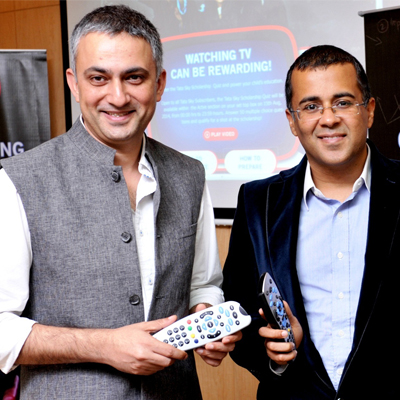
    MUMBAI: Tata Sky, the leading digital Pay-TV player in the country, has taken edutainment to the next level by announcing the launch of the first ever Scholarship for kids that can be availed through television. Author & motivational speaker Chetan Bhagat has been roped in to promote the Tata Sky Scholarship Quiz – a gratifying concept of edutainment.

    For the first time ever television will be the medium of participation for children to win the edutainment based Tata Sky Scholarship. Tata Sky subscribers will be able to participate in the quiz on 15th August’14 by simply answering questions on television, with a click of their Tata Sky remote control, from the comfort of their homes.

    Vikram Mehra, Chief Commercial Officer at Tata Sky explained, “The varied range of learning channels and interactive services for children on Tata Sky has been an apt medium to deliver edutainment and knowledge based content, as kids always grasp more from what they see and hear. Now with the Tata Sky Scholarship Quiz we look forward to quizzing and rewarding children across the country, for their vast exposure to educative content.”

    Tata Sky will roll out scholarships worth Rs. 20 lakhs with top 10 winners being entitled to a scholarship worth Rs. 2 lakhs each. Tata Sky is also launching a kid’s campaign titled – ‘Ab Bachchey Seekhein TV se…’, conveying the fact that television is a good learning aid for children.

    Promoting the TataSky Scholarship Quiz, Chetan Bhagat said, “It gives me great pleasure to be associated with Tata Sky. Their unique edutainment platform gives a great opportunity for children to learn through television. The scholarship provides an impetus to fulfil their future dreams and aspirations.”

  • Videocon d2h Selects Brocade Ethernet Fabrics to Turbocharge its Data Center Networks

    Videocon d2h Selects Brocade Ethernet Fabrics to Turbocharge its Data Center Networks

    MUMBAI: India’s fastest-growing Direct-To-Home (DTH) satellite broadcaster has selected Brocade® Ethernet fabric solutions to revamp its data center networks. Videocon d2h, a unit of Videocon Industries (BSE: 511389, NSE: VIDEOIND), deployed innovative Brocade VCS® Fabric Technology running on Brocade VDX® switches within its new and existing data centers in order to support continued rapid business growth.


    India is the world’s most competitive DTH satellite market with the participation of six private service providers and India’s state-owned TV broadcaster. When Videocon d2h launched its services in 2009, it was last to enter the field, yet it managed to attract more than 10 million subscribers in just over four years, putting it within 30 percent of the much longer-established market leader.


    “Thanks to pioneering high-end services—such as full 1080i high-definition channels ,3D programming, PVR, USB PVR, and so on—we’ve been adding around a million new customers a quarter in the recent past ,” said Samir Dhaga, Vice President, IT at Videocon d2h. “With such rapid business growth, there has been an exponential increase in the internal data center traffic. With the 1 Gbps network quickly running out of steam, we had to rapidly embrace newer technologies. We therefore embarked on a program to expand capacity by building a third data center and upgrading our existing infrastructure with an emphasis on high-speed internal networks that would support virtualisation, availability, and manageability.”


    Brocade VDX 6720 switches were initially deployed at Videocon D2h’s new data center, which was specifically designed to support virtualisation, with the deployment at the company’s two other facilities following in a second phase. Along with other members of Brocade VDX family, the Brocade VDX 6720 switches feature Brocade VCS Fabric technology, which enables Videocon to “flatten” its data center networks, provide Virtual Machine (VM) mobility without network reconfiguration, and manage the entire fabric more efficiently.


    Each fabric operates as a single virtual Ethernet device, which greatly simplifies management. Moreover, the approach eliminates the use of the Spanning Tree Protocol (STP), which would otherwise be a serious impediment to virtualised data center performance. The single-layer Ethernet fabric is also highly efficient and resilient, with load-balanced multipathing at Layers 1, 2, and 3 and support for multiple Layer 3 gateways.


    “Clearly, a smart networking decision was required in order to address existing and potential bottlenecks arising from the adoption of data center virtualisation. We conducted a thorough study of the available options—including six months of testing—before deciding on Brocade VDX switches as our data center networking platform going forward,” added Samir Dhaga.


    “Videocon d2h’s progress has been spectacular, which has necessitated the rapid adoption of next-generation networking technologies to match the business requirements,” said Edgar Dias, regional director for Brocade India. “Brocade Ethernet fabric solutions address Videocon d2h’s entire data center networking needs: extreme speed, scalability, non-stop resiliency, VM-awareness, and automation in terms of manageability.”


    Post implementation, Videocon d2h was delighted that Brocade delivered in performance, application integration, connectivity, interoperability, and management integration beyond their expectations. Brocade will be a key technology partner for the implementation of high-speed fabric technologies in their upcoming data centers.


    About Brocade Brocade (NASDAQ: BRCD) networking solutions help the world’s leading organisations transition smoothly to a world where applications and information reside anywhere. (www.brocade.com) © 2014 Brocade Communications Systems, Inc. All Rights Reserved.


    ADX, Brocade, Brocade Assurance, the B-wing symbol, DCX, Fabric OS, HyperEdge, ICX, MLX, MyBrocade, OpenScript, VCS, VDX, and Vyatta are registered trademarks, and The Effortless Network and The On-Demand Data Center are trademarks of Brocade Communications Systems, Inc., in the United States and/or in other countries. Other brands, products, or service names mentioned may be trademarks of others.

  • Tata Sky launches ‘TV is Good’ campaign for Kids!

    Tata Sky launches ‘TV is Good’ campaign for Kids!

    MUMBAI: Tata Sky, the leading DTH player in the country, launched its latest ad campaign ‘Ab Bachchey Seekhein TV se’ (Kids learn with television). The ad is set out to convey the fact that while television is a great entertainment medium, it is equally a good learning aid, helping children gain beyond bookish knowledge.


    The campaign is targeted primarily at the parents with children between ages 6 to 12 years, trying to break the myth most Indian parents have on ‘television is only mindless viewing for kids’. Hence one of the three ad films features a young boy stating an interesting fact on how to find out if the eggs are old or new. Similarly the other two ads have two kinder garden aged girls quizzing the audience on facts about ‘rhyming words to orange’ or ‘how to escape a leopard’ that catch you by surprise and leaves you with a smile. All the three ad films deliver the overarching message – Television is good!


    Vikram Mehra, Chief Commercial Officer, Tata Sky said, “Kids today are smart, not just studious. Give them the right content in an interesting package and see them absorb the knowledge at lightning speed. Over the last few years, Tata Sky’s pioneering efforts in ‘education through television’ with interactive (Actve) services and a bouquet of infotainment channels have been very well received by subscribers, specifically kids. With this campaign we wish to take the message to markets across the country on how fruitful learning through television can be.”


    Elaborating on the ad campaign, Abhijit Avasthi, National Creative Director, Ogilvy & Mather, “If you ask any parent they would say that television and education are like chalk and cheese, rather most will insist that television gets in the way of education. But what we found out in research was quite the contrary. Parents are starting to recognize that there is enough wholesome content on television to supplement their kid’s academic learning, more so in smaller cities where there are very few avenues to give kids holistic education, television plays a role to provide that. Our campaign, ‘Kitna kuch seekh saktein hai bacche TV se’ features kids flaunting the interesting pieces of knowledge that they have learnt from the 13 learning channels that Tata Sky has to offer. Actually we ourselves learnt so much while shortlisting these knowledge facts for the campaign. That discovery only fueled our conviction that kids can learn so much from TV.”


    · Name of the ad agency: Ogilvy & Mather

    · Name of the creative director: Abhijit Avasthi


    Isko laga daala toh TV jinga lala!


    YouTube links to the three TVCs:

    Orange – https://www.youtube.com/watch?v=0uhWKas1YSM

    Eggs – https://www.youtube.com/watch?v=A9bErWRuglk

    Leopard – https://www.youtube.com/watch?v=FP9h2sf-aJA

  • DTH ops face jammers again

    DTH ops face jammers again

    MUMBAI: Direct to home (DTH) operators are already facing annoyed users because of signals being disconnected due to rains. Now, they have a fresh problem to tackle, that of jammers being used in the city of Mumbai to distort DTH signals.


    Bringing the issue to light, the DTH Operators Association of India president and Tata Sky CEO Harit Nagpal has written letters to the Telecom Regulatory Authority of India (TRAI), Sanchar Bhavan, Ministry of Information and Broadcasting, Department of Telecommunications, the Prime Minister’s Office, Ministry of Home Affairs and the Mumbai Police commissioner.


    The letter states that ‘these jammers are being used by anti social elements to disrupt DTH signals and are also a threat to national security as the same are capable of being used to interfere with other signals besides DTH.’


    The letter also states that several incidences of signal losses were found during the FIFA World Cup matches in areas such as Versova, Yari Road and Lokhandwala. The jammers were disturbing the signals of all DTH ops including Freedish. Five specific dates have been tracked which were key FIFA match dates- 4 July, 10 July, 11 July, 12 July and 13 July.


    While locating the area of mischief, the technical team came across destroyed DTH antennas. During the service visits, interference was found in the lower Ku band between 10.7 GHz and 11.7 GHz.


    Similar cases have happened in Noida in 2011 and in Mumbai in 2008 and 2012. While the culprits were put behind bars in Noida, the signal disruption stopped in Mumbai after a written complaint was sent to the police.


    DTH ops feel it could be cable ops that are hampering their service. “Government has made it a fair playing field for MSOs and DTH with digitisation and this has put pressure on some operators to provide quality in their offering such as HD channels, interactive service etc. Just because someone can’t cope with DTH’s offering they shouldn’t get into such low acts,” said a senior executive of a leading DTH brand.


    Nagpal states that Tata Sky has received several complaints from consumers about poor picture quality and freezing of pictures on screen and so it has tracked certain key locations.


    The letter states that according to section 20, 21 and 25A of the Indian Telegraph Act, 1885 and section 3 of Indian Wireless Telegraphy Act, 1933, possession and use of unauthorised equipment and interference with transmission of authorised signals is illegal.


    It ends by stating that the real loser is the DTH operator since there is no continual preventive measure to keep jammers away. ‘Due to such illegal activity the subscribers think that the signal interference is caused by the DTH service providers and they lose goodwill and credibility resulting in loss of subscriber base,’ states the letter.

  • Dish TV adds 3.32 lakh net subscribers in Q1-2015; maintains FY-2014 ARPU of Rs 170

    Dish TV adds 3.32 lakh net subscribers in Q1-2015; maintains FY-2014 ARPU of Rs 170

    Updated: 05:45 PM


    BENGALURU:  In its earnings release today, India’s largest DTH operator, Dish TV Limited (Dish TV) informed the bourses that its net subscriber base in Q1-2015 has gone up to 1.17 crore, the company says that it has added a net of 3.32 lakh subscribers in this quarter. The company says further that its average revenue per user (ARPU) is Rs 170, same as the ARPU reported for FY-2014.


     Note:  100,00,000=100 lakh = 1 crore = 10 million


    Dish TV’s total income from operations (TIO) has gone up marginally by 0.6 per cent in Q1-2015 to Rs 640.69 crore from Rs 636.91 crore in Q1-2014 but was 1 per cent lower than Rs 647.38 crore in Q1-2014. The company has reported a lower loss of Rs 16.5 crore in Q1-2015 as compared to a loss of Rs 149.05 crore in Q4-2014 and a profit of Rs 31.73 crore in Q1-2014. It may be noted that Dish TV’s Q4-2014 loss was impacted by a prior period adjustment of Rs 116.4 crore.


    The company reported subscription revenue for the quarter were Rs 588.6 crore while total standalone operating revenues stood at Rs 640.7 crore.


    Let us look at the other Q1-2015 numbers reported by Dish TV


    Dish TV’s Total expenditure (TE) in Q1-2015 at Rs 628.88 crore (98.2 per cent of TIO) was 4.3 per cent lower than the Rs 657.05 crore (103.2 per cent of TIO) in Q4-2014 and 3.4 per cent more than the Rs 607.94 crore (93.9 per cent of TIO) in Q1-2014.


    The company’s programming content and other costs (programming cost) in Q1-2015 at Rs 66.44 crore (10.4 per cent of TIO) was 0.8 per cent lower than the Rs 66.98 crore (10.5 per cent of TIO) in Q4-2014 and 0.9 per cent less than the Rs 67.04 crore (10.4 per cent of TIO) in Q1-2014.


    Dish TV paid 16 per cent lower licence fees at Rs 69.24 crore (10.8 per cent of TIO) in Q1-2015 as compared to the Rs 82.38 crore (12.9 per cent of TIO) in the immediate trailing quarter and 10 per cent more than the Rs 62.92 crore (9.7 per cent of TIO) in the year ago quarter Q1-2014.


    The company’s commission expense at Rs 54.12 crore (8.5 per cent of TIO) was 6.9 per cent higher than the Rs 50.65 crore (8 per cent of TIO) in Q4-2014 and 36.4 per cent more than the Rs 39.69 crore (6.1 per cent of TIO) in Q1-2014.


    Dish TV’s other selling and distribution expense for Q1-2015 at Rs 37.86 crore (5.9 per cent of TIO) was 15.9 per cent more than the Rs 32.66 crore (5.1 per cent of TIO) in Q4-2014 and 24.8 per cent lower than the Rs 50.32 crore (7.8 per cent of TIO) in Q1-2014.


    Dish TV’s finance cost in Q1-2015 at Rs 39.48 crore (6.2 per cent of TIO) was 8.4 per cent more than the Rs 32.3 crore (5.1 per cent of TIO) in Q4-2014 and 5 per cent lower than the Rs 35.44 crore (5.5 per cent of TIO) in Q1-2014.


    Dish TV chairman Subhash Chandra said, “Going by the first quarter run-rate, the Indian DTH industry seems to have set ground for a 25 per cent growth in subscriber additions this year. Factoring in the opportunities ahead Dish TV is optimistic about outgrowing the industry growth rate. The company delivered in line with expectations during the first quarter and reclaimed its position as the fastest growing DTH player in the country”.


    Dish TV managing director Jawahar Goel said, “Post a mediocre 2014, fiscal 2015 had a promising start for the DTH industry. Dish TV, supported by a debt light balance sheet and a more willing consumer market, put the pedal to the metal and led the industry growth by garnering the highest incremental share during the quarter.”


    “In line with our objective of growth with profitability, we took a price hike of 5-7 per cent across the middle and top level packs with effect from the first week of June. ARPU increased to Rs. 170 per month in the first quarter with churn also increasing marginally to reach 0.7 per cent per month. There have been efforts to implement last mile billing by the MSO’s however, a full-fledged roll-out is key to a step jump in ARPU’s across the category,” added Goel. In Q4-2014, the company had reported a churn of 0.6 per cent.


     “We continued to expand ‘Zing’, our innovative offering for vernacular content across regional markets. The ‘Zing’ service is now available across Odisha, West Bengal, Tripura, parts of Assam and most parts of Maharashtra. A powerful sub-brand, ‘Zing’ has also propelled the sales of the main brand through a wider reach and top of the mind recall. Moving closer towards Phase III and IV of digitisation we remain optimistic about our strategy to capture leading share in these markets,” further added Goel.


    Click here to read the financial result

    Click here to read the Earnings release

  • Dish TV adds some Zing to Maharashtra

    Dish TV adds some Zing to Maharashtra

    MUMBAI: After targeting the east of the country, Dish TV has trained its sights on the diametrically opposite part of India – Maharashtra – with its regional sub brand Zing.  The western state has arguably the highest penetration of TV viewing homes nationally.

    Zing has been spreading out gradually over various towns and districts of Maharashtra right from Nashik to Ratnagiri to Aurangabad to Amravati over the past few days. It will however be focusing primarily in the heartlands and on areas where language consumption is very high; hence bigger cities like Mumbai, Thane, Pune and Nagpur won’t be exposed to the brand.


    Earlier this year, Zing was launched in West Bengal, Odisha and Tripura. The aim is to provide a DTH offering that can compete with cable but with digital picture quality, stereophonic sound and at affordable rates. Says Dish TV marketing VP Anjali Malhotra, “When these analogue consumers think of going digital we come as the first proposition. As markets will open up in phase III and IV, we do see an opportunity between other private DTH players and DD’s Freedish.”


    There are three packs available – Utsav, Anando and Shubharambh that will have 16 Marathi channels such as Zee Talkies, Zee 24 Taas, Zee Marathi, Star Pravah, Mi Marathi, ABP Mazha, IBN Lokmat, Saam TV, Maayboli, 9X Jhakaas, Jai Maharashtra, TV9 Maharashtra,  DD Sahyadri and ETV Marathi.


    Estimates peg Maharashtra’s cable TV and DTH homes at around 4-5 crore with a considerable amount of that being covered under the first two phases of digitisation.

    A marketing campaign worth Rs 6 crore has already begun across various towns and cities. The first phase was ground activations through mobile vans and merchandising activities. The ATL campaign that just commenced includes Marathi newspapers, local radio spots and close to 100 outdoor billboards in city and market areas. The ATL marketing that has been executed by McCann with planning in the hands of Madison will go on for a month.

    “Consumers are warming up to the idea that they are getting an offering that his cablewallah will have,” says Malhotra while highlighting some of the learning from Zing in the east. West Bengal and Odisha were test areas and she says that at an aggregate level the two brands, Dish and Zing, have collectively taken 40 to 50 per cent share.


    The regionalisation of DTH also means that new channels need to be added as and when they come. Earlier this year the DTH operator secured additional transponder space on the newly launched SES 8 satellite, thus allowing it to add several more channels.


    While there is a worry that the sub brand may eat up into the parent brand, Malhotra says that research has shown that isn’t the case. “The customers for Dish and Zing are very different. Which is why we aren’t even bringing Zing to the cities. In some places we will only display Zing, in some Dish and in some both, depending upon the language consumption in each of the areas,” she says.


    While on the one hand, a couple of DTH operators are going high tech and targeting premium viewers with 4K Ultra HD announcements, Dish TV, the oldest of them all, is going desi and local.

  • Sandeep Bajpai joins Dish TV as VP marketing

    Sandeep Bajpai joins Dish TV as VP marketing

    MUMBAI: DTH operator Dish TV has appointed Sandeep Bajpai as the new vice president for marketing. Bajpai who took charge nearly two weeks ago, was earlier with Tata Docomo handling the communication and consumer experience.


    A PTI report quotes Bajpai saying, “It is a great opportunity for me to lead Dish TV into its next phase of growth by consolidating and further strengthening its position in India, and looking at global markets to complete its transition of becoming a global force to reckon with.”


    Bajpai replaces Animesh Misra who has since then moved on. Prior to Tata Docomo, Bajpai has worked at Spice Hotspot, Bharti Airte, Idea Cellular and net2phone from the last 14 years.

  • Videocon d2h plans Rs 700 crore IPO by Diwali

    Videocon d2h plans Rs 700 crore IPO by Diwali

    MUMBAI: It has been seeking to make a public offering over the past two years, but market conditions have forced it to delay it time and again. But with the new Modi government generating a bullish sentiment in both the economy and the stock markets, the Videocon group’s direct to home operation Videocon d2h has finally decided to take the public listing route once again.


    Videocon Industries chairman &MD Venugopal Dhoot told a couple of business news  channels late last week that the DTH operator’s IPO is planned for sometime during Diwali this year and it has filed a fresh prospectus  with the Securities Exchange Board of India (SEBI), as the earlier one has lapsed.


    Dhoot pointed out to one of the business news channels that “Videocon d2h has been No1 in customer acquisition since it began. We have around 11 million subscribers today and we are wanting to take that up to 20 million. Hence we require some Rs 600 crore to Rs 700 crore which we will raise from the public to fuel expansion, growth and deliver value added services to consumers.”


    His view is that around 15 per cent or so of Videocon d2h’s equity might be diluted to raise the funds, though the premium for public offering has not yet been decided. He, however, expects the d2h IPO to do well, as organic demand for DTH is only going to grow with the government mandated digitisation gathering pace, especially in rural areas. 


    He emphasised that the DTH operator is on course to report a positive EBIDTA in Q1 2015, following planned losses over the past few years. “When you begin DTH you have losses in the beginning. But once you start generating positive EBIDTA, it continues,” he said.


    Dhoot also spoke highly about the first mover advantage Videocon d2h has in announcing its 4K or ultra HD service for Indian customers which it hopes to launch by Diwali too. Tata Sky, too announced last week that it will roll out its 4K transmission by early 2015.


    But Dhoot is confident about Videocon d2h’s success. Said he: “Our DTH quality has been very good, service is very prompt and people across India have liked it because our brand is very popular and at low cost we can distribute the same. In India and across the globe, DTH has been very successful and we are already getting a good response from the market for our IPO.”