Category: DTH Operator

  • DTT should be completed in Delhi by 2010

    DTT should be completed in Delhi by 2010

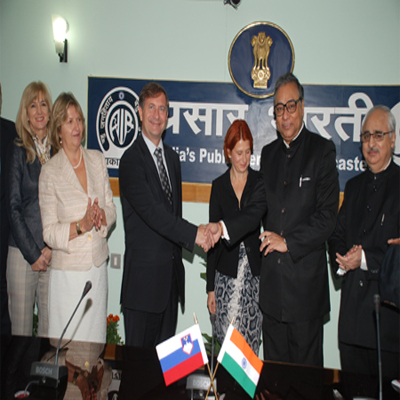
     NEW DELHI: A sub-group on ‘Going Digital’, set up by the Planning Commission, has recommended that digital terrestrial transmission by Doordarshan should be launched with a slogan Digital Delhi by 2010 to coincide with the Commonwealth Games in that year.

    The Sub-Group headed by Rajeev Ratna Shah, Member Secretary in the Planning Commission and a former CEO of Prasar Bharati, said a phased approach should be taken for going digital covering all the seven mega cities by 2011 in the first phase and the rest of the country by 2013.

    The sub-group, comprising 17 members, was set up by the Committee on Information, Communication and Entertainment (ICE) that has been examining the larger issue of convergence and advent of modern technology. Members include the secretaries in Information and Broadcasting and Department of Telecommunications, the Prasar Bharati CEO, the presidents of Cetma, Mait, Nasscom, and ISP Association of India, co-chairman of the Ficci entertainment committee Kunal Dasgupta, chairman of the CII entertainment committee, chairman of the Film & Television Producers Guild of India, president of the Cable TV Operators Association, Rajiv Mehrotra who is the managing trustee of the Public Service Broadcasting Trust, Virat Bhatia from AT&T Communications Services, Zee Telefilms President Abhijit Saxena, Sameer Rao who is vice-president in charge of strategy, planning & regulatory in STAR India, and a representative of the Prime Minister’s Office.
     

    It was also agreed that a group chaired by BS Lalli, the CEO of Prasar Bharati who is also chairman of the Indian Broadcasting Foundation, and some private broadcasters like Star, Zee, Sony, Eenadu etc. and their major MSOs will examine an 11-stage process and firm up their sequencing and put the entire process on a “digital upgrade timeline”.

    Digital migration process

    Ideally, the Sub-Group said the migration process must commence from Delhi in 2010, coinciding with the Commonwealth Games, and proceed to other mega cities by 2011 and Tier II and Tier III cities by 2012. In non-urban areas simulcast can continue for a few more years. Analogue transmission should be completely phased out by 2015 as the outer limit. It was decided that to keep the transition costs to the minimum, the switching over time as well as the simulcasting period should be kept to the minimum.

    There is need for convergence in regulation in the light of developments in technology and the I&B Ministry was requested by the sub-group to take a fresh look at the proposal for having a common communications convergence regulator with separate bureaus under it for dealing with content and carriage. A supplementary report will be submitted with regard to regulatory issues relating to going digital.

    All the content producers – Prasar Bharati as well as private operators – should provide agreed and identified channels in the digital / HDTV format to MSO / cable operators under “Must Carry” clause.

    High Definition TV should be introduced in a phased manner starting from Delhi (2008-09), extending it to all the six mega cities. Commonwealth Games should be covered in HDTV format in 2010.
     
    Spectrum planning

    The I&B Ministry, private broadcasters and service providers along with the Department of Telecommunications (WPC cell) should work in a coordinated manner to identify spectrum requirements keeping their rollout plans so that spectrum planning could be proactively made. A Spectrum Management Group could be set up to achieve this.

    Prasar Bharati should work out the financial implications of going digital, covering AIR and Doordarshan operations and submit the same to the Planning Commission.

    Prasar Bharati should digitally archive all its contents including educational contents for providing them for distribution streaming audio-video technologies. Prasar Bharati may also work out a mechanism to leverage the rich content available by appropriately pricing them and retailing them. All Prasar Bharati content of Classics or Fiction should be made web accessible with premium content accessible through payment gateway. Public service broadcasting content should be freely accessible on the web.

    Digital cinema

    The Sub-Group has also recommended amending the Cinematograph Act 1952 for inclusion of digital cinema. It said digital cinema should be seen as a means of securing the Intellectual Property Rights of the producer. Digitally recorded content taken from satellite in an encrypted conduit provides a failsafe method of delivering films to exhibitors directly, without intermediary or distributor’s interface at multiple locations simultaneously, in streaming audio-video-mode. It said this was the best guarantee against piracy. Digital cinema should, therefore, be encouraged by recourse to various fiscal and non-fiscal incentives.

    Production of cinema in digital format could be on lower tax regime and the theaters that have installed digital cinema exhibition facilities can be subjected to say lower entertainment tax. This would need to be taken up with State Governments, the Sub-Group said.

    It said all conditional access devices (and Set Top Boxes) should be built on common standards for inter-operability, so that customers are not put to inconvenience. This will also help in better absorption, acceptability of digital technology. The plain-vanilla-STB should lend itself to modular insertion of proprietary data to include value-added services.

    Content providers should be encouraged to work on creation of domain specific server farms and data depositories. The concept of digital libraries promoted by the Department of Information & Technology should also be publicly made available. Create open access platforms like Google libraries and others should also be encouraged. Memory modules could specially be created for lawyers, doctors, accountants and other professionals for instant data mining and retrieval in respect of their domain.

    Triple play services

    Triple play services riding on entertainment related applications would be able to create the most viable business models for spread of rural connectivity. Applications of Wi Max technology will allow entertainment to rural areas and this will provide ubiquitous Broadband experience to rural areas. Just as Wi Fi band has been delicensed, we need to move to the next step in encouraging proliferation of Wi Max technology for which the Wi Max band (2.5 GHz / 3.5 GHz / 700 MHz or existing Wi Fi band 2.4 – 2.48 GHz) could be delicensed for rural connectivity.

    Content creation would be a specialised area requiring thorough understanding of the local requirements and language that can only be done through local entrepreneurs. The Rural Content Provider (RCP) would provide content and other facilities, including entertainment, which will be of interest to the rural population. Delivery of services could be through home TV or Mobile telephone. The business model of such an RCP would vary from region to region and would be driven by the market. The department of IT and the Department of Telecommunications need to evolve a suitable policy framework that would encourage such RCPs.

    The Deparment of Information & Technology/National Informatics Centre should work out a comprehensive plan for rollout of statewise, regionwise and citywise GIS database and encourage private enterprise to do customized applications and value addition for various public sector as well as private sector applications.

  • Indya.com gears up for cricket World Cup

    Indya.com gears up for cricket World Cup

    MUMBAI: Played with passion! Followed with obsession!

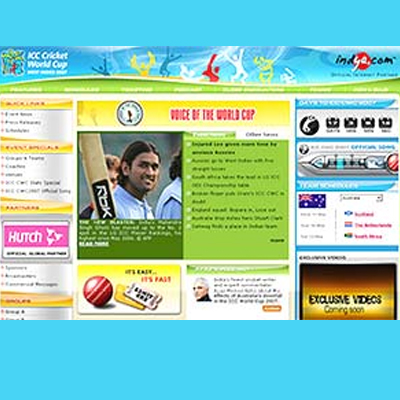
    With the cricket World Cup scheduled to kick off in less than a month’s time indya.com, which is running the official website www.cricketworldcup.com as the International Cricket Council’s (ICC) web partner, is starting to make a push.

    The site officially launches on Monday, 26 February.

    Information available with indiantelevision.com indicates that one presenting sponsor and four associate sponsors have been signed up so far for this year’s highlight cricket event.

    It was last year that Star inked a deal with the ICC to run its sites for the Champions Trophy and next month’s World Cup. Indya.com business head Sumant Kasliwal claims that its Champions Trophy site got three million unique users. In total there were over a billion hits, a lot of which, not surprisingly came from India. One million downloads took place and there were 100,000 registered users.

    For the Champions Trophy the site got 230 million page views. Kasliwal says that for the World Cup the site is expecting a billion page views during the event. “Our application Matchcast (which is a scorecard) has been expanded upon. It will be interactive. The aim is to give the consumer a complete experience. One can get match highlights, fall of wickets package, interactive contests. There will be live chat during the game. Users can comment on the state of the game. Our video content will include highlights from the previous World Cups. Other sites (as per the ICC diktat) are not allowed to show cricket videos.”

    Kasliwal also mentions another application – the Simulator. The visitor can view a graphical representation of what is happening ball by ball. He says that from a technological point of view it is a challenge. For each over two dozen parameters are taken into account. The recording takes place on the fly.

    There will also be expert analysis of each match. Prominent names are in the process of getting signed up. There will also be interviews with players and the captains. For the captains there is a section Captainspeak. Kasliwal says that it is in the process of tying up with speakers.

    It is also doing an interactive Voice Of the World Cup initiative. The contest kicks off next month. Here a clip of India’s match versus Pakistan in the previous World Cup is featured. Sachin basically hammers Shoaib. One can visit the section and provide a commentary recording. The winner who will be chosen by the public and a team of experts gets to do commentary for the semi finals and the final for the site.

    The site will also have a picture gallery courtesy gettyimages. For fun one can participate in games. One game that will shortly be launched is called Pick The Score. This is a prediction game and one has to guess scores. There will also be a fantasy game. Here one chooses a dream team for each match and one scores depending on how well the individual players are faring.

    The site will also have quizzes, an ICC contests suite. There will also be pages dedicated to teams and players, merchandise that can be ordered. In some countries like New Zealand, Hong Kong, Korea, Germany, France the site will offer for a fee live streaming of matches. In India highlights and the other earlier mentioned features will be given for free.

    GroupM COO South Asia Vikram Sakuja says that at first the agency was not sure how the product would turn out. However he is happy that for the Champions Trophy the site got a quarter of a billion page views. “I am glad that GroupM saw this potential and got some of our brands like Lufthansa to work with this exciting media offering.”
     

  • eBay India celebrates Cricket Mania with Mandira Bedi

    eBay India celebrates Cricket Mania with Mandira Bedi

    MUMBAI: Online marketplace eBay India, and Mandira Bedi have announced the launch of the eBay Cricket Mania campaign.

    This is a campaign for the two million strong eBay India community toexpress their support to Team India as they prepare for the World Cup by wearing trendy “Go India Go!” bands in the Indian tricolours and win rare cricket collectibles.

    eBay India is donating Rs. 5 to the NGO Mouth and Foot Painting Artists (MFPA) on behalf of every eBay member who sports the patriotic and colourful bands.

    The eBay India Cricket Mania rewards all buyers on eBay India with cricket collectibles through the World Cup. One can shop on eBay India and win cricket gifts. Every buyer who hits a single (completes one transaction) wins a eBay India “Go India Go!” band.

    If the buyer scores two runs (completes two transactions), he gets a special 100 years of cricket VCD compiled by David Gower. If the buyer scores 4 runs (completes four transactions), he is rewarded with a cricket ball autographed by Mandira Bedi. For all buyers hitting a sixer or completing six transactions, they get an original Sachin Tendulkar autographed biography – The making of a cricketer.

    Bedi said, “I am thrilled to be associated with eBay which is one of the most exciting online brands and the India’s leading online marketplace. eBay Cricket Mania gives millions of Indians the opportunity to demonstrate their cricket passion by actively participating in the World Cup campaign and winning rare cricket memorabilia.”

    eBay India country manager Rajan Mehra says, “At eBay India, we believe in engaging with the youthful online shopper by providing a shopping experience which is fun and exciting. As cricket is the national passion, we wanted to provide an opportunity for the Community to express their support for Team India at the World Cup. The eBay Cricket Mania initiative helps to build on the cricket fervor and additionally supports the noble cause of Mouth and Foot Painting Artists Association.”

  • FDI nod for Sun’s DTH

    FDI nod for Sun’s DTH

    MUMBAI: Kalanithi Maran’s Sun Direct TV has secured government approval to induct 20 per cent foreign equity worth $150 million. Malaysia-based Astro is making the investment in the direct-to-home (DTH) venture through its wholly owned subsidiary company South Asia Entertainment Holdings Ltd (SAHEL) of Mauritius.

    The cabinet committee on economic affairs gave its nod today to Sun Direct to issue equity shares to SAHEL. The approval is subject to guidelines issued by the ministry of information and broadcasting.

    Sun, which was waiting for a satellite and regulatory approvals, can be ready to kick off its services after Insat-4B launches on 10 March.

  • Tata Sky to pump in Rs 20 billion, expects break even in 5-7 years

    Tata Sky to pump in Rs 20 billion, expects break even in 5-7 years

     MUMBAI: Tata Sky will take 5-7 years to break even and plans to further invest Rs 20 billion to ramp up its direct-to-home (DTH) business.

    “We have already invested close to Rs 10 billion. We will pump in a further Rs 20 billion,” says Tata Sky CEO and MD Vikram Kaushik.

    There is a hardware and content subsidy and it will take us 5-7 years to break even, he adds. Tata Sky charges Rs 3999 for hardware and installation cost while the subscription fee is Rs 300 per month.

    The DTH service provider has a subscriber base of half a million and expects to benefit largely from the ICC cricket World Cup with its free subscription promotional scheme for the next three months.

    It has roped in actor Hrithik Roshan for its new marketing campaign where select viewers would get to watch the World Cup final match with him.

    “We are on course to achieve our target of one million subscribers in our first year of operations. We have activated half a million boxes. The World Cup should give us a spurt as we have interesting value-added features. In the Cas (conditional access system) areas, we have also seen a rise in demand for our service,” says Kaushik.

    Tata Sky hopes to add on the Sun network channels soon. “There was a hearing in the court today. The final hearing will be before the first half of March,” says Kaushik.

  • BKN seals new media deal with Digital Music Group

    BKN seals new media deal with Digital Music Group

    Mumbai: BKN International AG signed an agreement with NASDAQ listed Digital Music Group (DMGI) to handle all USA and Canada digital rights for current and upcoming BKN films and series. The announcesment was made by BKN CEO Allen Bohbot, CEO and DMGI CEO Mitchell Koulouris.

    The deal includes BKN series such as Legend of the Dragon, Dork Hunters from Outer Space and Zorro – Generation Z and films such as Jungle Book – Rikki-Tikki-Tavi to the Rescue, Robin Hood – Quest for the King and Kong – Return to the Jungle.

    “Having an organization like DMGI with expertise in handling all digital rights in the key USA and Canada markets is very important to us,” said Bohbot.

    He further added “DMGI provide access to new stores particularly online retailers including iTunes Music Store, Google Video, RealNetworks, Napster, Wal-Mart Music, and Yahoo! which will enable kids to view our shows on these channels.”

    “BKN’s list of film and television productions is impressive in both its scope and tremendous success with audiences,” said Koulouris. “DMGI is looking forward to working with BKN to maximize the earnings potential on their entire list of productions.”
     

  • Viacom partners with online global TV distribution platform Joost

    Viacom partners with online global TV distribution platform Joost

    MUMBAI: US media conglomerate Viacom and broadcast-quality Internet television service Joost have announced that Viacom will be a key content partner.

    It will offer a range of brands and programming for free to consumers on the Joost distribution platform.

    Under the agreement, Viacom’s divisions – MTV, Bet and Paramount Pictures – will provide television and theatrical programming on the Joost platform. Founded by Niklas Zennström and Janus Friis who were behind Skype, Joost is powered by an Internet platform that enables premium interactive video experiences while guaranteeing copyright protection for content owners and creators. The financial terms of the deal were not disclosed.

    Joost will allow users to have free access to thousands of programs and channels not readily available on the Web. Through Joost, viewers can watch programming from many of Viacom’s brands on their computers through a customizable platform with advanced television viewing features such as links that lead to more information or related websites based on the content; and a variety of plug-in applications, such as instant messaging, message boards, and news tickers.

    Currently available in limited beta, Joost combines TV and the internet by offering viewers a TV-like experience. Joost is the first online, global TV distribution platform, bringing together advertisers, content owners and viewers in an interactive, community-driven environment, according to an official release.

    MTV will offer shows, both past and present, including Laguna Beach, Beavis and Butthead, Real World. Comedy Central will feature episodes from Stella, CCP’s and Freak Show. Nickelodeon, CMT: Country Music Television, MTV2, Logo, Spike TV, mtvU, and Gametrailers.com will also provide content.

    VH1’s offerings will include episodes of Flavour of Love, Surreal Life and I Love New York.

  • DoT grants ILD & NLD licenses for BT India

    DoT grants ILD & NLD licenses for BT India

     MUMBAI: BT announced that it has been granted international long distance (ILD) and national long distance licenses (NLD) by the Department of Telecommunications, Government of India. These licenses enable BT’s newly-formed joint venture company, BT Telecom India Pvt Ltd, to offer services for the first time directly to multi-site corporate customers in the Indian market.

    BT plans to provide corporate customers who have sites in India with virtual private network-based (VPN) services using technologies such as internet protocol-based multi-protocol label switching (MPLS) and ATM.

    BT Global Services CEO Andy Green said, “This is fantastic news, allowing BT to establish and manage our own operations in India. It’s also great news for our multinational customers doing business in India and our Indian customers wanting to access a BT-managed network which is connected to BT’s comprehensive global network across Asia Pacific, Europe and North America.”

    Minister of Communication and IT M Maran said, “To further promote investment into India and enhance business opportunities for Indian companies operating overseas, India must have the best and latest infrastructure. These licenses will allow BT to bring its 21 CN services to India’s IT and ITES sector and increasing their competitiveness through connectivity, availability, quality and responsiveness on a global scale.”

    The company also predicted in 2006 that its revenues from India will be US$250 million by 2009 and that it is looking to increase its Indian employee strength by hiring an additional 6,000 people within the next two years. In February 2007, BT signed an agreement for the acquisition of i2i Enterprise Pvt Ltd, a Mumbai-based enterprise services company specialising in internet protocol (IP) communications services for major Indian and global multinational companies.BT also plans to add additional resources to support its already substantial capabilities in outsourcing and systems integration services.
     

  • Reliability issues turn off mobile TV users in Europe

    Reliability issues turn off mobile TV users in Europe

    MUMBAI: A survey of 22,000 European mobile users commissioned by Tellabs has revealed that a high percentage of early adopters of mobile TV and video services are snubbing a second helping. The research, conducted by M:Metrics in the United Kingdom, Germany, Italy, France and Spain, brought up an interesting issue: on average, former users of mobile TV and video outnumber current users by more than 19%. Users cited price, quality and reliability issues as the main reasons why they do not come back for more.

    “At 3GSM we will be treated to a feast of new mobile TV launches with millions of dollars being spent on developing, marketing and distributing mobile TV services. But if services fall short of user expectations on quality and reliability, it could be money wasted,” said Pat Dolan, Tellabs vice president for Europe, Middle East and Africa. “So while we share our industry’s enthusiasm for mobile TV, the detailed results of this survey provide important food for thought for the global operator community, who want to address network backhaul issues to improve mobile TV and video services.”

    Forty-five percent of European mobile video and TV users cited pricing issues as a factor causing them to switch off the services. And nearly a quarter (24%) of users who tried mobile video and TV stopped using the services due to concerns about service quality and reliability.

    The split between perception and reality was most pronounced in the United Kingdom. Only 6% of those who had never used mobile video and TV cited quality and reliability as reasons not to try such services, but 29% of users had stopped using services because of quality and reliability.

    “Pricing has already been highlighted as a stumbling block for recurrent use of mobile video and TV services, but we were surprised by just how much value users place on quality and reliability,” said Paul Goode, senior analyst, M:Metrics. “Once the basic requirements of quality and reliability are good enough, the focus will rightly shift to issues of programming, brands and marketing in addition to price. This research highlights the need to address quality and reliability so the industry can retain viewers, which is a key part of growing audience numbers.”

  • Trai faces QoS issue to ensure improved Cas rollout

    Trai faces QoS issue to ensure improved Cas rollout

    NEW DELHI: Many cable households are unhappy with repeated signal failure and Trai is now faced with the issue of what to do about enforcing Quality of Service provisions, sources tell indiantelevision.com.

    One of the major confusions in the market in the national Capital is what are the cable operators doing about the billing of chosen channels.

    At the moment, the operators are giving all the channels that can be shown in India, and they have been telling the subscribers, those who have filled up the forms indicating their choice, that at the end of the month, they would be charged for what they have indicated in the forms.

    “The COs have told us that the programming for each STB is taking time, but they would charge each household what the latter has opted for,” the official said.

    He said also that the COs are watching the scenario. “They feel that in a month or two, subscribers might want to drop some channels and want others, or just want more channels than they have opted for now. So then, they would have to do the programming all over again.”

    The official felt that the COs want the situation to stabilise before they get into programming for “watch what you pay for”.

    However, in many cases, the COs have registered the subscribers and taken the advance charges at the beginning, when they gave the STBs but have so far not returned for collecting the advance fees for February.

    “This means subscribers would suddenly be faced with having to pay for two months if the COs do not take the fees for February now,” said an official, agreeing that all this is causing more confusion than is good for the ongoing Cas rollout to regain the traction it has lost quite a bit of recently.

    One MSO is not showing contact numbers in the appropriate window when the signal goes off, and still signal loss is quite a regular phenomenon and, though less than in the beginning, there is a lot of pixelisation of images.

    The MSOs have so far not raised the issue of QoS being enforced, for reasons best known to them. But they are aware that this is one of the reasons for not just slowdown of Cas rollout, but in many cases, people wanting to return the boxes and settle for just the FTAs.

    In a report last week, indiantelevision,com had reported the worries amongst MSOs on these issues, and their informing Trai that broadcasters and they themselves need to do attractive packaging and ensure QoS, but nothing seems to have materialised so far.