Category: DTH Operator

  • Q1-2015: Airtel Digital TV y-o-y revenue grows 21 per cent, subscriber base up 11 per cent

    Q1-2015: Airtel Digital TV y-o-y revenue grows 21 per cent, subscriber base up 11 per cent

    BENGALURU: India headquartered communications giant Bharti Airtel Limited (Airtel)’s digital TV (DTH)segment reported a y-o-y growth in revenue of 21 per cent to Rs 591.5 crore as compared to the year ago revenue of Rs 490 crore. The DTH segment’s contribution to Airtel’s Indian and South Asian (India & SA) revenue of Rs 16201.9 crore in Q1-2015 was 4 per cent. Airtel’s India & SA revenue forms 71 per cent of the company’s global revenue of Rs 22961.6 crore in the quarter.


    Note: (1) Rs 100 lakh = Rs100,00,000 = Rs 1 crore = Rs 10 million.


    Airtel’s DTH segment reported  11 per cent jump in its net subscriber base to 93.88 lakh in Q1-2015 from 84.52 lakh in Q1-2014 and a 4.2 per cent rise from the 90.12 lakh in Q4-2014. Q-o-q the subscriber base grew by 3.76 lakh says the company.


    Airtel’s DTH segment reported average revenue (Arpu) of Rs 214, which was 5 per cent more than the Rs 203 in Q4-2014 and 9 per cent more than the Rs 195 in the corresponding quarter of last fiscal.


    Airtel’s DTH segment reported a monthly subscriber churn of 0.6 per cent in Q1-2015 and Q1-2014, as compared to 0.9 per cent in Q4-2014.


    The DTH segment’s EBITDA for the quarter increased to Rs 143.7 crore as compared to Rs 76 crore in the corresponding quarter last year. EBIDTA margin improved significantly in Q1-2015 to 24.3 per cent as compared to a margin of 15.5 per cent in the corresponding quarter last year.  During the current quarter, the DTH segment incurred a capital expenditure of Rs 262.7 crore for higher procurement of boxes  for higher gross adds.  The DTH Segment’s cash burn during the quarter at Rs 119 crore has dropped, compared to Rs 147.9 crore in the corresponding quarter last year reports the company.


    Bharti Airtel’s consolidated highlights for the first quarter ended 30 June 2014


    Overall customer base stands at 29.99 million across 20 countries, up 9.1 per cent y-o-y.


    Consolidated total revenues at Rs 22,962 crore, up by 13.3 per cent y-o-y.


    India & South Asia (India SA) up 11.8 per cent; Africa up 17.5 per cent (INR terms) y-o-y.


    Consolidated Mobile Data revenue at Rs 2,204 crore, up by 73.9 per cent y-o-y; growth across geographies.


    Consolidated EBITDA at Rs 7,720 crore, up by 18.0 per cent y-o-y, EBITDA margin up 1.3 per cent y-o-y.


    India & SA EBITDA margin at 37.2 per cent, up by 3 per cent y-o-y.


    Net Income at Rs 1,108 crore, up by 60.9 per cent y-o-y.
  • Videocon d2h Selects Brocade Ethernet Fabrics to Turbocharge its Data Center Networks

    Videocon d2h Selects Brocade Ethernet Fabrics to Turbocharge its Data Center Networks

    MUMBAI: India’s fastest-growing Direct-To-Home (DTH) satellite broadcaster has selected Brocade® Ethernet fabric solutions to revamp its data center networks. Videocon d2h, a unit of Videocon Industries (BSE: 511389, NSE: VIDEOIND), deployed innovative Brocade VCS® Fabric Technology running on Brocade VDX® switches within its new and existing data centers in order to support continued rapid business growth.


    India is the world’s most competitive DTH satellite market with the participation of six private service providers and India’s state-owned TV broadcaster. When Videocon d2h launched its services in 2009, it was last to enter the field, yet it managed to attract more than 10 million subscribers in just over four years, putting it within 30 percent of the much longer-established market leader.


    “Thanks to pioneering high-end services—such as full 1080i high-definition channels ,3D programming, PVR, USB PVR, and so on—we’ve been adding around a million new customers a quarter in the recent past ,” said Samir Dhaga, Vice President, IT at Videocon d2h. “With such rapid business growth, there has been an exponential increase in the internal data center traffic. With the 1 Gbps network quickly running out of steam, we had to rapidly embrace newer technologies. We therefore embarked on a program to expand capacity by building a third data center and upgrading our existing infrastructure with an emphasis on high-speed internal networks that would support virtualisation, availability, and manageability.”


    Brocade VDX 6720 switches were initially deployed at Videocon D2h’s new data center, which was specifically designed to support virtualisation, with the deployment at the company’s two other facilities following in a second phase. Along with other members of Brocade VDX family, the Brocade VDX 6720 switches feature Brocade VCS Fabric technology, which enables Videocon to “flatten” its data center networks, provide Virtual Machine (VM) mobility without network reconfiguration, and manage the entire fabric more efficiently.


    Each fabric operates as a single virtual Ethernet device, which greatly simplifies management. Moreover, the approach eliminates the use of the Spanning Tree Protocol (STP), which would otherwise be a serious impediment to virtualised data center performance. The single-layer Ethernet fabric is also highly efficient and resilient, with load-balanced multipathing at Layers 1, 2, and 3 and support for multiple Layer 3 gateways.


    “Clearly, a smart networking decision was required in order to address existing and potential bottlenecks arising from the adoption of data center virtualisation. We conducted a thorough study of the available options—including six months of testing—before deciding on Brocade VDX switches as our data center networking platform going forward,” added Samir Dhaga.


    “Videocon d2h’s progress has been spectacular, which has necessitated the rapid adoption of next-generation networking technologies to match the business requirements,” said Edgar Dias, regional director for Brocade India. “Brocade Ethernet fabric solutions address Videocon d2h’s entire data center networking needs: extreme speed, scalability, non-stop resiliency, VM-awareness, and automation in terms of manageability.”


    Post implementation, Videocon d2h was delighted that Brocade delivered in performance, application integration, connectivity, interoperability, and management integration beyond their expectations. Brocade will be a key technology partner for the implementation of high-speed fabric technologies in their upcoming data centers.


    About Brocade Brocade (NASDAQ: BRCD) networking solutions help the world’s leading organisations transition smoothly to a world where applications and information reside anywhere. (www.brocade.com) © 2014 Brocade Communications Systems, Inc. All Rights Reserved.


    ADX, Brocade, Brocade Assurance, the B-wing symbol, DCX, Fabric OS, HyperEdge, ICX, MLX, MyBrocade, OpenScript, VCS, VDX, and Vyatta are registered trademarks, and The Effortless Network and The On-Demand Data Center are trademarks of Brocade Communications Systems, Inc., in the United States and/or in other countries. Other brands, products, or service names mentioned may be trademarks of others.

  • DTH ops face jammers again

    DTH ops face jammers again

    MUMBAI: Direct to home (DTH) operators are already facing annoyed users because of signals being disconnected due to rains. Now, they have a fresh problem to tackle, that of jammers being used in the city of Mumbai to distort DTH signals.


    Bringing the issue to light, the DTH Operators Association of India president and Tata Sky CEO Harit Nagpal has written letters to the Telecom Regulatory Authority of India (TRAI), Sanchar Bhavan, Ministry of Information and Broadcasting, Department of Telecommunications, the Prime Minister’s Office, Ministry of Home Affairs and the Mumbai Police commissioner.


    The letter states that ‘these jammers are being used by anti social elements to disrupt DTH signals and are also a threat to national security as the same are capable of being used to interfere with other signals besides DTH.’


    The letter also states that several incidences of signal losses were found during the FIFA World Cup matches in areas such as Versova, Yari Road and Lokhandwala. The jammers were disturbing the signals of all DTH ops including Freedish. Five specific dates have been tracked which were key FIFA match dates- 4 July, 10 July, 11 July, 12 July and 13 July.


    While locating the area of mischief, the technical team came across destroyed DTH antennas. During the service visits, interference was found in the lower Ku band between 10.7 GHz and 11.7 GHz.


    Similar cases have happened in Noida in 2011 and in Mumbai in 2008 and 2012. While the culprits were put behind bars in Noida, the signal disruption stopped in Mumbai after a written complaint was sent to the police.


    DTH ops feel it could be cable ops that are hampering their service. “Government has made it a fair playing field for MSOs and DTH with digitisation and this has put pressure on some operators to provide quality in their offering such as HD channels, interactive service etc. Just because someone can’t cope with DTH’s offering they shouldn’t get into such low acts,” said a senior executive of a leading DTH brand.


    Nagpal states that Tata Sky has received several complaints from consumers about poor picture quality and freezing of pictures on screen and so it has tracked certain key locations.


    The letter states that according to section 20, 21 and 25A of the Indian Telegraph Act, 1885 and section 3 of Indian Wireless Telegraphy Act, 1933, possession and use of unauthorised equipment and interference with transmission of authorised signals is illegal.


    It ends by stating that the real loser is the DTH operator since there is no continual preventive measure to keep jammers away. ‘Due to such illegal activity the subscribers think that the signal interference is caused by the DTH service providers and they lose goodwill and credibility resulting in loss of subscriber base,’ states the letter.

  • Dish TV adds 3.32 lakh net subscribers in Q1-2015; maintains FY-2014 ARPU of Rs 170

    Dish TV adds 3.32 lakh net subscribers in Q1-2015; maintains FY-2014 ARPU of Rs 170

    Updated: 05:45 PM


    BENGALURU:  In its earnings release today, India’s largest DTH operator, Dish TV Limited (Dish TV) informed the bourses that its net subscriber base in Q1-2015 has gone up to 1.17 crore, the company says that it has added a net of 3.32 lakh subscribers in this quarter. The company says further that its average revenue per user (ARPU) is Rs 170, same as the ARPU reported for FY-2014.


     Note:  100,00,000=100 lakh = 1 crore = 10 million


    Dish TV’s total income from operations (TIO) has gone up marginally by 0.6 per cent in Q1-2015 to Rs 640.69 crore from Rs 636.91 crore in Q1-2014 but was 1 per cent lower than Rs 647.38 crore in Q1-2014. The company has reported a lower loss of Rs 16.5 crore in Q1-2015 as compared to a loss of Rs 149.05 crore in Q4-2014 and a profit of Rs 31.73 crore in Q1-2014. It may be noted that Dish TV’s Q4-2014 loss was impacted by a prior period adjustment of Rs 116.4 crore.


    The company reported subscription revenue for the quarter were Rs 588.6 crore while total standalone operating revenues stood at Rs 640.7 crore.


    Let us look at the other Q1-2015 numbers reported by Dish TV


    Dish TV’s Total expenditure (TE) in Q1-2015 at Rs 628.88 crore (98.2 per cent of TIO) was 4.3 per cent lower than the Rs 657.05 crore (103.2 per cent of TIO) in Q4-2014 and 3.4 per cent more than the Rs 607.94 crore (93.9 per cent of TIO) in Q1-2014.


    The company’s programming content and other costs (programming cost) in Q1-2015 at Rs 66.44 crore (10.4 per cent of TIO) was 0.8 per cent lower than the Rs 66.98 crore (10.5 per cent of TIO) in Q4-2014 and 0.9 per cent less than the Rs 67.04 crore (10.4 per cent of TIO) in Q1-2014.


    Dish TV paid 16 per cent lower licence fees at Rs 69.24 crore (10.8 per cent of TIO) in Q1-2015 as compared to the Rs 82.38 crore (12.9 per cent of TIO) in the immediate trailing quarter and 10 per cent more than the Rs 62.92 crore (9.7 per cent of TIO) in the year ago quarter Q1-2014.


    The company’s commission expense at Rs 54.12 crore (8.5 per cent of TIO) was 6.9 per cent higher than the Rs 50.65 crore (8 per cent of TIO) in Q4-2014 and 36.4 per cent more than the Rs 39.69 crore (6.1 per cent of TIO) in Q1-2014.


    Dish TV’s other selling and distribution expense for Q1-2015 at Rs 37.86 crore (5.9 per cent of TIO) was 15.9 per cent more than the Rs 32.66 crore (5.1 per cent of TIO) in Q4-2014 and 24.8 per cent lower than the Rs 50.32 crore (7.8 per cent of TIO) in Q1-2014.


    Dish TV’s finance cost in Q1-2015 at Rs 39.48 crore (6.2 per cent of TIO) was 8.4 per cent more than the Rs 32.3 crore (5.1 per cent of TIO) in Q4-2014 and 5 per cent lower than the Rs 35.44 crore (5.5 per cent of TIO) in Q1-2014.


    Dish TV chairman Subhash Chandra said, “Going by the first quarter run-rate, the Indian DTH industry seems to have set ground for a 25 per cent growth in subscriber additions this year. Factoring in the opportunities ahead Dish TV is optimistic about outgrowing the industry growth rate. The company delivered in line with expectations during the first quarter and reclaimed its position as the fastest growing DTH player in the country”.


    Dish TV managing director Jawahar Goel said, “Post a mediocre 2014, fiscal 2015 had a promising start for the DTH industry. Dish TV, supported by a debt light balance sheet and a more willing consumer market, put the pedal to the metal and led the industry growth by garnering the highest incremental share during the quarter.”


    “In line with our objective of growth with profitability, we took a price hike of 5-7 per cent across the middle and top level packs with effect from the first week of June. ARPU increased to Rs. 170 per month in the first quarter with churn also increasing marginally to reach 0.7 per cent per month. There have been efforts to implement last mile billing by the MSO’s however, a full-fledged roll-out is key to a step jump in ARPU’s across the category,” added Goel. In Q4-2014, the company had reported a churn of 0.6 per cent.


     “We continued to expand ‘Zing’, our innovative offering for vernacular content across regional markets. The ‘Zing’ service is now available across Odisha, West Bengal, Tripura, parts of Assam and most parts of Maharashtra. A powerful sub-brand, ‘Zing’ has also propelled the sales of the main brand through a wider reach and top of the mind recall. Moving closer towards Phase III and IV of digitisation we remain optimistic about our strategy to capture leading share in these markets,” further added Goel.


    Click here to read the financial result

    Click here to read the Earnings release

  • Dish TV adds some Zing to Maharashtra

    Dish TV adds some Zing to Maharashtra

    MUMBAI: After targeting the east of the country, Dish TV has trained its sights on the diametrically opposite part of India – Maharashtra – with its regional sub brand Zing.  The western state has arguably the highest penetration of TV viewing homes nationally.

    Zing has been spreading out gradually over various towns and districts of Maharashtra right from Nashik to Ratnagiri to Aurangabad to Amravati over the past few days. It will however be focusing primarily in the heartlands and on areas where language consumption is very high; hence bigger cities like Mumbai, Thane, Pune and Nagpur won’t be exposed to the brand.


    Earlier this year, Zing was launched in West Bengal, Odisha and Tripura. The aim is to provide a DTH offering that can compete with cable but with digital picture quality, stereophonic sound and at affordable rates. Says Dish TV marketing VP Anjali Malhotra, “When these analogue consumers think of going digital we come as the first proposition. As markets will open up in phase III and IV, we do see an opportunity between other private DTH players and DD’s Freedish.”


    There are three packs available – Utsav, Anando and Shubharambh that will have 16 Marathi channels such as Zee Talkies, Zee 24 Taas, Zee Marathi, Star Pravah, Mi Marathi, ABP Mazha, IBN Lokmat, Saam TV, Maayboli, 9X Jhakaas, Jai Maharashtra, TV9 Maharashtra,  DD Sahyadri and ETV Marathi.


    Estimates peg Maharashtra’s cable TV and DTH homes at around 4-5 crore with a considerable amount of that being covered under the first two phases of digitisation.

    A marketing campaign worth Rs 6 crore has already begun across various towns and cities. The first phase was ground activations through mobile vans and merchandising activities. The ATL campaign that just commenced includes Marathi newspapers, local radio spots and close to 100 outdoor billboards in city and market areas. The ATL marketing that has been executed by McCann with planning in the hands of Madison will go on for a month.

    “Consumers are warming up to the idea that they are getting an offering that his cablewallah will have,” says Malhotra while highlighting some of the learning from Zing in the east. West Bengal and Odisha were test areas and she says that at an aggregate level the two brands, Dish and Zing, have collectively taken 40 to 50 per cent share.


    The regionalisation of DTH also means that new channels need to be added as and when they come. Earlier this year the DTH operator secured additional transponder space on the newly launched SES 8 satellite, thus allowing it to add several more channels.


    While there is a worry that the sub brand may eat up into the parent brand, Malhotra says that research has shown that isn’t the case. “The customers for Dish and Zing are very different. Which is why we aren’t even bringing Zing to the cities. In some places we will only display Zing, in some Dish and in some both, depending upon the language consumption in each of the areas,” she says.


    While on the one hand, a couple of DTH operators are going high tech and targeting premium viewers with 4K Ultra HD announcements, Dish TV, the oldest of them all, is going desi and local.

  • Videocon d2h plans Rs 700 crore IPO by Diwali

    Videocon d2h plans Rs 700 crore IPO by Diwali

    MUMBAI: It has been seeking to make a public offering over the past two years, but market conditions have forced it to delay it time and again. But with the new Modi government generating a bullish sentiment in both the economy and the stock markets, the Videocon group’s direct to home operation Videocon d2h has finally decided to take the public listing route once again.


    Videocon Industries chairman &MD Venugopal Dhoot told a couple of business news  channels late last week that the DTH operator’s IPO is planned for sometime during Diwali this year and it has filed a fresh prospectus  with the Securities Exchange Board of India (SEBI), as the earlier one has lapsed.


    Dhoot pointed out to one of the business news channels that “Videocon d2h has been No1 in customer acquisition since it began. We have around 11 million subscribers today and we are wanting to take that up to 20 million. Hence we require some Rs 600 crore to Rs 700 crore which we will raise from the public to fuel expansion, growth and deliver value added services to consumers.”


    His view is that around 15 per cent or so of Videocon d2h’s equity might be diluted to raise the funds, though the premium for public offering has not yet been decided. He, however, expects the d2h IPO to do well, as organic demand for DTH is only going to grow with the government mandated digitisation gathering pace, especially in rural areas. 


    He emphasised that the DTH operator is on course to report a positive EBIDTA in Q1 2015, following planned losses over the past few years. “When you begin DTH you have losses in the beginning. But once you start generating positive EBIDTA, it continues,” he said.


    Dhoot also spoke highly about the first mover advantage Videocon d2h has in announcing its 4K or ultra HD service for Indian customers which it hopes to launch by Diwali too. Tata Sky, too announced last week that it will roll out its 4K transmission by early 2015.


    But Dhoot is confident about Videocon d2h’s success. Said he: “Our DTH quality has been very good, service is very prompt and people across India have liked it because our brand is very popular and at low cost we can distribute the same. In India and across the globe, DTH has been very successful and we are already getting a good response from the market for our IPO.”

  • Tata Sky demos 4K TV with FIFA World Cup quarter-final match

    Tata Sky demos 4K TV with FIFA World Cup quarter-final match

    MUMBAI: The era of India being a country that lags behind the more developed nations is gone. Indian  DTH operators in the country are waking up, ancticipating  future desires of Indian TV viewers. Which is why one of the oldest and largest DTH operators Tata Sky, is keeping itself and its subscribers up to date with the  introduction of its 4k Ultra HD service.


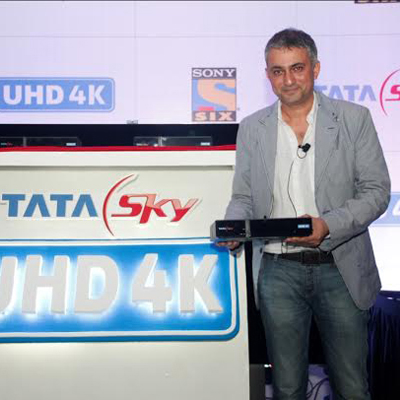
    The first quarter of 2015 will see Tata Sky roll out its set top boxes (STBs) for its 4k Ultra HD service. The STBs are being made by Technicolor and are based on the high efficiency video coding (HEVC) format that 4k uses the world over. However, prices of the STB are not yet known as the DTH operator wants to reveal it closer to the commercial launch date.


    At a demonstration event in Mumbai, Tata Sky along with Sony Six unveiled the 4k UHD service with a live uninterrupted broadcast of the France versus Germany FIFA World Cup 2014 quarter final. The FIFA 4k signal rights had been bought by Sony Six while the cost of acquisition and transmission was split 50:50 by the broadcaster and the operator. The telecast took place live via satellite transmission.  


    Indiantelevision.com readers will note that Videocon d2h had previewed its 4K service on 3 July 2014 too, a day before Tata Sky..


    Even though most industry professionals  claim that it is too early to launch 4k Ultra HD in India, Tata Sky chief commercial officer Vikram Mehra feels otherwise. “When we launched HD in 2010, people doubted us saying it won’t work. As you keep enhancing TV experience, the viewer will appreciate it. So, Ultra HD is our endeavour in that area. A technology becomes popular when mainline pay-TV adopts it.”


    Mehra feels that movies and sports will be the initial drivers for 4k technology and talks with broadcasters have already commenced. In three to four years, he expects it to be the way of life for most Indian TV viewers. Even though currently there is a lack of 4K content, he feels that it isn’t too far away. “We will make a product that makes sense to the customer. Customers will not buy STBs to adorn their homes. They will buy it for content,” he says.


    Sony Six business head Prasana Krishnan feels that more sporting events should be produced in 4K soon, probably in the next year or so. “4K is the future of broadcasting, specially sports. We saw technology move from SD to HD and now HD has become standard. 4K is next,” he says. Krishnan is aware that a full-fledged 4K channel can’t be expected very soon. Big sporting events will have 4K production on crucial days such as the finals, while the run up matches will be in HD and SD.


    The 4K screening of the FIFA World Cup 2014 quarter finals that took place in Mumbai yesterday, 4 July saw the Sony Six logo being superimposed on the FIFA feed on an 84 inch Sony television set that is soon to be launched in India and across the world. 4K screens give four times the clarity as compared to an HD feed.


    Mehra  was not willing to venture any guesstimates about how much uptake the Tata Sky 4K service will have when it launches next year as he feels making futuristic statements is of no use. However, the fact that the DTH operator is confident about its prospects is clear from the contract that it has signed with Technicolor, according to which deliveries of 4K set top boxes in “volume” are expected to commence in early 2015.


    Adds Mehra: “We started active service in 2007 and today we have 2.9million people paying Rs 45 each for them. Close to 65 per cent of our STBs sold today are HD. This from our total subscriber base of 13.5 million.” It is pertinent to note that Tata Sky, since late last year, has stopped buying any more SD boxes.

  • RC Venkateish elected as president of DTH Operators Association

    RC Venkateish elected as president of DTH Operators Association

    MUMBAI: A new face will be representing the six direct to home (DTH) operators. In a meeting, held by the DTH Operators Association of India, Dish TV CEO RC Venkateish was unanimously elected as the new president for a term of one year.


    The earlier president was Tata Sky MD and CEO Harit Nagpal who was the president for three years. Unlike the earlier rule, where the elected president served a term of three years, it has been now decided that the term will be for one year which can be extendable by another year.


    Speaking to indiantelevision.com, Venkateish expressed delight on his new role. “Of course I am happy but it also means more work to be done,” he says. He takes office from 1 August 2014.


    The association has also decided that from now on it will hold regular meetings every quarter to address issues.

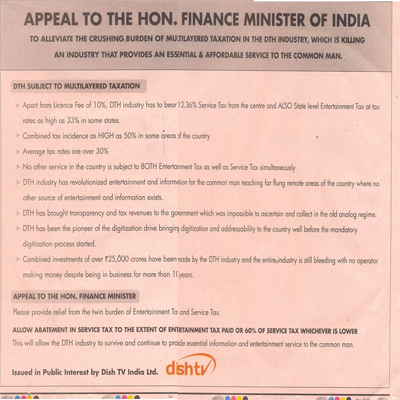
  • Dish TV’s appeal to the Finance Minister

    Dish TV’s appeal to the Finance Minister

    MUMBAI: The Direct to Home (DTH) industry has been vehemently opposing the heavy taxation being levied on the various operators in the country. In view of the same, the country’s oldest DTH operator Dish TV has appealed to the new Finance Minister Arun Jaitley.


    The DTH operator in its appeal has requested the Minister to alleviate the crushing burden of multilayered taxation in the DTH industry which is in turn killing the industry. The operators are subject to several taxes such as 10 per cent licence fee, 12.36 per cent service tax from the centre and the state level entertainment tax which is as high as 33 per cent in some states. While the average tax rates in most states is 30 per cent, in some it is as high as 50 per cent.


    The appeal states that no other service in the country is subject to both service as well as entertainment tax at the same time. “DTH industry has revolutionised entertainment and information for the common man reaching far flung remote areas of the country where no other source of entertainment and information exists. It has brought transparency and tax revenues to the government which was impossible to ascertain and collect in the old analogue regime,” states the appeal.


    Dish TV says that the entire industry has made investments of over Rs 25,000 crore but is still bleeding with no operator making money despite being in business for more than 10 years.


    The request by the operator on behalf of the entire industry is to provide relief from the twin burden of entertainment tax and service tax. It requests to allow abatement of service tax to the extent of entertainment tax paid or 60 per cent of service tax whichever is lower.   

  • DTH ops latch onto the FIFA juggernaut

    DTH ops latch onto the FIFA juggernaut

    MUMBAI: The world is in the grip of football fever and India isn’t far behind, though it is traditionally a cricket-crazy country where an Indian Premiere League would score any day higher than a FIFA in terms of fan frenzy.


    As aficionados prepare to settle down in front of the idiot box, popcorn and coke in tow, DTH operators are doing all they can to woo customers with special services and what not during the World Cup.


    A strategy adopted by almost all DTH operators is to offer Sony Six free for the entire duration of FIFA to all new subscribers taking a connection between June and the FIFA finale. While Tata Sky, Sun Direct and Airtel DTH are offering the channel free-of-charge to all their new subscribers, Dish TV is offering it only to its new subscribers and also to Zing subscribers. “FIFA viewing pockets are West Bengal, Odisha, Kerala and urban cities. So when compared to cricket, it isn’t as big an event in India,” says Dish TV CEO RC Venkateish.


    Additionally, Tata Sky and Videocon d2h have timed the launch of two of their services to coincide with the beginning of FIFA. Tata Sky has launched its TV Everywhere application for desktops and laptops, which was hitherto only available on Android and iOS smartphones. Furthermore, Sony Six is the new addition to the list of channels available on the app that would be available to subscribers at the same cost of Rs 60 per month. Tata Sky COO Vikram Mehra says, “The service launch has been timed just before the football World Cup to ensure that the home laptop doubles as the second TV at home, thus allowing youngsters to watch late night football matches on their laptops and headphones without disturbing their entire family.”


    Whereas, Videocon d2h has recently launched its earphone service through which, viewers can connect to radio frequency remotes and watch TV. “We have been working on this proposition for our consumers for quite some time. As per extensive research done by us, the typical Indian male consumer likes to watch content late night. Mostly consumption is of sports and movies. Given that in a typical Indian household, television is in the bedroom, volume becomes an issue. With a huge following for the World Cup in India and its late night timing, it coincided well with our plans,” says Videocon d2h CEO Anil Khera. Special product offerings will be provided for headphone remote-enabled set top boxes.


    Even Sun Direct’s existing customers, who take a recharge of six months or more, can watch Sony Six free during the FIFA period. Those who don’t have Sony Six in their packs can avail the FIFA add-on for a special price of Rs 39 for the duration of the World Cup or buy Sony Six at Rs 30 per month. A mix of above the line (ATL), below the line (BTL), digital and PR activities have been planned close to the beginning of the World Cup. ATL is through radio, TV and focus on Kerala; BTL is through posters, leaflets and wobblers; while other activities are through SMS, OBD and blogs. The operator has already received nearly 40,000 requests for Sony Six.


    Dish TV and its second brand Zing are banking not just on Sony Six but also on Sony Aath which will be providing commentary in Bangla. Says Dish TV VP marketing Anjali Malhotra, ”Zing caters to a larger language customer base. Sony Aath is already available in all base packs of Zing as well on Dish TV in the north. With Sony Six available to consumers free of any extra fee during FIFA, it will help people buy Zing and watch it.”


    The operator has also rolled out an intense marketing campaign across West Bengal involving print, outdoor and radio mediums.