Category: DTH Operator

  • How DTH got digitisation right

    How DTH got digitisation right

    MUMBAI: Two years gone, two more in hand. But the cable TV industry is still grappling with getting its act right for digitisation. It was 10 years ago when the direct to home (DTH) players entered the Indian market with huge tasks in hand: introduce and convert people from the analogue regime into the digital ecosystem.

    Currently, the DTH sector commands about 36 million active subscribers (as per the recent TRAI report). While Dish TV was first to enter, it was soon followed by Tata Sky, Sun Direct, Airtel Digital TV, Videocon d2h and Reliance Digital. Not to forget, Prasar Bharati’s DD Freedish.

    How did the DTH industry manage to cultivate the business model which the MSOs are still finding cumbersome? Ask the DTH players and they say, it is because of their direct contact with the customer. “We were able to deal directly with the customer and provide a business model the way we wanted to. There isn’t any intermediary,” says Dish TV CEO RC Venkateish.

    Agrees Sun Direct CEO Mahesh Kumar, “DTH adopted the retail distribution model akin to aggressive FMCG/ telecom companies which is purely B2C. Majority of the employees at the senior and middle level are from the retail background.”

    The MSOs on the other hand had been running the analogue business, handled mostly by the local cable operators (LCOs). It was only after being pressurized by the government and regulator that they finally took up digitisation and started work on creating a proper business model. Tata Sky CEO Harit Nagpal feels that MSOs are working like puppets. “Cable operators are looking at digitisation as forced upon them. Digitisation is not about putting a box; this is inconvenient for the customer. It has to be sold to the customer as empowerment and not as a curse. DTH has done that.”

    While initially convincing the customer to switch from analogue to digital DTH wasn’t easy, what went in their favour was superior product offering with better quality sound and picture and selection of channels and packaging. “When DTH first came, it was the only digital offering. The country was largely analogue. That was the big advantage we had. We started from zero and had the opportunity to build the billing system and packaging,” says Venkateish.

    The claims made by DTH ops were supported by setting up call centres, backend and investment in brand building. However, what all executives agree as the best tool is the prepaid mode of payment. “The biggest success factor of the DTH model is the prepaid model which is a very transparent business model,” says Kumar.

    Nagpal feels that the crux of their model is the consumer centric approach, which MSOs don’t have. “You can activate and deactivate channels and packages whenever you want. Go on a holiday and don’t recharge. This is not yet possible in cable. The benefits of flexibility and empowerment in the case of DTH are in the customers’ hands,” he says.

    The only difference in the two is the pricing models for packages. While DTH starts its base pack at around Rs 200 to Rs 220, cable gives the entire channel list for approximately Rs 250. But Nagpal disagrees, stating that MSOs are not subject to taxes and also gets carriage fees from broadcasters. Whereas DTH, despite paying taxes and also paying for content, gives channels at a decently low cost with options of adding more.

    Kumar points out that DTH community has been able to segment the market and the customer which has helped the industry to do up-selling and consistently improve average revenue per user. Though the initial uptake of dishes was slow, over the years it has picked up speed. The choice of packages, HD channels, addition of newer channels and easy payment methods have put them on the better side of digitisation.  

    While DTH did have the upper hand in entering the market with a fixed plan of action, it is about time the MSOs come to terms with getting addressable digitisation done rather than just fixing boxes in homes. “DTH got digitisation right because we looked at it from what benefits it has to customer and not what the regulator is asking me to do,” points out Nagpal.


  • DD Freedish readies for 18th online e-auction with reserve price of Rs 3.7 crore

    DD Freedish readies for 18th online e-auction with reserve price of Rs 3.7 crore

    NEW DELHI: Aiming at a target of 112 television channels in the next few months, Doordarshan has set a reserve price of Rs 3.7 crore per slot for the 18th online e-auction to be conducted on 28 November.

     However, it is learnt that the bid amount went up to Rs 4.2 crore in the last e-auction held on 12 November. This came shortly after the 16th e-auction on 28 October.


    Prasar Bharati CEO Jawhar Sircar had said recently that the future of Doordarshan was in Freedish and digitisation. He had added that this may mean that some channels would have to be attracted to Freedish by means other than e-auction.
     
    DD sources also said that while Freedish may be encrypted to keep a tab on the number of subscribers, it would remain free-to-air.

     The e-auction will be conducted by Synise Technologies, Pune on behalf of Prasar Bharati.   

     The reserve price in the 15th e-auction was Rs 3 crore and was raised to Rs 3.7 crore in the 16th auction.

     Prior to the sixteenth auction, the total number of channels on Freedish was 58.

     Meanwhile, a Doordarshan official declined to give the number of successful bids on 28 October as engineers of the pubcaster had to test these channels before verifying any numbers.

     A Prasar Bharati official told indiantelevision.com that DD had decided not to disclose the number of slots to be e-auctioned to prevent bidders forming consortia to bid or resort to other malpractices.

     The eligibility terms and conditions including other relevant details for this e-auction are displayed on DD website: www.ddindia.gov.in.

     However, the participation amount (EMD) in the e-auction is Rs.1.5 crore which has been deposited in advance on or before 11 November evening along with processing fee of Rs.10,000 (Non-refundable) in favour of PB (BCI) Doordarshan Commercial Service, New Delhi.

     Applicants have also been asked mandatorily to deposit a demand draft of Rs 5,500 registration amount favouring M/s. Synise Technologies Ltd., payable at Pune at the time of submission of the application. The time for every slot e-auction will be of fifteen minutes duration.

     The applicants must provide details of the uplink/downlink permission documents received from the concerned Ministries with the Applications to ensure they are not rejected.

     The demand drafts of unsuccessful bidders will be returned immediately or within a week after the e-auction process is completed.  


  • DirecTv’s US, Brazil ARPU up; Latin, pan-Americana ARPU down in Q3-2014; rev improves

    DirecTv’s US, Brazil ARPU up; Latin, pan-Americana ARPU down in Q3-2014; rev improves

    BENGALURU: DirecTv announced its Q3-2014 results (quarter ended 30 September 2014, current quarter). The company reported 4.8 per cent growth in its US segment’s monthly average revenue per user (ARPU) from $ 102.37 in Q3-2013 to $ 107.27 in the current quarter. During the nine month period ended 30 September 2014 (9M-2104, ytd) ARPU from the US segment rose 4.6 per cent to $ 103.57 from $ 99 in 9M-2013.


    Its Sky Brasil segment reported 6.2 per cent growth in ARPU to $ 60 in Q3-2014 from $ 56.50 in Q3-2013. During 9M-2014, ARPU reduced fractionally by 0.6 per cent to $ 59.57 from $ 59.9 in 9M-2013.


    DirecTv’s Latin America segment ARPU at $ 48.88 in Q3-2014 fell 1.1 per cent from $ 49.92 in Q3-2013. 9M-2014 ARPU at $ 49.02 was 5.1 per cent lower than the $ 51.68 in 9M-2013.


    Pan Americana segment reported the sharpest ARPU fall of 8 per cent to $ 39.64 in Q3-3014 from $ 43.07 in the corresponding year ago quarter. ARPU in 9M-2014 fell 9.4 per cent to $ 40.12 from $ 44.27 in 9M-2013.


    Subscribers:


    The company reported a subscriber churn of 1.73 per cent in its US segment in Q3-2014 versus a churn of 1.61 per cent in Q3-2013. Ytd subscriber churn was 1.58 per cent versus 1.53 per cent in 9M-2013. The number of cumulative subscribers rose 0.2 per cent to 20.203 million in Q3-2014 and 9M-2014 from 20.160 million in Q3-2013 and 9M-2013.


    DirecTv Latin America (DTVLA ) owns approximately 93 per cent of Sky Brasil, 41 per cent of Sky Mexico and 100 per cent of PanAmericana, which covers most of the remaining countries in the region. Sky Mexico, whose results are accounted for as an equity method investment and therefore are not consolidated by DTVLA, had approximately 6.52 million subscribers as of 30 September 2014, bringing the total subscribers in the region to 18.87 million.


    To its Sky Brasil segment, the company added net 27,000 subscribers in Q3-2014 to reach a total of 5.644 million as compared to 88,000 subscribers added to reach cumulative subscribers of 5.255 million in Q3-2013. During 9M-2014, Sky Brasil added 273,000 subscribers versus the 216,000 subscribers added in 9M-2013. The company has not reported churn for its Sky Brasil segment.


    The number of cumulative subscribers for Latin America segment in Q3-2014 and 9M-2014 rose 9 per cent to 12.353 million from 11.337 million in Q3-2013 and 9M-2013. Average total subscriber churn in Q3-2014 was 2.99 per cent against 2.27 per cent in Q3-2013. Churn during 9M-2014 was 1.94 per cent, lower than the 2.18 per cent churn in 9M-2013.


    For its Pan Americana and other segment, DirecTv reported a reduction of 146,000 subscribers in Q3-2014 to 6.709 million as compared to an increment of 172,000 subscribers and a base of 6.082 million in Q3-2013. During 9M-2014, the company added 512,000 subscribers as compared to the 792,000 subscribers added in 9M-2013. Subscriber churn figures for this segment have not been mentioned by the company in its Q3-2014 result.


    Financials (Company speak)


    DirecTv announced that third quarter 2014 revenues increased 6 percent to $ 8.37 billion, adjusted operating profit before depreciation and amortisation (OPBDA) and adjusted operating profit both increased 5 percent to $ 2.04 billion and $ 1.28 billion, respectively, and adjusted diluted earnings per share increased 4 percent to $ 1.33 compared to last year’s third quarter. Adjusted financial results exclude a pre-tax charge of $ 62 million in the third quarter of 2014 resulting from the revaluation of the net monetary assets of the company’s subsidiary in Venezuela. Reported OPBDA increased 2 percent to $ 1.98 billion, reported operating profit was relatively unchanged at $ 1.22 billion and reported diluted earnings per share declined to $ 1.21 compared to last year’s third quarter.


    “Our third quarter financial results continue to demonstrate the strong execution of our operations,” said DirecTv president and CEO Mike White. “In the US, although competition for subscribers continues to be intense, revenue growth was very solid while operating profit before depreciation and amortisation margin expanded year-over-year for the fifth consecutive quarter, highlighting our commitment to profitably grow our businesses through disciplined subscriber acquisitions and expense management, as well as smart pricing.” White added, “In Latin America, due to challenging macroeconomic and foreign exchange headwinds, we continue to focus on local currency performance which has allowed us to profitably grow our businesses, as well as begin generating positive cash flow in the region – one of our primary goals for the year.”


    Segment financials


    US segment 


    In the third quarter, DirecTv US revenues increased 5 percent to $ 6.51 billion compared with the third quarter of 2013 primarily due to strong ARPU growth of 4.8 percent. The improvement in ARPU to $ 107.27 was driven by price increases on programming packages, higher advanced receiver service fees, increased ad sales, higher fees for the enhanced warranty program and increased commercial business revenues. These improvements were partially offset by increased promotional offers to existing customers and lower revenue from pay-per-view events. 


    Third quarter OPBDA increased 11 percent to $ 1.55 billion and OPBDA margin improved from 22.6 percent to 23.8 percent principally due to higher revenues combined with lower upgrade and retention expenses mostly  related to reduced equipment costs, as well as relatively unchanged subscriber service expense. Also contributing to the margin improvement was slower relative growth in subscriber acquisition costs mainly associated with the decrease in gross additions. Operating profit increased 13 percent to $ 1.11 billion and operating profit margin improved from 16.0 percent to 17.1 percent in the third quarter mainly due to the higher OPBDA and OPBDA margin. 


    Sky Brasil


    Excluding changes in foreign exchange rates, Sky Brasil’s third quarter revenues grew 14 percent versus the prior year period driven by an 8 percent increase in the average number of subscribers and a 5 percent increase in local currency ARPU. The increase in local currency ARPU was principally due to a reduction in credits to existing subscribers. When factoring in changes in foreign exchange rates, Sky Brasil’s revenues increased 15 percent to $ 1.01 billion and ARPU improved 6 percent to $ 60 compared to the third quarter of 2013.


    Excluding the impact of the favourable ECAD settlement in the third quarter of 2013, Sky Brasil OPBDA increased 8 percent to $ 307 million, while OPBDA margin declined from 32 percent to 30 percent. The decline in OPBDA margin was principally due to increased expenses related to customer service and systems initiatives. Also excluding the impact of the favourable ECAD settlement, operating profit increased 19 percent to $ 118 million and operating profit margin increased from 11.2 percent to 11.6 percent. Operating profit margin improved as the decline in OPBDA margin was more than offset by the impact of relatively unchanged depreciation expense.


    Pan Americana and other regions


    Excluding changes in foreign exchange rates, third quarter revenues in the PanAmericana and other segment grew 45 percent versus the prior year period driven by a 13 percent increase in the average number of subscribers and a 28 percent increase in local currency ARPU. The increase in local currency ARPU was principally due to price increases and growth in advanced services, partially offset by the higher penetration of lower ARPU mass market subscribers. When factoring in unfavorable changes in foreign exchange rates, most notably in Argentina and Venezuela, revenues increased 3 percent to $ 806 million compared to the third quarter of 2013, while ARPU decreased 8.0 percent to $ 39.64.


    Also in the third quarter, adjusted OPBDA in the PanAmericana and other segment increased slightly to $ 208 million while adjusted OPBDA margin declined to 25.8 percent. The decline in adjusted OPBDA margin was primarily driven by higher programming costs in Venezuela and increased subscriber acquisition costs mostly due to inflationary pressure on labor costs. In addition, adjusted operating profit decreased to $ 81 million and adjusted operating profit margin declined to 10.0 percent mainly due to the impact of higher depreciation and amortization resulting from leased equipment and infrastructure capital expenditures made over the last year. Reported OPBDA and reported operating profit decreased to $ 146 million and $ 19 million, respectively.
  • Dish TV’s Sri Lanka arm gets licence approval

    Dish TV’s Sri Lanka arm gets licence approval

    MUMBAI: Dish TV has finally received the nod from the government of Sri Lanka to commence operations for its Sri Lanka unit.

    The DTH operator in a statement to the BSE has said ‘Dish TV India Ltd has informed BSE that Dish TV Lanka (Private) Limited, the Company’s Subsidiary Company in Sri Lanka, has been granted the ‘Satellite Television Broadcasting License’ (DTH License) by the Government of Sri Lanka to establish, operate and maintain Satellite Television Network for the purpose of Digital Television Satellite Broadcasting.’

    Speaking to indiantelevision.com, Dish TV COO Salil Kapoor says, “We are pleased that we have been issued the DTH license by government of Sri Lanka to operate DTH services in the country, which we are working on for last couple of months. Now the focus will be on building up the ground opportunities”.

    Dish TV has been awaiting the licence clearance for quite some time. The company has expressed its intent to invest close to Rs 100 crore in the JV with Satnet.
    It has also bought extra transponder space on SES 8 that was launched in December last year.


  • Higher ‘other expense’ pares Dish Network PAT to less than half in Q3-2014

    Higher ‘other expense’ pares Dish Network PAT to less than half in Q3-2014

    BENGALURU:  US pay-TV player Dish Network Corporation (Dish Network) reported net income after taxes of $ 145.52 million ($ 14.552 crore) in Q3-2014, which was less than half the US$ 414.91 million reported during the year ago quarter. Year to date, for 9M-2014, the company’s net income increased by 2.9 per cent to $ 534.76 million from $ 519.45 million in 9M-2013.


    Dish Network reported ‘other expense’ of $ 185.39 million in Q3-2014 as compared to the $ 38.93 million in Q3-2013. For 9M-2014, the company reported more than double the other expense at $ 478.13 million as compared to the $ 226.18 million in 9M-2013.


    Here are excerpts of the Dish Network’s own review in its press release:

    Dish Network reported revenue totalling $ 3.68 billion for the quarter ending 30 September 2014, compared to $ 3.51 billion for the corresponding period in 2013. Subscriber-related revenue increased 5.3 percent to $ 3.65 billion from $3.46 billion in the year-ago period.


    Net income attributable to Dish Network totalled $ 146 million for the quarter ending 30 September 2014, compared to net income of $315 million from the year-ago quarter. Diluted earnings per share for the quarter were $0.31, compared with $0.68 during the same period in 2013.


    Pay-TV ARPU for the third quarter totalled $ 84.39, compared to the year-ago period’s pay-TV ARPU of $ 80.98. Pay-TV subscriber churn rate increased slightly to 1.67 percent versus 1.66 percent for third quarter 2013.


    Total pay-TV customers decreased by approximately 12,000 in the quarter. Dish Network closed the third quarter with 14.041 million pay-TV subscribers, compared to 14.049 million pay-TV subscribers at the end of third quarter 2013. Dish Network activated approximately 691,000 gross new pay-TV subscribers, compared to approximately 734,000 gross new pay-TV subscribers in the prior year’s third quarter.


    Dish Network added approximately 28,000 net broadband subscribers in the third quarter, bringing its broadband subscriber base to approximately 553,000. Dish Network added approximately 75,000 net broadband subscribers in the third quarter 2013.


    Year-to-Date Review


    For the first nine months of 2014, Dish Network’s revenue of $ 10.96 billion increased 5.7 percent, compared to $ 10.37 billion in revenue from the same period last year. Subscriber-related revenue increased 5.7 percent to $10.85 billion in the first nine months of 2014 from $ 10.26 billion from the year-ago period. Year to date, net income attributable to Dish Network totalled $ 535 million compared with $ 519 million during the same period last year. Diluted earnings per share were $ 1.16 for the first nine months of 2014, compared with $ 1.13 during the same period in 2013.

    Click here for the statements


    Click here for the statements


  • Videocon d2h taps into the Star-MSO feud

    Videocon d2h taps into the Star-MSO feud

    MUMBAI: Star India’s incentives on its various channels on RIO has not gone down well with several MSOs in the country, who feel that this will actually raise consumer bills rather than make it easier, despite being on a-la-carte. However, the DTH industry sees a prized opportunity in the whole matter.


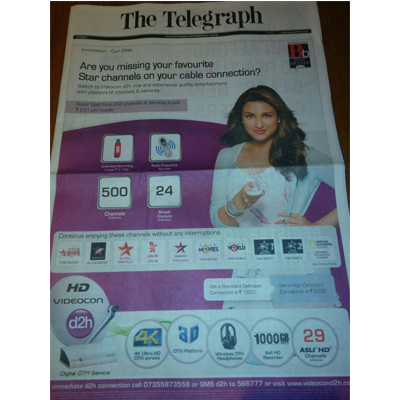
    Videocon d2h has taken out ads in several markets, concentrating in the east of the country, asking consumers to shift from cable to DTH. The ad asks consumers if they are ‘missing their favourite Star channels on your cable connection’ and if so then they should switch to Videocon d2h. The ad also lists the channels that the viewers can watch uninterrupted – Star Jalsha, Jalsha Movies, Star Plus, Life Ok, Star Sports, Star Gold, NGC, Star Movies, Star World etc.


    The ad also points out that viewers can avail 24 Bengali channels on the platform.


    Last week, Star India had come up with a new RIO agreement that it will be enforcing with MSOs across the country. According to Telecom Disputes Settlement Appellate Tribunal (TDSAT), the last date for undertaking the RIO will be 10 November after which the broadcaster can disconnect signals to MSOs.


    The network claims that up to now, nearly 33 per cent of independent MSOs have come forward to sign the RIO.


  • Dish TV appoints new independent directors

    Dish TV appoints new independent directors

    MUMBAI: Dish TV, in the recently held 26th Annual General Meeting (AGM) announced the appointment of four new independent directors in the company.


    Lakshmi Chand, Bhagwan Dass Narang, Arun Duggal and Eric Louis Zinterhofer have been appointed as independent directors of the company to hold office for a term of three years.


    According to the statement issued by the company, all the four independent directors were appointed as “Director whose office was liable to retire by rotation, be and is hereby appointed as independent director of the company, whose office is not subject to retirement by rotation, to hold office for a term of three consecutive years.”


    Lakshmi Chand was an independent non-executive additional director on the board of the company. He is a post graduate in MA (Eco) from Punjab University and is a Law graduate from Delhi University.


    101 equity shareholders representing 78,27,27,656 equity shares comprising 99.999 per cent of  total  votes casted, voted in favor of the resolution of appointing Chand as an independent director and seven equity shareholders representing  10,170 equity shares comprising 0.001 per cent of total votes casted, voted against the resolution.


    Narang was an independent non-executive member of the board and is a post graduate in agricultural economics and brings with him 32 years of banking experience.


    68 equity shareholders representing 75,02,72,688 equity shares comprising 95.852 per cent of total  votes casted, voted in favor of the resolution of appointing Narang as an independent director and 40 equity shareholders representing  3,24,65,138 equity shares comprising  4.148 per cent of total votes casted, voted against.


    Arun Duggal was an independent non-executive member of the board. Duggal is a Mechanical Engineer from Indian Institute of Technology, Delhi, and holds an MBA from the Indian Institute of Management, Ahmedabad.


    97 equity shareholders representing 76,72,71,725 equity shares comprising 98.024 per cent of total  votes casted, voted in favor of the resolution of appointing Duggal and 11 equity shareholders representing  1,54,66,101 equity shares comprising 1.976 per cent of total votes casted, voted against.


    Eric Louis Zinterhofer was an independent non-executive member of the board. Prior to co-founding Searchlight Capital Partners in 2010, Zinterhofer was a senior partner at Apollo Managemen which he joined in 1998.


    61 equity shareholders representing 74,52,43,442 equity shares comprising 95.210 per cent of total  votes casted, voted in favor of the resolution of appointing Zinterhofer and 47 equity shareholders representing  3,74,94,384 equity shares comprising  4.790 per cent of total votes casted, voted against.


    In the AGM, the re-appointment of Mintoo Bhandari as the non­executive nominee director was also announced.


    64 equity shareholders representing  74,87,25,208 equity shares comprising  95.655 per cent of total  votes casted, voted in favor of the resolution and 44 equity shareholders representing  3,40,12,618 equity shares comprising  4.345 per cent of total votes casted, voted against.


    The company recently announced its financial results for the current quarter and reported a decline in loss for the current quarter at Rs 15.1 crore as compared to the Rs 16.05 crore in the trailing quarter. The company also reported an addition of 332,000 subscribers in the quarter.

  • Q2-2015: Airtel Digital TV y-o-y revenue grows 23 per cent, subscriber base up 11.3 per cent

    Q2-2015: Airtel Digital TV y-o-y revenue grows 23 per cent, subscriber base up 11.3 per cent

    BENGALURU: India headquartered communications giant Bharti Airtel Limited (Airtel)’s digital TV (DTH) segment reported a y-o-y growth in Q2-2015 (current quarter) in revenue of 23 per cent to Rs 626.3 crore as compared to the year ago revenue of Rs 507.2 crore. Q-o-q, the company reported a growth of 5.4 per cent from Rs 591.5 crore. For HY-2015, revenue at Rs 1217.8 crore was 22 per cent more than the Rs 997.2 crore in HY-2014.


    Note:  100,00,000 = 100 lakh = 10 crore = 1 crore.


    EBITDA for the quarter increased to Rs 152.9 crore as compared to Rs 64.6 crore in the corresponding quarter last year. EBITDA margin improved significantly to 24.4 per cent in the current quarter, as compared to a margin of 12.7 per cent in the corresponding quarter last year.


    During the current quarter, the Company incurred a capital expenditure of Rs 225.5 crore. Cash burn during the quarter at Rs 72.6 crore has increased, compared to Rs 39.6 crore in the corresponding quarter last year, primarily on account of seasonal build-up of boxes says the company.


    Subscription numbers:


    The company reported a 1.6 per cent increase in subscriber base to 9.54 million in Q2-2015 from 9.388 million in Q1-2015 and 11.3 per cent more than the 8.572 million in Q2-2014.


    Net subscriber additions for the quarter dipped 60 per cent to 151,000 from 376000 in Q1-2015, but was 11 per cent more than the 120,000 subscribers added in the corresponding year ago quarter Average revenue per quarter (arpu) in Q2-2015 was 3 per cent more at Rs 220 from Rs 214 in Q1-2015 and 11 per cent more than Rs 198 in Q2-2014. Monthly churn in Q2-2015 was higher than the 0.6 per cent in Q1-2015 and 1 per cent in Q2-2014.


    Bharti Airtel’s consolidated highlights for the second quarter ended September 30, 2014


    Customer base crossed mark of 30 crore and stands at 30.37 crore across 20 countries, up 8.4 per cent y-o-y.


    Consolidated total revenues at Rs 22,845 crore, up by 7.1 per cent y-o-y.


    India revenues up 12.3 per cent; Africa revenues (in local currency) up 6.4 per cent y-o-y.


    Consolidated Mobile Data revenue at Rs 2,540 crore, up by 66.7 per cent y-o-y; growth across geographies.


    Consolidated EBITDA at Rs 7,705 crore, up by 12.1 per cent Y-o-y, EBITDA margin up 1.5 per cent y-o-y.


    India EBITDA margin at 38.3 per cent, up by 3.2 per cent y-o-y.


    Net Income at Rs 1,383 crore, up by 170.2 per cent y-o-y.

  • Dish TV exploring possibility of setting up domestic STB manufacturing business

    Dish TV exploring possibility of setting up domestic STB manufacturing business

    MUMBAI: The positive thrust that the cable and DTH industry has been receiving from the current Information and Broadcasting (I&B) Minister Prakash Javadekar is getting encouraging response from the industry.


    While the government has classified set top boxes (STBs) as telecom equipment to encourage indigenous manufacturing of STBs, Dish TV has decided to tap into the emerging domestic market.


    Reporting improved results, Dish TV MD Jawahar Goel said that the company is ‘re-evaluating possibilities for domestic manufacturing of STBs’.


    Speaking to indiantelevision.com, Dish TV CEO RC Venkateish said, “We are exploring the idea of domestic STB manufacturing given the incentive and fillip that the government is keen to provide to domestic manufacturers.” He added that there seems to be an overall trust of the government which is the underlying assumption that indigenous manufacturing will save costs as compared to importing boxes.


    Venkateish said that the company is currently evaluating the cost structure for setting up an STB manufacturing unit that will not just provide boxes to Dish TV but to others in the industry as well. Though the company would have to invest in capex and opex for the manufacturing unit, whether this will help them save up the additional cost of custom duties that imported boxes incur, is still a question mark.


    Dish TV has reported an addition of 332,000 subscribers in Q2 2015 with lower losses at Rs 15 crore as compared to the previous quarter.

  • Dish TV reports improved results for Q2-2015

    Dish TV reports improved results for Q2-2015

    MUMBAI: Reporting earnings for the current quarter (Q2-2015), Dish TV India Limited (Dish TV) announced addition of 3,78,000 subscribers in the quarter taking net subscriber base to 1.21 crore at the end of the quarter. The company added 3,32,000 subscribers last quarter and 164,000 subscribers in the corresponding quarter last year.


    The subscription revenue for the quarter rose 12.2 per cent to Rs 616.8 crore y-o-y while the total operating income (Total Income from Operations – TIO) at Rs 672.3 crore was 11.9 per cent more than Rs 600.8 crore in Q2-2014 and 4.9 per cent more than Rs 640.6 crore in Q1-2015.


    Also reporting the half yearly result, the HY1-2015 TIO for the company at Rs 1290.8 crore was 7.2 per cent more than Rs 1203.9 crore in HY1-2014.


    The company announced a decline in loss for the current quarter at Rs 15.1 crore as compared to the Rs 16.05 crore in the trailing quarter but higher than the Rs 8.53 crore in the corresponding quarter last year.


    The total expenditure of the company for the current quarter also rose to Rs 661.9 crore, 11.1 per cent up from Rs 595.5 crore in Q2-2014 and 5.2 per cent more than Rs 628.8 in the trailing quarter.


    The company reported the total expenditure for HY1-2015 at Rs 1290.8 crore which was 7.2 per cent more than Rs 1203.9 crore in HY1-2014.


    The increase in total expenditure can be attributed to rise in Employee benefit expense (EBE), advertising expense (AE) and selling and distribution expenses (S&DE).


    The EBE for Q2-2015 was reported at Rs 25.16 crore, up 12.6 per cent from Rs 22.34 crore in the corresponding quarter last year and 1.6 per cent lower than the trailing quarter.


    AE in Q2-2015 at Rs 17.7 crore, was 39.4 per cent more than Rs 12.7 crore in Q1-2015 while the selling and distribution expenditure rose 22.1 per cent Q-o-Q.


    The S&DE comprises of commission and other selling and distribution expenses.


    The commissions for the company in Q2-2015 was reported at Rs 60.74, 12.2 per cent more than Rs 54.12 crore announced in the immediate trailing quarter and  41.3 per cent more than Rs 42.96 crore in Q2-2014.


    While the other selling and distribution expenses at Rs 53.8 crore jumped 42.1 per cent from Rs 37.86 in Q1-2015 and 74.9 per cent from Rs 30.76 crore in the corresponding quarter last year.


    ARPU for the second quarter increased to Rs 172 from Rs 170 in the previous quarter. Despite significantly higher activations, churn continued to be at a healthy 0.7 per cent per month. Festival driven, higher selling and distribution expenses resulted in the EBITDA margin being marginally lower at 24.1 per cent compared to 24.5 per cent in the previous quarter, said the press release.


    EBITDA for the quarter was Rs 162.3 crore, up 4.4 per cent as compared to Rs 155.4 crore in the corresponding quarter last fiscal.

    Talking about the overall industry growth, Dish TV chairman Subhash Chandra said, “The industry, led by Dish TV, recorded a healthy 38 per cent Y-o-Y growth in gross additions during the second quarter of fiscal 2015.”


    “Our performance during the second quarter is a reflection of our belief that a financially stable business is best placed to capitalize on any growth opportunity. While we have been growing in the right direction, growth without healthy returns to our shareholders falls below our aspirations. However, we are committed to generate them and by focusing on revenues, expenses and balance sheet quality we are building near term benefits for all our stakeholders,” he added commenting on the company’s earnings report.


    Adding to the same, Dish TV MD Jawahar Goel said, “Dish TV maintained its leadership position during the second quarter. Buoyed by a healthy growth in HD sales and good traction coming in from sale of the ‘Zing’ brand.”


    He further added, “In view of the Prime Minister’s ‘Make in India’ campaign Dish TV is re-evaluating possibilities for domestic manufacturing of set top boxes.” High Definition (HD) box sales gained Traction. It comprises of 15 per cent of the incremental additions.


    Despite the push back of digitization, ‘Zing’ helped propel the sales of the flagship ‘Dishtv’ brand through a wider reach and top of the mind recall. The newly introduced Sports driven packaging also found instant favor with subscribers, thus enabling Dish TV outgrow the industry growth rate, the press release added.


    Click here to read the unaudited financial result


    Click here to read the press release