Category: Comment

  • There is a Government in my TV

    There is a Government in my TV

    From the days of a single Doordarshan channel where one had to watch Krishidarshan and pretend that one is enjoying it, Indian TV has come a long way.  The choice of channels is awesome, sometimes even exhausting. There is music. There are movies. There are soaps. There is news. There is education and there are a host of special interest programmes and channels. TV is no longer just colour. If one is willing to pay for it, it is full HD with Dolby Surround Sound.


    Indian Government in general and a succession of Ministers of Information and Broadcasting have played a stellar role in this progress. They have been supported by outstanding bureaucrats – from Secretaries of I&B at the top to Joint Secretaries. They have been friends of the Indian public and accessible to the industry. How much the industry values the caliber and integrity of these people individually is reflected in the fact that a couple of years ago, by popular vote the industry picked Mrs Ambika Soni as the Impact Person of the year.


    That said, government actions in the last year or two have raised a question in many minds about the role the Government should be playing in the world of media. Not many will debate that Government has a role to play in setting the policy for media. And that the policy has to cover a number of areas.  Content to the extent it can impact law and order or public’s sense of decency for one.  Foreign investment for another. These two policy areas are relevant to all media. The third are where TV, Internet and probably radio are unique is the pace of technological advancement.  Various components of the industry have to move forward in unison to commercialize technological innovations and make them accessible to all. And to that extent government must be involved in setting these technological standards.


    Beyond that, Government’s involvement in issues like adcap and TV audience measurement in truth is hard to justify.  In the courts and tribunals, one can advance arguments referring to clauses of acts to justify these ‘policies’. Examples of anything can be found if one looks at government regulations around the world to support a government’s stand.


    But let us pause and look at some of these questions dispassionately, honestly.  What is not so unique about TV that it has advertising. If the government does not prescribe the max percentage of advertising a newspaper can carry or a website can carry, why should it prescribe a limit in the case of TV?


    What is not unique about TV is that advertisers want audiences of each media vehicle measured so that they may rationally decide the price they will pay for it. If the government does not prescribe guidelines for print readership measurement or internet engagement measurement, why should it be involved in setting guidelines for TV ratings measurement?


    Fewer regulations in important areas of policy and their strong enforcement make for a healthy, economically vibrant society.  Government’s involvement in setting ‘policy’ in dozens of micro-areas makes for a high-cost uncompetitive economy. Perhaps the incoming Government will take heed and pull out of regulating these micro-areas that are best left to the market forces.


    (Arvind Sharma, outgoing chairman of Leo Burnett, was the Guest Editor Of the Day at Indiantelevision.com)
  • PIX’s focus is on social media conversations to build the channel

    PIX’s focus is on social media conversations to build the channel

    Saurabh Yagnik


    A  viewer is neutral to genres and consumes content that addresses his need state.


    In the English movie space nearly three-fourth of the viewership is driven by males and nearly three-fifth of this is driven by the age group 16 – 29 years.


    Choices of content consumption for males and particularly young males are driven by elements like talkability, recency, topical themes, current affairs and what appears to be cool. Coupled with it is the inherent need for speed, thrill and adrenaline rush.


    By nature, the audience set we deal with is and likes to be spoilt for choice – his options are television, malls, multiplexes, hangouts, coffee shops et al. A viewer would feel “claustrophobic” in case they were told that there is only so much that you can get.


    While dealing with creating loyalty the trick is giving more rather than restricting choice.  The inherent desire is to experiment before settling for anything specific. Also, for the younger male, the concept of “badge value” and a “cool hangout” are important to make anything a destination of choice. It is accordingly, our constant endeavour to be a companion of relevance to the viewer.


    (Saurabh Yagnik is Executive Vice President & Business Head – PIX at Multi Screen Media)

  • Is blaming the watchdog politicos’ new defence matra?

    Is blaming the watchdog politicos’ new defence matra?

    MUMBAI: The countdown to the general elections has well and truly begun, what with political parties and their prime ministerial hopefuls engaging in an unending game of one-upmanship.


    What is surprising though is that this time round, the fourth estate, otherwise hailed as ‘the watchdog of democracy’, is at the receiving end of this mud-slinging match.


    For starters, two years after an Indian Express report about the controversial movement of two army units towards the national capital, General VK Singh, who was the then army chief, opted to call the reporters ‘presstitudes’ while dismissing the article as ‘the fable of a sick mind’.  


    Then, Arvind ‘Aam Aadmi’ Kejriwal, during his recent speech at Rohtak in Haryana, alleged that Mukesh Ambani had bought some TV channels and newspapers and asked them to give extensive coverage to Rahul Gandhi and Narendra Modi.


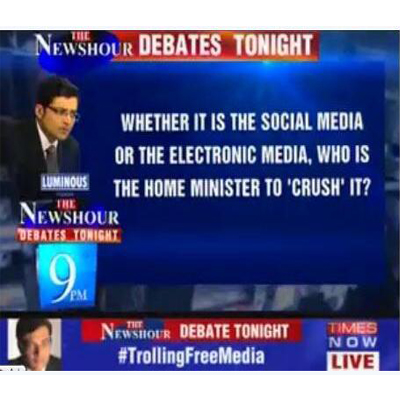
    Just the other day, at a Congress function in Solapur, Union Home Minister Sushil Kumar Shinde threatened “to crush elements in the electronic media spreading false propaganda” although he clarified the very next morning that he was targeting “social media, not journalism”.


    And while on the subject of social media, readers will recall how West Bengal Chief Minister Mamata Banerjee, known for her stiff stance on most issues, got a Jadavpur University Chemistry Professor arrested for allegedly circulating ‘anti-Mamata’ cartoons on the Internet in 2012.


    The same year, a similar fate befell a small scale industrialist who was arrested for allegedly posting ‘offensive’ messages on social media targeting Union Finance Minister P Chidambaram’s son Karti.


    Yes, social media can often be a double-edged sword but what is equally important is that it has given the aam aadmi a voice.


    Times Now Editor-in-Chief Arnab Goswami puts it correctly when he says that the media is variously termed as good or bad depending on whether it praises or bashes politicians. Indeed, politicos trolling media to suit their purpose was the subject of a News Hour debate not so long ago while #Trollingfreemedia had the Twitterati debating the issue endlessly.


    So much so, the Editors Guild came out in protest with a statement that read: “Ironically, leaders who built up reputations and support by engaging the public through the media are now turning on the very media when they come under critical scrutiny.”


    The News Broadcasters Association (NBA) too issued a press statement saying: “A news channel’s endeavour is to cover news-worthy events across all segments of national and international life and to present news to viewers, which is current and relevant. The media provides a service that is essential for any democratic society. This is particularly important when the most fundamental aspect of a democracy, the elections are round the corner. At such a time, the media plays an indispensable role in enabling citizens to stay well informed and make important choices. There can be no acceptable reason for attacking the media on frivolous, unsubstantiated grounds. Intimidation and preventing the media from performing its duties amounts to interfering with the freedoms enshrined in and guaranteed by the Constitution.”


    The NBA specifically appealed to political leaders across parties and public figures not to level baseless charges against the media and keep the discourse civil and sane.


    Somehow, now media has become everyone’s punching bag. Nonetheless, journalistic maturity is needed without losing the enthusiasm, energy and insightfulness.

  • Broadband not at loggerheads with broadcasting

    Broadband not at loggerheads with broadcasting

    MUMBAI: Star India CEO Uday Shankar today spoke on the rise of the digital media and the role of advertising in the business of content at the Pitch Madison Media Advertising Outlook 2014.


    Excerpts:


    We consider the advertising fraternity of fundamental value to us. There is no one who believes that business of content creation can exist without advertising support. Also television is critical to advertising. As a medium, television in India reaches out to 600 million viewers for three hours every day, 365 days a year.


    When we started cable and satellite, television had a strong urban reach. But today, according to the C&S report, the rural reach is marginally higher than urban reach.  And as the rural urban continues to evolve, this will only get better.


    We, at Star Network, don’t see ourselves as broadcasters. Lately, a lot of discussion has been taking place around digital and television or print and digital, but for me digital is just another mode of delivery of content, with both content and consumer being the same.


    Digital is just another pipe that has come in to deliver content. I do not understand when satellite and cable transmission is not considered a business of broadcast, why do you want to call broadband as a completely different digital business, which is positioned as being at loggerheads with broadcasters.


    Earlier, often the business got named on the technology.  But over a period of time, the enigma around technology has reduced, and the service and value that the technology delivers has become more important.


    Digital will also go through that phase. No one today refers to television as a plasma screen business, because they no longer are enigmatic. Similarly, the next generation will not refer to digital as digital business. And that is where I see the fundamental role we play.


    The way I see it, we are in the business of telling stories. And this is what we do day after day. And when you do that for such a long time, you do not wither away just because the technology has changed.


    The nature of the delivery pipe changes. We are here to stay and stay till the society has an interest in the story that we tell.


    A new medium like digital will get added and it’s a reality. Just as print even today continues to exist despite television becoming so huge, we as storytellers are very much a part of this reality, because this reality cannot exist  without the power of content and storytelling. We will continue to be fully relevant, no matter how the technologies evolve.


    Whether it is YouTube, Netflix or Hulu, it is the power of high quality, intense stories, content and narrative that has not changed so far and will not change.


    In India, YouTube is being consumed, but it is the one-year old content of Star, along with catch-up content of Colors, Sony and Zee Network, which constitutes not less than 30 per cent of the entire content consumption on YouTube.


    So, we are relevant and central to the business, regardless of the pipe through which content is delivered.


    When we launched Satyamev Jayate, we became popular not only on TV, but got a whooping 1.2 billion online impressions, 40 million views on digital and it was also the content that shook the entire nation on TV, it was also a content that was most written about, than any other piece of content. So the point is that the power of content will drive the industry.


    The new media will arrive, then something else will come, which will be very relevant. It is good for all of us, because it challenges us to re-invent ourselves. It makes sure that we do not lapse into a slumber. But the centrality of creativity does not shift.


    The problem is that this debate is happening today, primarily because, we as content creators have become broadcasters. We have been regulating our business to old structures and statues, but those structures were designed to do business in a very different world and that world has changed and that is why, last year, the standoffs that we saw, were the manifestations of old ways of doing business and that’s what we need to change, or else we will continue to see those tensions.


    While we as a network at Star have acquired the skill to hold the attention of 600 million viewers for over 3.5 hours every week, hardly does any advertiser come to us to ask for solution in figuring out a deeper strategy for the same 600 million viewers whom we hold for 23 minutes for every content. The perception is that there is a completely different genotype that is required to hold the audience for 10 seconds. That is the mindset of the old world and this mindset will not hold for future.


    Through digital medium, through reduction in advertising inventory, through different generation of consumers and above all the changing landscape of economic growth, we need to find ways of creating constructive relationship between advertiser and content creator that will be relevant, robust and constructive to both parties.


    If this doesn’t happen, the standoffs will continue. The world around us has changed, we have one common goal, we both need to give message about our products. If we can work together, we can create a huge value for both the parties and continue to do that regardless of the shift in technology.

  • A wrong to correct a wrong

    A wrong to correct a wrong

    MUMBAI: If you look back a few years it was the MSOs who were arm twisting the Broadcasters and carriage subsidies shot up to an estimate of about 1800-2000 crores so it was but obvious that the broadcasters had to resort to some countervailing power and adopted the age old saying of ‘in unity there is strength’ to fight back. Hence, the mergers and partnerships to create the Aggregator now termed the Aggressor!


    But the battle here is not between the MSO and the Broadcaster. Unfortunately, both have been caught in a situation and a created one at that. Both are responsible for this situation. The Broadcaster wanted distribution beyond available bandwidth, the MSO but naturally driven by common supply – demand market dynamics fleeced exorbitant carriage fees. To demand higher shares of which he started grabbing more territory. For doing so he gave significant concessions towards the subscription collections. Soon it reached a stage that they began to subsist on this easy money and forgot about the upward flow of subscriptions. So, the broadcasters were giving and getting back their own monies and plus or minus a little depending on the so called legacy of the channels rather than any rationale of popularity. That is where the business model started floundering. It’s not that the subscriber was getting a free view. Sure 20,000 + crore was getting collected and of course most of it in cash.


    So, where did all this money go? And why are both the Broadcasters and MSOs bleeding. One has to examine the value chain and leakages in the upward flow. The interface to the customer is the LCO/LMO the one who is making the collections. A reasonable share of this will need to flow upward to the broadcasters. Content too with all the competition is only getting more expensive especially with international formats and Bollywood hosts.


    How much should be a fair share is secondary. First, one needs to ensure that there actually is a streamlined reverse flow. The bottlenecks and leakages lie in the value chain and systems created by both the MSO and the broadcasters. In addition to the MSO in the middle between the LCO/LMO at one end and the Broadcaster at the other end, there are at least three more middlemen in the current system that prevails. The agent aggregator, their dealers and the distributor/JV partner of the MSOs. The money the consumer pays goes through five hands before what’s left will eventually reach the broadcaster. Obviously there are not one but two too many middlemen and this is where the ecosystem needs change.


    Now in all of this, how’s the consumer or subscriber faring? We are the cheapest cable market in the world and honestly without an iota of debate our consumers have been spoilt. For three to five dollars a month subscription, we get the most premium of content. (Given the way our rupee is depreciating we’ll soon be down to $2 subscriptions!) And for that an abundance of choice with half a dozen channels per genre. Live sports of pretty much every event around the world and movies within two months of theatrical release.


    Wow! Even if the Govt. is floundering in providing Roti, Kapda aur Makaan nobody is complaining about the 4th essential – Entertainment. Sure everyone’s complaining about the cost of electricity and fuel and multiple taxes but no one’s saying cut off my cable!


    Fortunately, we are also the 2nd largest cable and satellite market in the world and so can provide affordable entertainment and the best there is to offer. There’s enough to go around for legitimate stake holders we just need to get the business model right. Imbalances will correct themselves over time.


    As to the regulator and regulation, digital addressable system (DAS) is great, but for now let’s just focus on getting the boxes. Let it just be an exercise in technological evolution. Enjoy the digital experience and abundance of choice. We are a privileged lot. Trying to introduce addressability and ‘pay for what you want’ is only going to increase the consumer’s monthly outflow or severely restrict choice. When DAS gets to that stage of choosing and billing, it is not going to be a populist regulation.


    So Mr Khullar Sir, the aggregator has been disarmed (agent regulation), the MSO reigned in (max 50 per cent of state control) and the broadcaster chastised (12-minute ad cap). The LCO is still trying to figure out how by merely putting a box, the MSO claims the home whereas he’s the guy who has been upgrading the cables and amplifiers for over two decades. Let’s not add a confused customer to this. He’s happy leave him alone for now. Let the market dynamics come into play and let it all settle for a while. Average Revenue Per User (ARPUs) will increase but not at the cost of denying the consumer what he is already used to. Niche content, value added services and TV on the go are new revenue streams and customers will be willing to pay more for these. Affordable internet access is the key to this next phase of growth wherein traditional media and what we call new media need to converge. What will certainly be interesting is to see who will be the players here to emerge.


    (The author is a media observor and consultant, and the views expressed are his own.)

  • TRAI’s toothless content aggregator regulations

    TRAI’s toothless content aggregator regulations

    The Telecom Regulaotry Auhtority of India  (TRAI) was right in both identifying and bringing in new regulation in an attempt to curb content aggregator aggression (read: broadcaster aggression). However, the restrictions are very minimal and on the face of it, they don’t seem to have too much teeth. Aggregators can get renamed as Agents but will TRAI’s effort at redoing and notifying regulations for them really act as an agent of change?


    There is no restriction on the ownership of agent companies or how many broadcasters they can represent. (Will need to be addressed in issue of cross media.) Broadcasters belonging to the same group can bundle channels. For the immediate future it is more likely to lead to a futile exercise in splitting existing contracts and  and overtime and consulting fees for the guys in black suits (read: lawyers).


    Already agreed terms including carrying weak channels and desired packages are the tradeoffs by which the DPOs negotiate to their advantage, so contrary to TRAI’s belief that they add to unwanted costs, they actually subsidize the DPOs costs – whether for carriage, packaging or for a preferred LCN.


    Restricting multi-broadcaster packages is not important. What is important are the DPO’s packages which are what subscribers eventually subscribe to. As mentioned, these are negotiation tradeoffs.


    In any case most of the channel pricing and bouquets evolved arbitrarily at a time when there were already existing TRAI restrictions on a-la-carte, bouquets, price freeze on existing channels etc and very often broadcasters introduced highly priced new channels to offset the freeze on existing channels pricing. Even internal allocations between various broadcasters within an aggregator skewed rationale on pricing.


    The new regulations have not addressed many potent issues which have been plaguing the business and continue to beg solutions. For starters, let us understand that the entity signing the RIO is of little consequence to the consumer.  Where are the guidelines for DPOs to price to consumers? Should the retail pricing be determined by the DPO or Broadcaster and who should communicate this to the consumer?  Same goes for the packages. Is the DPO the real content aggregator buying in wholesale and then retailing to consumers or is he merely offering his delivery infrastructure and payment gateway for a commission?  What is the business model TRAI envisages? Is it going to continue as a B2B or should there be complete transparency to consumer in a B2C approach? 


    Third party channels within aggregator/agent will be most likely impacted. The Stars and Zees are big enough bouquets by themselves, same goes for the TV18/Viacom18 group channels. (Presuming 50 per cent ownership qualifies to label a broadcaster a Group Company!). Yes, Sony and Discovery channels on paper need to be split but their distribution venture has survived many long years and they can resolve any internal issues without upsetting present equations.


    The onus is now on the various DPOs – whether DTH or MSO – to leverage the only real advantage and actually negotiate separately for each of the various broadcasters’ bouquets. Some positive effect of this is likely but it would take a while for the dynamics of negotiations to change. For now it will more likely be just a paper tiger.


    All of this makes sense only if the end objective of DAS is achieved: which is individual consumer choice and billing. For now it seems to be stuck in a farcical CAF exercise. No one has really asked the consumer if he is happy paying his 150-200 bucks (ARPU) and wants to continue having his unlimited thali and buffet! And if one were to do the maths on this basis for current pay TV homes and allocate say 40 per cent to content- well, everyone’s happy!


    (The author is a media observor and consultant, and the views expressed are his own.)

  • TRAI’s lifeline for content aggregators

    TRAI’s lifeline for content aggregators

    The Telecom Regulatory Authority of India’s  latest notification of regulations for content aggregators has attempted to curb their muscling power, even as it has allowed them to continue as agents carrying out the same function.


    TRAI on Monday notified amendments to its regulations barring content aggregators from bundling of channels belonging to different broadcaster groups and mandated broadcasters to themselves sign Reference Interconnect Offers (RIOs) with Distribution Platform Operators (DPOs). The broadcasters have, however, been allowed to appoint authorised agents to market their bouquets, which could be the existing aggregators.


    The amended regulations change the status of content aggregators from entities that aggregated television channels and marketed them in bundled packages to television distribution platforms to that of agents of broadcasters.


    But the role of content aggregators may not change radically. Content aggregators as agents of broadcasters might still be able to perpetuate their dominance, though in a slightly diluted form.


    The concerns flagged by TRAI vis-?-vis the business of content aggregation were:


    a. Top three content aggregators – MediaPro Enterprise India, IndiaCast UTV Media Distribution, MSM Discovery – controlled 58.6% of the total pay TV market.

    b. Content aggregators forced all-channel bouquets on the DPOs, validated by the fact that even though the largest bouquets offered by the aggregators in their RIOs are in the range of 13 to 20 channels, the agreements entered into are for a package of channels consisting of almost all the channels they are authorised to distribute.

    c. Content aggregators grossly discriminated against independent DPOs, charging 62 per cent to 85% more than DPOs which are established by broadcasting groups.


    The outcome of the amendments to the TRAI regulations could be the following:


    a. End of the era of clout wherein aggregators used to bundle channels of various broadcaster groups into  package cluster and thrust them down the DPOs throats.

    b. Making it obligatory for broadcasters to publish RIOs will result in relative transparency of pricing of channels.

    c. The margin of discrimination against independent DPOs may substantially get narrowed.

    d. The existence of content aggregators gets erased from the regulatory point of view. The regulations make the broadcasters responsible for the actions of content aggregators, now described as authorised agents of broadcasters.


    The issues the amendments have not addressed:


    a. By allowing channels from broadcasters within a corporate group to be packaged, the TRAI has allowed weak channels to piggyback on highly dominant  and popular channels. This could lead to problem and conflict in future when these networks swell as they add more and channels.

    b. Agents have been allowed to sell channels of different broadcaster groups though as separate bouquets. This does not completely eliminate the bargaining power of agents. They can bargain with DPOs for weak bouquets in exchange for a supposedly more favourable deal on dominant bouquets.

    c. Though TRAI made a mention of the undue advantage enjoyed by content aggregators owned by broadcasters, it stopped short of clamping down on the cross-holding norms for them, meaning it has continued to allow different broadcast networks to own a distribution agent.

    d. Independent DPOs will still be discriminated against, though the scale of bias against them is expected to significantly narrow.


    The amended regulations may have shaken up content aggregators. For the past six months, executives working in these companies were filled with trepidation that they would be forced to shut down their operations. But by allowing them to continue as agents, the TRAI has offered them a lifeline.

  • Mission 2014: The rise of the political campaign

    Mission 2014: The rise of the political campaign

    While the two-horse race hasn’t disappointed so far, what with all the mudslinging, sloganeering, crowd-pleasing and promising, there seems to be not a marked difference between the election strategies of the main opponents.


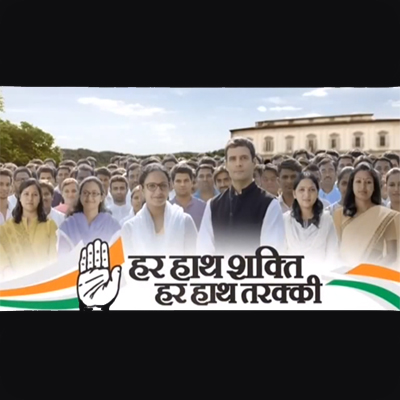
    The Congress Party has flagged off its Rs 500 crore advertising and publicity campaign to promote leading light Rahul Gandhi. With a slogan that reads ‘Har haath shakti, har haath tarakki’, the blitzkrieg mirrors the idea of power and progress to each and every person while focusing on the progress made by the nation in the past decade, albeit with the Congress at the helm of affairs. One of the ads even features a young, Muslim party member, Hasiba Amin, urging the youth to join RaGa along with the tagline ‘Kattar Soch Nahi, Yuva Josh’.


    Apart from this, the ruling alliance has initiated a Rs 100 crore Bharat Nirman campaign, which is being handled by ad agency Percept and run from the Information and Broadcasting Ministry’s budget headed by Manish Tewari.


    What’s more, recently, Times Now Editor-in-chief Arnab Goswami grilled the Gandhi scion in his first ever television interview since his political debut in 2004. RaGa answered questions including whether he is a reluctant politician and what are his views on the multiple scams facing UPA 2 but his answers elicited a mixed response where some found him frank and others felt he needed growing up, politically speaking.  


    Not far behind the Congress, the BJP is close to finalising the ad agency to kick-off its Rs 400 crore campaign around prime ministerial candidate Narendra Modi. It is learnt that McCann Worldgroup led by adman-lyricist Prasoon Joshi and WPP agency Contract Advertising are in the fray to grab the hotly-contested account.


    This – after the recent furore over Congress’ initial campaign slogan “Main nahin, hum”, which the party claimed had been lifted from NaMo’s tagline during the 2011 Gujarat Chintan Shivir. So much so, the Congress was forced to drop the tagline even after AICC media head Ajay Maken refuted BJP’s allegations by tweeting a picture featuring the slogan at a mushaira of Congress workers in Indore in 2010.


    So while the Congress and the BJP gear up for battle in the media space, it remains to be seen how much of this will translate into votes for their prime-ministerial hopefuls. Historically speaking, in 2004, the then ruling party, BJP, had run a similar campaign ‘India Shining’ highlighting all its good work but the aam junta wasn’t swayed. One of the main reasons for the failure of the campaign was people’s inability to relate to it.


    Whether things will work out differently this time one can’t really say but it might do well for both parties to take a cue from AAP’s unique strategy.


    Unlike its traditional parties, AAP has largely stuck to communicating through outdoor activation programs and social media while steering clear of mass media campaigns.


    The rookie party won 28 out of 70 seats in the Delhi Assembly Elections and went on to form the government in the national capital sans any campaigning worth writing home about.


    In establishing a door-to-door (person-to-person) connect with the common man in buses, trains, autos, juggis and bastis, the party’s volunteers stayed true to its one agenda – the aam aadmi.


    As Delhi Chief Minister, Arvind Kejriwal’s recent dharna won him (and the party) more brickbats than bouquets as it is unheard for a constitutional head in a democracy to resort to such means. However, it helped AAP become the darling of the masses at no humungous cost, allegations of using the media to advantage notwithstanding.


    Whether the junta will fall for the publicity and hype created by Congress and BJP or will give its nod to the AAP-brand of democracy, is highly debatable. Our only hope is let the best man (party) win!

  • The LMO-MSO relationship will get clarified within six months: Sameer Manchanda

    The LMO-MSO relationship will get clarified within six months: Sameer Manchanda

    NEW DELHI: Digitisation has given an opportunity for cable to compete with direct-to-home (DTH). There was a time when digital meant DTH and cable was largely analogue. But now, there is competition between digital and digital. While world over, cable is supposed to provide premium products, here in India, DTH was and is considered as a premium product. Digitisation has given cable an opportunity to show its might to DTH, compete with it, and provide customers television without interruption and with broadband internet and Value Added Services (VAS).


    We are in a highly competitive work environment. For smaller players to emerge, they will need scale, pure execution and vision of where they want to see themselves. They should be thinking big and along with that, should have the patience to wait for at least 5-10 years. There will be hiccups and ups and downs, but as long as they manage and maintain the course, they will achieve their goal. Cable has a unique proposition. It has scale, is a mass product, has mass appeal, is bigger than DTH, and every home has been watching cable since 1991. So just believe in the vision.


    Cable is a technology; we just have to leap frog from analogue to a complete different pipe, and that will happen in the next 5-10 years. As we saw in the case of mobile, even cable will go the same way as the world has gone.


    I know that there is a lot of pain, and in the beginning years, we have all faced it and will probably face it for a little longer too. But in the next 10 years, everyone will benefit. And every stakeholder, be it small Multi System Operators (MSOs), Last Mile Owners (LMO) or national MSOs, each one will gain. The industry can only be as vibrant and strong as each of its players. So, one player cannot remain vibrant while the other isn’t. The whole industry has to be vibrant and so, we all have to take a step forward in unifying the cable industry and making it vibrant.


    The LMOs and MSOs have to think that they are partners. Right now, there is a turf war of economics. But it will wear off once they realise that the customer will go wherever he/she wants to. He will go to DTH or the IPTV platform or 4G or any other platform where he/she gets better service. So, the LMOs and MSOs have to understand that they have to be together.


    If you see, the MSOs are ploughing in a lot of investment; they are dealing with broadcasters and are taking risks. They are also the ones who are making the pipe much stronger, so if you look at that, there is a role that the MSO plays and then there is a role that the LMO plays.


    Today, the turf war is on economics. But in six to nine months, each player will understand the strengths and weaknesses of each party. And if they play to the strengths, the customer will get a better product and then he/she will pay much more than what he/she earlier paid. Because if you see that from 70 channels, they will have 300-400 channels, then there will be VAS and much more. So you will see that the LMOs will be making much more than what they are making today.


    The revenue share needs to be sorted and these are things that need discussion. The MSO is also in a tight position. He has to deal with broadcasters and also ensure that the customer management is better than DTH. There are investments that need to be made. So I think that both parties need to understand each other.


    The first effect of digitisation has already been felt and that has happened from the customers’ end. The customer today has moved from some 70 channels to 300 channels and all this with no interference. He/she has been given a box for a reasonable sum and in a few minutes, with no wire and antenna, he has started getting the digital experience. This has been the real effect of digitisation, which has unfortunately gone unnoticed. And this was the reason that 21 million homes, which could have chosen DTH, chose digital cable instead. So the effect of digitisation has been felt, but now because of switch offs, the LMO issue, and under investment by some players, the impact is marred. So there will be good and bad times for cable, but then in a couple of years, it will all be sorted.


    The entire chain of media will become vibrant. The broadcaster, LMO and MSO will gain. Currently, since everybody is looking at getting the most, there are wars, but this will get resolved in six months, it can’t take longer. I want to see the industry getting stronger, more vibrant. Customers should be so happy with cable that they start moving from other players to cable. We all want cable to be strong and the whole chain to be very vibrant.


    I am an optimist. Media has a great future in the next 5-10 years. No one part can say that he will gain while others don’t. All stakeholders will benefit. Even the customers will have the option of close to 1,000 channels. Yes, they will have to pay more for that, but at least, they will have the option to pay for what they want to watch, which was not there earlier. But unfortunately, this will need them to cough up a lot of money. There will be pain, but eventually, every stakeholder will have to think about 5-10 years later.


    (The remarks above are a part of the acceptance speech by DEN Networks Chairman & Managing Director Sameer Manchanda during indiantelevision.com’s The First Indian Digital TV Honours held in New Delhi on 28 January 2014)

  • ‘Post 2-min ad cap on TV, OOH medium will see double digit growth’

    ‘Post 2-min ad cap on TV, OOH medium will see double digit growth’

    Out of Home industry has always been categorised as a supporting medium for television; however, it has gained more popularity amongst advertisers after the two-minute ad cap on television. Interestingly, television medium has sufficient channels and different TV slots to cope up with ad cap restriction. But I really think that OOH medium will grow and see double digit growth in the next three to five years. The key reasons for OOH medium’s growth would be that people have figured out better ways to utilise this medium in terms of innovations, latest technology and result orientated campaigns  and another reason is that the young audiences is spending ample amount of time outside, therefore this medium becomes much more relevant.


    The FMCG category has never made a significant use of OOH medium. But this will change consistently and this medium has more potential for the FMCG category. But the OOH medium will see a lot of spends from the entertainment and movies categories. Also, the OOH medium will see huge impulse spends from e-commerce sites and therefore this area will grow. I also believe that it will be difficult for brands to pay such sharp increase in rates.


    I believe that outdoor advertisements are one of the most cost efficient ways to reach potential customers and clients. Additionally, we can target with OOH the consumers across culture, language, season, age, and in any format. In order to address GAPS in terms of marketing reach, OOH is the best customized solution for the organization.


    However, there is tussle between advertisement spend when it comes to Internet and OOH. In fact OOH media is used throughout the year for product launches, branding initiatives, sales activation because of its cost-effectiveness.


    But I am also sure that TV budget will never be kept nil as it is an important medium. But having said that, a brand needs to be always active in OOH medium, as it gives multiplier effect on ground level. The large format with its local communication, singular pictorial representation, minimal and bold message, strategic locations, cost efficiency and media effectiveness helps a brand deliver its key message to a large audience in an uncluttered environment.


    With new techniques, innovation and new formats, outdoors has earned its share in the market. Brands which are looking at exploring unique solutions, outdoor offer them great creativity in still media and random visibility with the help of transit media.


    Importantly, outdoor will have to compete with print, radio and most importantly social media. Innovations will play crucial role if more brands are diverting their interest on this medium. Ambient and transit media along with BTL activation will become important.  Monitoring system and assured ROI will enhance the preference for the medium.


    (The writer is the Managing Director, Global Advertising)