Category: Cable TV

  • Kolkata’s cable TV customers feel CAF heat as blackouts spread

    Kolkata’s cable TV customers feel CAF heat as blackouts spread

    KOLKATA: Kolkata is seeing some frenetic activity on the cable TV front. The city’s multisystem operators (MSO) have started switching off signals in several pockets in Kolkata where cable operators have failed to comply with the Telecom Regulatory Authority of India (TRAI) norms and not provided them with the KYC or CAF forms of their subscribers. But MSOs have also been prompt in bringing the disconnected customers back online once the CAFs are submitted and fed into their systems.

    Apparently, the consensus amongst the cable TV fratenity is that cable TV subscribers are understanding the gravity of the situation with their cable TV connections being cut. And they have been a hurry to submit their CAFs now. “About 30,000 boxes had been deactivated and then reactivated after we received filled out forms from them,” said Manthan director Sudeep Ghosh.

     “We are in touch with the MSOs and we have been told that nearly two lakh set top boxes have been deactivated across the city and about 1.3 lakh boxes have been downgraded to DD channels only,” says a TRAI official.”And this is working as all the MSOs are saying that they are being flooded with CAFs as compared to earlier when there was lethargy.”

    The phase-wise deactivation of set top boxes had proved to be effective in sending out the intended message to consumers, he said.

    Consumers are confused and are complaining that there had been no intimation to them about the forms.

    A DTH service provider said that its call centres are receiving extra call loads with cable TV subscribers enquiring about the options available to them. “Our callers have expressed that it is better to settle with the seamless connection instead of haggling with the cable operator, who is ill-informed and not up to date with what is expected to be done,” says the DTH executive.

    We will have to simply keep our eyes glued to see if those callers will migrate to DTH. Going by past track records in other cities in phase I and phase II, it probably does not seem likely. Though many have expressed that a paradigm shift is needed.

  • “We are hoping for a fair share of revenue in a digitised ecosystem” :The One Alliance president Rajesh Kaul

    “We are hoping for a fair share of revenue in a digitised ecosystem” :The One Alliance president Rajesh Kaul

    Cable TV digitisation has forced the entire television ecosystem to come face to face with some gut-wrenching changes. Each one of the players has come under the scathing gaze of either the ministry of information and broadcasting or the telecom regulator, the Telecom Regulatory Authority of India (TRAI). Some have even got a rap on their knuckles as the powers that be continue to work overtime on evolving a rickety old cable TV landscape into one capable of delivering top of the line world class digital services.

    Earlier this month, it was the aggregators that came under the scanner of TRAI which sent out a consultation paper which tries to reduce their importance in a digitised cable TV India. TRAI has said that aggregators tend to misuse the clout they have and need to have their wings clipped.

    The One Alliance, a  Discovery India-MSM joint venture which distributes 28 channels to the 30,000 or so cable operators nationally is one of the aggregators whose future and existence many are questioning.  But its president Rajesh Kaul, a scarred veteran of many a cable TV battle,  is hopeful things will get sorted out and work out well for him and others of his ilk such as MediaPro and IndiaCast.

    Even as The One Alliance has been celebrating the completion of 11 years of being in business, Kaul was busy preparing his responses to be presented to the regulator before the scheduled 27 August deadline. He still found some time to speak to Indiantelevision.com’s Seema Singh on trends in carriage and placement fees, the TRAI consultation paper and all things cable TV. 

    Excerpts:

    Do you see the aggregators become more relevant or less in the coming years? Why or why not?

    We will be as relevant as we are right now. We are a very important link in the chain of the entire television ecosystem. We just hope that with digitisation we will get a fair share of revenue which we haven’t got for so many years.

    What is your take on the TRAI consultation paper, which if implemented will cut down on the aggregator’s clout?

    We are evaluating the entire paper for which we need to file replies.

    TRAI in all its open houses and interaction with stakeholders has maintained that the era of regulation should go now and that they want to deregulate. So the consultation paper came as a surprise. On one hand they talk of deregulation, while on the other they put us under more regulations.

    May be the regulators need some clarification on the same and we are working on it. I am unsure of the intensity of the complaints put by the MSOs. 

    All through we have been following the TRAI and Information & Broadcasting Ministry (MIB) guidelines, with not a single case of deviation.

    There are close to 700 channels today and this has led to huge competition. The situation is such that no one channel can behave unreasonably with an MSO or with consumers. We all need eyeballs from our consumers. The competition ensures that the channels’ content and rate is good. We have to ensure that everything is as per market dynamics so that they are more liked and watched. This is the age we should be talking of forbearance rather than regulation.

    As per the TRAI regulation we are supposed to offer our channels on a la carte rate as well and this is available to the MSOs. In this country, there is a ‘must provide’ for all broadcasters, according to which not a single channel can say “No”  to an MSO for providing the channel to them.  But the MSO has the option to not subscribe to our channels. Since all the channels are on a la carte rate as well, there is no question of forcing them to subscribe to our bouquet.

    Another point that needs mentioning is that the broadcasters have not been getting a fair share of revenue in subscription. We thought with digitisation things will change. We have been a very good stakeholder in this entire process and done all that the regulator wanted us to do, be it doing quick deals to help MSOs sell the set top boxes or curbing our ambitions to make profits.  We hope that we will bear the fruit of being responsible stakeholders in this entire stretch one day.

    TRAI had even in the past come up with such consultation papers, but always heard us and I am hopeful they will listen to us even in this case. We are going to them to present our thought process. May be some wrong impression and feedback has gone to them, our duty is to explain to the regulator.

    The second phase of DAS will conclude soon. Any problems that you faced in this switch? What is the percentage growth in revenue in phase two as compared to phase one?

    We are still waiting for a transparent system. With digitisation the consumer can chose what they want, and pay for it. This transparency has not come out so far. We are still not getting reports from the MSOs and do not know who is watching what. These are the bottlenecks that we face.

    We were looking at ambitious numbers when digitisation kicked off. We didn’t get that in the first phase. Also as responsible stakeholders we curbed our ambitions then because we knew it would be difficult to expect a huge jump in the beginning. We supported the MSOs, which is what the regulator wanted us to do.

    But with the completion of phase II, we should be inching towards that fair share, which should be around 35 to 40 per cent of the on-ground subscription revenue collected. This should happen by April 2014. Channels cannot survive only on ad sales, subscription money is a very important revenue stream for broadcasters, but unfortunately it hasn’t so far happened in India.

    Another problem that the broadcasters face is the high carriage fees. In an analogue system, due to capacity constraint, broadcasters had to pay huge carriage fees. But now with digitisation there is no question of any capacity constraint, so why have carriage fees?

    How are you playing out the carriage fee market? Will the carriage fees come down? How much has this come down, pre- and post-DAS?

     In the next three years there should be no carriage fees. Though carriage fees  have come down post DAS, we still have been paying some placement fees to support the MSOs as they make their transition. But, with the completion of digitisation, even this should go down.  I expect carriage and placement fees to disappear over the next two to three years. While these were expected to go down further by phase II of digitisation, it has only been to the extent of about 25 per cent.

    Earlier the subscription revenue share we (read: broadcasters) were getting from the cable TV ecosystem was about 10-15 per cent. Now it has gone up to maybe to 20 per cent on the overall. Some broadcasters may have got 25 per cent but others may have got lower amounts of the digital dividend.  Many of the channels don’t get any subscription revenues because in the analogue environment they could not afford to have that as a part of their business model. With digitisation all this could change.

    Do you plan to add more channels in the bouquet? What was your strategy to ensure that you had Times Network in your bouquet, when other news channels were walking out of the bouquet?

    We are not market shopping for channels and we are not desperate. Only if tomorrow we come across something good, we will think of adding it to our bouquet.

    We added Times Television Network to our bouquet this year. It was a mutual decision between the two of us. They fitted in our profile and also they wanted to be a part of our network. They are a premium channel and they deserve suitable revenues considering their performance and we at The One Alliance are working to get them those revenues.

    We are in the process of concluding deals for Times with other MSOs. We have finished with Hathway, GTPL, and some other MSOs. And more are coming.

    You had a dispute with Hathway going on for some time? How is that progressing?

    There were many issues like are bound to happen in the cable TV business and yes one of these issues was the one we had with Hathway. And one of the issues – amongst the many issues – we had with Hathway was The Times network, which we have been distributing. But we amicably resolved all the issues with Hathway this evening. And the One Alliance bouquet of channels should have come back on all of Hathway networks by this evening. (26 August).

    It’s been 11 years in the business, how has the journey been so far?

    The journey has been fantastic. While we started with three or four channels now we have a bouquet of 28 channels, with extremely powerful and premium channels. We have various genres, we have a solid name and repututation. It has a journey which has had  more ups than downs.


    Unfortunately, even with the IPL being the biggest sporting property in this country, we have not been able to monetise it well due to under declaration. But, now we have aggressive plans to monetise it for the next season..

    What are the key pointers that set The One Alliance apart from other aggregators? As compared to others aggregators you have less channels, is that a limitation. How do you see things going ahead?

    We are the most stable joint venture (JV) in the industry. All the other aggregators are just a couple of years old. Our partners are very much involved and keen to ensure that the stability continues. For us the quality of the channel is important. We have never been in the race of having 50-60 channels in our bouquet. 

    We have channels from different genres in our bouquet and most of them are amongst the top two or three ranking in their respective genres. There are many more who want to be a part of One Alliance, because they trust the JV. Also our dealings are very transparent. We can add two to three channels at any given time, but our policy doesn’t allow us to do that. We have always believed in quality and so want to have premium channels in our bouquet.

    Today we are the strongest, despite having 28 channels. Also we are the only one having a sports channel in our bouquet unlike the others. Considering we have most genres covered in the bouquet, I don’t see any limitation. Our revenue is far higher than the others.

    Are you selective about the channels you take in the bouquet? What are the criteria that a channel needs to fulfill to be a part of The One Alliance bouquet?

    The channel and the company backing the channel should have similar kind of values and ambitions like ours. We also look at the channels’ performance, which we understand on the basis of the weekly television viewership ratings.

    What is the reach of the bouquet and which is the largest channel in the bouquet?  

    We currently have 28 channels from different genres in our bouquet. Sony Entertainment has the largest reach and, during IPL, Sony Max gets the largest reach.
    IPL is the biggest sporting property that we have. What is interesting is that though most sporting properties are a simulcast with Doordarshan, IPL is the one property which is exclusive on Max. This makes it the most important property in the sporting channel world and we have it.

    We are present almost across the country. We would be there in around 90 per cent of the towns, which have cable and satellite, but through DTH our reach is 100 per cent. Close to some 6,000 cable networks across the country carry our channels. 

    What is the current strength of the organisation?

    One Alliance employs 125 people with offices in Delhi, Bengaluru, Kolkata, Indore and Mumbai. Apart from this, we also have a strong distribution network with distributors in Rajkot,  Pune, Ahmedabad, Guwahati, Patna, Ranchi and Lucknow among others. Like this we have offices in 60 cities. The distributors have their own employees. So, if we take a cumulative strength, we have around 350 people working for us.

    The major revenue for The One Alliance is dependent on IPL. So till how long will IPL be with Sony Max? How do you maintain subscription post IPL and also with so many controversies surrounding IPL, how will you deal with it?

     Unfortunately, even with IPL being the biggest sporting property in this country, we have not been able to monetise it well due to under declaration. But, now we have aggressive plans to monetise it for the next season.

    What are the future plans for The One Alliance?

    We have to lead the change and ensure that everybody gets their fair share.

  • Time Warner Cable supplies customers with rabbit ears “TV antennas” during CBS Blackout

    Time Warner Cable supplies customers with rabbit ears “TV antennas” during CBS Blackout

    MUMBAI: Time Warner Cable is trying out a traditional solution to its longstanding CBS blackout problem. The cable operator has started offering free television antennas to help its customers continue watching their favorite CBS shows via broadcast signals. The offer is particularly effective in major cities including Los Angeles, Dallas, and New York.

    The cable company notified its customers in affected areas about its latest offer that would serve as a temporary solution to the CBS blackout. It has posted the message on its Website and has sent communication through email. Time Warner Cable is giving away basic indoor antennas to its subscribers. The tool could be claimed at any Time Warner Cable store. It is also offering a $20 voucher to each customer who prefers to purchase TV antennas at any Best Buy location.

  • Around 1.80 lakh defaulters in Kolkata face TV blackout as of 26 August

    Around 1.80 lakh defaulters in Kolkata face TV blackout as of 26 August

    KOLKATA: With the Telecom Regulatory Authority of India (TRAI) pressuring service providers in Kolkata to disconnect the television connections of customers for not submitting the subscriber application forms, multiple system operators, more than 1.80 lakh customers have experienced a black out till Monday evening.

    While talking about the snapping of the connection which started from Saturday morning, Den Networks, Hathway Cable and Datacom and Manthan Broadband Services snapped the maximum number of cable connections, out of 80,000 which were disconnected on August 24.

    Also, with just around 45 days remaining for the grand festival of Durga Puja, some cable operators are relaxed and have assured the customers that they can send the details after the festival is over, said a customer, using the service of one of the players, which has maximum penetration in KM area.

    Industry sources said: “The consumer application forms (CAF) of these MSOs were not ready as compared to other players like SitiCable. As a result, the three MSOs had to switch off the connection,” adding that the MSO will continue to switch-off few connections at a time in the coming days to guard against law-and-order problem.

    As per the TRAI mandate, the MSOs were supposed to switch-off the cable connections of those customers, who had not filled-up the CAFs in Kolkata post midnight of 23 August.

    Committee of the Association of Cable Operators, Cable Operators Digitalisation convener Swapan Chowdhury said the MSOs have been asked by the TRAI to provide details of TV connections running illegally in the KM area.

    Siticable that has disconnected more than 90,000 subscribers till Monday evening, has seen a good response from customers. “We are not switching off the connections of CAF non compliance customers at a go. We are doing it in small numbers – say 15,000,” expounded Siticable director (Kolkata) Suresh Sethia.

    Manthan Broadband Services which has installed 6.5 lakh to seven lakh set top boxes, had alone disconnected around 30,000 connections on Saturday, said Manthan Broadband Services director Sudip Ghosh.

    “Our purpose is not to switch-off the connection. But after snapping say four connections, more than 100 customers have approached from the vicinity,” he added.

    Seeing the fast response from the customers, it can be easily assumed that in the KM DAS area, CAFs rate is likely to be 70 per cent to 80 per cent in next six days – seven days, Ghosh predicted.

    Den Networks and Hathway Cable and Datacom could not be asked specifically about the connections snapped by them in KM area.

    Cable Shilpa Bachao Committee convener Mrinal Chatterjee said instead of disconnecting the TV sets, TRAI should penalise the MSOs and not the customers by asking MSOs to switch off the connection; as the CAFs were not given to the customers on time.

    With no official extension notice from the regulatory body, will Kolkata see deactivation of set-top boxes of more and more defaulters at this juncture? Watch this space for the latest updates.

  • lost 2.5 mn viewers between 2010 and 2012: FCC

    lost 2.5 mn viewers between 2010 and 2012: FCC

    MUMBAI: According to recently released FCC data from their annual report on cable industry competition, the cable industry lost roughly 2.5 million video subscribers between 2010 and 2012. According to the FCC, cable operators laid claim to 57.3 million pay TV subscribers at the end of 2012, down from 59.8 million in 2010. 

    Most of these customers flocked to telcoTV, with AT&T U-Verse increasing their subscriber total from three million to 4.1 million between 2010 and 2012, and Verizon FiOS’s total subscriber total going from 3.5 million to 4.5 million during the same stretch. Verizon and AT&T recently announced they’ve both passed the five million cable TV subscriber mark, giving them more TV customers than all but the nation’s two largest traditional cable companies: Comcast and Time Warner Cable.

    Cord cutters make up a very small but growing part of the equation as well, with even the industry’s biggest cord cutting deniers now acknowledging the glacial but inevitable trend toward less expensive internet options for many users.

    Meanwhile, the FCC report also pointed out that the soaring costs of programming is slowly but surely driving many of the nation’s smaller cable operators out of business. “800 cable systems serving over 35,000 subscribers have closed mostly in small and rural communities, leaving those communities without any wireline MVPD (cable video) service,” claims the report.

  • Manthan Broadband to invest big bucks to expand reach

    Manthan Broadband to invest big bucks to expand reach

    KOLKATA: The kingpin of the Multi System Operator (MSO) ecosystem in the East, Manthan Broadband Services has drawn an aggressive plan to secure its current position. Aware of the competitive market, this Kolkata-headquartered MSO plans to invest Rs 450 crore by 2014 end to upgrade its cable TV operations and also expand its reach in the eastern region.

    The cable operator which planned to install around 36 lakh Set Top Boxes (STBs) in the entire eastern region including Kolkata, rest of Bengal, Orissa, Jharkhand, Meghalaya and Assam by September 2014, has already installed around seven lakh STBs in Kolkata.

    While for the subscribers’ management system (SMS), Manthan is likely to sign a contract with an international brand soon. “We will soon be signing Rs 120 crore contract for the management work for 10 years. We will also invest to build best infrastructure which includes network, encryption, SMS and call centre,” informed Manthan Broadband Services director Sudip Ghosh.

    Created way back in 2002 through a merger of the operations of nine cable TV operators, Manthan has indeed come a long way.  The MSO caters to 30 lakh households, serving a greater part of Kolkata and West Bengal and other eastern regions with four digital headends and 40 analogue headends. It has more than 2,500 cable operator partners in the region.

    Manthan had earlier earmarked an investment of Rs 600 crore, out of which around Rs 150 core was spent in the markets of Kolkata and Jharkhand. “We will now spend Rs 450 crore in other states of the east. The promoters would invest a part of it and Manthan is looking at raising debt from banks,” added Ghosh.

    The company has a market share of 34 -35 per cent in the installed STBs offering 350 channels in Kolkata Metropolitan Area (KMA). Manthan has penetration in areas like Kolkata, Howrah, Hooghly, Baraipur and Chandannagar among others.

    On the company’s plans to hit the capital market with its initial public offering (IPO) to fund its expansion plans in the next two to three years, Manthan Broadband Services director Gurmeet Singh said, “We have started the backend work. There are many regulatory issues which we have to look at.”

    Also on the back of Indian rupee depreciating against the US dollar and Manthan as a company is likely to import more than 30 lakh STBs in the next one year. Ghosh said the import of the boxes have become costlier now as compared to when the rupee to dollar rate was Rs 46 – Rs 47 a dollar.

    “Even if the import cost for us is Rs 2,000, we give a subsidy to consumers and sell at Rs 999,” he hinted, saying that apart from other cable operators, it has a tough war to fight with direct-to-home (DTH) players. “We feel a hit at the revenue but it does not strike the bottom line up since we are in other added services too,” he said.

    Singh said that the company imports STBs mainly from China and added that if any local manufacturer sets up an assembling unit upon getting benefits and incentives from the government, it would help the industry people immensely.

    Manthan currently employs more than 300 people. This number will go up by another 30 per cent by 2014 end. The MSO currently serves more than 25 lakh households in the states of eastern region. “Of this we have around 18 lakh analogue cable connections,” he informed.

    According to sources, by September 2014, the rest of Bengal will witness 50 lakh STB installations. Also Orissa will see seven lakh installations, Jharkhand eight lakh-10 lakh, Meghalaya and Assam will register five lakh STB installations each.

    Commenting on the reach of Manthan, Hathway Cable and Datacom MD and CEO Jagdish Kumar G Pillai said, “The fragmented cable TV is likely to see some consolidation and the same applies to eastern region too. Manthan’s investment plans in the eastern region shows its commitment.”

    While aother MSO on the condition of anonymity stated: “Manthan had been performing well in the past but with digitisation kicking in, it has lost its hold on the market and dropped in its position. In terms of box supply and system integration, the company could not stand at par with its competitors. In fact recently due to funding issues, it has become difficult for it to operate in locations like Mednipur, Kharagpur and Bankura among other locations.”

    Industry sources feel that the company in order to move ahead and achieve such ambitious plans will have to work jointly with other companies, going forward.

  • Cox launches cable TV app for iPad that learns what users like to watch

    Cox launches cable TV app for iPad that learns what users like to watch

    MUMBAI: Cable companies have been rolling out their own apps for years now.

    But Cox Communications’ new Contour experience, which incorporates a tablet app, aims to go beyond the usual offerings with a suggestion engine that learns what you like to watch, viewer profiles for up to eight people and the ability to watch different channels on the tablet and television.

    Cox director product marketing Bruce Berkinshaw said the company didn’t construct Contour to fit its own notions of how to surf cable channels. Instead, the app was designed around how customers want to use it.

    Support for other tablets is expected by the end of the year.

    Cox Communications unveiled Contour earlier this month nationwide, and the app was downloaded more than 10,000 times in the first week.

    The app, which is designed to work on the same network as the DVR, works by overlaying a transparent menu over a live feed of a preview channel.

     
    The main menu offers access to on-demand content, links to channel-based apps like CNN or ESPN and a selection of suggested channels based on the preferences and viewing habits of the person using the Contour app.

    Users can search for shows using a traditional program grid, a keyword search or a scrolling list of channels near the current preview channel. Tapping on a program will instantly bring up more information about it as well as the options to record it on the DVR or add it to a watch list.

    The currently playing channel on the app can even be changed like a traditional remote control by swiping up or down. When the user is ready, the app can change the TV’s channel to match the channel on the tablet.

    The new DVRs can record up to six shows at once and have two terabytes of storage, or 1,000 hours of programming. Berkinshaw said the DVRs can be networked, allowing customers with two networked DVRs to record up to 12 channels at once.

  • Kolkata MSOs racing against time to meet DAS deadline

    Kolkata MSOs racing against time to meet DAS deadline

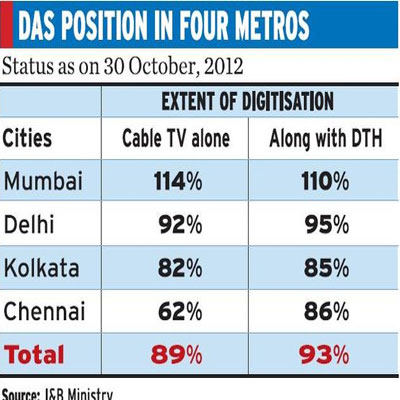
    KOLKATA: Multi System Operators (MSOs) and local cable operators (LCOs) in Kolkata are busy collecting the consumer application forms (CAF) and feeding in details for the complete implementation of the Digital Addressable System (DAS).

    “There’s a huge increase in workload, and everything has to be collected quicker and reported quicker,” says a Kolkata headquartered MSO. While a LOC says: “It’s very tiring to go home and get called back in again, and go home and get called back in again for clarifications and further clarifications.”

    With the Telecom Regulatory Authority of India (TRAI) confirming last week that it will strictly adhere to the 23 August deadline for implementation of subscriber management system (SMS) rollout in Kolkata, the MSOs and cable operators are collecting the know your client (KYC) form details and subscribers’ choice of channels swiftly and are racing against time to feed the data into their systems day and night.

    So far 30-35 per cent of the subscriber management system (SMS) data of cable consumers in Kolkata is completed as per the TRAI data.

    SitiCable which controls a substantial share of cable TV users in Kolkata said the call centers would update the details overnight. “We will work overnight and plan to achieve as much of the work before the deadline,” said SitiCable (Kolkata) director Suresh Sethia.

    SitiCable has set up around 11.5 lakh digital addressable systems (DAS) here.

    While for Manthan Broadband Services there are no holidays and Sundays. “We have 6.5 lakh to seven lakh subscribers. The CAF rate was around 25 per cent for us last week,” said Manthan Broadband Services director Sudip Ghosh.

    “The operators connected with Manthan are working 10 times faster than before,” added Ghosh.
    While Manthan Broadband Services director Gurmeet Singh, said: “With the regulation, we have to collect 100 per cent details. We have no other choice than asking the operators to work and achieve the target.”

    DEN Networks CEO SN Sharma said the CAF collection rate for it’s close to three lakh STBs in Kolkata is nearly 40 per cent-45 per cent.

    “Before the deadline, we aim to achieve 85 per cent -90 per cent work,” said Sharma with assurance.

    “The operators are so lethargic that the customers have not yet got the forms and we are getting calls from frantic TV viewers now,” said a MSO. “We have asked them to download the form from the website and fill it up, scan and mail it to us if possible so that their TV screens do not go blank,” he added.

    With just five days in hand to meet the switch-off date, other MSOs and LCOs said that they have deployed more personnel on shift and temporary basis.

    “Consumer Application Form (CAF) collection rate is expected to be around 70 per cent-75 per cent altogether in Kolkata by 23 August,” assumes Sethia.

    “Achieving 100 per cent target by 23 August is next to impossible. Kolkata will miss the deadline,” said Association of Cable Operators, Cable Operators Digitalisation Committee convener Swapan Chowdhury. “But the cable TV industry people are toiling hard now,” he expounded.

    On the other hand industry sources on the condition of anonymity said it is not possible to give authentic data in just five days. “Filling up more than 18 lakh CAFs is not a matter of joke. The LCO may tick mark the preference of the users themselves,” he said. “For not providing genuine information, the MSOs may face dreadful consequences,” he hinted.

    If around 5,000 local cable operators and 14 MSOs, which provide service in DAS areas do not abide by the deadline of submitting the CAFs, TRAI may file a case against any MSO, concluded a source.

    With the clock ticking and TRAI not willing to give any leeway, the MSOs and LCOs have their work cut out.

  • Turner launches HBO Defined & HBO Hits on Hathway & GTPL

    Turner launches HBO Defined & HBO Hits on Hathway & GTPL

    MUMBAI: Turner International India has announced the launch of HBO Defined and HBO Hits on two of the country’s leading digital cable platforms, Hathway and GTPL. With this HBO’s two premium advertising-free movie channels will be available to digital cable subscribers for the first time.

    The channels are available for a free preview in the initial phase of the launch. Turner International, the distributor for HBO Defined and HBO Hits will soon have the channels available on other digital cable platforms as well.

    “With the successful on-going digitisation of the Indian television industry, Turner is committed to continue bringing compelling content inside homes of consumers in India and on any device they own. HBO Defined and HBO Hits signify a new era of television viewing for the Indian consumer. We have received a very enthusiastic response from all platforms and are happy to have, Hathway and GTPL, two of the leading cable platforms partner with us,” said Turner International India MD Siddharth Jain.

    “The launch of HBO Hits and HBO Defined on our digital platforms is a reinforcement of our belief in the power of compelling content which can drive customer value and realisations. Hathway and GTPL have a foot-print of more than seven million addressable customers. We are delighted to partner with Turner in our on-going endeavour of delivering premium services to our discerning customers” said Hathway Cable and Datacom CEO & MD Jagdish Kumar.

  • Comcast Cable and Time Warner Cable join to manage software in STBs

    Comcast Cable and Time Warner Cable join to manage software in STBs

    NEW DELHI: Comcast Cable and Time Warner Cable have joined hands to manage the Reference Design Kit (RDK) software being used in set-top boxes (STBs).

    The new venture RDK Management will manage the RDK licensing, community support and training, as well as code management.

    Comcast will contribute RDK components into the new entity, including the RDK code and specifications, related intellectual property rights, associated contracts and licenses which will be transitioned to the RDK Management.

    The RDK is a pre-integrated software bundle, developed and licensed by Comcast to create a common framework for powering tru2way, IP or hybrid STBs and gateway devices and accelerate the deployment of video services.

    RDK works with the CableLabs OCAP Reference Implementation software along with other open source components.

    The new entity will provide continuity with the existing licensing program and continue to offer a licensing program similar to the existing program. In addition, the new entity will set up an expanded support program to provide technical support to RDK licensees as operators more broadly deploy the RDK solution.

    Since its introduction in early 2012, more than 100 licensees have joined the RDK community, including OEMs, systems integrators, SOCs and software vendors as well as MVPDs to create a community of innovators focused on bringing rich, multi-screen TV home entertainment experiences to consumers faster.