Category: Cable TV

  • New technology simplifies collection for cable ops

    New technology simplifies collection for cable ops

    MUMBAI: Even as industry prepares for phase III of digitisation, here comes a technology that is likely to get more than a warm welcome from cable operators.

    UPASS, a front-end automation for the cable sector and mobility solutions provider, has announced that it has successfully integrated with the subscriber management system of Media Nucleus; a development set to change the collection system. While Kottayam-based Star Vision Cable Networks is the first LCO to use the integrated solution, Media Nucleus is in talks with three other operators for installing the solution to their systems.

    It was at the recently concluded SCaT that the collaboration took place. “We finished the integration and also showcased a part of it during SCaT,” informed Media Nucleus director Santosh Nair. He explained the working of the solution as: “Each subscriber will have an ID, subscriber number or name that will be stored in the subscriber database. Once the subscriber pays the monthly fees, the collection agent will type it on the mobile phone that has all the details relating to the package etc. Also, there is a Bluetooth printer connected to this device, which will help him print a receipt immediately.  The same data will also be sent to the database, which clears the subscriber’s outstanding amount.”

    Technically speaking, UPASS’s cloud model acts as data bridge between the mobile device and the SMS server. There is an option for collection entries to be made either in cash or cheque and the relevant data is passed on to the SMS server in real-time.

    UPASS managing director Ravindra Deshmukh said: “We are excited that Media Nucleus and UPASS are collaborating to help operators overcome the challenges of billing and collection hurdles by providing data in real-time as trusted and actionable information. Our system benefits end users quickly and with self-service, regardless of data volumes and variety, or whether the data is on-premise or in the cloud.”

    The advantages of the solution are three-fold. One, it will make the collection process easier. Two, it will make the system more transparent and help MSOs with instant data on subscribers and revenue collected per day. Three, it is more economical, since it can be used even on a simple Rs 500 mobile phone.

    Nair said every operator had collection issues and with this system in place, “MSOs will just have to follow up on the data. They will get instant information, unlike earlier, when LCOs would collect data and sometimes, not even reveal it. The information will give an upper hand to MSOs as well, who can show it to their investors.”

    The new solution will help both the MSOs and LCOs by making collection easier, says Santosh Nair

    Explained Media Nucleus director technology and delivery Rajiv Tomer: “We had been providing the core solution of subscriber management solution and were looking at integration services to enable collection at the ground level become a part of our solution to our clients.  UPASS, having an industry benchmark solution, gave us the right option to be a go-to-market, providing end-to-end technology with a single integrated platform. We have enabled it in such a way that operators can provide the basic handset to the collection agents, which gets integrated with our SMS.”

    The solution will be available to operators at a one-time investment of Rs 2500. This apart, “the operator will have to pay less than Re 1 per transaction per month,” informed Nair, adding, “We will be meeting operators from Pune next week. We have been getting a good response for the technology.”

    Maharashtra Cable Operators Federation president Arvind Prabhoo said the technology would address the biggest problem of digitisation, which is collection. “The cost of collection for the operator is approximately Rs 25. Also, there is a huge process involved with it- right from collecting money from each subscriber to putting the data on computer etc. The solution will reduce this burden and make the system more transparent.”

    “Rs 2500 is just 10 customers for an operator, so it is very economical for them. Also, getting two-three handhelds will also reduce their burden. As for the MSO, they have for long wanted a transparent system, which they can achieve through this,” Prabhoo said.

    The UPASS solution claims that it provides customer data capture and STB activation in real time, channel/package activation from the LMO phone as well.
  • TRAI meets MCOF’s Prabhoo on LMO issues

    TRAI meets MCOF’s Prabhoo on LMO issues

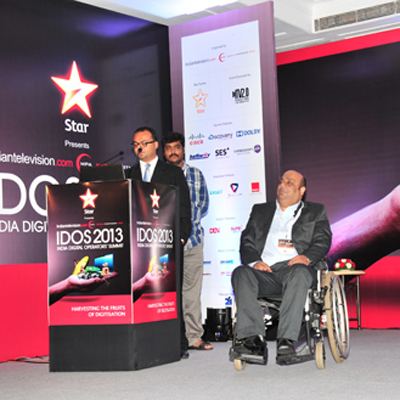
    MUMBAI: It was at indiantelevision.com & MPA’s (Media Partners Asia) India Digital Operators Summit (IDOS) that Mumbai-based cable TV heavyweight and MCOF (Maharashtra Cable Operators Federation) president Arvind Prabhoo first presented to India’s cable, DTH, regulatory and broadcast leaders the local cable TV operators’ perspective. Everyone was impressed including Telecom Regulatory Authority of India (TRAI)’s advisor N. Parameswaran, who said the regulatory body would like him to come and present at its headquarters in Delhi.

    The wheelchair bound Prabhoo did exactly that three days ago on 6 November when he presented the LMO’s viewpoint once again before the TRAI’s N Parmeshwaran, Wasi Ahmed, S K Singhal and G S Kesarwani.

    Prabhoo once again highlighted the issues that are bothering the LMOs and the role they can play in phase III and phase IV of digitisation.

    “There is a crisis in DAS I and II areas regarding LMO-MSO relationship,” says Prabhoo, adding that it was important to address the problems. Prabhoo has told TRAI that his major concern was the MSO-LMO-subscriber relationship. Subscribers belong to LMOs who collect money from them and give it to the MSOs who in turn pass it on to broadcasters. However, the MSOs believe that subscribers belong to them and not to the LMOs.

    Prabhoo also raised the issue of uneven pricing of packages in cities like Mumbai. He wants all MSOs to have similar packages so that it is convenient for a subscriber to migrate and that will even make money collection easier. At the same time, clarity on a-la-carte channels is missing even today.

    He also brought to fore the issue regarding the ownership of set top boxes (STBs). He thinks it is a big bone of contention. “On one hand, customers think they own the STBs, while the MSOs think that STBs are their property,” he remarks. “This disallows customers from migrating from one provider to another using the same STB when he shifts to a new place with a new provider and if he does, the LCO is held responsible for it. Because of this, many subscribers are shifting from cable to DTH, as it seems to be more convenient.”

    Since there’s no fixed revenue sharing deal between the MSOs and LMOs, Prabhoo came up with few solutions. He suggested that for an FTA (Free to Air) channel the sharing between MSO and LMO can be 20:80, while for pay channels it can be 75:25.

    He also suggested that the price of a STB can be reduced and a free basic broadband service be given to communicate by mail. Another suggestion was to rename the LMOs as Horizontal Connectivity Provider Agency (HCPA).

    Prabhoo also brought to TRAI’s notice the issue of entertainment tax. The 42B licenses of LMOs have not been renewed since two to three years and yet the tax is being collected from them. TRAI seemed to be unaware about the issue and has told to get in touch with the chief secretary of Maharashtra soon. They also said that as a regulator they had done everything they could.

    “There needs to be more interaction between LMO, MSO, broadcaster and TRAI if we need a proactive solution to address all our concerns,” concludes Prabhoo.

  • Close Charter launches TV streaming app

    Close Charter launches TV streaming app

    MUMBAI: Charter Communications launched its first mobile TV streaming app on Tuesday, offering a lineup of more than 100 live TV channels in the home, though the plan is to eventually allow authenticated customers to access live TV streams while they are on the go as well, Charter CEO Tom Rutledge said during Charter’s third quarter earnings call.

    Rutledge said the MSO anticipates that the new Charter TV app, offered first on Apple devices and coming later to the Android platform, will eventually add video-on-demand content to the mix and offer out-of-home access.

    Rutledge said: “Charter’s TV app is the beginning of a lot of things. It may ultimately be monetisable in ways that are different than we currently envision it.”

     “We may sell download-to-go services. We may sell video-on-demand everywhere. We may sell subscriptions everywhere,” he said. “But right now our primary business and our primary objective is to enhance our service offering and to make the total value of what we sell more valuable to the consumer.”

    Rutledge, who was a champion of Wi-Fi at Cablevision Systems, said Charter is drawing up a Wi-Fi plan of its own.

    “We think that Wi-Fi makes sense,” Rutledge said, noting that the MSO intends to start off by using dual SSIDs in Wi-Fi gear installed at commercial customer locations.

    “We want to start putting it out in our commercial customer base next year…While we don’t have a complete rollout plan yet, we’re working on beginning to deploy Wi-Fi at Charter,” Rutledge said.

    He did not mention if Charter has any plans to join the “Cable WiFi” roaming initiative that counts five members – Comcast, Bright House Networks, Time Warner Cable, Cablevision and Cox Communications – that have collectively deployed more than 200,000 Wi-Fi hot spots, with more than 500,000 on the horizon.

  • Howrah’s DAS travails

    Howrah’s DAS travails

    KOLKATA: To DAS or not to DAS? That is the question in West Bengal’s Howrah.
    Howrah, which is among those regions that are under phase II of DAS, has seen the implementation of DAS in only around 40 per cent of the million or so cable TV connections that dot the district.

    The remaining 60 per cent continues to be stuck watching analogue cable TV services. Subscribers have been loathe to pick up a set top box (STB) as local cable TV operators have clearly assured them that they fall under Howrah district and not Howrah city.

    A Howrah resident Rohan Das when contacted says: “I don’t mind buying the set top box (STB) but my operator has informed that it is not necessary to buy now.”

    Sources further add that not enough is being done to monitor or police how cable TV is making the transition to digital in Howrah. Cable Operators Digitisation Committee of the Association of Cable Operators convener Swapan Chowdhury confirmed that there is slackness in the DAS rollout.

    Manthan director Sudip Ghosh pointed out that things are doing well in “Howrah city which has around five lakh cable TV connections; most of these have been digitized. More over the CAF collection has also been completed by many, while some are doing it now.”

    Manthan has installed 20-25 per cent STBs in the region out of the four to five lakh STBs. Ghosh clarified that “Howrah district and Howrah city are different.”

    SitiCable Kolkata director Suresh Sethia also confirmed that the company has completed the work as mandated by TRAI. He however added, “TRAI has to define whether the border of Howrah falls under phase II or not. The regulator has to clarify the DAS area.”

    SitiCable controls a sizeable chunk of cable TV viewers in the region. It should be noted that broadcast regulator TRAI has extended the deadline for collection of Consumer Application Forms (CAF) in phase II cities including Howrah by MSOs to 15 November from its previous deadline of 30 September. MSOs operating in Howrah vicinity confirm that they will meet the deadline.

    While cable TV analysts say that CAF forms have not been received by many cable subscribers due to festive holidays – firstly, Durga Puja, and now Kali Puja followed by Diwali. “LCOs and MSOs will be back to work only after these are over.” 

  • Howrah’s DAS travails

    Howrah’s DAS travails

    KOLKATA: To DAS or not to DAS? That is the question in West Bengal’s Howrah.
    Howrah, which is among those regions that are under phase II of DAS, has seen the implementation of DAS in only around 40 per cent of the million or so cable TV connections that dot the district.

    The remaining 60 per cent continues to be stuck watching analogue cable TV services. Subscribers have been loathe to pick up a set top box (STB) as local cable TV operators have clearly assured them that they fall under Howrah district and not Howrah city.

    A Howrah resident Rohan Das when contacted says: “I don’t mind buying the set top box (STB) but my operator has informed that it is not necessary to buy now.”

    Sources further add that not enough is being done to monitor or police how cable TV is making the transition to digital in Howrah. Cable Operators Digitisation Committee of the Association of Cable Operators convener Swapan Chowdhury confirmed that there is slackness in the DAS rollout.

    Manthan director Sudip Ghosh pointed out that things are doing well in “Howrah city which has around five lakh cable TV connections; most of these have been digitized. More over the CAF collection has also been completed by many, while some are doing it now.”

    Manthan has installed 20-25 per cent STBs in the region out of the four to five lakh STBs. Ghosh clarified that “Howrah district and Howrah city are different.”

    SitiCable Kolkata director Suresh Sethia also confirmed that the company has completed the work as mandated by TRAI. He however added, “TRAI has to define whether the border of Howrah falls under phase II or not. The regulator has to clarify the DAS area.”

    SitiCable controls a sizeable chunk of cable TV viewers in the region. It should be noted that broadcast regulator TRAI has extended the deadline for collection of Consumer Application Forms (CAF) in phase II cities including Howrah by MSOs to 15 November from its previous deadline of 30 September. MSOs operating in Howrah vicinity confirm that they will meet the deadline.

  • SitiCable sets sights on the East

    SitiCable sets sights on the East

    KOLKATA: In a bid to expand its reach, SitiCable Network plans to launch seven to eight server-based TV channels in the eastern region. Of which, a devotional 24-hour Hindi channel is likely to premiere in the next 20-25 days, with plans afoot for a massive marketing campaign in Kolkata.

    While the name of the newbie hasn’t been revealed, we’ve learnt it will include the word ‘Bhakti’.

    Speaking to indiantelevision.com, SitiCable Kolkata director Suresh Sethia reveals: “We would be launching a 24-hour Hindi bhakti channel in the next 20-25 days. We aim at other channels as per local requirements.”

    The MSO plans to launch its other server-based channels in locations including Patna and Guwahati.

    Among the other channels, Sethia said SitiCable was looking at events – one for round the clock telecast of happenings across the city. “It can be any occurrence. Whether it is a function at Netaji Indoor Stadium or any accident or event organised by any company, the channel will cover it,” he said.
    Without divulging the amount of investment, Sethia said the MSO had been spending for the past couple of years for exclusive content and would reap the benefits by airing the same.

    “We are also acquiring content now. We are working with our partners as well,” he added.

    A few months ago, SitiCable had also started the first Bengali devotional channel called Srijan TV: Spiritual and Cultural TV Channel. The Hindi devotional channel is possibly another effort in the same direction.

    However, city-based media planners lauded the initiative saying the Hindi bhakti channel would do well in Kolkata as many non-Bengali devotees would be benefitted from it and going forward, it would also cater to a niche clientele in terms of both content and advertisements.

  • Network18 Q2 FY-14 EBITDA is back to black

    Network18 Q2 FY-14 EBITDA is back to black

    BENGALURU: Investors in TV18 Broadcast Limited (TV18) have a reason to smile and cheer, though the stock market has not reacted positively to the Q2-2013 results post the financial announcement. The stock’s price had taken a shallow dive (down by about 1.75 per cent) at the time of writing this report.

    Though the company has been showing improved performance over the past few quarters, it has returned a profit of Rs 10.1 crore for the current quarter Q2-2014. “While the general news and niche genres witnessed continued softness, our advertising revenues from entertainment led by Colors grew strongly,” says the company.

    TV18 Broadcast, a subsidiary of Network 18 that operates news channels, also operates a joint venture with Viacom, called Viacom18, which houses a portfolio of popular entertainment channels – Colors and Colors HD amongst others.

    Let us look at some of the Q2-2014 figures reported by TV18

    A consolidated summary shows that TV18’s revenue at Rs 483.2 crore for Q2-2014 has grown by almost a third (32.3 per cent) as compared to the Rs 365.1 crore for Q2-2013 and by 22 per cent as compared to the Rs 396.2 crore for Q1-2014.

    Revenue from news and infotaiment at Rs 119.7 crore in Q2-2014 has shrunk by 1.2 per cent as compared to the Rs 121.1 crore in Q2-2013 and is almost flat (grown by 0.6 per cent) as compared to the Rs 119 crore for Q1-2014. Though y-o-y operating profit for Q2-2014 from news and infotainment at Rs 8.4 crore is more than double (2.1 times more) than the Rs 4 crore for Q2-2013, it is almost half (57 per cent) of the Rs 14.7 crore the segment had returned for Q1-2014 (q-o-q).

    It is general news that has bled news and infotaiment profit that has accrued through business news. General news with revenue of Rs 49 crore in Q2-2014 has taken a 19 per cent fall as compared to the Rs 60.3 crore in Q2-2013 and a 11.2 per cent drop to Rs 55.2 crore in Q1-2014. Operating loss from general news at Rs (-8.2) crore more than doubled (operating loss increased by 248 per cent) the Rs (-3.3 crore) reported for Q2-2013 and was almost six times the Rs (-1.4) crore operating loss for Q1-2014. Maybe the group needs to consider a massive revamp of its general news programming and presenters’ offerings?

    Business news with revenue of Rs 65.2 crore saw a more than healthy growth of 26 per cent as compared to the Rs 51.9 crore in Q2-2013 and 14 per cent growth as compared to the Rs 57.3 crore for Q1-2014. Business news returned an operating profit of Rs 18.3 crore, 8.3 per cent higher than the Rs 16.9 crore for Q2-2013 and 4.6 per cent higher than the Rs 17.5 crore in Q1-2014.

    Revenue from entertainment – television (Colors and other channels) in Q2-2014 at Rs 174.5 crore has gone up by a whopping 36 per cent as compared to the Rs 128.5 crore for Q2-2013 and is more by 15 per cent when compared to the Rs 151.8 crore for Q1-2014. TV18’s operating profit from entertainment – television segment at Rs 24.7 crore is 80 per cent more than Rs 13.7 crore for Q2-2013 and 62.5 per cent more than the Rs 15.2 crore in Q1-2014.

    TV18’s entertainment-Motion Pictures segment revenue of Rs 62 crore for Q2-2014 was about 2.8 times more than the Rs 22.1 crore for Q2-2013 and 2.3 times more than the Rs 18.8 crore for Q1-2014. This segment also has returned an operating profit of Rs 3.7 crore in Q2-2014 as compared to losses of Rs (-7.4) crore and Rs (-8.4) crore in Q2-2013 and Q1-2014 respectively.

    Though revenue from IndiaCast has almost doubled to Rs 182.5 crore as compared to the Rs 95 crore in Q2-2013, operating profit of Rs 1 crore from this stream is almost a fourth of the Rs 3.9 crore for Q2-2013 and less than half the Rs 2.3 crore for Q1-2014.

    Inter-segmental eliminations have wiped off a massive Rs 55.1 crore from TV18’s consolidated revenue, but have had a net gain of Rs 1.8 crore to the overall results.

    Note: IndiaCast is a 50:50 joint venture between TV18 and Viacom18 and has been consolidated as such. IndiaCast commenced operations on 1 July 2012 and as such, is consolidated only from Q2 FY13. For the previous year it was consolidated as a 100 per cent subsidiary. TV18 moved to the net distribution income methodology of accounting for carriage and subscription from Q2-2013. Q1-2013 results had been regrouped to ensure comparability. For Q1-2013, gross subscription and carriage numbers are included in the audited results of FY2013. From the current year (FY-2014); TV18 says that it has stopped reporting new operations separately given their vintage and that segmental numbers are based on management accounts and are not audited.

    Viacom 18 numbers

    Q2-2014 revenue for Viacom 18 stood at Rs 546.7 crore, a growth of 34 per cent over the previous quarter. Operating profits grew strongly to Rs 57.5 crore as against Rs 12.6 crore in Q2-2013.

    Television broadcasting revenue for the current quarter (Q2-2014) was Rs 349.1 crore as against Rs 257 crore in the previous year. Operating profit from TV18’s television business stood at Rs 49.4 crore and grew by 80 per cent over previous year. The growth was driven by both strong advertising and distribution revenues, says the company.

    Viacom18 Motion Pictures released five movies during the quarter under review (Q2-2014). The slate had three Hindi titles Bhaag Milkha Bhaag, Luv U Soniyo and Madras Café and two Marathi titles – 72 miles and Kumari Gangubai Non Matric. Bhaag Milkha Bhaag and Madras Café were critically acclaimed and runaway hits. Operating profits from the business stood at Rs 7.5 crore for the quarter (Q2-2014).

    Network18 managing director Raghav Bahl says, “Even though the macroeconomic environment continued to be uncertain, the media and entertainment industry is well poised to deliver robust growth. At TV18, we are confident of maintaining our growth trajectory to create value for our stakeholders. During the current quarter our broadcasting operations turned in strong operating profits. We are particularly heartened by the doubling of operating profits in the first half of the current financial year as compared to previous year.”

    Group CEO B. Saikumar said, “During the current quarter, we turned in robust operating profits for both our broadcasting and motion pictures businesses. We embarked on an operational restructuring programme to realise synergies across the news network which will be instrumental in creating sustained value. Our entertainment business turned in an excellent quarter and IndiaCast continued on its growth trajectory. The advertising environment continues to be lackadaisical especially for news and other niche genres but we remain confident of delivering a strong year ahead.”

  • Look ‘PhotoReady’ with Revlon’s digital campaign,Dimsy Mirchandi

    Look ‘PhotoReady’ with Revlon’s digital campaign,Dimsy Mirchandi

    MUMBAI: Revlon, the cosmetic company, has launched a new digital campaign for its make-up range PhotoReady.

    The campaign includes a Facebook application, Twitter handle and online contest called ‘CelebrityYou.’  Elaborating more on it, Revlon India marketing manager Dimsy Mirchandi says, “The objective of this campaign was to introduce and engage consumers with our new range of PhotoReady products. But our overall digital objective is to entice consumers; use the platform to share our common purpose of inspiring women to express themselves freely. And this is exactly what we have tried to do through this campaign. Based on the insight that women want to look photo-ready all the time, we encouraged her to share her best celebrity moment, i.e. find that one moment when she felt special, just like a celebrity. By sharing and realising her moments, she is not only being expressive but also inspiring others to do so.”

    The PhotoReady digital campaign has been introduced to promote new products within the PhotoReady Range namely – PhotoReady BB Cr?me, PhotoReady Dual-ended Kajal and PhotoReady Mascara. It also reinforces and further promotes the already existing products within the range.

    Mirchandi adds, “Since the campaign is based on a simple yet effective insight i.e. women wants to look photo-ready all the time, it is ought to resonate well with them. And the fact that close to 500 women participated in the contest validates that they found it relevant and interesting. More so, such campaigns help brand connect and co-create with consumers.”

    Throughout the campaign, Revlon’s make-up expert Bianca Hartkopf   will provide various make-up tips on ‘How to’ wear make-up along with Revlon’s guest photographer (Anushka Menon) who will share inside secrets to being PhotoReady.  There will also be various tips, trends that the photographer will write in terms of articles, posts, tweets etc.

    The campaign was developed by VML Quais.

  • Seven Indian channels added to StarHub TV in Singapore

    Seven Indian channels added to StarHub TV in Singapore

    MUMBAI: Festive season is the time when channels make the best use of the opportunity served to them. This time, it’s also happening overseas as StarHub TV, Singapore’s only cable operator service has decided to give its viewers a treat of seven new Indian channels to view, increasing its lineup of channels from the country to nine.

    The channels that are now a part of the bouquet include: Life Ok, NDTV 24 X 7, NDTV Good Times, Verna, Zee Tamizh, Zee Khana Khazana and Zee TV HD. While the channels became a part of StarHub from 18 October, subscribers can get a free preview till 4 November.

    StarHub TV also has a facility called ‘Anywhere TV’ that allows subscribers to view TV on their personal devices through a subscription plan. Except for Life OK, remaining six new channels along with three others Vannithirai, Zee Cinema and Zee TV can be viewed through ‘Anywhere TV’.

    “India is a colourful country with a rich cultural tapestry,” said StarHub TV head of media business unit Lee Soo Hui. “The diversity of content across these seven new channels will ensure that our customers are now spoilt for choice when it comes to Indian programmes,” she added.

    As part of Diwali celebrations, the existing channels will also be available for free from 1 to 4 November. These include Colors, Asianet, Channel V India, Sony, Star Gold, Sony Max, Star Plus, Star Vijay, Sun Music, Sun TV and Zee News apart from the nine that will be available on ‘Anywhere TV.’

    A ‘Manoranjan’ pack gives eight entertainment channels including Life Ok and Zee TV at $25.90 per month while the NDTV pack comes at $6.24 per month. Verna and Zee Tamizh are available at a la carte price of $8.56 and $6.42 respectively per month.

  • RTL CBS Asia now available on Sky Cable in Philippines

    RTL CBS Asia now available on Sky Cable in Philippines

    MUMBAI: The experience of RTL CBS Entertainment HD channel now reaches Philippines. With Sky Cable and RTL CBS Asia Entertainment Network announcing a carriage deal, consumers in Philippines can get RTL CBS Entertainment HD channel to their homes.

    Sky Cable is the largest cable TV provider in the Philippines. The channel is available ? la carte and as part of Sky Cable’s silver, gold, dual def499, dual def999 and titaniumHD40 packages, offering content to all family members.

    Sky Cable COO Ray Montinola said, “The addition of RTL CBS Entertainment HD to Sky Cable’s widest and still growing channel line-up goes hand in hand with our mission to provide every Filipino family with quality entertainment. We are excited and honoured to be the first cable TV provider in the country to offer this world-class channel.”

    The Philippines is the fourth market to launch the channel since it began broadcasting in September this year, after Thailand, Malaysia and Singapore.

    RTL CBS Asia Entertainment Network CEO Jonas Engwall commented, “RTL CBS Entertainment HD has received an extremely enthusiastic reception from all operators across the region and initial audience feedback has been very encouraging. We are delighted to bring the channel to Filipino viewers through our partner Sky Cable. The Philippines is a significant market where viewers of all ages value high quality content.”