Category: Multi System Operators

  • Cox launches cable TV app for iPad that learns what users like to watch

    Cox launches cable TV app for iPad that learns what users like to watch

    MUMBAI: Cable companies have been rolling out their own apps for years now.

    But Cox Communications’ new Contour experience, which incorporates a tablet app, aims to go beyond the usual offerings with a suggestion engine that learns what you like to watch, viewer profiles for up to eight people and the ability to watch different channels on the tablet and television.

    Cox director product marketing Bruce Berkinshaw said the company didn’t construct Contour to fit its own notions of how to surf cable channels. Instead, the app was designed around how customers want to use it.

    Support for other tablets is expected by the end of the year.

    Cox Communications unveiled Contour earlier this month nationwide, and the app was downloaded more than 10,000 times in the first week.

    The app, which is designed to work on the same network as the DVR, works by overlaying a transparent menu over a live feed of a preview channel.

     
    The main menu offers access to on-demand content, links to channel-based apps like CNN or ESPN and a selection of suggested channels based on the preferences and viewing habits of the person using the Contour app.

    Users can search for shows using a traditional program grid, a keyword search or a scrolling list of channels near the current preview channel. Tapping on a program will instantly bring up more information about it as well as the options to record it on the DVR or add it to a watch list.

    The currently playing channel on the app can even be changed like a traditional remote control by swiping up or down. When the user is ready, the app can change the TV’s channel to match the channel on the tablet.

    The new DVRs can record up to six shows at once and have two terabytes of storage, or 1,000 hours of programming. Berkinshaw said the DVRs can be networked, allowing customers with two networked DVRs to record up to 12 channels at once.

  • Kolkata MSOs racing against time to meet DAS deadline

    Kolkata MSOs racing against time to meet DAS deadline

    KOLKATA: Multi System Operators (MSOs) and local cable operators (LCOs) in Kolkata are busy collecting the consumer application forms (CAF) and feeding in details for the complete implementation of the Digital Addressable System (DAS).

    “There’s a huge increase in workload, and everything has to be collected quicker and reported quicker,” says a Kolkata headquartered MSO. While a LOC says: “It’s very tiring to go home and get called back in again, and go home and get called back in again for clarifications and further clarifications.”

    With the Telecom Regulatory Authority of India (TRAI) confirming last week that it will strictly adhere to the 23 August deadline for implementation of subscriber management system (SMS) rollout in Kolkata, the MSOs and cable operators are collecting the know your client (KYC) form details and subscribers’ choice of channels swiftly and are racing against time to feed the data into their systems day and night.

    So far 30-35 per cent of the subscriber management system (SMS) data of cable consumers in Kolkata is completed as per the TRAI data.

    SitiCable which controls a substantial share of cable TV users in Kolkata said the call centers would update the details overnight. “We will work overnight and plan to achieve as much of the work before the deadline,” said SitiCable (Kolkata) director Suresh Sethia.

    SitiCable has set up around 11.5 lakh digital addressable systems (DAS) here.

    While for Manthan Broadband Services there are no holidays and Sundays. “We have 6.5 lakh to seven lakh subscribers. The CAF rate was around 25 per cent for us last week,” said Manthan Broadband Services director Sudip Ghosh.

    “The operators connected with Manthan are working 10 times faster than before,” added Ghosh.
    While Manthan Broadband Services director Gurmeet Singh, said: “With the regulation, we have to collect 100 per cent details. We have no other choice than asking the operators to work and achieve the target.”

    DEN Networks CEO SN Sharma said the CAF collection rate for it’s close to three lakh STBs in Kolkata is nearly 40 per cent-45 per cent.

    “Before the deadline, we aim to achieve 85 per cent -90 per cent work,” said Sharma with assurance.

    “The operators are so lethargic that the customers have not yet got the forms and we are getting calls from frantic TV viewers now,” said a MSO. “We have asked them to download the form from the website and fill it up, scan and mail it to us if possible so that their TV screens do not go blank,” he added.

    With just five days in hand to meet the switch-off date, other MSOs and LCOs said that they have deployed more personnel on shift and temporary basis.

    “Consumer Application Form (CAF) collection rate is expected to be around 70 per cent-75 per cent altogether in Kolkata by 23 August,” assumes Sethia.

    “Achieving 100 per cent target by 23 August is next to impossible. Kolkata will miss the deadline,” said Association of Cable Operators, Cable Operators Digitalisation Committee convener Swapan Chowdhury. “But the cable TV industry people are toiling hard now,” he expounded.

    On the other hand industry sources on the condition of anonymity said it is not possible to give authentic data in just five days. “Filling up more than 18 lakh CAFs is not a matter of joke. The LCO may tick mark the preference of the users themselves,” he said. “For not providing genuine information, the MSOs may face dreadful consequences,” he hinted.

    If around 5,000 local cable operators and 14 MSOs, which provide service in DAS areas do not abide by the deadline of submitting the CAFs, TRAI may file a case against any MSO, concluded a source.

    With the clock ticking and TRAI not willing to give any leeway, the MSOs and LCOs have their work cut out.

  • Turner launches HBO Defined & HBO Hits on Hathway & GTPL

    Turner launches HBO Defined & HBO Hits on Hathway & GTPL

    MUMBAI: Turner International India has announced the launch of HBO Defined and HBO Hits on two of the country’s leading digital cable platforms, Hathway and GTPL. With this HBO’s two premium advertising-free movie channels will be available to digital cable subscribers for the first time.

    The channels are available for a free preview in the initial phase of the launch. Turner International, the distributor for HBO Defined and HBO Hits will soon have the channels available on other digital cable platforms as well.

    “With the successful on-going digitisation of the Indian television industry, Turner is committed to continue bringing compelling content inside homes of consumers in India and on any device they own. HBO Defined and HBO Hits signify a new era of television viewing for the Indian consumer. We have received a very enthusiastic response from all platforms and are happy to have, Hathway and GTPL, two of the leading cable platforms partner with us,” said Turner International India MD Siddharth Jain.

    “The launch of HBO Hits and HBO Defined on our digital platforms is a reinforcement of our belief in the power of compelling content which can drive customer value and realisations. Hathway and GTPL have a foot-print of more than seven million addressable customers. We are delighted to partner with Turner in our on-going endeavour of delivering premium services to our discerning customers” said Hathway Cable and Datacom CEO & MD Jagdish Kumar.

  • Comcast Cable and Time Warner Cable join to manage software in STBs

    Comcast Cable and Time Warner Cable join to manage software in STBs

    NEW DELHI: Comcast Cable and Time Warner Cable have joined hands to manage the Reference Design Kit (RDK) software being used in set-top boxes (STBs).

    The new venture RDK Management will manage the RDK licensing, community support and training, as well as code management.

    Comcast will contribute RDK components into the new entity, including the RDK code and specifications, related intellectual property rights, associated contracts and licenses which will be transitioned to the RDK Management.

    The RDK is a pre-integrated software bundle, developed and licensed by Comcast to create a common framework for powering tru2way, IP or hybrid STBs and gateway devices and accelerate the deployment of video services.

    RDK works with the CableLabs OCAP Reference Implementation software along with other open source components.

    The new entity will provide continuity with the existing licensing program and continue to offer a licensing program similar to the existing program. In addition, the new entity will set up an expanded support program to provide technical support to RDK licensees as operators more broadly deploy the RDK solution.

    Since its introduction in early 2012, more than 100 licensees have joined the RDK community, including OEMs, systems integrators, SOCs and software vendors as well as MVPDs to create a community of innovators focused on bringing rich, multi-screen TV home entertainment experiences to consumers faster.

  • DAS: Kolkata cable TV rates rise; consumers resist

    DAS: Kolkata cable TV rates rise; consumers resist

    KOLKATA: At a time when some cable television viewers in Kolkata are worried about their TV sets going blank for not filling up consumer application forms (CAF) from 24 August, some are worried as they have been rudely presented with a hike in subscription prices of between 30 per cent and 50 per cent, for watching their preferred TV channels.

    Hitherto, the monthly tab for cable TV subscribers was between Rs 150-Rs 180 but with digital DAS, the sticker prices are slated to escalate for the same number of channels as earlier, disclosed Cable Operators Digitalisation committee of the Association of Cable Operators convener Swapan Chowdhury said: “It can go high up to Rs 325 plus service tax which is 12.36 per cent at present,” he said.

    “Now customers will have to pay extra,” he agreed.

    City based cable operators said the basic package would start at Rs 180 and then with the choice of the channel and packages, it would be Rs180, Rs 230, Rs 280 and Rs 325 respectively exclusive of service tax, going forward.

    Apart from the increased monthly subscription fee, the consumers will have to bear another Rs 10 as amusement tax charged by the state government.

    Explaining the various packages, the operators said in the basic DAS packages, the consumer might just be offered one sports channel like DD Sports but on upgrading to the second package he might have access to Star Cricket and Sony Six apart from DD Sports. “But now if the person is interested to watch Ten Sports, ESPN among others, he will have to pay more and go for the higher package,” the operators added. Cable TV subscribers are already experiencing sticker price shock and have expressed their ire against it.

    City based cable operators said the basic package would start at Rs 180 and then with the choice of the channel and packages, it would be Rs180, Rs 230, Rs 280 and Rs 325 respectively exclusive of service tax, going forward.

    Apart from the increased monthly subscription fee, the consumers will have to bear another 10 per cent as amusement tax charged by the state government.

    Explaining the various packages, the operators said in the basic DAS packages, the consumer might just be offered one sports channel like DD Sports but on upgrading to the second package he might have access to Star Cricket and Sony Six apart from DD Sports. “But now if the person is interested to watch Ten Sports, ESPN among others, he will have to pay more and go for the higher package,” the operators added. Cable TV subscribers are already experiencing sticker price shock and have expressed their ire against it.

    A cable operator on the condition of anonymity said in Barrack pore subscribers not only protested the hike in rental but informed the local police authorities that they were being cheated and especially after the Saradha scam. Citing his meeting with the authorities as a ‘peculiar meeting’ he said he was ordered by the police not to charge a penny more than Rs 180 a month.

    While cable TV operators in Shyam Bazaar and north Kolkata vicinity said the customers who are paying Rs 120 every month at present, when asked to pay Rs 150, raised a hue and cry. “We really do not know how to explain things and convince people,” they said.

    “All new emerging delivery platforms like DTH use CAS. Which is going to happen in the case of cable TV too with the spread of digitisation and addressable systems. Subscribers will pay for only the channels they want to watch,” explains a cable operator.

    On the other hand, Manthan Broadband Services director Sudip Ghosh feels that with the implementation of the DAS package, the monthly tariffs are likely to be rationalised. “These have been streamlined in a way that the consumer will pay according to his channel consumption.”

  • Kolkata’s cable TV ecosystem struggles to cope with CAF

    Kolkata’s cable TV ecosystem struggles to cope with CAF

    KOLKATA: Ritika Saha, a city based Gujarati engineer, recently installed a set top box (STB) at a cost of Rs 1,400 and has still not been able to mention in writing about her preference for channels. The reason: her cable operator has not yet approached her with a consumer application form (CAF).

    “I hardly stay at home. For news and updates, a cheaper DAS package is more than enough for me. If the local cable operator does not provide me with the form, I shall not have access to cable TV post August on account of no fault of mine,” says Saha, adding that her hectic schedule does not allow her to follow up with her operator.

    “Had I placed the order for the STB eight months ago, it would have cost me just about Rs 800. The prices of these STBs have sky rocketed in the past few months,” she rues, little knowing that the depreciation of the Indian rupee against the US dollar has led to the rise in import cost of these boxes.

    There are many in Kolkata who have not yet filled up their CAFs. This is the situation even after TRAI’s order to the cable TV ecosystem in Kolkata undergoing digitisation to complete the process of collecting subscriber details before 23 August Saha is not the only one. There are many in Kolkata who have not yet filled up their CAFs. This is the situation even after the Telecom Regulatory Authority of India’s (TRAI) order to the cable TV ecosystem in Kolkata undergoing digitisation to complete the process of collecting subscriber details before 23 August. “TRAI plans to crack the whip against any MSO that fails to abide by the deadline of submitting CAFs,” informs a Kolkata based cable operator.

    CAF collection rate in Kolkata currently is about 25 per cent and should be around 60-75 per cent by 28 August,” says Siticable Kolkata director Suresh Sethia. “The implementation of DAS and its performance is not upto the mark in Kolkata,” adds media analyst Namit Dave.

    According to a report issued by TRAI last month, only 20 per cent of the city’s subscriber details and choices for channels were put up in the subscriber management system as part of the digitisation process.

    “The MSOs and cable operators are likely to miss the deadline,” says the Association of Cable Operators’ cable operators digitalisation committee convener Swapan Chowdhury. “Achieving the target by 30 August is next to impossible. Kolkata will miss the deadline,” he adds.

    “There are many other teething problems. One, not many CAFs were in supply; Two, from past seven days only the MSOs are supplying the forms to people and three even feeding in customer details is time consuming. For an exercise so massive and with so many loopholes in the process, more time is needed,” informs Chowdhury.

    While one local service provider complains of not receiving any subscriber information and management forms from his MSO, there is another MSO who says that his cable operator continues to be lethargic and has been loathe to do anything even after the forms were given to him.

    Both the MSOs and LCOs will appeal to the TRAI to extend the deadline by 15-20 daysm Both, MSOs and LCOs will appeal to the TRAI to extend the deadline by 15-20 days. “The operators and MSOs can send the subscribers’ choices of package till 31 August. And the billing can start from 1 September,” informs Sethia. “Though the MSOs will not switch off channels, the decision has been left on TRAI.”

    While 30 lakh STBs have already been installed in Kolkata, the steeper sticker prices – following the rupees downslide- makes digitisation of another 200,000 cable TV homes in Kolkata nigh impossible.

    With the depreciation of the Indian rupee to Rs 61.70 (approx) against the dollar, the import price of STBs has gone up by Rs 500-Rs 600. And this extra burden has been passed on by the distributors to consumers, says Chowdhury, adding that for some in the low income category in Kolkata, digital cable TV looks unaffordable now. “Despite the extension of the digitisation deadline, 100 per cent achievement is not possible,” he informs.

    Abhishek Cable director Rajendra Prasad Agarwal, feels that out of 35 lakh cable TV subscribers, around 30 lakh have taken STBs. “Houses with four to five cable connections have not yet taken up set top boxes,” he says. Contradicting this claim is Sethia whose estimate is that 27 lakh homes have been digitised with no analog connections left in the metropolitan area of the city.With 11.5 lakh cable TV subscribers, SitiCable is a giant in Kolkata which offers 410 channels.

    Manthan Broadband Services, another big daddy has a 34-35 per cent marketshare with a 350 channel service. . “We have 6.5 lakh to seven lakh subscribers. The CAF rate is around 25 per cent as of now,” informs Manthan Broadband Services director Sudip Ghosh. According to industry sources Hathway Cable and Datacom and Digicable Network (India) have jointly achieved 5.5 lakh installations so far.

    While the current average revenue per user in Kolkata is around Rs 180-Rs 200, cable operators in south Kolkata charge anything from Rs 350–Rs 475. What’s more is that operators in Shyam Bazaar and north Kolkata have been complaining that customers who are used to monthly subscription fees of Rs 120 are yelping about a hike to Rs 150. MSOs get to keep only Rs 70 on an average out of what subscribers are paying to local cable operators. “The local operators make huge profits,” informs Ghosh.

    Turfs have been maintained in Kolkata with everyone maintaining their position and no mergers or acquisitions taking place, unlike in the neighbouring states of Shillong, Jaharkhand, Orissa and Assam where there has been a flurry of activity.

    When asked if DTH is making inroads in Kolkata, Chowdhury says, “Since the performance of the DTH is subject to weather conditions, some dissatisfied customers will definitely opt for a digital cable connection. This can happen more so if their queries are not well addressed by the DTH players.”

    So will Kolkata meet the 31 August deadline? Answers Dave, “For the next few weeks nearly 5,000 local cable operators and 14 MSOs, which provide service in DAS area will have a herculean task to perform.”

    Yes it’s something the entire Kolkata cable TV ecosystem will have to jointly and collaboratively work together to achieve. Failing which, cable TV subscribers will see their cable connections cut.
  • CBS-TWC in a tiff over digital services

    CBS-TWC in a tiff over digital services

    MUMBAI: The blackout dispute between CBS and Time Warner Cable has shifted from the TV set to the tablet.

    In their latest heated exchange, TWC claims that CBS wants to charge higher fees while shortchanging it on digital programming rights that it “has provided to others.”

    CBS contends that the cable-TV outfit is aiming to get digital rights for free or inhibit licensing deals with newer online rivals like Netflix and Amazon.

    The battle between the two companies, which has left CBS-owned TV stations dark in New York and other cities, underscores how the demand for digital rights, including the ability to watch shows on tablets and other mobile devices, is overshadowing the traditional cable bundle.

    On Monday, TWC honcho Glenn Britt offered to end the five-day blackout and pay a higher rate – $2 a month per subscriber, up from $1 now – in exchange for video-on-demand and digital rights to CBS and Showtime programming under the terms of their old contract.

    In response, CBS head Les Moonves argued that the terms of the 2008 deal no longer apply.

    “Those terms and conditions, better known as rights, were established in 2008,” Moonves wrote in his rebuttal. “That was before the introduction of the iPad. Netflix was still doing little but mailing out DVDs. Amazon was known simply for selling books.”

    Moonves wants to protect future digital revenue and doesn’t want TWC limiting his ability to sell shows such as The Big Bang Theory to whomever he sees fit.

    For its part, TWC wants to protect its turf. It doesn’t want CBS giving Amazon preferential treatment to air shows such as miniseries Under the Dome if it’s paying huge fees to carry CBS, according to those familiar with the talks.

    As one cable executive told The Post, “The program guys want all the Amazon revenue to be incremental, and the cable guys are saying we’re not doing that anymore. We want to compete and offer the same experience.”

  • AFs: Mumbai switch offs begin; Kolkata quo vadis?

    AFs: Mumbai switch offs begin; Kolkata quo vadis?

    MUMBAI: With Delhi under control now, the Telecom Regulatory Authority of India (TRAI) is focusing increasingly on the other two metros to ensure that all the consumer application forms (CAFs) come in to the MSOs.

    Following a meeting held on 2 August with MSOs operating in Mumbai and Kolkata, a decision has been taken that the time for carrots is over, now one needs to use the stick to get customers to get moving on their CAFs. And that stick is like Delhi is switching off their cable TV service, if the CAF is not yet in.

    “There will be no further extensions like in the past,” says a senior TRAI official. “In fact, the switch offs have already begun from 3 August. The process for switching off the set top boxes will take at least four to five days because we are talking about a huge number.”

    Hathway Cable & Datacom MD and CEO Jagdish Kumar agrees that his network has started switching off subscribers who are being tardy from 3 August. “But the process will be tedious,” he says. “So far, we have managed to collect 80 per cent of the forms duly filled.”

    Indiantelevision.com spoke to another three MSOs operating in the financial capital and all of them stated that CAF collection was between 70 and 80 per cent. Going by that yardstick, it appears as if cable TV subscribers don’t seem to be too disturbed about the stick, as the numbers mentioned by MSOs to indiantelevision.com even a month ago were in that range. Could they be opting for a DTH connection? We do not know, but a media observer, says that it could be a possibility.

    The TRAI official says that Kolkata should not expect to be treated with kid’s gloves. “When Delhi can meet the deadline why not Kolkata?” he questions. “We are sure that Kolkata will be able to meet the 23 August deadline as it does not have any other option.”

    Well cable TV operators and subscribers in Kolkata, that’s as ominous a warning as you can get!

  • Cox said to discuss merger with Malone-backed Charter

    Cox said to discuss merger with Malone-backed Charter

    MUMBAI: Cox Communications, the third-largest US cable provider, has held talks about combining with Charter Communications, according to reports on the matter.

    Cox president Pat Esser has discussed a deal with representatives from Liberty Media, which owns a 27 per cent stake in Charter. The structure of a potential deal hasn’t been determined; including which company might be the acquirer.

    Liberty and Charter are also still pursuing an acquisition of Time Warner Cable, the people said. Billionaire John Malone, who controls Englewood, Colorado-based Liberty, has said he wants Charter to get bigger so it can gain leverage in negotiations with TV networks, which have sought higher prices for the use of their programming.

    Cox has 4.8 million video subscribers, while Charter has 4.4 million, according to Craig Moffett, an analyst at Moffett Research LLC in New York.

    Malone sees mergers as an appealing way for the cable industry to cope with the lower video profit margins that have come from higher programming costs and fewer new customers.

    Malone’s strategy isn’t just about traditional cable. The high-speed internet connections that companies like Charter provide to US households are the key to the future of the TV industry, Malone said at the June meeting. He cited the growing viewership of streaming-video services, also known as over-the-top.

    Dissolving the trust is a step toward Cox gaining flexibility to merge the cable company.

  • Kolkata misses DAS deadline the third time

    Kolkata misses DAS deadline the third time

    NEW DELHI: West Bengal government is again headed for a showdown with the Information & Broadcasting Ministry as the deadline for compulsory switchover to digital cable ends today, the third time since digitisation in the four metros was notified.

    The Multi-System Operators (MSOs) have been given strict instructions by the state government against switching-off analogue signals to cable TV homes.

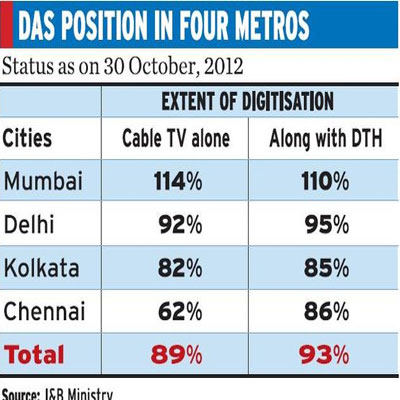
    According to TAM, around 70 per cent of TV homes in Kolkata have gone digital by mid-December. Going by industry estimates, 25-30 per cent homes are still to be seeded with set-top boxes (STBs) required to receive signals of television channels in digital mode.

    West Bengal Urban Development Minister Firhad Hakim has made it clear that the central government cannot force cable operators in Kolkata to switch to digital addressable systems.

    The minister has also warned of action against operators who switch-off analogue signals, which will lead to television sets going blank with no STBs.
     
    He said, "The Centre cannot arbitrarily announce these deadlines for compulsory switchover to digital signals. We have written to the Centre and emphasised that such an exercise can only be attempted through a proper dialogue, but we have not received any response."

    Hakim said I&B ministry is yet to respond to the letters by him and the state‘s Chief Secretary Sanjoy Mitra on the matter.

    While analogue signals of some television channels would continue, the number of channels being carried by MSOs in analogue has reduced significantly. The MSOs had begun the process of switching off of analogue signals from 16 December. The Bengali language channels were expected to go dark by 27 December.

    "While we have switched off a lot of channels but at the same time we have to do a balancing act," an executive from a leading MSO said on the condition of anonymity.

    The executive said the off-take of STBs for installing in cable TV homes has been very good and complete switchover is only a matter of time.

    Echoing his sentiment, an executive from another MSO said, "We have to go along with the I&B Ministry as well as the state government. In the last one month, STB seeding progressed very smoothly."

    The executive said the state government has called for a meeting in the first week of January to take stock of the situation.

    Cable operators in the city told Indiantelevision.com that West Bengal Chief Minister Mamata Banerjee had been a member of the Union Cabinet when it had decided to go in for digitisation in four phases, beginning with the metros.

    But now the operators felt they were being put in an awkward situation with the centre and the state at loggerheads on the situation.

    "We have to operate in West Bengal and it will not be prudent to act against the instructions of the state government. But if the MSOs do not follow the directives of the Centre then they risk losing their licences," said Cable & Broadband Operators’ Welfare Association Secretary Swapan Chowdhury. 
     
    It must be noted that the original deadline for the first phase of digitisation in the four metros was 30 June which was extended to 31 October by the ministry to allow MSOs more time to prepare.

    While Mumbai and Delhi adhered to the 31 October deadline by switching off analogue signals (although pirated signals were available in many parts of Delhi), in Kolkata the signals were not switched off by MSOs on the state government‘s diktat.

    After maintaining a studied silence on the issue for more than a month, the ministry had finally cracked the whip on Kolkata MSOs to switch off analogue television signals in a phased manner in Kolkata by 27 December.

    Meanwhile, broadcasters have begun carrying scrolls on their channels about the 38 cities that will be digitised in the second phase by 31 March even as Chennai is yet to be digitised.