Category: Multi System Operators

  • Q3-2015: Time Warner Cable – residential Internet data ascend, video slide; Business Services numbers up

    Q3-2015: Time Warner Cable – residential Internet data ascend, video slide; Business Services numbers up

    BENGALURU: The slide in retail or residential video numbers continues for the US television cable industry, if one were to go by the numbers reported by Comcast Cable Communications division and now by Time Warner Cable Inc., (TWC) for the quarter ended 30 September, 2015 (Q3-2015). Data, or more specifically high speed data continues its juggernaut, climbing YoY and QoQ.  The company’s Business Services segment reported increase in numbers across all parameters.

    TWC’s consolidated revenue in the current quarter increased 3.6 per cent (increased by $208 million) to $5922 million from $5714 million in Q3-2014, but declined marginally (declined by 0.1 per cent or $4 million) from $5926 million in the immediate trailing quarter.

    Note: 100,00,000 = 100 lakh = 10 million = 1 crore

    Subscription numbers have been mentioned in lakhs and revenue and other financial numbers in millions of US dollars.

    Time Warner Cable chairman and CEO Rob Marcus said, “I’m very excited about the operating momentum reflected in our third-quarter results. Subscriber growth was the strongest in years; revenue growth accelerated; and we continued to make significant investments in our network, equipment, products and customer service. Our ongoing transformation is a testament to the strength of our operating plan and the commitment of our entire team – all 55,000 employees – who work tirelessly every day to make Time Warner Cable an even better company.”

    Residential numbers

    Customer relationships

    For Q3-2015, TWC has reported amongst the best subscriber numbers over a long time, and this improvement is reflected by the low drop in video numbers of only 7000 that the company has reported. Residential High Speed Internet Data (Data) and Voice customers have both increased YoY and QoQ basis. Voice has shown the largest YoY and QoQ growth in terms of number of subscribers as well as in percentage terms.  

    Overall, TWC’s total customer relationships (including business services) increased 3.3 per cent (increased by 472,000) in Q3-2015 to 156.63 lakh from 151.31 lakh in Q3-2015 and by 1.1 per cent (increased by 163,000) from 155 lakh in the previous quarter. Please refer to Fig A below.

    Residential or retail customer relationships improved to an all-time high of 149.29 lakh in the current quarter as compared to the 144.57 lakh in Q3-2014 or the 147.82 lakh in the previous quarter.  

    Business Services saw increase across all three plays, both YoY and QoQ. Business Services customer relationships increased 8.9 per cent (increased by 60,000) YoY to 734,000 in Q3-2015 from 674,000 in Q3-2014 and increased by 2.2 per cent (increased by 16,000) from 718,000 in Q2-2015.

    Video Numbers

    Please refer to Fig B below.

    Video revenue declined 1.8 per cent (declined $44 million) YoY in Q3-2015 to $ 2453 million from $2497 million and declined 2.4 per cent from $2514 million in the immediate trailing quarter. Video customer relationships declined 0.6 YoY to 107.67 lakh from 108.27 lakh and declined QoQ from 107.74 lakh.

    Within TWC’s Video segment, six products or sub-segments contribute to revenue. The major segment is Programming tiers, which contributed $1566 million or about 64 per cent to Video revenue and more than 26 per cent to TWC’s consolidated revenue in the current quarter. The other sub-segments are Premium networks ($216 million, about nine per cent of video revenue in Q3-2015); Transactional Video-on-demand ($45 million, about two per cent of video revenue in Q3-2015); Video equipment rental and installation charges ($362 million, about 15 per cent of Video revenue in Q3-2015); Digital video recorder service ($150 million, about six per cent of Video revenue for Q3-2015) and Franchisee and other fees ($114 million, about five per cent of Video revenue for Q3-2015).

    Except for Premium tiers and Video equipment rental and installation charges, revenue from all the other sub-segments declined both YoY and QoQ. 

    High Speed Internet (Data) numbers

    Data revenue increased 9.4 per cent (increased $152 million) in the current quarter to $1772 million from $1620 million in Q3-2014 and increased 1.7 per cent (increased $30 million) from $1742 million in the immediate trailing quarter.

    TWC’s Data customer relationships in the current quarter increased 7.7 per cent YoY to 123.94 lakh from 119.90 lakh and 1.9 per cent QoQ from 121.62 lakh, while voice customers increased 22.1 per cent YoY to 60.93 lakh in the current quarter from 49.89 lakh in Q3-2014 and by four per cent from 58.56 lakh in the previous quarter. Please refer to C below.

    Voice Numbers

    TWC’s Voice revenue increased 1.5 per cent (increased $7 million) to $483 million in the current quarter from $476 million in Q3-2014 and increased one per cent (increased by $5 million) in the immediate trailing quarter.

    Voice subscribers increased 22.1 per cent (increased by 1,104,000) to 60.93 lakh in Q3-2015 from 49.89 lakh in Q3-2014 and increased four per cent (increased 237,000) from 58.56 lakh in Q2-2015.

    Single Play, double play and triple play

    The company’s residential single play customer relationships have been slowly increasing over time. Single play relationships in the current quarter increased by 0.6 per cent (35,000) to 57.09 lakh YoY from 56.74 lakh and by 0.9 per cent (50,000) from 56.59 lakh. Please refer to Fig D below.

    Double play customers have been declining over time, with the decline steepening even further since Q3-2014. In the current quarter, double play customer declined YoY by double digits – 12.4 per cent (declined 585,000) to 41.14 lakh from 47 lakh and declined 2.9 per cent (declined 121,000) QoQ from 42.36 lakh.

    Triple play customers have been increasing, the increase becoming more rapid since Q3-2014, indicating to an extent that double play customers were adding one more play, rather than the company losing double play customers, besides adding more new customers for residential triple play. Triple play customers in Q3-2015 increased 25 per cent (increased 1,022,000) to 51.05 lakh from 40.83 lakh in the corresponding year ago quarter and increased 4.5 per cent (increased 218,000) from 48.87 lakh in Q2-2015.

    Business Services

    While TWC’s Business services segment had only 4.7 per cent of TWC’s overall customer relationships, it contributed 14.1 per cent to TWC’s consolidated revenue. As a matter of fact, its contribution to TWC’s revenue has been increasing much faster than the increase in its customer relationship share in the overall pie. BS revenue in the current quarter increased 15.5 per cent (increased by $112 million) in Q3-2015 to $836 million (14.1 per cent of consolidated revenue from 4.7 per cent of overall customer relationships) from $724 million (12.7 per cent of consolidated revenue from 4.5 per cent of overall customer relationships) in the corresponding year ago quarter and increased 4.1 per cent (increased by $33 million) from $803 million (13.6 per cent of consolidated revenue from 4.6 per cent of overall customer relationships) in the immediate trailing quarter. Please refer to Fig E below.

    Revenue from Business Services High Speed data was more than 4 times the revenue from Business services video sub-segment or product in Q3-2015.


  • Den Network gets RBI nod for increase in FDI to 74%

    Den Network gets RBI nod for increase in FDI to 74%

    BENGALURU: After receiving Foreign Investment Promotion Board’s (FIPB) permission to increase its foreign direct investment (FDI) limit from the existing 49 per cent to 74 per cent a few months ago, Den Network Limited has now received approval for the same from the Reserve Bank of India (RBI).


    A letter from Den Network’s company secretary Jatin Mahajan to the Bombay Stock Exchange (BSE) and the National Stock Exchange (NSE) says that the company has received approval from the RBI for increase in FDI limit beyond 49 per cent and up-to 74 per cent by Foreign Institutional Investors (FII), Non Resident Indians (NRI), Foreign Portfolio Investors (FPI) and other eligible foreign investors.


    The approval is subject to compliance Regulation 5(2) of FEMA Notification No 20/2000 RBI dated 3 May, 2000 (as amended time to time) issued under FEMA 1999 and conditions specified in FDI Policy circular dated 12 May, 2015.


    As was reported earlier by Indiantelevision.com, with this, the company which is currently building its broadband base and also working towards digitisation in phase III and IV areas, is looking at attracting overseas capital into the company.


    It can be noted that Den Networks had sought for increase in FDI limit beyond 49 per cent and up to 74 per cent by FIIs, NRIs, FPIs, and other eligible foreign investors through route of secondary market and / or open market purchase.


    Earlier in March this year, the Board of Directors of Den Networks had approved this proposal to increase foreign investment limit. The decision was subject to shareholder approval (through postal ballot), FIPB nod and adherence to all other statutory requirements.


    Currently, FIIs hold 22.79 per cent stake in Den Networks.

  • DEN networks to use Alcatel-Lucent’s GPON tech for broadband services

    DEN networks to use Alcatel-Lucent’s GPON tech for broadband services

    MUMBAI : DEN Networks will deploy Alcatel-Lucent’s GPON and IP routers to enable DEN Networks to launch ultra-broadband access services in India.


    DEN Networks is offering services in the fast-growing broadband market, where cable and satellite pay-TV subscribers are estimated to rise to 175 million by 2019, from 139 million today. With a customer base 13 million cable TV service over 200 cities, DEN Networks plans to use fiber-optic access technology to expand its ‘DEN Boomband’ broadband service to 8.5 million city homes within three years.


    Since September 2015, Alcatel-Lucent has been deploying its GPON (gigabit passive optical networking) fiber-to-the-home, Ethernet aggregation and Broadband Network Gateway IP routing technologies with DEN Networks, delivering services to new customers as well as those already served by the existing DOCSIS-based network. In some areas of the network Alcatel-Lucent’s technology is providing backhaul connectivity, with the existing coaxial cable being used for ‘last-mile’ service delivery.


    Alcatel-Lucent is providing its GPON technology, which includes the 7360 Intelligent Service Access Manager (ISAM) FX, the 7368 Intelligent Services Aware Manager ONT and the 5520 Access Management System (AMS) to enable high-speed ultra-broadband access for homes and businesses using both fiber-to-the-home and fiber-to-the-node technologies to serve individual and multi-dwelling residences.


    Alcatel-Lucent will also provide its IP routing and switching portfolio to Den Networks. The 7210 Service Access Switch will provide layer three aggregation and the 7750 Service Routers will act as a broadband network gateway for residential services. Network management and subscriber level reporting will be provided by the 5620 Service Aware Manager and 5670 Reporting and Analysis Manager respectively.


    Pradeep Parameswaran of DEN Networks said, “We are committed to delivering the fastest high speed experience to our business and residential subscribers in India. Broadband is our key thrust area and we constantly strive to make the experience fast and consistent for our customers. With Alcatel-Lucent’s fiber and IP routing solutions we now extend our high-speed Internet connectivity and services superfast surfing experience to more people and businesses around the country.”


    Srini Sundararajan of Alcatel-Lucent said, “Working with the DEN Networks on an in-depth study and trials, we were able to show how our IP routing and GPON technology would help it scale to better meet the growing demands of their customers.”

  • Comcast & Cartoon Network team up on new voice remote searches

    Comcast & Cartoon Network team up on new voice remote searches

    MUMBAI: Speech recognition technology is more popular than ever and in the past few months alone with related announcements from Amazon, Apple, and Google.


    Comcast launched the cable industry’s first voice controlled TV remote earlier this year and the response has been terrific with nearly 1.5 million homes now having one. What’s more Comcast is distributing about 70,000 new remotes each week.


    “Users are speaking aloud to find titles, channels, actors and actresses as well as to record, tune, fast forward and rewind. Last month alone, there were 20 million voice commands made using our new remote.


    We’ve added some fun features too: quoting certain movies gets you to the film just as fast as a title search, Taylor Swift talks back when you search for her songs, and our remote happens to speak perfect Minionese,” said Comcast Cable executive director, product management Jeanine Heck.


    Now Comcast has added another interactive component in partnership with the Cartoon Network, which will be especially entertaining for kids.


    “It turns out that one of our most ‘voice-searched’ titles is Teen Titans Go!, a Cartoon Network fan favorite. Now, just by saying ‘Hello Beast Boy’ or ‘Boy Wonder,’ viewers are taken to the show’s homepage on X1 and will hear a special audio greeting from one of the characters. They also can say the names of other Titans like Cyborg, Robin and Raven and hear responses unique to each character,” Heck added.


    Comcast is planning add more new functions to its voice remote over time.

  • Q2-2016: Reliance Jio to ramp beta program; organized retail on growth path

    Q2-2016: Reliance Jio to ramp beta program; organized retail on growth path

    BENGALURU: The Mukesh Ambani led Reliance Industries Limited (RIL) organised retail segment – Reliance Retail, continued its growth momentum and profitability in the quarter ended 30 September, 2105 (Q2-2016, current quarter).


    RIL chairman and managing director Ambani said, “Reliance Retail achieved a milestone of Rs 5,000 crore quarterly turnover mark for the first time, reflecting continuing growth momentum in physical retailing. In Digital Services, we have substantially completed the network roll-out across the country and initiated the process of beta testing of our network and platforms.”


    “We achieved record levels of EBITDA and profits for the quarter, underscoring our ability to optimally utilise our assets across the value chain to leverage favourable market conditions. Refining business performance was notable, as it benefited from a combination of high utilisation levels, advantageous crude market opportunities and strong global fuels demand. Petrochemicals segment performance reflects strong volume growth, product mix improvement and lower energy costs,” he said.


    “We maintained a rapid pace of construction activity during the quarter. The company’s world-scale petroleum coke gasification facility and ethylene cracker complex remains on track for its planned 2016 start-up,” added Ambani.


    Revenues for Q2-2016 grew by 22 per cent Yo-Y to Rs 5,091 crore from Rs 4,167 crore and 8.4 per cent QoQ from Rs 4698 crore. RIL says that all format sectors grew through store additions as well as like for like growth ranging up to 16 per cent. The business delivered PBDIT growth of 12.9 per cent at Rs 210 crore in Q2-2016 as against Rs 186 crore in the corresponding period of the previous year, and PBIT growth of 3.4 per cent from Rs 203 crore in Q1-2016.


    Further, Reliance Retail expanded its reach with a net addition of 110 stores during the quarter. As on 30 September, 2015, Reliance Retail operated 2,857 stores across over 250 cities in India.


    The company says that Reliance Retail 2.0 initiatives encompassing fashion and lifestyle e-commerce, development of market place platform and building distribution ecosystem for Reliance Jio devices are on track and gearing up for rollout in a staged manner.


    Reliance Retail would soon launch its own brand of 4G LTE smartphones under the brand LYF. The brand built on the premise of unmatched user experience will offer high performance handsets that deliver a true 4G experience comparable to the best in the world. LYF range of smartphones with features like Voice over LTE (VoLTE), Voice over Wi-Fi (VoWi-FI), HD Voice and HD quality video calling will enable users to experience a new digital life.


    LYF phones will reach consumers across the country through one of the widest distribution and retail network for smartphones. The devices will soon be available at multi-brand outlets (MBOs) and modern trade including Reliance Retail stores across India.


    RIL numbers


    For Q2-2016, RIL achieved a turnover of Rs 75,117 crore, a decrease of 33.8 per cent, as compared to Rs 113,396 crore in Q2-2015 and 9.6 per cent lower than the Rs 83064 crore in the immediate trailing quarter.


    However, RIL’s net profit after tax (PAT) increased 12.5 per cent in Q2-2016 to Rs 6720 crore as compared to the Rs 5972 crore in Q2-2015 and increased 8 per cent as compared to the Rs 6222 crore in the previous quarter.


    Sale of Network18 shares


    In July 2015, RIL sold 3.25 crore shares of Network18 Media & Investments Limited, (representing 3.10 per cent of the equity capital of NW18) to bring down the aggregate shareholding of the promoter and promoter group to 75 per cent and increase the public shareholding to 25 per cent as mandated by Clause 40A of the listing agreement pursuant to Securities Contract (Regulation) Rules, 1957.


    Reliance Jio Infocomm Limited


    Reliance Jio Infocomm Limited (RJIL), a subsidiary of RIL, has substantially completed its network roll-out across the country. The network is currently being tested and optimised. Most of the business platforms have been rolled out and are being tested in a limited use environment. Large number of testers have been employed by the company across the country to facilitate extensive testing of network and business platforms.


    The company expects to ramp up its beta program over the next few weeks to further optimise the network, prior to commercial launch of operations. Financial year 2016-17 is projected to be the first year of commercial operations for RJIL.


    RJIL has launched Wi-Fi hot spots across several locations in the country and has entered into agreements with some of the State and Local Authorities to provide Wi-Fi services. RJIL has also started rolling out last-mile connectivity for its fibre-to-the-home (FTTH) business.

  • Hathway to demerge broadband business to subsidiary company

    Hathway to demerge broadband business to subsidiary company

    MUMBAI: Hathway Cable & Datacom is planning to demerge its broadband business into its wholly owned subsidiary Hathway Broadband Private Limited.


    The company’s board of directors have given in-principle approval to demerge, transfer and vest the company’s entire broadband business into its wholly owned subsidiary, subject to requisite approvals from the shareholders, creditors, High Court(s), Department of Telecommunications, Stock Exchanges, Securities and Exchange Board of India and other applicable regulatory governmental authorities.


    The carving out of the broadband business is aimed at accelerating value creation for Hathway shareholders. The separation will allow Hathway to aggressively focus on the significant growth potential for high speed data and related services in India. Globally, wireline or fixed broadband has emerged as a key driver of technology adoption and overall, GDP growth. India lags most countries including countries in Asia in wireline broadband penetration reaching only about eight per cent  of the potential universe.


    Hathway Broadband intends to take the lead in driving wireline broadband penetration in India and become a key player in Prime Minister Narendra Modi’s Digital India initiative. The company believes that its hybrid fiber coax infrastructure on DOCSIS 3.0 platforms is the most effective and sustainable technology in a price sensitive market like India.


    Hathway Cable & Datacom MD & CEO Jagdish Kumar said, “We are uniquely placed to leverage our leading position in the cable television industry and our brand to provide Indian subscribers with a world class broadband experience. This restructuring recognises that the market dynamics of the broadband business are unique as compared to our parent cable television business. The separation is a step towards increasing the broadband business’ customer focus and market competitiveness and in delivering a superior value proposition to our subscribers.”

  • Will Mukesh Ambani’s Reliance Jio do what Bill Gates’ Windows did?

    Will Mukesh Ambani’s Reliance Jio do what Bill Gates’ Windows did?

    MUMBAI: Computer in its early days was only used by government organisations for various defence purposes. The size of the device kept getting smaller as generations passed by and now, deemed as a necessity, it is omnipresent in almost every house. But what opened the floodgates for computer in every house almost twenty years ago in 1995 was Bill Gates’ Windows 95.

    Cut to 2015 and the present scenario in India. The current fad, which might just be here to stay, are Over The Top (OTT) players. Media and entertainment content companies are bullish on the OTT scenario and multiple apps have mushroomed left, right and centre over the last few months. However, they haven’t yet managed to augment a revolution of sorts by their services, thanks to the poor infrastructure support in the country. The broadband or mobile internet bandwidth is, on the one hand, too slow to offer a good viewing experience and on the other, it is also very expensive.

    The country currently has more than 350 million internet users and the number is expected to reach 640 million by 2019, of which 528 millions are estimated to be wireless consumers as per a report by KPMG.

    The growth rate of smartphones and tablets is also very encouraging for the video on demand (VOD) ecosystem. The number of tablets in India is is expected to be more than 18 million by 2019, according to the US-based firm’s Visual Networking Index (VNI) global mobile data traffic forecast for 2014 to 2019.

    The report said that in India, the number of smartphones grew 54 per cent during 2014, reaching 140 million in number and the number of smartphones will grow 4.7-fold between 2014 and 2019, reaching 651 million in number.

     What Colors CEO Raj Nayak has to say is by far the most apt depiction of the Indian OTT ecosystem in the current scenario. “The only reason why digital has not yet taken off in  India is because of the bandwidth issue. If any service can resolve that issue, it will be a complete game changer. There will be a leapfrogging of content consumption in mobile devices be it smartphones or tablets,” he opines.


    And addressing that issue soon will be Mukesh Ambani’s ambitious project Reliance Jio.

    Reliance Jio is Ambani’s visionary mission of spreading internet to every nook and corner of the country. Industry watchers say that the organisation in entering the market with a ginormous corpus fund of approximately Rs 70,000 crore. Under the able leadership of cable industry veteran K Jayaraman as CEO of Reliance Jio, the company has now started to take the aerial route to fast forward proceedings. It is now connecting pole to pole through cable in order to spread deep and fast.

    Jio is also teaming up with multiple last mile owners (LMOs) to expedite execution. As was reported earlier by Indiantelevision.com, Reliance is planning to carry out Jio’s soft launch on the occasion of Dhirubhai Ambani’s birth anniversary on 28 December this year. 

    Speculations are also rife that Reliance Jio is planning to unleash its services with affordable pricing, which will no doubt disrupt the market. “The focus with Jio is not money but the vision that we have. The pricing and speed will surprise many,” said a source close to the development.

    The question on every one’s lips is: Will Reliance Jio resolve bandwidth issues in the country? Moreover, will Mukesh Ambani’s Jio do what Bill Gates’ Windows did?

    Indiantelevision.com spoke to multiple industry stakeholders to ascertain their expectations. Here’s what they had to say: 

    Spuul Global CEO Subin Subaiah says, “Give a consumer higher speed at lower costs, and it gives him a huge incentive to consume more content – especially video – online. We  are watching Reliance Jio’s launch with keen interest, which should lead to other service providers following suit – creating a market where data costs and speeds are not an  impediment to consumption.”


    Reliance Industries’ latest AGM grabbed Eros Now COO Karan Bedi’s attention. “Mr Ambani in their AGM announced that they are rolling out Reliance Jio in December and that’s  a very positive move. The statement made Airtel roll out their 4G services immediately and the service is good. Other telcos are also planning to unleash their services soon. So  overall it’s certainly a move towards the positive side,” he says.  


    ”Bandwidth has been an issue for OTT services and we are looking forward to the new launch of Reliance Jio. Hope it turns out to be a consumer friendly proposition. Any improved internet service will certainly help the ecosystem,” asserts Zee Digital Convergence Limited CEO and India web portal CEO Debashish Ghosh.


    #Fame CEO Saket Saurabh adds, “We are waiting for the launch. Let’s see how it goes. If the internet infrastructure develops, it will be good for the entire ecosystem.”  


     “From a consumer perspective, 4G would more be a network bandwidth problem solver and hence would immensely expand the experience of browsing and interacting with  mobile internet products. And from a digital and mobile player perspective, I expect 4G to significantly enhance the reach and innovation in the mobile video ecosystem. Today,  Indian online users watch approximately 40 per cent of YouTube videos on their mobile phones even when the experience is not the best and I am really looking forward  to Reliance Jio’s launch. Any new player disrupting the mobile ecosystem adds a new dimension to the environment. So from a consumer perspective, just as Monsoon Dhamaka  was a massive disruption to making mobile phone accessible to all, I expect 4G launch of Reliance to be also a dhamaka for the consumer and the mobile marketing,” opines Madhouse South Asia COO Milind Pathak.


    Ping Network CEO Rajashree Naik adds, “Even a marginal shift in internet speeds will have a significant impact in data consumption – for us in the video space, there is a relevant link between consumption and speeds. For everyone in the internet and content space, if the consumer experience is enhanced because of speeds much of our own    business metrics will change. So whether it is Jio or any other data options that will make it cheaper to consume and remove the buffering hurdle, will certainly be something to look forward to.”  

    Even as the stage is set for Reliance Jio’s disruptive entry into the Indian telecom market, rivals are gearing up to fire their respective salvos. While India is waking up to some interesting times ahead in the telecom space, what each one does to change the ecosystem, only time will tell.

  • Hinduja’s NXT Digital installs Actus broadcast monitoring platform

    Hinduja’s NXT Digital installs Actus broadcast monitoring platform

    MUMBAI: Hinduja Group’s headend-in-the-sky (HITS) digital service platform NXT Digital has installed the Actus broadcast monitoring platform.


    The recently launched HITS platform offers over 500 channels to the fast-growing television market in India.


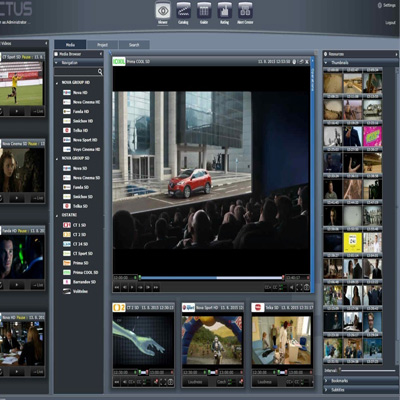
    By implementing the latest version of Actus’s broadcast monitoring platform, NXT is being guaranteed that all IP-based channels are reliably recorded 24×7 and that whenever more channels are added; Actus’s scalable broadcast recording platform will be easily expanded. In order to comply with the current requirements, Actus has deployed Actus View to record and monitor the 350 IP-based channels, Actus Multitrak to support multiple audio tracks, Actus EncoderPro to save hardware resources, Actus Loudness to monitor audio levels, and Actus AlertCenter to provide NXT with real-time alerts for any audio or video issues.


    Grant Investrade MD Tony D’Silva said, “In the dynamic digital video world, we are assured that Actus Digital will not only fulfil our current requirements but also comply with future requirements that the digital world will dictate. Actus has vast experience with installations worldwide and we are confident that the platform will grow as our business expands constantly.”


    Actus was selected for this premier service after a rigorous four-stage RFP evaluation process conducted by Castle Media – Asian broadcast consultancy tasked with end-to-end programme management and delivery of the HITS project.


    “The Actus platform is scalable and modular, which makes the solution cost-effective by allowing GIL to implement only the modules required yet be assured that once additional requirements arise, Actus’s platform will provide us the solution,” added Castle Media executive director Vynsley Fernandes.


    Shaf Broadcast, Systems Integrator, implemented the solution. 


    “We have the knowledge base and experience to deploy Actus Digital’s solutions. The installation, implementation and integration of the Actus platform went fluently and complied with all of our high expectations. The Actus local team worked closely with Shaf engineers to make sure the system will be up and running and meet the high demands and tight time frames. I am assured Actus will provide an excellent platform to NXT Digital also in the future,” said Shaf Broadcast director P.R. Suresh. 


    “One of the challenges, beyond the installation of a large system, was the fastest-possible deployment that was required to meet the time frames of launching the digital rollout of NXT Digital services. In order to be sure that Actus would meet the tight time frames, we sent an Actus-trained local team to the customer’s site to prepare the site ahead of time. With good cooperation with Shaf, we optimized our recorders to take advantage of recent improvements in hardware and of a new version of Actus’s EncoderPro technology and were thus able to offer better performance than initially proposed for the same budget,” said Actus CEO Sima Levy. 

  • NAGRA powers Hinduja’s NXT Digital HITS platform in India

    NAGRA powers Hinduja’s NXT Digital HITS platform in India

    MUMBAI: Switzerland based Kudelski Group’s digital TV division NAGRA has powered the Hinduja Group’s new headend-in-the-sky (HITS) platform – NXT Digital in India.


    NAGRA’s anyCAST, OpenTV solutions and user interface are enabling NXT Digital. This makes it NAGRA’s first HITS platform in India, which is one of the fastest growing markets in pay-TV today, as the country continues the government-mandated digitisation process. According to a recent report by Media Partners Asia, the Indian pay-TV market is expected to grow by 11 per cent annually on average by 2018, with total pay-TV subscribers expected to grow from 65 million in 2013 to 165 million by 2018 and 180 million by 2023.


    NAGRA’s anyCAST content protection and OpenTV middleware solutions are enabling the HITS platform, which will provide backend operations to local and multi-system cable operators in India. NXT Digital offers a variety of packages and services including 500-plus MPEG 4-encrypted services featuring SD and HD channels along with value-added services like PVR and educational content.


    “Our new HITS platform gives regional cable operators access to an infrastructure that helps them deliver high-quality video services to a new generation of viewers. NAGRA has been a key partner in the process, providing the expertise and support expected of a pay-TV leader, as well as solutions that provide the right level of content protection, scale seamlessly and allow for flexible business models that are critical to our operators’ success as they kick off their new services,” said Hinduja Group subsidiary Grant Investrade managing director Tony D’Silva.


    “It is an honor to work with Grant Investrade and be a part of the digital TV transformation in India that is making access to digital TV services a reality for millions of people. This new platform makes it easy for local and regional cable operators to deploy new services without having to worry about the operational complexities that can come with installing their own system. And by leveraging NAGRA’s deployed, market-leading solutions, they are ensuring a high quality user experience that is not only highly secure but offers pay-as-you-grow models adapted to their strategy,” said NAGRA sales SVP Asia-Pacific Jean-Luc Jezouin.


    NAGRA’s anyCAST Security Services Platform, OpenTV middleware and user interface are ready-to-deploy solutions that enable of range of entry-level and advanced DTV services. They allow operators to leverage scalable, pay-as-you-grow business models with multiple set-top boxes and chipsets, and include an intuitive user interface adapted to India’s diverse population and languages.

  • Reliance Jio appoints Amit Shah as senior vice president

    Reliance Jio appoints Amit Shah as senior vice president

    MUMBAI: Reliance Jio Media has appointed Amit Shah as the senior vice president – content carriage and Value added services (VAS) of the company.  


    Shah will report to Reliance Jio CEO K Jayaraman and will be looking after the content and carriage aspect of the business. 


    A source in the company informs Indiantelevision.com, “A series of veterans from the cable fraternity will be joining Jio as the launch date comes closer.”
     

    Earlier, Shah worked for two years as head content carriage and VAS for Videocon d2h. He was also associated with Hathway Cable & Datacom as GM accounts content and strategy.