Category: Multi System Operators

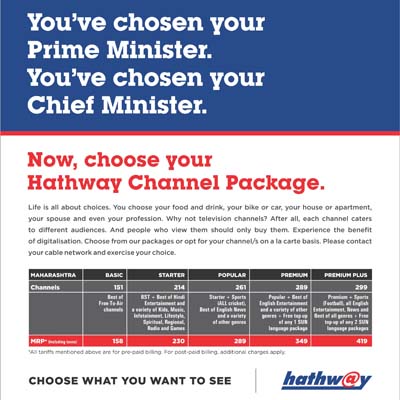
  • Hathway Cable gets approval to raise funds worth Rs 99.63 crore

    Hathway Cable gets approval to raise funds worth Rs 99.63 crore

    MUMBAI: Leading cable and broadband player Hathway received an approval to raise funds worth Rs 99.63 crore at a board meeting held on 29 August. Following the approval the company’s shares rallied as much as 15 per cent.

    The approval has come for raising of funds through issuance of 30,800,000 equity shares at a price of Rs 32.35 per equity share including premium of Rs 30.35 per equity share which is higher than the issue price determined in accordance with Regulation 76 of Securities and Exchange Board of India (Issue of Capital and Disclosure Requirements) Regulations, 2009, as amended, aggregating to Rs. 99.63 crore on preferential basis to Hathway Investments Private Ltd, an entity forming part of the promoter group, as posted on BSE.

    Hathway offers cable television services across 140 cities and towns and high-speed cable broadband services across 21 cities.

  • Hathway ropes in Sitendu Nagchaudhuri as new CFO

    Hathway ropes in Sitendu Nagchaudhuri as new CFO

    MUMBAI: Leading cable operator Hathway Cable and Datacom Ltd has appointed Sitendu Nagchaudhuri as the new chief financial officer (CFO). The fellow chartered accountant’s experience in the field of corporate finance, commercial and strategy leadership spans over 27 years.

    In a corporate announcement to the BSE, the company has informed about the appointment decided in a meeting of the board of directors held on 2 July.

    The earlier CFO Vineet Garg resigned in May after a stint of almost four years in the company. He was promoted to the position of CFO in February 2016.

    Prior to this appointment, Nagchaudhuri worked as CFO in Navin Fluorine International Ltd. The company is engaged in the specialty fluoro-chemicals. Along with plants in Gujarat and Madhya Pradesh, the company has a global footprint in the UK, US and Asia Pacific.

    The expert has experience with Fortune 500 MNCs and leading Indian enterprises in diverse sectors like specialty chemicals, oil and gas, lubricants, FMCG and infrastructure.

    Also Read :

    Hathway CFO Vineet Garg resigns

    Hathway reports improved standalone Q3 results

  • Sony to bring Pictures, TV division under one roof

    Sony to bring Pictures, TV division under one roof

    MUMBAI: Sony Pictures TV is set to merge international TV operations to bring its television networks, home entertainment and distribution businesses together. This shuffle may lead to some job cuts, with many senior executives from Sony having already departed.

    Sony Pictures TV chairman Mike Hopkins has reportedly sent out an email to the staff informing them of the company’s plans of merging the businesses, which so far have been operated separately.

     “The aim is to bring together the various and often quite disparate, divisions, and to  create a stronger and more agile organisation, one that is better able to pivot and capitalise on opportunities in a fast-changing and increasingly complex global marketplace,” Hopkins wrote in the email, according to a report on Advanced Television.

    He went on to add that the new territory management model brings together businesses that have been historically separate. 

    “With this approach, we gain a more efficient structure giving regional leaders, along with their direct reports in each country, the ability to make smart, strategic business decisions, while keeping local consumers at the core of what we do,” he wrote.

    Hopkins was named chairman of Sony Pictures TV in October 2017 after running the streaming video service Hulu as its chief executive officer for four years.

    Also Read:

    Sony Pictures Networks India inaugurates its first music room at Bhondsi Jail, Gurugram

    Sony Pictures Networks Productions announces T for Taj Mahal

  • DEN Network fixed-line b’band biz plan hinges on partnerships & leveraging present infra

    DEN Network fixed-line b’band biz plan hinges on partnerships & leveraging present infra

    MUMBAI: With telcos handing out data at cheap rates in various package sizes under innovative schemes, mobile data consumption has increased rapidly in India in the last few years, while the growth of fixed-line broadband (FLBB) users has been tepid, if not completely static. MSO DEN Networks now wants to tap the hitherto unexplored opportunities of FLBB as a business proposition. So, what’s the plan?

    Not only DEN wants to use its own and partners’ customer bases in 100 small cities of India, but is also, probably, eyeing the huge FLBB market that will open up as the Indian government ramps up its BharatNet project to provide Internet and broadband services to approximately 250,000 gram panchayats or local village administrations through state-run telcos and third-party service providers, including cable operators. 

    The reason for hi-speed broadband in 100 cities in 10 Indian states is to try overcome the low returns in big cities and metros. “We have also seen a lot of stress in the fixed line broadband ARPUs of all the major metros, be it Mumbai, Delhi, Bangalore [and] Kolkata,” DEN Networks CEO SN Sharma said during a recent analyst call, going onto add that the ARPUS were low in the “top 10 towns of the country”.

    public://graph_1.jpg

    In April, DEN Broadband Pvt. Ltd, a subsidiary of DEN Networks, had announced expansion of its hi-speed internet services to 100 cities across India.  After completion, DEN Broadband aims to enable 1.1 crore (11 million) Indian households with high-speed broadband services by 2020 with 20 MB speeds on an average under different sets of packaging and schemes — in contrast to average lower offerings from various telcos.

    And, to back its claims, DEN Networks quotes data from international and domestic sources. In a presentation made to investors, the Sameer Manchanda-founded company justified its focus on FLBB by saying that if regulator TRAI’s December 2017 data was to be believed, there were 425 million wireless Internet subscribers, while there were only 18 million FLBB subs. Over the years, Indian FLBB growth has remained static compared to its APAC peers like Australia, China, Vietnam and Thailand.

    So, how is DEN going to go about its FLBB plans in 100 cities? The company plans to leverage its existing cable universe and tie-ups with last mile operators by going the franchisee model, leveraging present infrastructure (80 per cent already fibre-enabled), and lower capex and operational costs. Affordable technology like Metro Ethernet and GPON, coupled with standardized technical solutions, customer support from DEN and a pre-paid collect model on B2C basis, according to the company, would make good business sense.

    “We have a plan to enable 15 towns in the first quarter. Overall, 100 towns have to be enabled, and you will be surprised that LCOs themselves are approaching us,” Sharma informed an analyst, adding that it was not just a one-way traffic as company execs too were tapping LCOs informing them of the benefits as the infrastructure is already in place and the project could have additional revenue spin-offs for the LCOs. DEN has earmarked Rs. 100 crore (Rs.1 billion) as capex for the FLBB project over the three-year period.

    What is fueling DEN’s aspirations? Quoting Singapore-based Media Partners Asia figures, the company presentation told investors that there had been 

    15X rise year-on-year in Internet data traffic in 2017 with video content contributing 65 per cent of total mobile data traffic apart from the fact that India’s FLBB penetration was expected to increase to 10.3 per cent from the present single digit share by year 2022. Moreover, as content and applications keep getting heavier and denser in size, FLBB high speed broadband solutions could be ideal for offices and homes.

    “Our fiber is just 100 meters away from each of the subscriber that is being served by us,” Sharma explained to analysts, adding with broadband ARPUs low in metros and bigger cities it was decided to target the rest of the country that is not only a “virgin area” but has “equally good” demand.

    Asked about Reliance Jio’s ambitious plans to rollout broadband services in the country, which can disrupt this segment too, Sharma refused to comment, saying, “I am nobody to comment on others business.” 

    Also Read :

    DEN expands broadband services; plans Rs 100 cr capex

    Aim to take phase 3 ARPU to phase 1 value: Den Networks’ SN Sharma

    DEN readies Android-based STB for Feb launch

    TDSAT rules in favor of DEN Networks, directs ZEE entertainment to provide channels on RIO basis

  • DEN aims to convert 10% of SD subscribers to HD in a year

    DEN aims to convert 10% of SD subscribers to HD in a year

    MUMBAI: DEN Networks CEO SN Sharma has set a target of converting 10 per cent of its standard definition (SD) subscribers to high definition (HD) within a year.

    Sharma, speaking on an analysts call, said that DEN currently has 7.4 million paid digital subscribers, but only about 100,000 of those view HD transmissions.

    He further noted that the price of HD set top boxes (STBs) has seen a decline from Rs 4,000-5,000 to Rs 1,500-1,600 and that should help in increasing the HD penetration.

    Reports said that DEN has locked in content deals with most broadcasters with the increase being less than 15 per cent. The MSO’s content deals are valid till April 2019 barring that of Star which will come up for renewal in nine months by January. DEN has also resolved its dispute with ZEEL. 

    “All these deals have been signed up and are firmly in the place. The content cost increase is in the range of less than 15 per cent,” Sharma said.

    He also said that all the deals will come up for renewal next year as agreements with Sony and IndiaCast will expire in March 2019. Star and Zee are now signing only one-year deals. 

    “So as of now our content deals are all frozen till March and April next year. By then all of them become due for renewal,” he noted.

    The deals with broadcasters are consolidated and include both standard definition (SD) and HD channels.

    Currently, the DEN strategy is to replace older STBs as they run out of warranty, as well as to use new HD STBs as the cable network expands into new areas.

    Also Read:

    Den Networks appoints Himanshu Jindal as CFO

    DEN expands broadband services; plans Rs 100 cr capex

  • Hathway plans to seed 2.5 lakh high definition set top boxes in FY19

    Hathway plans to seed 2.5 lakh high definition set top boxes in FY19

    MUMBAI: Going along the lines of FY18, broadband and cable TV service provider Hathway Cable and Datacom is planning a Capex of Rs 310 crore in FY19. In addition to that, it plans to seed 2.5 lakh high definition (HD) set top boxes (STB) in FY19. The company had 2.16 lakh HD subscribers at the end of March 2018.

    While in FY18 Hathway spent Rs 225 crore on broadband business and Rs 85 crore on the cable TV business, the company has a similar planning of expenditure in both the business for FY19. The company had 7.2 million cable TV subscribers along with a broadband subscriber base of 0.8 million.

    “In FY18, we spent around Rs. 225 crore in broadband capex and around Rs. 85 crore in video business capex. We intend to spend similar capex in FY2019 as well. In terms of addition of consumers, we have seen good momentum so we are confident that this momentum will continue in FY2019 as well,” Hathway Cable and Datacom MD Rajan Gupta told analysts during an earnings call.

    The company is focusing on four key markets including Maharastra, Mumbai, Karnataka, Bengaluru, Hyderabad, and West Bengal.

    Due to the inability to implement the Telecom Regulatory Authority of India’s (TRAI) upcoming tariff order and regulations, a number of MSOs may collapse. Taking the opportunity, company is looking to acquire customers of MSOs to increase market share. Along with increase in market share, increase in average revenue per user (ARPU), HD STB seeding will play key role in the subscription revenue growth in next fiscal year.

    More importantly, Gupta revealed that the company has closed content deals with broadcasters for FY19. While net increase in content cost for FY19 will be Rs. 40 crore, however, there will be no increase in content cost for two to three large broadcasters.

    Also Read:

    Hathway CFO Vineet Garg resigns

    IndiaCast, Hathway fail to concur on carriage, subscription fees

  • VITEC and ATX join hands for distribution of IPTV content

    VITEC and ATX join hands for distribution of IPTV content

    MUMBAI: VITEC, a worldwide leader in advanced video encoding and streaming solutions, and ATX Networks, a technology leader of optical and media access platforms, has announced a strategic partnership to provide a fully secure architecture for distribution of IPTV content throughout the enterprise network.

    ATX’s UCrypt family of cable gateways enables MSOs and service providers to secure and convert content for a variety of applications, including the secure delivery of content to commercial and hospitality locations. UCrypt’s any-to-any capabilities extend across all formats, including analog, IP, and QAM

    ATX chief product officer Ian Lerner said, “The addition of AES output encryption support allows partners like VITEC to have a more practical and cost-effective way to ensure encrypted streams from the UCrypt IP video gateway can only be viewed by authorized users.” He added that together with VITEC’s EZ TV Platform for managing DRM workflows, it is able to offer a secure, enterprise-grade, multiscreen experience with AES decryption for desktop users via a browser player, for TV and signage displays utilising EZ TV end-points, and for Android and iOS users using EZ TV’s mobile app.

    VITEC VP Eli Garten said, “IP-based video distribution of live cable and satellite TV content brings a broad range of advantages for any organisation seeking to cost-effectively and securely deliver high-quality content to any screen and any user in the organisation.” He added that this latest integration enables customers to achieve maximum protection with a simple, reliable setup that is approved by leading service providers.

    IPTV, digital signage, and advanced video solution, VITEC’s EZ TV IPTV and digital signage platform automates video streaming workflows and campaigns over existing IP networks, allowing any organisation to centrally manage IPTV and content from a single interface. With easy-to-use tools for signage authoring, administration, and analytics, the future-proof platform supports both H.264 and H.265 (HEVC) formats in resolutions up to 4K. 

  • GTPL revenue up as subs base, ARPU increase in fiscal 2018

    GTPL revenue up as subs base, ARPU increase in fiscal 2018

    BENGALURU: As mentioned by us earlier, Indian multi-system operator and internet service provider GTPL Hathway Ltd’s(GTPL) consolidated total revenue for FY 2018 (fiscal 2018, yearunder review, year ended 31 March 2018) had increased 18.2 percent as compared to the previous year (FY 2017). The company’s investor presentation for FY 2018 says that its active cable TV subscriber base in fiscal 2018 increased 1.42 million (0.142 crore) in the year under review to 7.4 million (0.74 crore) from 5.98 million (0.598 crore) in the previous year. The company says that it seeded 1.8 million (0.18 crore) digital set top boxes in the FY 2018. In FY 2018, GTPL’s cable TV digital paying subscriber base increased by 2.07 million (0.207 crore) to 7.0 million (0.7 crore). 

    Average revenue per user (ARPU) in phase II, phase III and phase IV by 6.25 percent, 1.64 percent and 1.96 percent respectively during the quarter ended 31 March 2018 Q4 2018 as compared to the quarter ended 31 December 2017 (Q3 2017). Phase-wise ARPU increased in FY 2018 as compared to FY 2017 as follows: phase I increased to Rs 103 from Rs 100; phase II increased from Rs 95 to Rs 105; phase III increased from Rs 54 to Rs 62; phase IV increased from Rs 41 to Rs 52.

    Over 38 percent of the company’s subscriber base in phase IV areas, which for GTPL has seen the highest increase in ARPU during FY 2018, both in terms of absolute rupees and in terms of percentage growth. Arising from the above, share of GTPL’s cable TV business to revenues and profits has gone up. 
    Please refer to the figure below

    public://g1_0.jpg

    Further, the company says that it has added 40,000 broadband internet subscribers in fiscal 2018, taking its broadband subscriber base to 0.28 million (0.028 crore). The company’s broadband ARPU remained the same in FY 2018and FY 2017 at Rs 480. Hence broadband revenue will have increased to an extent on account of the increased broadband subscriber base in fiscal 2018. The company has revealed that data consumption per user has increased from 38GB per month in March 2017 to 62 GB per month in March 2018.

    The company’s consolidated total income increased 18.2 percent during the year under review to Rs 1,113.35 crore from Rs 941.83 crore in the previous year. GTPL’s consolidated operating revenue for fiscal 2018 at Rs 1,091.27 crore was 20.2 percent higher than the Rs 907.70 crore for FY 2017. Other income reduced 35.3 percent in FY 2018 to Rs 22.09 crore from Rs 34.13 crore in FY 2017.

    Please refer to the figures below the company’s total revenue breakup in FY 2018 and FY 2017:

    public://g2_0.jpg

    public://g3.jpg

    Consolidated operating profit (EBIDTA) excluding other income increased 29.6 percent in FY 2018 to Rs 383.12 crore (35.1 percent of operating or op revenue) from Rs 295.71 crore (32.6 percent of op revenue) in the previous fiscal. Consolidated EBIDTA including other income increased 30.7 percent to Rs 314.43 crore (28.2 percent of total revenue) in FY 2018 from Rs 240.56 crore (25.5 percent of total revenue) in the previous year. 

    However, the company’s profit numbers still depend upon placement and activation revenue. It is heartening to note that the shares of placement and activation revenue to total revenue in FY 2018 as compared to FY 2017 have gone down as is obvious from the above figures.  If one were to calculate EBIDTA without placement and activation revenue, the company has incurred a lower operating loss of about Rs 35 crore in FY 2018 as compared to an operating loss of about Rs 72 crore in the previous year.

    The board of directors of GTPL has mooted dividend of Re 1 or 10 percent per equity share of face Rs 10 each subject to approval from shareholders for the year ended FY 2018. The outstanding capital of GTPL as on 31 March 2018 was Rs 112.463 crore.

  • Hathway reports improved numbers

    Hathway reports improved numbers

    BENGALURU: The demerged Hathway Cable and Datacom Ltd (Hathway) reported standalone profit after tax (PAT) of Rs 12.62 crore (8.7 per cent of operating revenue) for the quarter ended 31 March 2018 (Q4 2018, quarter under review), 47.1 per cent lower as compared PAT of Rs 23.87 crore (17.2 per cent of operating revenue) in the immediate trailing quarter Q3 2018 (q-o-q).  It may be noted that Hathway’s numbers for Q4 2017 include both cable television and broadband numbers and hence cannot be compared with Q4 2018 revenues that include only broadband revenue. Hence, Hathway’s numbers for the quarter under review have been compared to its numbers from the immediate trailing quarter Q3 2018 (quarter ended 31 December 2017). As a matter of fact, after the transfer of the Hathway’s cable television business as a slump sale since Q1 2018, the company has reported standalone profits after tax for each quarter as well as for fiscal 2018.

    Hathway’s standalone total revenue of Rs 149.24 for Q4 2018 was 5.1 per cent more q-o-q then Rs 144.53 crore for Q3-2081. Revenue from operations in Q4 2018 was 5.1 per cent higher q-o-q at Rs 145.74 crore than Rs 138.65 crore.

    Hathway’s total comprehensible income (TCI) for the quarter under review was 43.9 per cent lower q-o-q at 13.47 crore than Rs 24.01 crore. Simple operating EBITDA for Q4 2018 at 59.04 crore (40.5 per cent of operating revenue) was 1.7 per cent lower q-o-q than Rs 60.6 crore (43.3 per cent of operating revenue).

    Hathway’s total expenditure in the quarter under review increased 12.4 per cent q-o-q to Rs 135.70 crore from Rs 120.70 crore. Finance costs in Q4 2018 increased 17.1 per cent q-o-q to Rs 23.37 crore from Rs 17.54 crore. Employee Benefits Expense in Q4 2018 reduced 1.7 per cent q-o-q to Rs 11.14 crore from Rs 11.33 crore. Other expenses in the quarter increased 26.6 per cent q-o-q to Rs 43.32 crore from Rs 34.20 crore. Other operational costs reduced 2.5 per cent q-o-q in Q4 2018 to Rs 32.25 crore from Rs 33.06 crore in Q3 2018.

    Hathway’s standalone numbers for FY 2018

    Hathway’s standalone operating revenue or broadband revenue for the year ended 31 March 2018 (year under review, FY 2018) was Rs 544.54 crore. Standalone total revenue for FY 2018 was Rs 556.51 crore. The company reported standalone TCI of Rs 78.92 crore. Standalone PAT for 2018 was Rs 77.66 (14.3 per cent of operating revenue). Total expenditure for the year under review was Rs 495.06 crore.

    Hathway’s consolidated numbers for FY 2018

    Hathway reported consolidated total revenue of Rs 1,544.33 crore for the year ended 31 March 2018 (year or fiscal under review, FY 2018) was 12.9 per cent more than Rs 1,368.25 crore in FY 2017. Revenue from operations including other operating revenue in FY 2018 was 14.1 per cent higher in FY 2018 at Rs 1,534.62 crore than Rs 1,344.40 crore in the previous year. The company reported a lower total comprehensible loss (TCL) of Rs 105.21 crore for FY 2018 as compared to TCL of Rs 193.19 crore for FY 2017. Net loss for the year under review was also lower at Rs 108.30 crore as compared to Rs 193.79 crore in FY 2017.

    Consolidated total expenditure for FY 2018 at Rs 1,686.45 crore was 7.8 per cent higher than Rs 1,564.17 crore in FY 2017. Consolidated pay channel cost during the year under review was 20.7 per cent higher at Rs 569.35 crore as compared to Rs 471.69 crore in FY 2017. Consolidated other operating costs in FY 2018 were 2.9 per cent higher at Rs 263.90 crore as compared to Rs 256.47 crore in FY 2017. Consolidated employee benefits expense during the period under review reduced 17.3 per cent to Rs 76.99 crore from Rs 93.15 crore in the previous year. Consolidated finance cost in FY 2018 was 37.9 per cent higher at Rs 152.76 crore as compared to Rs 110.75 crore in the previous fiscal. Consolidated other expenses reduced 11.5 per cent in FY 2018 to Rs 288.75 crore from Rs 326.26 crore in FY 2017.

    Hathway’s consolidated numbers include revenue from two segments – broadband business and cable TV. The standalone numbers mentioned above were for Hathway’s broadband business. Cable television revenue for FY 2017 was Rs 990.08 crore and an operating loss of Rs 129.33 crore.

    Also Read :

    GTPL Hathway board okays additional stake buy in subsidiaries

    Hathway reports improved standalone Q3 results

    IndiaCast, Hathway fail to concur on carriage, subscription fees

  • Competition, provision for doubtful receivables paint Ortel’s bottom line red

    Competition, provision for doubtful receivables paint Ortel’s bottom line red

    BENGALURU: Higher competitive intensity in the market, delay in collections and issues pertaining to debt repayment are some of the reasons that Indian regional cable and broadband player Ortel Communications Ltd (Ortel) says that it has incurred a loss of Rs 95.28 crore for the year ended 31 March 2018 (FY 2018, year, fiscal under review).

    Ortel president and CEO Bibhu Prasad Rath said, “Our FY 2018 was very challenging for the company due to delay in collections, higher competitive intensity in the marketplace as well as issues pertaining to debt repayment. We have been working on all these parameters with an objective to improve our overall performance in the future. As intimated in the previous quarter, the management reviewed the details of receivables and took a firm step by creating provision of Rs 679.4 million (Rs 67.94 crore) against doubtful receivables. This amount is primarily on account of disruption of services during the process of digitisation and acquisition of local operators. This significantly impacted our P&L in FY 2018.”

    However, Rath is confident of a brighter 2019. He added, “We want to start afresh in FY2019 and restore our business momentum. We have also taken many steps for increasing the net growth of our broadband business. This will result in lesser churn and higher sales thereby increasing our subscriber base and broadband revenue.”

    Segment numbers

    Three segments contribute to Ortel’s revenue. They are cable TV; broadband; and infrastructure leasing. Revenues from both cable TV and broadband segments declined in FY 2018 as compared to FY 2017.

    Ortel’s cable TV segment’s revenue declined 5.1 per cent in fiscal 2018 to Rs 145.41 crore from Rs 153.19 crore. The segment reported an operating loss of Rs 15.54 crore in FY 2018 as compared to an operating profit of Rs 61.48 crore in FY 2017.

    Broadband segment’s revenue declined 35.5 per cent in FY 2018 to Rs 23.16 crore from Rs 35.91 crore in FY 2017. The segment’s operating profit declined to less than a sixth (declined 83.5 per cent) in FY 2018 to Rs 3.13 crore as compared to Rs 18.96 crore in the previous fiscal.

    Ortel’s infrastructure and leasing segment had operating revenue of Rs 11.72 crore in FY 2018 which was 5.6 per cent more than the Rs 11.10 crore in FY 2017. The segment’s operating profit declined 15.5 percent in FY 2018 to Rs 8.92 crore from R 10.55 crore in FY 2017.

    Let us look at the other numbers reported by Ortel

    Ortel operating revenue for the year under review declined 9.4 per cent in FY 2018 to Rs 184.04 crore as compared to Rs 203.21 crore in the previous year. Total income including other income for fiscal 2018 reduced 10.1 per cent to Rs 186.20 crore as compared to Rs 207.07 crore in the previous fiscal. The company incurred an operating loss (negative EBITDA including other income) of Rs 34.85 crore in FY 2018 as compared to a positive EBITDA including other income of Rs 53.88 crore in the previous fiscal. As mentioned above, net loss for the period under review was Rs 95.28 crore as compared to a profit after tax of Rs 0.50 crore in FY 2017.

    Ortel’s total expenditure in FY 2018 declined two per cent to Rs 202.63 crore from Rs 206.81 crore in fiscal 2017. Programming costs increased 17.7 per cent in FY 2018 to Rs 45.26 crore from Rs 38.45 crore in FY 2017. Bandwidth costs in the year under review increased 6.1 per cent to Rs 18.03 crore from Rs 16.99 croreFinance costs in FY 2018 increased 9.7 per cent to Rs 29.19 crore from Rs 26.62 crore in FY 2017.

    Also Read: Ortel takes on competition with new broadband plans

    Ortel to issue shares worth Rs 8.75 cr to promoters

    Ortel to move broadband business to new entity