
AD Agencies
Breaking the ad code ASCI Global Adda 2025 sparks bold brand conversations

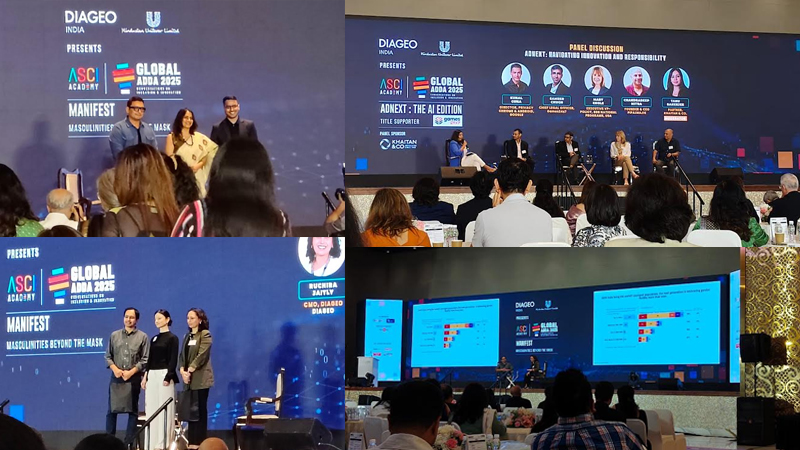
MUMBAI: Advertising isn’t just about selling products anymore, it’s about shaping the world we live in. That was the resounding message at Asci Global Adda 2025, where industry leaders, marketing pioneers, and policy experts gathered to discuss the power of advertising to drive meaningful change. From redefining masculinity in Indian media to harnessing AI’s potential responsibly, the event sparked thought-provoking discussions on the evolving role of brands in an increasingly complex digital world.
Masculinity in advertising is getting a reality check, The event kicked off with a powerful discussion on gender representation in Indian advertising with the unveiling of Manifest: Masculinities Beyond the Mask. The report, presented by Arvind Mohan of Religious Brands, explored how masculinity has evolved in Indian media and the advertising industry’s role in shaping it.
Taking the conversation further, renowned mythologist Devdutt Pattanaik analysed how traditional archetypes of masculinity rooted in mythology and historical narratives continue to influence modern media. He argued that while Indian advertising has made progress in challenging outdated gender roles, the industry still has a long way to go in truly redefining masculinity for contemporary audiences.

A panel discussion followed, featuring actor Abhishek Banerjee, filmmaker Paromita Vohra, and Unilever’s Anila Vinayak. They debated whether advertising should simply reflect societal changes or actively drive progress. With Indian cinema still dominated by hyper-masculine narratives (like Kabir Singh and Animal), the advertising industry faces a critical choice, should it play it safe or push for progressive storytelling?
The consensus? Stereotypes might sell, but inclusivity builds long-term brand loyalty. As the panelists pointed out, modern audiences—especially Gen Z—are demanding more authentic, diverse, and inclusive portrayals of gender in advertising.

How brands Can Drive Real Change? Well, brands have immense power in shaping culture, but inclusivity in advertising must go beyond token gestures. That was the key takeaway from the Insights & Action: Brand Case Studies session, featuring Diageo India’s Ruchira Jaitly and L&K Saatchi & Saatchi’s Kartik Smetacek.
Jaitly highlighted Diageo’s commitment to unstereotyping, showcasing campaigns that do more than just tick diversity checkboxes. For example, Royal Challenge’s gender-equitable jersey campaign broke stereotypes in sports marketing, while Johnnie Walker’s ‘Keep Walking’ campaign told stories of resilience and reinvention that resonated across diverse identities.

“We’re not just talking about representation,” Jaitly stated. “It’s about depth, agency, and authentic storytelling—because consumers can see through empty gestures.”
Joining the discussion, Bajaj Auto’s Sumeet Narang and Ogilvy’s Sukesh Nayak explored how brands can strike the right balance between mass appeal and progressive storytelling. In a country where traditional masculinity still dominates pop culture, brands must navigate the fine line between commercial success and meaningful representation.
The discussion underscored that progressive storytelling isn’t just ethical, it’s profitable. Diageo’s research with Kantar and Asci revealed that ads promoting inclusivity drive higher brand distinctiveness, purchase intent, and long-term sales. However, the challenge lies in ensuring authenticity, as performative inclusivity can backfire and damage a brand’s credibility.
As the day progressed, the spotlight turned to AdNext: The AI Edition, a deep dive into how artificial intelligence is reshaping the advertising industry.
Kunal Guha (Google) set the tone, describing AI as both “overhyped and underappreciated”. He compared it to having “the world’s greatest polymath in your pocket”, a tool that enhances human creativity, decision-making, and efficiency at an unprecedented speed.
But with great power comes great responsibility. Sameer Chugh (Games24x7) raised concerns about AI-driven hyper-personalisation, warning that while AI can enhance consumer experiences, it also poses risks from privacy violations to manipulative targeting.
Meanwhile, Mary K Engle (BBB National Programs, US) highlighted the urgent need for self-regulation in AI-driven advertising, arguing that proactive industry standards must be established before government intervention becomes inevitable.

One of the most heated debates of the day revolved around whether AI-generated content should be labelled.
While panelists agreed that AI-generated content in high-risk industries (like healthcare and finance) should be clearly labelled, they cautioned against over-labeling in advertising. Excessive disclaimers could create consumer fatigue, making audiences less likely to trust AI-generated content altogether.
AI is set to contribute nearly $1 trillion to India’s digital economy, but for India to lead globally, panelists emphasised the need for strong collaboration between businesses, regulators, and policymakers.
To truly harness AI’s potential, the advertising industry must prioritise the development of ethical AI frameworks that strike a balance between innovation and responsibility, ensuring that technological advancements do not come at the cost of consumer trust. Additionally, AI literacy among consumers must be actively promoted, helping them understand how AI-driven content and recommendations work, thereby fostering greater transparency and trust in digital interactions. Equally important is the commitment to inclusive, unbiased AI-driven advertising, ensuring that automated decision-making does not reinforce stereotypes or exclude marginalised voices. By integrating these principles, the industry can leverage AI’s transformative power while maintaining ethical integrity and consumer confidence.
Whether it was Diageo’s commitment to breaking gender stereotypes in advertising or the transformative role of AI in reshaping marketing strategies, Asci Global Adda 2025 made one resounding point, brands are no longer just selling products; they are actively shaping the world we live in. The discussions at the event underscored how companies must move beyond traditional storytelling and embrace purpose-driven marketing to connect meaningfully with modern consumers. With AI becoming the driving force behind hyper-personalised advertising, ethical considerations around transparency, bias, and consumer trust took centre stage. Industry leaders agreed that AI is as disruptive as the internet was in its early days, bringing both unprecedented opportunities and complex challenges.
As Tanu Banerjee of Khaitan & Co. aptly put it, “AI is the new internet, we must decide now how we want it to shape our lives.”
This powerful statement highlighted the urgency for businesses to take proactive steps in defining ethical AI frameworks, ensuring inclusive narratives, and fostering consumer education to build trust in AI-powered advertising. With marketing standing at a pivotal crossroads, the question remains: will brands take charge and lead this transformation, or risk being left behind? Judging by the insights and commitments made at Asci Global Adda 2025, the industry is already racing towards a future where innovation and responsibility must go hand in hand.







MUMBAI: Innocean has renewed its global media partnership with Havas Media Network following an internal review across Hyundai Motor Group brands.
The renewed mandate spans Hyundai, Kia and Genesis across Europe, the Middle East, Asia Pacific and Latin America. The work will be coordinated with Innocean’s international teams in Seoul, Frankfurt, Dubai, New Delhi and Jakarta.
The refreshed alliance is designed with a sharper focus on data and technology, aiming to connect the dots across customer acquisition, conversion and retention as the Group’s global audience continues to diversify.
Innocean head of global business Steve Jun, said the extension reflects a shared push for stronger, data-led media performance across key markets. He added that the partnership would focus on creating more connected and effective customer experiences for Hyundai Motor Group brands.
Havas Media Network global CEO Peter Mears, described the relationship as one built on innovation and global scale. He said the next phase would lean on the network’s Converged.AI platform to deliver seamless, data-driven media experiences and drive business outcomes for the automotive brands.
The renewed partnership officially commenced in January 2026.
INDIA: India’s advertising industry is entering a new phase of structural transformation, with digital media now the central growth engine, according to the Dentsu digital advertising report 2026.
Total advertising spends closed 2025 at Rs 1.21 lakh crore, up 8.3 per cent year on year, and are projected to reach Rs 1.40 lakh crore by 2027, implying a compound annual growth rate of over 7 per cent.
Digital advertising accounted for Rs 71,621 crore in 2025, representing 59 per cent of total spends. By 2027, digital’s share is expected to rise to around 70 per cent, with spends nearing Rs 98,034 crore.
The report stresses that this is no longer a temporary shift but a permanent rebalancing of advertising priorities, driven by mobile-first consumption, short-form video, creator ecosystems, embedded commerce and AI-led optimisation.
Retail media has emerged as the fastest-growing segment, with ad spends on e-retail platforms reaching Rs 17,601 crore in 2025: a surge of nearly 56 per cent year on year. Retail platforms are evolving into full-funnel media ecosystems, linking storytelling directly with purchase outcomes through first-party data.
Within digital formats, social media leads with a 29 per cent share, closely followed by online video at 28 per cent, while paid search contributes 23 per cent. Online video is expected to overtake social as the largest digital format over the next two years.
Programmatic buying now accounts for 42 per cent of digital spends, exceeding Rs 30,000 crore, and is increasingly becoming the default media operating layer across video, connected TV and retail platforms.
FMCG remains the largest advertising category at 30 per cent of total spends, followed by e-commerce at 18 per cent, which also recorded the fastest growth.
Dentsu South Asia chief executive Harsha Razdan said the most meaningful industry shift has been in how consumers consciously allocate attention.
Dentsu South Asia president and chief strategy officer Narayan Devanathan, added that the next growth phase will belong to organisations that successfully integrate creativity, data, media and technology.

PARIS: Publicis Groupe is laughing all the way to the bank whilst its rivals scramble to catch up. The French advertising colossus reported full-year 2025 net revenue of €14.5bn, marking its sixth consecutive year of outperforming the industry. Organic growth hit 5.6 per cent, accelerating past its five-year compound annual growth rate of 5.0 per cent.
The secret sauce? Artificial intelligence-powered products and services, which contributed roughly 300 basis points to growth. Arthur Sadoun, chairman and chief executive, has staked Publicis’s future on becoming clients’ “most valuable partner” for what the firm calls “agentic business transformation”—essentially helping companies build enterprise-grade AI solutions that actually make money.
The fourth quarter proved particularly robust, with organic growth of 5.9 per cent despite tougher comparisons. Connected media, which accounts for 60 per cent of the business, surged with high-single-digit growth. Creative and production services delivered mid-single-digit expansion. Only the technology consulting arm stumbled, finishing nearly flat for the year as clients adopted a “wait-and-see” attitude—a malaise afflicting all IT consulting firms.
Geography tells a tale of American dominance. The United States, representing 57 per cent of group revenue, grew 5.2 per cent organically for the year, cementing Publicis’s position as the market leader. Europe managed 4.2 per cent growth, whilst Asia-Pacific posted 5.8 per cent, with China impressing at 6.0 per cent. The most dramatic expansions came from emerging markets: Latin America roared ahead at 18.7 per cent, whilst Middle East and Africa surged 10.8 per cent.
Operating margin improved to 18.2 per cent from 18.0 per cent, delivering 50 basis points of operating leverage. Crucially, Publicis reinvested 30 basis points—totalling 230 basis points overall—into AI capabilities, talent upgrades and new business development. The remaining 20 basis points flowed straight to the bottom line. Michel-Alain Proch, chief financial officer, called it “the highest operating margin in the industry”.
Free cash flow before working capital changes reached €2.03bn, up 10.6 per cent from an already-record 2024. The firm deployed roughly €1bn on bolt-on acquisitions targeting identity resolution, pharmaceuticals, influencer marketing and sports marketing. Client retention remained stellar at 98 per cent for top-100 clients, whilst new business wins exceeded $8bn.
Headline earnings per share climbed 6.6 per cent at constant currency to €7.48. In dollar terms—increasingly relevant given Publicis’s American dominance—EPS rose 7.0 per cent to $8.45. The board proposed a dividend of €3.75 per share, up 4.2 per cent, representing a payout ratio of 50.1 per cent, which Publicis claims is the highest in the industry.
The financial fortress looks impregnable. Net debt turned into net cash of €548m by year-end, down from net cash of €775m the previous year after funding acquisitions. The firm maintains €2bn in undrawn committed credit facilities and €4bn in cash and marketable securities. Average net debt to EBITDA stood at a negligible 1.0 times.
Industry sectors showed divergent fortunes. Consumer goods clients increased spending by 20 per cent, whilst automotive rose 14 per cent and financial services climbed 11 per cent. Technology clients, however, cut budgets by 7 per cent, and telecommunications spending dropped 2 per cent.
Publicis’s AI strategy extends beyond client services to internal transformation. The firm is “agentifying” processes using AI agents, equipping all 100,000-plus employees with AI tools through its Marcel learning platform. The goal: make everyone “AI-fluent” whilst boosting productivity and results. The company reckons AI-powered capabilities grew 20 per cent organically in 2025.
Looking ahead, Publicis guided for 2026 organic growth of 4.0 to 5.0 per cent—marking a potential seventh consecutive year of industry outperformance. Operating margin should tick “slightly” higher from the already-elevated 18.2 per cent whilst maintaining “high levels” of investment. Free cash flow is targeted at roughly €2.1bn, based on an exchange rate assumption of €1.20 to the dollar, earmarked for dividends, maintaining a stable share count and more bolt-on acquisitions.
The firm’s longer-term ambitions border on audaciousness. Management projects annual net revenue growth of 6.0 to 7.0 per cent and earnings-per-share expansion of 7.0 to 9.0 per cent, both at constant currency. The logic: AI is fragmenting the marketing landscape, with no top client spending more than 4.0 per cent of budget on any single platform. Publicis reckons its “unique connective tissue” positions it perfectly to orchestrate this complexity.
The advertising world has witnessed a decade-long reshaping. Since 2017, when Publicis began its data and technology pivot, the firm has invested €14bn integrating capabilities whilst rivals dithered. That first-mover advantage in AI has compounded. Publicis now claims the number-one position in global media billings, including in the crucial American and Chinese markets. Its market capitalisation exceeds the combined value of its next two competitors.
Yet competition is heating up as everyone piles into AI. Omnicom’s proposed merger with IPG would create a formidable rival. Technology giants are muscling into advertising with their own AI platforms. And clients are becoming more sophisticated, building in-house capabilities and squeezing agency margins.
Publicis is betting the farm that complexity favours the orchestrator. As marketing technology proliferates and AI agents multiply, companies will need partners who can connect the dots. Whether that vision proves prescient or hubris will determine if Sadoun’s transformation becomes a case study in strategic brilliance or just another expensive pivot that failed to justify its price tag. For now, though, the numbers suggest Publicis is winning the AI arms race in adland—and widening the gap with every quarter.


Hamdard honours changemakers at Abdul Hameed awards

Why the Best Campaigns Today Start With Insights, Not Ideas

Ahmad Muneeb elevated to VP – HR centre of excellence at Zepto

Fans Take Centre Stage as Zee Cine Awards Turns the Spotlight Around

GUEST COLUMN: How content leaders decide what gets greenlit

The man who dubbed Lord of the Rings in 50 languages is stunned by Mumbai traffic

Dell names Aishwarya Sudhakar director of marketing intelligence

These ’90s fashion trends are making a comeback in 2017
The final 6 ‘Game of Thrones’ episodes might feel like a full season
According to Dior Couture, this taboo fashion accessory is back
The old and New Edition cast comes together to perform
Phillies’ Aaron Altherr makes mind-boggling barehanded play
Uber and Lyft are finally available in all of New York State
Disney’s live-action Aladdin finally finds its stars
Hamdard honours changemakers at Abdul Hameed awards
Why the Best Campaigns Today Start With Insights, Not Ideas
Ahmad Muneeb elevated to VP – HR centre of excellence at Zepto
Fans Take Centre Stage as Zee Cine Awards Turns the Spotlight Around
GUEST COLUMN: How content leaders decide what gets greenlit
The man who dubbed Lord of the Rings in 50 languages is stunned by Mumbai traffic
Dell names Aishwarya Sudhakar director of marketing intelligence
-

 News Broadcasting4 days ago
Mukesh Ambani, Larry Fink come together for CNBC-TV18 exclusive
-

 iWorld1 week ago
Netflix celebrates a decade in India with Shah Rukh Khan-narrated tribute film
-
 MAM3 months ago
HoABL soars high with dazzling Nagpur sebut
-
 MAM4 days ago
Nielsen launches co-viewing pilot to sharpen TV measurement
-
 iWorld12 months ago
BSNL rings in a revival with Rs 4,969 crore revenue
-
 I&B Ministry3 months ago
India steps up fight against digital piracy
-
 iWorld3 months ago
Tips Music turns up the heat with Tamil party anthem Mayangiren
-

 Film Production1 week ago
UFO Moviez rides high on strong Q3 earnings
