
Digital
Are digital metrics telling the truth? BFSI leaders take a closer look


MUMBAI: The numbers look good—but are they real? That’s the question banking and financial services marketers will confront at a closed-door roundtable in Mumbai on 12th December. Titled “Breaking the Myths: The Truth About Digital ROI”, the session aims to strip away the gloss from dashboard metrics and expose the distortions lurking beneath: invalid traffic, inflated engagements and unverified conversions that make it nearly impossible to tell what’s actually working.
In an industry grappling with rising acquisition costs and increasingly complex customer journeys, the stakes have never been higher. Yet too many campaigns are measured by surface-level vanity metrics (impressions, clicks, reach) that tell marketers little about genuine performance. The roundtable will challenge that orthodoxy, pushing participants to dig deeper and focus on validated, down-the-funnel outcomes that translate spend into measurable returns.
The event, organised by Indian Television dot com, will tackle three core questions: why top-line metrics so often fail to reflect real performance, how to separate authentic engagement from artificial amplification, and what transparency and validation should look like across every stage of the digital funnel.
The speaker lineup brings together marketing leaders from across BFSI.
Suresh Gajendran, deputy general manager of marketing and branding at Bank of Baroda, will be joined by Anand Bhatia, chief data officer and analytics at HDB Financial Services; Himanshu Jha, lead for integrated media at AB Capital; Harshita Hemnani, deputy vice-president of marketing at Bharti AXA Life; Prashant Choudhari, head of marketing at Fino Payments Bank; Ankita Sharma, associate vice-president of marketing at Generali Central General Insurance; Rupinderjit Singh, head of tech product and digital business at Kiwi Insurance; Ayush Kumar, vice-president of marketing at Appreciate; Ravi Kiran, associate vice-president of growth and strategy at mFilterIt; and Jyoti Kalra, business unit head at mFilterIt.
The session will be moderated by Bitupan Baruah, managing partner for digital transformation at Essence Mediacom by WPP Media.
The partnership with mFilterIt, a firm that specialises in trust and accuracy in digital measurement, underscores the event’s focus on transparency. The format is designed to encourage candid, peer-driven conversation—the kind that doesn’t happen when vendors are in the room.
For an industry that has long celebrated digital transformation, the event poses an uncomfortable question: what if the metrics we’ve been chasing were never fit for purpose? Attendees will leave with frameworks, not fluff—and a clearer view of where their money is actually going.




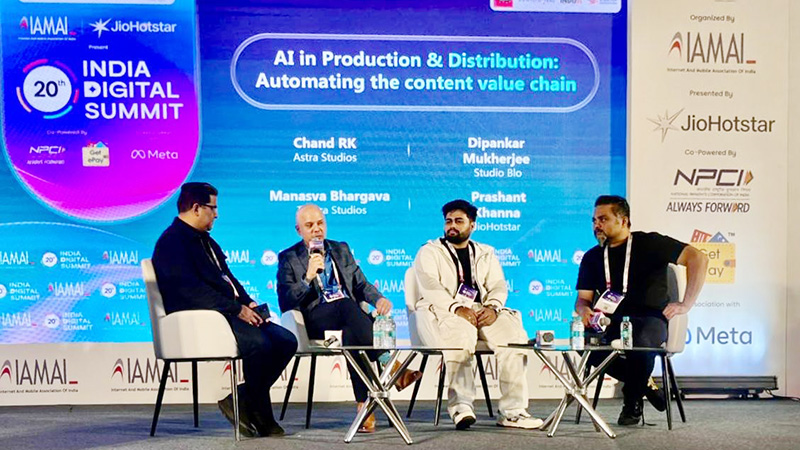
BENGALURU: Artificial intelligence is rapidly becoming the operating backbone of the media industry, transforming everything from content creation to distribution, said JioStar head – sports and live experiences, production technology and services Prashant Khanna, at the India Digital Summit 2026.
Speaking at a panel on automating the content value chain organised by IAMAI, Khanna said AI was no longer a peripheral tool but a core layer enabling scale, precision and personalisation across media workflows.
Live sports, he noted, requires unparalleled accuracy, with tens of millions of viewers watching in real time. AI-driven systems are now helping production teams move from reactive execution to predictive storytelling, using data, context and historical patterns to anticipate visuals, graphics and narrative elements before they are needed.
This shift, Khanna said, allows creative professionals to focus more on storytelling while automation handles manual processes.
Beyond production, AI is reshaping distribution by enabling the same live content to be delivered across multiple formats, from vertical video and short highlights to extended recaps and full-length broadcasts, tailored to different viewing preferences.
According to Khanna, seamless automation across the value chain is increasingly central to acquiring viewers and deepening engagement. He added that AI is also democratising premium production experiences, making features such as high-quality language commentary, advanced camera work, auto-framing and real-time adaptation accessible at scale.
Addressing the rise of AI-generated content, Khanna said technology lowers barriers to entry but does not replace the need for strong storytelling. Its true power lies in expanding creative possibilities rather than substituting narrative craft.
Looking ahead, he predicted a more immersive and interactive future for live entertainment, driven by virtual reality, second-screen experiences and personalised data layers, allowing fans to curate their own viewing experiences.
In Khanna’s view, AI’s true impact on media will be measured not by novelty, but by how seamlessly it integrates creativity, certainty and scale, turning the entire content lifecycle into a more intelligent, responsive and inclusive system.
MUMBAI: We’ve all been sold the same sci-fi fever dream for decades: the invisible digital butler. The Jarvis to our Tony Stark, if you may. An intelligence that doesn’t wait for a prompt but simply exists in the periphery, whispering the right answer before you’ve even finished forming the question.
Recent moves from the tech giants suggest we’re finally crossing the threshold into “personal intelligence,” a system that pulls context across your entire digital life. We have, thankfully, graduated from the “goldfish amnesia” phase of early LLMs. Context windows and memory features have given AI a decent short-term recall, but we are still languishing in the uncanny valley of partial context. You’ve likely had that moment where you stare at a generated response and wonder, “What on earth made you think that was what I wanted?” Custom instructions and pinned memories can only do so much heavy lifting when the AI is still looking at your life through a keyhole.
But as AI moves from a tool we “talk to” to a system that essentially lives in our OS, the industry is obsessed with the wrong metric. We’re still counting parameters and bragging about reasoning capabilities. The real breakthrough isn’t going to be how much the AI knows; it’s going to be how much it chooses to ignore.
From “Helpful” to “Opinionated”
When AI starts linking context across your life, it ceases to be a neutral tool and starts becoming an opinionated system. This is where the “intelligence” narrative gets spicy. At their core, Large Language Models still function as high-speed autocomplete. They predict the next word in a sequence based on a generic world-view, and that isn’t fundamentally changing. What is changing is the rise of agentic AI. Agents sit around the model, interacting with tools, data, and the environment to observe context, react to signals, and take action. Personal intelligence, then, becomes about how those predictions get applied to your specific history.
If these agents know your budget, your health goals, and your calendar, and you ask for a dinner recommendation, does it give you what you want or what it thinks you need? Imagine a scenario where you’ve had a brutal day at work, and you just want a greasy burger. However, your AI “sees” your high cortisol levels and the fact that you’ve missed your last three gym sessions. Does it “helpfully” bury the burger joint in the search results and prioritize a salad bar instead?
At what point does “helpful context” become a digital nanny? This isn’t just a UI challenge; it’s a fundamental shift in the power dynamic between human and machine. As these systems grow more proactive, governance can’t just be about data privacy, it has to be about agency. We need to ensure that as AI gets better at recognizing our needs, it doesn’t start dictating them to us. A system that “knows best” is only one bad update away from becoming a system that “knows better than you.” If an AI becomes too opinionated, it doesn’t solve friction; it creates a new kind of psychological tax where the user feels they have to “fight” their assistant to get what they actually want.
Designing the Invisible (and Avoiding the Creepy)
There is a razor-thin line between an AI that feels like a superpower and one that feels like a digital stalker. The tech industry has a pathological need to show its work. Usually, when a system gains a new capability, the marketing instinct is to broadcast it. But in the world of personal intelligence, this “Are you proud of me?” approach to software engineering is a fast track to the uncanny valley.
The goal for personal intelligence should be to become digital wallpaper essential, but unnoticed. The moment an AI “interrupts” to show off how much it knows about you, it has failed. To make AI feel invisible rather than invasive, we have to master the art of the “nudge.” This requires a deep understanding of human psychology, and by extension the art of shutting up.
The Ultimate Advantage: Strategic Restraint
The “hero narrative” of AI has always been about more: more data, more speed, more answers. But as we move into the era of personal intelligence, the ultimate competitive advantage is going to be restraint. This is a concept we rarely talk about in Silicon Valley, where “growth” and “engagement” are the primary gods. However, for a system to be truly personal, it must respect the sanctity of the user’s focus.
In the real world, the smartest person in the room is rarely the loudest; it’s the one who knows exactly when to chime in and when to stay silent. The same applies to our silicon counterparts. The engineering challenge is no longer just about building a model that can pass the Bar Exam or write a sonnet in the voice of a 17th-century pirate. The real challenge is building a model that has access to your deepest digital secrets and has the “wisdom” to do absolutely nothing with them until the exact moment it actually matters.
This brings us to the core question: Is the next AI advantage about intelligence, or about knowing when not to act on personal data?
If a company can prove that their AI has the discipline to stay in the background, they will win the one thing that is currently in shortest supply: trust. We are reaching “intelligence saturation.” Every major player has a model that is “smart.” What they don’t all have is a philosophy of silence. Knowing when not to act is the highest form of intelligence because it requires a level of contextual nuance that goes beyond pattern matching. It requires an understanding of human boundaries.
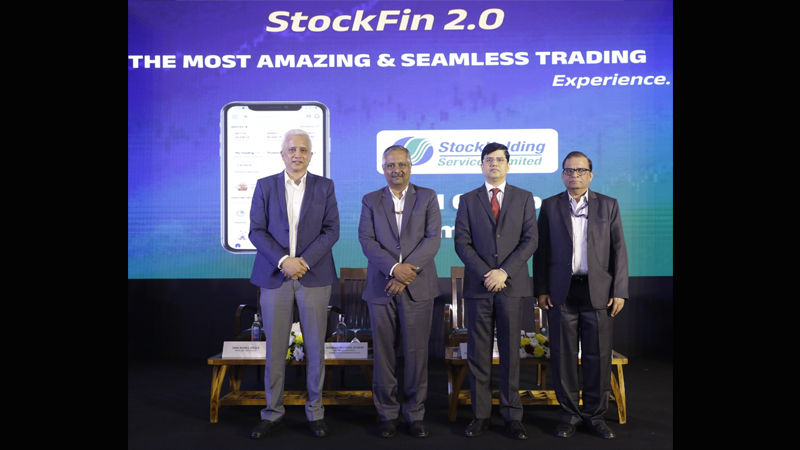
MUMBAI: When investing meets a software refresh, ease is the real upgrade. Stockholding Services Limited has rolled out Stockfin 2.0 nationwide, positioning the revamped investing app as a one-stop, mobile-first platform aimed at widening retail participation across India.
Designed to work as smoothly in metro markets as in fast-growing tier II and tier III cities, Stockfin 2.0 reflects the changing profile of India’s investors. Built on a future-ready architecture, the app features upgraded performance, a refreshed interface and a simplified structure intended to make market participation less intimidating and more intuitive.
The platform brings together equities, derivatives, stock SIPs, mutual funds, ETFs, SME stocks and IPOs within a single interface. Product-wise grouping allows users to navigate quickly, while a clean dashboard offers real-time snapshots of market indices, portfolio value, top gainers and losers, and profit and loss positions.
For investors seeking deeper insight, Stockfin 2.0 includes screeners, technical indicators, research calls and detailed reports. Short-term traders are catered to with a dedicated ‘Buy Today, Sell Tomorrow’ section, while goal-based mutual fund flows aim to simplify long-term financial planning.
The app also focuses on execution and security. Best price routing directs trades to the exchange offering the most competitive price, while MPIN, biometric login and OTP-based verification reinforce account safety. Personalisation options, including themes, font sizes and saved order settings, add flexibility to the user experience.
Speaking at the launch, officials highlighted the role of technology-led platforms in expanding financial inclusion and supporting India’s broader digital and self-reliance goals. Company leadership described Stockfin 2.0 as more than a cosmetic upgrade, positioning it as a step towards making investing more accessible, informed and dependable for retail participants nationwide.
Backed by StockHolding’s long-standing presence in financial services, the new app is aimed at investors who want real-time insights, secure access and the ability to manage multiple asset classes on the move, all without losing clarity in a fast-moving market.

Netflix celebrates a decade in India with Shah Rukh Khan-narrated tribute film

Delhivery chairman Deepak Kapoor, independent director Saugata Gupta quit board

Meta appoints Anuvrat Rao as APAC head of commerce partnerships

Brnd.me enters Europe as haircare brands power global expansion

TechnoSport taps quick commerce with launch on Slikk’s 60-minute platform

Jitendra Singh joins Reliance Industries as senior vice president, special projects

Tinder brings real-world dating experiences to North East India

These ’90s fashion trends are making a comeback in 2017
The final 6 ‘Game of Thrones’ episodes might feel like a full season
According to Dior Couture, this taboo fashion accessory is back
The old and New Edition cast comes together to perform
Phillies’ Aaron Altherr makes mind-boggling barehanded play
Uber and Lyft are finally available in all of New York State
Disney’s live-action Aladdin finally finds its stars
Netflix celebrates a decade in India with Shah Rukh Khan-narrated tribute film
Delhivery chairman Deepak Kapoor, independent director Saugata Gupta quit board
Meta appoints Anuvrat Rao as APAC head of commerce partnerships
Brnd.me enters Europe as haircare brands power global expansion
TechnoSport taps quick commerce with launch on Slikk’s 60-minute platform
Jitendra Singh joins Reliance Industries as senior vice president, special projects
Tinder brings real-world dating experiences to North East India
-
 iWorld3 months ago
Tips Music turns up the heat with Tamil party anthem Mayangiren
-
 iWorld12 months ago
BSNL rings in a revival with Rs 4,969 crore revenue
-
 I&B Ministry3 months ago
India steps up fight against digital piracy
-
 MAM3 months ago
HoABL soars high with dazzling Nagpur sebut
-

 News Headline4 weeks ago
Preeti Sahni set to join TV9 Network in senior leadership role
-

 GECs4 weeks ago
Brick by Brick Zee TV Builds a Family Saga With Lakshmi Niwas
-

 iWorld2 weeks ago
Jio shifts gears as 5G, homes and AI deals drive quarter momentum
-

 News Broadcasting5 days ago
Palki Sharma leaves Firstpost: Reports