
News Broadcasting
Election trail proves an ‘SMSing’ success

“This is Atal Bihari Vajpayee. Five years ago you gave me a chance to serve you. In these years, our country has come a long way… But there are still a lot of things to do. A new age has to be found in India – an age where there is no poverty, no unemployment… Let‘s get together and realise our dreams.”
That was the prime minister‘s speech, not spoken on a podium in front of a crowd… but into the ears of many a mobile phone subscriber.
 |
A lot of brouhaha has already been created around the kind of monies that the Bharatiya Janta Party (BJP) has been spending on this political ad campaign. Innovation is the buzz word here and politicians are clear about their agenda – to get maximum eyeballs, or in this case, votes!
What it does bring out load and clear is just how ubiquitous the mobile has become as an effective tool to get the message across. And while it was the direct call that was used to get the prime Minister‘s message across the communications tool of choice for most marketers when we talk mobile is the short message service (SMS) technology. Contests, downloads, information, trivia… all at the press of a button. Mobile phones are becoming ever more pervasive as technology gets cheaper by the day!
And there is plenty of that going around as regards the upcoming general elections. Politicians and various news channels alike are using SMS to seek and influence viewers‘ opinions.
 |
|
Reliance‘s Mukesh Ambani‘s mobile agenda
|
Among the political parties, the BJP has left its rivals way, way behind in terns of techno-savvy media management. The BJP‘s e-campaign has stormed into millions of Indian homes using the country‘s vast telecom network, e-mail, mobile phones and even spots on popular TV channels. BJP call centers have been set up and details collected of the 72 million phone connections in the country (46 million fixed lines and 26 million mobile phones). The party has been using the Reliance and BPL subscriber base to play a message by the PM seeking votes over the phone. The e-campaign also would allow voters with mobile phones to download ring tones of BJP‘s anthem and photographs of Vajpayee.
 |
| Atal Bihari Vajpayee‘s Bharat Uday (India Shining) Yatra |
While Reliance‘s database is being used by BJP to send out messages from the PM, Reliance officials were apprehensive to talk about a “sensitive issue like this” and refrained from offering a viewpoint when contacted by indiantelevision.com. Recently a PIL was filed against the Ambanis‘ owned company on the grounds that using a personal and private facility as public media by a political party was equal to unwanted infringement on the privacy of their communication apparatus. A visibly disgruntled Reliance subscriber Anand Jaisingh said, “I have been getting five calls a day since the last three days with Vajpayee‘s messages on my Reliance phone. It‘s ok once or twice but five to six calls in a day is atrocious and it‘s quite irritating listening to the PM‘s long message.” These calls can be traced to a Delhi based landline number and are likely to be coming from the BJP call centers.
The Congress on the other hand, has identified 48 media centers, both urban and rural, from where viewpoints on radio, television, print, Internet and other media would be disseminated. SMS and telephone calls would also play an important role, where the Congress would use a variety of leaders including some from the senior team like Manmohan Singh and Pranab Mukherjea. But unlike the BJP, the Congress would be using this medium respecting the privacy of an individual.

 |
|
Say Tata to politics
|
Tata Teleservices however, has refrained from sending out SMS messages on behalf of any political party. The company‘s president Amit Bose said, “However, we believe that our customers have the right to information and during the elections we will facilitate election related queries through SMS service. The regular rate of two rupees per SMS for information will apply.”
Hutchison Telecom‘s vice president – corporate marketing Harit Nagpal takes a far stronger stand on the matter. “We believe that unsolicited communication including SMS invade the privacy of our users and is tantamount to spamming. We do not have tie-ups with any corporate or political bodies for sending bulk messages to our subscribers and do not intend to do so for any consideration,” Nagpal states.
The PM‘s phone calls have also been doing their rounds on the BPL Mobile subscribers base. The calls like in the case of Reliance have been coming from a Delhi landline number. BPL Mobile officials too, refused comment on record. While the telecom companies may not be directly involved in doing PR for the PM, nevertheless their services are being used and the BJP‘s purpose is being served.
To sum it up, political telemarketing with maximum use of technology and minimum manpower has been at its peak in elections 2004.
News channels onto SMSing in a big way
News channels are also using the SMS service to keep viewers abreast with the latest happenings. Almost all news channels – NDTV, Star News, Aaj Tak, Sahara and Zee News are using the interactive medium for various polls, contests, trivia et al. NDTV has a wireless service – SMS 6388, on its website and a whole range of activities are being planned on that for the elections informs NDTV Media chief executive Raj Nayak. “The idea is to provide the user easy access to the latest results, news and other relevant information and what better way of doing it than receiving it as an SMS from a television channel like NDTV, reputed for its in depth election coverage,” says Nayak.
 |
|
NDTV on an SMS spree with 6388
|
NDTV uses Lifetree ASP (Application Service Provider) to run the SMS service and the responses to these activities have been phenomenal, Nayak says. “There has been an amazing interest that mobile phone users have shown in all the interactive services offered on 6388. Be it sending feedback on our channels or accessing the latest scores or news on 6388.” The idea behind SMS service is to provide instant access to the latest news. With NDTV‘s tie-ups with all the telecom operators, this unobtrusive news-on-demand service can be accessed at any point of time from anywhere in the country. So as people get more and more techno savvy, a whole lot of activities can be expected from telecom companies, general entertainment and news channels alike.
 |
|
Zee News: What‘s your political agenda?
|
Zee News is keeping its SMS plans for the polls under wraps for the present. “For the elections, we haven‘t come out with anything definitive till now. Though an initiative is in the offing, we cannot talk about it at present,” said Zee News editor Alka Saxena.
 |
| SMS savvy Star News |
Star News also has a SMS service Star 7827 wherein a comprehensive SMS contest, logo and ringtones downloads, trivia, poll etc is already being done through its website for the Indo-Pak ODIs. As far as the elections are concerned Star News‘ brand manager Keertan Adyanthaya said, “We are planning a series of polls using the medium of SMS on Star News during the elections. We used SMS polls during the State Elections in November. The polls will focus on current topics and will give people an opportunity to let their opinion be heard instantly.” The recent cricket contest which got approximately 30,000 responses has led Star News to come back with similar activity for the General Elections.
Says Adyanthaya, “We are expecting a whole lot of excitement around the elections and have a wide range of programming which is centered around our property – Kaun Banega Pradhan Mantri. The SMS polls will be used largely to support the same.”
 |
| SMS… easy access to news, anywhere, anytime |
For many news channels (unlike Dr Prannoy Roy‘s NDTV) this will be the first time they will be covering the general elections and no doubt it will be the most important event of this year, both in terms of their individual futures as well as getting increased viewer interest in their channels.
Says TV Today Network manager (marketing) Rajesh Sheshadri, “In light of the elections, we have planned a series of programs and segments for capturing the elections in their entirety. Most of the offerings will provide viewers with the opportunity to participate and opinionate on the elections. Some of this may be in the form of contests while others may involve eliciting viewer opinions, feedback and comments as part the content.”
For the India – Pak ODIs, Aaj Tak and Coca Cola had partnered to set up a prediction-based contest wherein viewers had to predict results or match related outcomes. Winners of the contest received prizes sponsored by Coca- Cola. Other notable tie ups that the channel has done are the ones with Electrolux for the ICC World Cup and Reebok for Sachin Tendulkar‘s birthday. “These contests have elicited tremendous a response from viewers. The World Cup contest alone saw more than a million responses within a month. A testimony to the success and popularity of contests as a whole are the nearly 10 million responses we have received from our viewers within a short period of 10 to 11 months. For the elections, there are various paid brand sponsorships of election programming. Apart from that, we may have other forms of marketing tie-ups and these discussions are still on in this regard,” says Sheshadri.
Mobile users across the country can also express their opinion on various critical issues affecting the country as well as access news on the go by sending an SMS to Aaj Tak on 2424 from their mobile phones. Also Airtel subscribers nationally can receive Aaj Tak news alerts on payment of a nominal fee of Rs 30 a month. Reliance subscribers, meanwhile, can view live Aaj Tak news on their handsets. The charges are as per the rates levied by the various mobile service providers and no extra charges levied on these SMSes. Its technology at its best!
The moot objective of all news channels seems to be to move from a unilateral dissemination of news to a more interactive format that allows viewers to be more involved thereby participating in the entire process as opposed to being mere spectators.
“The rapid growth in the telecom industry has tremendously increased the base of mobile users in the country, and it is no longer an elitist gadget as it used to be a couple of years back. The current mobile users base in the country is 31.4 million and the same is growing at an extremely fast pace and our aim is to target this base through our initiative,” says Sheshadri.
 |
In the news channels‘ race the four channels of the Sahara Parivar are definitely not left behind. Sahara Samay Rashtriya‘s Arup Ghosh said that the issue polls prepared by DRS Polls are already on air and the prediction polls will start on the channel from 10 April, opinion polls on Muslim factor and daily polls from 15 April and Sahara will wind up with the Exit Poll on the day of counting.
The SMS services technology is being outsourced by Sahara Samay Rashtriya. Said Ghosh, “It is not only an SMS service alone. Our polls are different as our own people along with DRS people will be going out and getting the answers.”
Sahara Samay‘s (regional) head Prabhat Dabral said, “We have a contest in which we ask viewers to respond to questions related to the elections. The first correct answer gets a cash prize.”
SMS is only one of the various media (and a cost effective one too) that is being used by news channels to stay connected to their viewers. More often than not, the only cost that a channel has to incur is to create the contest and put it on air. With the penetration and growth rate of wireless telephony far outstripping that of any other form of communication, a lot of synergy between this medium of communication and news channels can be expected in the near future.
 |
|
SMS news for people on the move
|
As far as the target group for SMS related activities such as NDTV‘s 6388, Aaj Tak‘s 2424 and Star News‘ 7827 are concerned; by virtue of the medium being used to send out information or interact; it is for people who are on the move and want instant access to updates, be it cricket scores, stocks or election updates. With mobiles no longer remaining a luxury item, SMS related activities are a part of the regular mobile subscriber‘s life.
Mobile technology has completely revolutionised how information is accessed, handled and viewed in our society. At some level, the quantum and quality of impact of this technology on the world, is as fundamental as the coming of the Internet. The time is not far when the mobile will be a one stop medium that will give people access to everything that they want. “Mobile penetration (CDMA and GSM) is growing too and soon will overtake fixed line connections and with the adoption of a single telecom license for all services, India has anyhow cleared the last major hurdle holding back growth in the telecom sector. So the sky is the limit,” said Nayak.












KERALA: A forensic audit commissioned by the Broadcast Audience Research Council (BARC) India has emerged as the centrepiece of the government’s response to fresh allegations of television rating point manipulation involving a regional news channel in Kerala, with both the audit findings and a parallel police investigation still awaited.
Replying to a query in the Lok Sabha, minister of state for information and broadcasting L Murugan, said Barc had appointed an independent agency to conduct a forensic probe into the conduct of senior personnel allegedly linked to the case.
The move followed media reports claiming that a Barc employee had accepted bribes to manipulate viewership data in favour of a regional television news channel.
“The report from BARC is still awaited,” Murugan told Parliament, signalling that the forensic exercise remains ongoing.
Industry specialists say forensic audits are crucial in alleged TRP fraud cases, as they examine internal controls, data access trails, panel household integrity, staff communications and financial transactions. The outcome could determine whether the alleged manipulation was an isolated breach or a deeper systemic weakness in India’s television measurement framework.
Running alongside the audit, the Kerala Police has formed a special investigation team to probe the allegations. The ministry has sought a preliminary report from the state’s director general of police, including details of action taken on the first information report. That report, too, is yet to be submitted.
The episode has revived long-standing concerns over the vulnerability of India’s TRP system, particularly in regional news markets where competition for ratings is fierce and advertising revenues hinge on weekly viewership rankings.
India’s sole television audience measurement body Barc, has faced scrutiny before, most notably during the nationwide TRP controversy involving news channels in 2020. While tighter compliance norms were introduced in the aftermath, the latest allegations suggest enforcement challenges may persist.
On regulatory consequences, the government said any punitive action against television channels, including suspension or cancellation of uplinking and downlinking permissions, would be governed by the Policy Guidelines for Uplinking and Downlinking of Television Channels issued in November 2022, and would depend on investigation outcomes and due process.
The ministry also pointed to ongoing efforts to overhaul the ratings ecosystem. Television measurement continues to be regulated under the Policy Guidelines for Television Rating Agencies, 2014. Draft amendments were released for public consultation in July 2025, followed by a revised version in November 2025, aimed at tightening audit mechanisms and improving transparency and representativeness.
In November 2025, Barc said it had taken note of allegations aired by Malayalam news channel Twenty-Four, which linked an internal employee to irregularities in audience measurement. The council said it had engaged a “reputed independent agency” to conduct a comprehensive forensic audit, underscoring the seriousness of the claims.
The ratings system sits at the heart of India’s broadcast advertising economy, shaping billions of rupees in annual ad spends. With trust in audience data once again under strain, advertisers, broadcasters and regulators are closely watching the outcome of the investigations.
Barc has urged industry stakeholders and media organisations to exercise restraint while the probe is underway, calling for an end to “unverified or speculatory claims” and reiterating its commitment to integrity and accountability.
Until the forensic audit and police findings are submitted and reviewed, the government said it would refrain from drawing conclusions.
News Broadcasting
Rajat Sharma defamation row: Delhi court summons Congress leaders Ragini Nayak, Pawan Khera and Jairam Ramesh
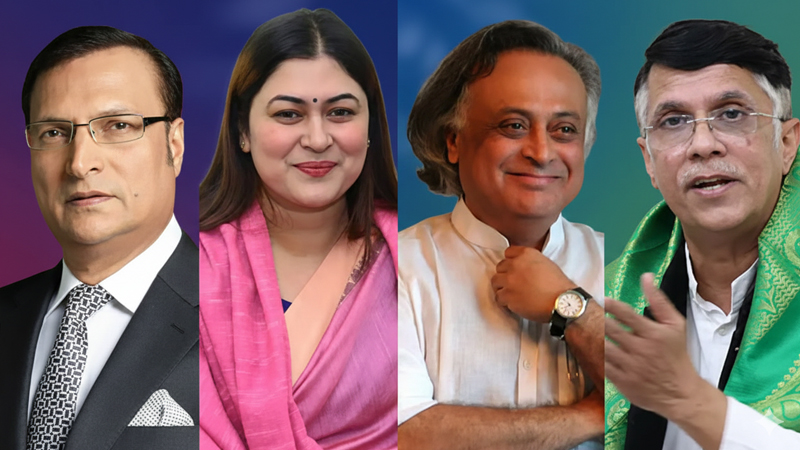
NEW DELHI: A Delhi court has ordered the summoning of senior Congress leaders Ragini Nayak, Pawan Khera and Jairam Ramesh in a criminal case filed by veteran journalist Rajat Sharma, sharpening a legal battle over alleged defamation and doctored digital content.
The order was passed on Monday by Devanshi Janmeja, judicial magistrate first class at Saket Courts, after the court found prima facie grounds to proceed under multiple sections of the Indian Penal Code, including forgery, creation of false electronic records and defamation.
Sharma, chairman and editor-in-chief of India TV, had approached the court over allegations made in June 2024 that he had used derogatory language against Congress spokesperson Ragini Nayak during a live television debate. He denied the charge, claiming it was fuelled by a manipulated video circulated online.
According to the complaint, a clipped version of the broadcast carrying superimposed captions, which were not part of the original programme, was first shared on social media platform X by Nayak and later amplified through retweets and public statements by Khera and Ramesh. Sharma said the viral spread caused serious reputational harm and personal distress.
The court took note of forensic science laboratory findings that pointed to visible post-production alterations in the video, including added titles and captions. It also cited witness testimonies from those present during the live broadcast, who stated that no abusive or objectionable language had been used.
In a related civil matter, the Delhi High Court had earlier observed a prima facie absence of abusive remarks and directed the removal of the disputed social media posts.
With criminal proceedings now set in motion, the case adds to mounting scrutiny around political messaging, digital manipulation and accountability on social media platforms.
News Broadcasting
Mukesh Ambani, Larry Fink come together for CNBC-TV18 exclusive
Reliance and BlackRock chiefs map the future of investing as global capital eyes India

MUMBAI: India’s capital story takes centre stage today as Mukesh Ambani and Larry Fink sit down for a rare joint television conversation, bringing together two of the most powerful voices in global business at a moment of economic churn and opportunity.
The Reliance Industries chief and the BlackRock boss will speak with Shereen Bhan, managing editor of CNBC-TV18, in an exclusive interaction airing from 3:00 pm on February 4. The timing is deliberate. Geopolitics are tense, technology is disruptive and capital is choosier. India, meanwhile, is pitching itself as a long-term bet.
The pairing is symbolic. Reliance straddles energy transition, digital infrastructure and consumer growth in the world’s fastest-expanding major economy. BlackRock, the world’s largest asset manager, oversees more than $14 tn in assets and sits at the nerve centre of global capital flows. When the two talk, markets tend to listen.
Fink’s appearance marks his third India visit, a signal of the country’s rising strategic weight for the Wall Street-listed firm, which carries a market value above $177 bn. His earlier 2023 trips included an October stop in New Delhi, where he met both Ambani and Narendra Modi.
India is now central to BlackRock’s expansion plans, notably through its joint venture with Jio Financial Services. Announced in July 2023, the 50:50 venture, JioBlackRock, commits up to $150 mn each from the partners to build a digital-first asset-management platform aimed at India’s swelling investor class.
The backdrop is robust. BlackRock ended 2025 with record assets under management of $14.04 tn, helped by $698 bn in net inflows, including $342 bn in the fourth quarter alone. Scale gives Fink both heft and a long lens on where money is moving.
He has been openly bullish on India. At the Saudi-US Investment Summit in Riyadh last year, Fink argued that the “fog of global uncertainty is lifting”, with capital returning to dynamic markets such as India, drawn by reforms, demographics and durable return potential.
Expect the conversation to range beyond balance sheets, into technology’s role in finance, access to capital and the mechanics of sustainable growth in a fracturing world order. For investors and policymakers alike, it is a snapshot of how big money is thinking about India.
At a time when capital is cautious and growth is contested, India wants to be the exception. When Ambani and Fink share a stage, it is less a chat and more a signal. The world’s money is still looking for its next big story, and India intends to be it.



MIB sets OTT accessibility rules, mandates captions and audio description

Boney Kapoor acquires remake rights of Tamil political satire Thalaivar Thambi Thalaimaiyil

Netflix India names Rekha Rane director of films and series marketing

Zabeen signs off from TV9 after shaping the network’s public voice

Dhawan steps up to bat for Delhi’s grassroots sports push

Orient Beverages pops the fizz with steady Q3 gains and rising profits

Cheekatilo shines in the dark with record debut on Prime Video

Swiggy Instamart’s GOV surges 103 per cent year on year to Rs 7,938 crore

These ’90s fashion trends are making a comeback in 2017
The final 6 ‘Game of Thrones’ episodes might feel like a full season
According to Dior Couture, this taboo fashion accessory is back

ATN International brings ATN Bangla to Canada
The old and New Edition cast comes together to perform
Phillies’ Aaron Altherr makes mind-boggling barehanded play
MIB sets OTT accessibility rules, mandates captions and audio description
Boney Kapoor acquires remake rights of Tamil political satire Thalaivar Thambi Thalaimaiyil
Netflix India names Rekha Rane director of films and series marketing
Zabeen signs off from TV9 after shaping the network’s public voice
Dhawan steps up to bat for Delhi’s grassroots sports push
Orient Beverages pops the fizz with steady Q3 gains and rising profits
Cheekatilo shines in the dark with record debut on Prime Video
-
 e-commerce1 month ago
Swiggy Instamart’s GOV surges 103 per cent year on year to Rs 7,938 crore
-
 iWorld1 year ago
Kuku TV transforms India’s OTT space with vertical microdrama boom
-
 News Headline1 year ago
TRAI puts a ‘stop’ to unsolicited calls and messages
-

 News Headline2 months ago
From selfies to big bucks, India’s influencer economy explodes in 2025
-
 Comedy2 years ago
Taarak Mehta Ka Ooltah Chashmah celebrates 4,000 episodes
-
 MAM2 years ago
OpenAI joins C2PA steering committee
-
 News Headline2 years ago
Odisha to host Ultimate Kho Kho Season 2 from December 24
-
 News Headline1 year ago
Abhishek Bachchan joins as co-owner of European T20 Premier League


