
eNews
‘Tryst with Ayodhya: Decolonisation of India’

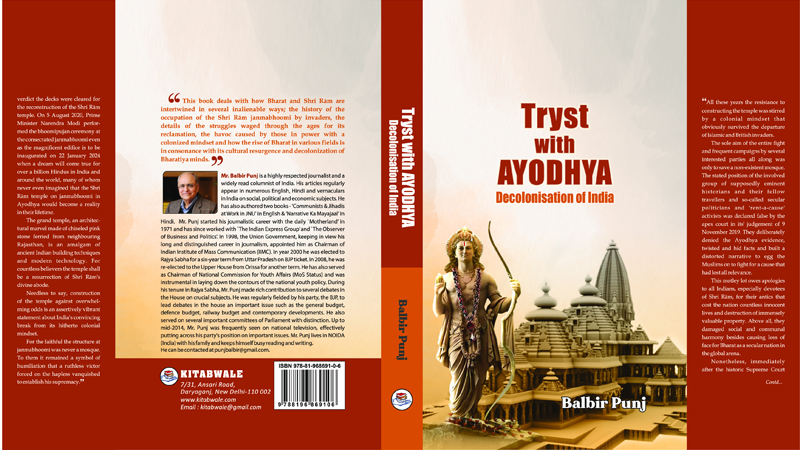
Mumbai: ‘Tryst with Ayodhya: Decolonisation of India’ by Balbir Punj is slated for release on 13 January 2024, at 2.30 pm onwards in Multipurpose Hall, Indoor Stadium, Delhi University, New Delhi. This book deals with how Bharat and Shri Rām are intertwined in several inalienable ways; the history of the occupation of the Shri Rām Janmabhoomi by invaders, the details of the struggles waged through the ages for its reclamation, the havoc caused by those in power with a colonized mindset and how the rise of Bharat in various fields is in consonance with its cultural resurgence and decolonization of Bharatiya minds.
This book emphasises that the resistance to the construction of the temple was stirred by a colonial mindset that obviously survived the departure of Islamic and British invaders. The sole aim of the entire fight and frequent campaigns by several interested parties all along was to save the structure that had ceased to be a mosque long back and somehow prevent the construction of the temple at the Janmabhoomi site in Ayodhya. The stated position of the involved group of supposedly ‘eminent historians’ and their fellow travellers and so-called secular politicians and ‘rent-a-cause’ activists were declared false by the apex court in its judgement of 9 November 2019. They deliberately denied the Ayodhya evidence, twisted and hid facts and built a distorted narrative to egg the Muslims on to fight for a cause that had lost all relevance.
This mischievous lot owes apologies to all Indians, especially devotees of Shri Rām, for their antics that cost the nation countless innocent lives and destruction of immensely valuable property. Above all, they damaged social and communal harmony besides causing loss of face for Bharat as a secular nation in the global arena. It’s noteworthy that the judgment delivered by the five-member Supreme Court bench was unanimous.
With the inauguration of the Shri Ram Temple slated for 22 January 2024, a dream will come true for over a billion Hindus in India and around the world, many of whom never even imagined that the Shri Rām temple on Janmabhoomi in Ayodhya would become a reality in their lifetime. The grand temple, an architectural marvel made of chiseled pink stone ferried from neighbouring Rajasthan, is an amalgam of ancient Indian building techniques and modern technology. For countless believers the temple shall be a resurrection of Shri Rām’s divine abode.
Needless to say, construction of the temple against overwhelming odds is an assertively vibrant statement about India’s convincing break from its hitherto colonial mindset. Several aspects of Ayodhya and the Shri Rām Janmabhoomi temple have been commented upon and debated over the past few decades, in particular post 1984. Many questions, some of them puerile, have been raised to confound the issue. Did Shri Rām really exist? What is the proof that He was born in Ayodhya? What is the evidence that the very spot of His birth is the Janmabhoomi? Is His story chronicled in the Rāmāyan merely a figment of imagination? Why does one need a temple when Shri Rām is omnipresent? Why not build a hospital or public toilets at that site since the country needs these more than another Shri Rām temple?

Most of these questions are neither innocent nor genuine but reek of mischief. Shri Rām’s antiquity is proven by itihās, as history is termed in Indian wisdom. The Rāmāyan, along with the Mahābhārat and Purāns, is a part of itihās. The issues that Janmabhoomi is the birthplace of Shri Rām and that He is the seventh incarnation or avatar of Bhagwān Vishnu are matters of faith supported by tradition and numerous historical accounts going back several millennia. All religions in the world are invariably sustained by faith as are most of their special religious places which draw legitimacy from parables and fables their followers believe.
The book claims that demolition of Babri structure on 6 December, 1992 was a Gandhian solution to the problem. Considered a moral compass of the world, Gandhiji was asked how to deal with a situation when a mosque is forcibly built on someone else’s land. He dealt with the vexed issue in ‘Young India’ on 5 February 1925. Here are excerpts,
“…The question of mosques built on another’s land without his permission is incredibly simple. If A is in possession of his land and someone comes to build some things on it, be it even a mosque. A has the right at the first opportunity of pulling down the structure. Any building of the shape of a mosque is not a mosque. A building to be a mosque must be duly consecrated. A building put up on another’s land without his permission is a pure robbery. Robbery cannot be consecrated. If A has not the will or the capacity to destroy the building miscalled mosque, he has the right of going to a law court to have the building pulled down… So long as I own property, I must defend it whether by the force of law-courts or by the force of my own strong arms… “
The author asserts that the Shri Ram Janmabhoomi would have been resolved immediately after the independence but for the colonial attitude of Pandit Jawahar Lal Nehru. The author accuses Nehru nursing of hate against Hindu religion and its traditions. According to author’s assessment, Nehru was highly influenced by Marxism; and his outlook towards India and Hindus was shaped by the alien education system introduced by TB Macaulay.
The book alleges Nehru did a volte-face on the Somnath temple issue, and had an opportunistic streak. At Sardar Patel’s instance, a cabinet meeting in December 1947, presided by Nehru had decided not only to rebuild the Somnath Temple, but also finance its reconstruction. However, at Gandhiji’s instance, it was later decided that instead of Government funding Somnath construction, it should be rebuilt with donations from public. Accordingly, a Trust headed by Dr. K. M Munshi, a cabinet minister, was formed to oversee the temple construction.
Gandhiji was assassinated on 30 January 1948 and on 15 December 1950 Sardar Patel breathed his last. After the demise of two stalwarts— Gandhiji and Sardar Patel, the Book alleges that Nehru’s attitude towards the Somnath temple project changed completely. After a Cabinet meeting in early 1951, Pandit Nehru called Dr. Munshi, and told him, “I do not like you trying to restore Somnath. It is Hindu revivalism.” After the Somnath temple was completed, Dr Rajinder Prasad, the then President of India, was requested to inaugurate it. When, President Prasad agreed to inaugurate the temple, Nehru asked him not to do so. The irony is, the President was merely respecting a decision that the Nehru cabinet had taken earlier. In a parliamentary democracy, the president is expected to go by the Cabinet decision. And the President was following that convention. The Prime Minister and the President had a stand-off on the issue because Nehru had conveniently changed his mind on the issue.
The book asserts, Pandit Nehru’s antipathy was not limited to Somnath or the Shri Rām temple in Ayodhya; it extended to all Hindu temples as such. Delivering his inaugural address at a seminar on architecture in Delhi in 1959, Nehru said:
“Some of the temples of the South, however, repel me in spite of their beauty. I just can’t stand them. Why? I do not know. I cannot explain that, but they are oppressive, they suppress my spirit. They do not allow me to rise, they keep me down…
…The dark corridors — I like the sun and air and not dark corridors”.
In contrast, he found Taj Mahal ‘astoundingly beautiful’, saying,
“The Taj Mahal is, of course, one of the most beautiful things anywhere and it is a delight to the eye and to the spirit to see it. It represented, as all architecture represents to a large extent, the age in which it grew. You cannot isolate architecture from the age, from the social conditions, from the thinking, from the objectives and ideals of that particular age…”
This book claims that Nehru was essentially a choice of the British who saw in him a successor who could effortlessly step into their shoes and carry on with the colonial system established by their empire. Based on sources, Author reveals that on 2 September 1946, Nehru took the following oath affirming his allegiance to the British Empire,
FORM OF AFFIRMATION OF ALLEGIANCE
I, Jawaharlal Nehru, do solemnly affirm that I will be faithful and bear true allegiance to His Majesty, KING GEORGE THE SIXTH, Emperor of India, His Heirs, and Successors, according to law.
FORM OF AFFIRMATION OF OFFICE
I, Jawaharlal Nehru, do solemnly affirm that I will well and truly serve our Sovereign, KING GEORGE THE SIXTH, Emperor of India, in the Office of Member of the Governor General’s Executive Council, and that I will do right to all manner of people after the laws and usages of India without fear or favour, affection or ill-will.”
The book which runs into 436 pages with over 1.28 lakh words, 12 annexures and about 500 references, claims that Shri Ram Janmabhoomi had ceased to be Hindu-Muslim issue post-Independence. Quoting relevant sources, the author asserts that there was near unanimity in Ayodhya over the issue of building a temple at the Ram Janmabhoomi site, following the mysterious appearance of idols in the intervening night of December 22 and 23, 1949. All kinds of differences, be they social, political, class and caste were subsumed by the shared adoration and love for Rām Lallā and strong faith that this very piece of land was undoubtedly His Janmabhoomi. Everyone in the temple town and in Lucknow seemed at peace with the new emerging reality.
For the believers the emergence of Rām Lallā was a divine phenomenon. A surprise statement by Abdul Barkat, a Muslim police constable on duty at the Police outpost at Rām Janmabhoomi on the night between 22 and 23 December 1949, made before a magistrate later further strengthened the devotees’ belief of the divinity of the episode that midnight. More than 12 Muslims of Ayodhya gave affidavits supporting the Hindu claim about the Ram Janmabhoomi. Baba Abhiram Das, the prime accused in the case relating to the installation of Rām Lallā in the shrine, was subsequently in 1960 gifted an ancestral house and land in Kanhipur village in neighbouring Barabanki district of Uttar Pradesh by Qayum Kidwai, a munificent Muslim. Abhiram Das built a Hanumān temple on the gifted land.
The Hindu-Muslim dimension to the controversy was given by those who had their own ideological axe to grind. They looked at the vexed issue from a colonial perspective in which the indigenous culture and traditions held an inferior position. Basically, the colonialists were fighting to retain the status quo. The local Muslims, barring some remnants of the feudal Islamic rule, were not interested in the Babri structure because as per law and Islamic tradition it had ceased to be a mosque long back.
This book also claims that for the Hindus, the Babri structure at Janmabhoomi was never a mosque. To them it remained a symbol of humiliation that a ruthless victor forced on the hapless vanquished to establish his supremacy.
Why build a temple, and not university or a hospital instead? A place of worship such as temple, gurdwara, mosque, church or synagogue is a prerequisite for sustaining any faith. These religious institutions help the believers organize themselves as communities and provide the necessary ambience and facilities to help them further their spiritual and ritualistic pursuits. Apart from such regular places of worship every religion has some sites that are particularly sacred or of special interest to the followers of that particular faith because of multiple reasons; be they mythological, historical or emotional.
For instance, Mount Sinai is a sacred site for Jews and Christians because it is there that Moses is believed to have received the Ten Commandments from God. Although there is no archeological or historical evidence to back this article of faith, except perhaps that the Commandments are mentioned in the Bible (Exodus 19-24), for the believers it is above all else a matter of faith. Other venerated places include the Dome of the Rock and the Al-Aqsa Mosque in Jerusalem, both of which are highly revered sites. The Al-Aqsa Mosque is believed to have been built over the Prophet Mohammad’s footprint in the rock. It again points to the importance and legitimacy of matters of faith and belief that no one questions. It may then be asked why were questions about the necessity for a Shri Rām temple in Ayodhya raised? Because of double standards prevalent in the Indian public life.
The book asserts that the Ayodhya dispute was avoidable and the Ram Temple would have come up at the Janmabhoomi site without any problem after independence but for the colonial attitude of Pandit Nehru and his fellow travellers who were deeply entrenched in the system.
Rahul Gandhi’s harping on his Brahmin lineage, wearing a janeyu over a kurta and doing selective pre-poll temple hopping are comical attempts to paper over his own and his party’s disconnect with the country. Stopping the construction of the Shri Rām temple at the Janmabhoomi was made into a litmus test for ‘secularism’ and the ‘safety’ of Muslims in the country. The unanimous verdict delivered by the Supreme Court’s constitutional bench, paving the way for the construction of the Shri Rām temple has proved beyond doubt that it was a completely false construct. Today, the magnificent Rām Lallā temple standing in Ayodhya surely sends a powerful message; the end of colonisation in Bhārat has started and almost reached a terminal stage; and with this end of the last vestiges of colonisation none can stop Bhārat’s march forward.


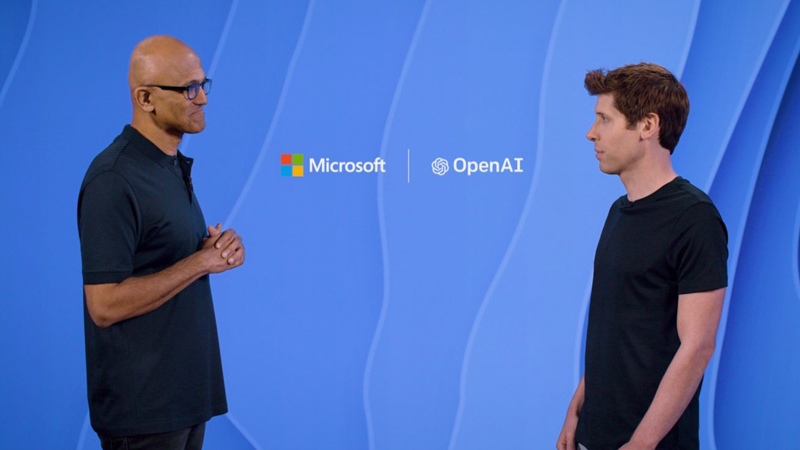
WASHINGTON: At OpenAI, the fight was not about artificial intelligence going rogue—it was about who got the GPUs.
An internal email from Microsoft chief technology officer Kevin Scott, sent on November 19, 2023, offers the clearest account yet of the events that culminated in the sudden firing of Sam Altman as OpenAI’s chief executive. Far from a single ideological rupture, Scott describes a combustible mix of resource wars, bruised egos and a board ill-equipped to manage the world’s hottest AI company.
According to the email, addressed to Microsoft chief executive Satya Nadella, president Brad Smith and other senior leaders, OpenAI co-founder Ilya Sutskever had been “increasingly at odds” with Altman on two fronts.
Read the full email below to find out:
[This document is from Musk v. Altman (2026).]
From: Kevin Scott
Sent: Sunday, November 19, 2023 7:31 AM
To: Frank X. Shaw, Satya Nadella, Brad Smith, Amy Hood, Caitlin McCabe
Frank,
I can help you with the timeline and with our best understanding of what was going on. I think the reality was that a member of the board, llya Sutskever, had been increasingly at odds with his boss, Sam, over a variety of issues.
One of those issues is that there is a perfectly natural tension inside of the company between Research and Applied over resource allocations. The success of Applied has meant that headcount and GPUs got allocated to things like the API and ChatGPT. Research, which is responsible for training new models, could always use more GPUs because what they’re doing is literally insatiable, and it’s easy for them to look at the success of Applied and believe that in a zero sum game they are responsible for them waiting for GPUs to become available to do their work. I could tell you stories like this from every place l’ve ever worked, and it boils down to, even if you have two important, super successful things you’re trying to work on simultaneously, folks rarely think about the global optima. They believe that their thing is more important, and that to the extent that things are zero sum, that the other thing is a cause of their woes. It’s why Sam has pushed us so hard on capacity: he’s the one thing about the global optima and trying to make things non-zero sum. The researchers at OAl do not appreciate that they would not have anywhere remotely as many GPUs as they do have if there were no Applied at all, and that Applied has a momentum all its own that must be fed. So the only reasonable thing to do is what Sam has been doing: figure out how to get more compute.
The second of the issues, and one that’s deeply personal to llya, is that Jakub moreso than Ilya has been making the research breakthroughs that are driving things forward, to the point that Sam promoted Jakub, and put him charge of the major model research directions. After he did that, Jakub’s work accelerated, and he’s made some truly stunning progress that has accelerated in the past few weeks. I think that Ilya has had a very, very hard time with this, with this person that used to work for him suddenly becoming the leader, and perhaps more importantly, for solving the problem that Ilya has been trying to solve the past few years with little or no progress. Sam made the right choice as CEO here by promoting Jakub.
Now, in a normal company, if you don’t like these two things, you’d appeal to your boss, and if he/she tells you that they’ve made their decision and that it’s final, your recourse is accept the decision or quit. Here, and this is the piece that everyone should have been thinking harder about, the employee was also a founder and board member, and the board constitution was such that they were highly susceptible to a pitch by Ilya that portrays the decisions that Sam was making as bad. I think the things that made them susceptible, is that two of the board members were effective altruism folks who all things equal would like to have an infinite bag of money to build AGI-like things, just to study and ponder, but not to do anything with. None of them were experienced enough with running things, or understood the dynamic at OAI well enough to understand that firing Sam not only would not solve any of the concerns they had, but would make them worse. And none of them had experience, and didn’t seek experience out, in how to handle something like a CEO transition, certainly not for the hottest company in the world.
The actual timeline of events through Friday afternoon as I understand them:
Thursday late night, the board let’s Mira know what they’re going to do. By board, it’s Ilya, Tash, Helen, and Adam.
Mira calls me and Satya about 10-15 minutes before the board talks to Sam. This is the first either of us had heard of any of this. Mira sounded like she had been run over by a truck as she tells me.
OAl Board notifies Sam at noon on Friday that he’s out, and that Greg is off the board, and immediately does a blog post.
OAl all hands at 2P to rattled staff.
Greg resigns. He was blindsided and hadn’t been in the board deliberations, and hadn’t agreed to stay.
Jakub and a whole horde of researchers reach out to Sam and Greg trying to understand what happened, expressing loyalty to them, and saying they will resign.
Friday night Jakub and a handful of others resign.
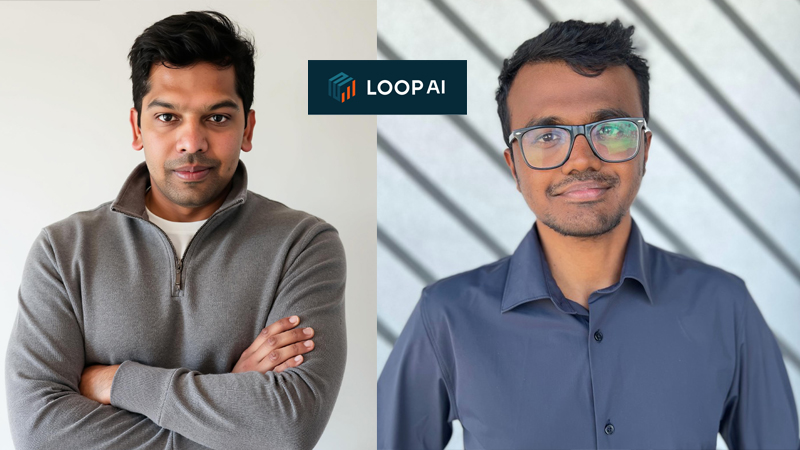
CALIFORNIA: Loop AI has just served itself a sizeable helping of fresh capital. The enterprise AI company focused on the restaurant and retail back office has raised $14 million in a Series A round, led by fintech investor Nyca Partners, signalling growing confidence in the future of food delivery as a profit engine rather than a margin killer.
Alongside the funding, Osama Bedier, former executive at Google and GoDaddy and now an investment partner at Nyca, will take a seat on Loop AI’s board. His arrival adds heavyweight experience as the company enters its next phase of growth.
Loop AI operates where artificial intelligence meets operational grit. Its platform helps restaurants manage the often messy realities of delivery, from margins and workflows to customer behaviour, using what it calls agentic workflows to automate and optimise back-of-house decisions.
Bedier believes the timing could not be better. With restaurants under pressure to deliver better customer experiences while running leaner operations, AI is fast becoming a necessity rather than a nice-to-have. He praised founders Anand Tumuluru and Sundar for building technology he sees as essential to the future of dining.
The backdrop is a delivery market that is ballooning fast. In 2025, the US delivery sector is estimated at $140 billion, accounting for about 10 per cent of the market. By 2035, that figure is expected to swell to $1 trillion, with delivery claiming nearly a third of all restaurant sales. What was once an add-on is quickly becoming the main course.
For Loop AI, delivery is not just another channel, it is the new drive-through. As eating habits tilt ever further towards takeout and doorstep dining, the company’s mission is to help restaurants grow without watching profits evaporate along the way.
Customers appear to be buying into the pitch. California-based casual dining brand Lazy Dog credits Loop AI with helping power rapid growth in its delivery business, while fast-casual chain Starbird says the platform has turned third-party delivery from a necessary evil into a viable growth lever.
Since 2024, Loop AI has grown sixfold and now supports thousands of restaurants. The new funding will be used to expand its product offering and hire across its offices in New York, San Francisco, Tampa and Bangalore.
In an industry where delivery has long been blamed for thin margins and operational headaches, Loop AI is betting that smarter systems can finally make the maths work. For restaurant operators juggling kitchens, couriers and customers, that could be a recipe worth following.
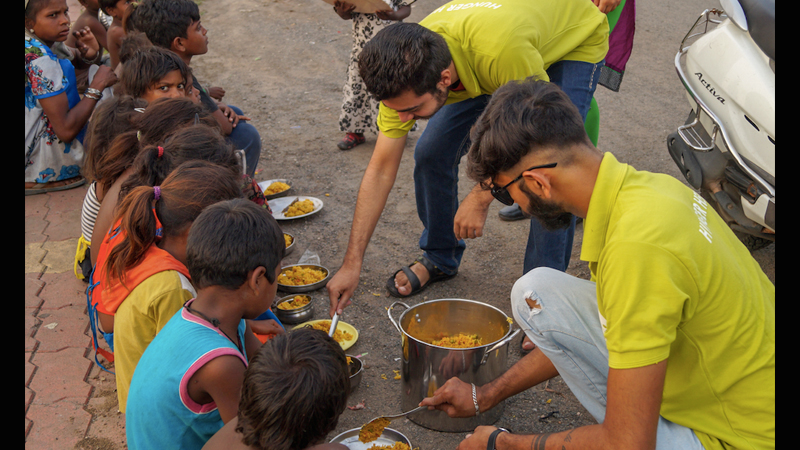
MUMBAI: Hunger may be stubborn, but Feeding India is proving it is not unbeatable. The not-for-profit has served more than 23 crore meals over the past seven years, turning nourishment into a nationwide movement that now spans over 150 cities, according to its Annual Report for FY 2024–25.
Titled A Year of Nourishing Dreams, the report captures a year in which the organisation sharpened its focus from simply filling plates to shaping futures. At the heart of its work is the fight against child malnutrition, with Feeding India now supporting over 1.4 lakh children every day through its partner network.
Its daily feeding programme has grown into a vast ecosystem, covering 1,097 partner schools and 726 Anganwadi centres. These include 275 formal schools, 720 informal learning centres, 58 schools for children with disabilities, and 32 orphan homes. Menus are tailored to local tastes, from rajma chawal in the North to idli sambhar in the South, ensuring meals are nutritious, culturally familiar and widely accepted. Food is provided through a mix of on-site kitchens and centralised cooking facilities.
Recognising that malnutrition often begins long before children enter classrooms, Feeding India has stepped deeper into early childhood care. Across districts such as Gurugram, Kushinagar and Varanasi, the organisation has worked with 726 Anganwadi centres, impacting around 27,000 children aged 0–6 years. More than 30 Anganwadis have been upgraded using Building as Learning Aid concepts, creating brighter, safer and more child-friendly spaces. In Varanasi, a pilot programme now provides full breakfast and lunch meals, a significant shift from the usual supplementary snacks.
The year also tested the organisation’s ability to respond in crisis. During 2024–25, Feeding India distributed nearly 2,000 ration kits following floods in Assam and landslides in Kerala, and served over 1.9 lakh hot meals after the Uttarakhand cloudburst. Relief operations extended to Bihar, Andhra Pradesh and Tamil Nadu in the wake of Cyclone Fengal.
Community participation remains central to the model. Events such as the Zomato Feeding India Concert, featuring Dua Lipa, brought together 28,000 people in 2024, while initiatives like Poshan Potli nutrition kits supported tuberculosis patients during recovery in Varanasi.
Funding patterns underline the power of platforms. Zomato users contributed nearly 80 per cent of total funds, amounting to Rs 74 crore, while Blinkit customers added 15 per cent, or Rs 14 crore. The remaining around 5 per cent came from institutional donors, employees and direct website contributions. Donors can track their impact directly via the Zomato or Blinkit apps, seeing how many meals they have funded and where those meals were served.
The report also highlights tangible outcomes. At the Malvi Educational and Charitable Trust in Gujarat, students recorded an average BMI improvement of 9.50 per cent after daily nutritious meals were introduced.
“Every meal represents hope, dignity and opportunity for a child who might otherwise go hungry,” a Feeding India spokesperson said, adding that the focus remains on nourishing potential through nutrition, infrastructure and care.
As the numbers grow, the message is simple but powerful, feeding a child today is an investment in tomorrow, and Feeding India is determined to keep that promise alive, one meal at a time.


MIB sets OTT accessibility rules, mandates captions and audio description

Boney Kapoor acquires remake rights of Tamil political satire Thalaivar Thambi Thalaimaiyil

Netflix India names Rekha Rane director of films and series marketing

Zabeen signs off from TV9 after shaping the network’s public voice

Dhawan steps up to bat for Delhi’s grassroots sports push

Orient Beverages pops the fizz with steady Q3 gains and rising profits

Cheekatilo shines in the dark with record debut on Prime Video

These ’90s fashion trends are making a comeback in 2017
The final 6 ‘Game of Thrones’ episodes might feel like a full season
According to Dior Couture, this taboo fashion accessory is back
The old and New Edition cast comes together to perform
Phillies’ Aaron Altherr makes mind-boggling barehanded play
Uber and Lyft are finally available in all of New York State
Disney’s live-action Aladdin finally finds its stars
MIB sets OTT accessibility rules, mandates captions and audio description
Boney Kapoor acquires remake rights of Tamil political satire Thalaivar Thambi Thalaimaiyil
Netflix India names Rekha Rane director of films and series marketing
Zabeen signs off from TV9 after shaping the network’s public voice
Dhawan steps up to bat for Delhi’s grassroots sports push
Orient Beverages pops the fizz with steady Q3 gains and rising profits
Cheekatilo shines in the dark with record debut on Prime Video
-

 News Broadcasting2 weeks ago
Mukesh Ambani, Larry Fink come together for CNBC-TV18 exclusive
-

 News Headline1 month ago
From selfies to big bucks, India’s influencer economy explodes in 2025
-
 iWorld5 months ago
Billions still offline despite mobile internet surge: GSMA
-
 Applications2 months ago
28 per cent of divorced daters in India are open to remarriage: Rebounce
-

 iWorld2 weeks ago
Netflix celebrates a decade in India with Shah Rukh Khan-narrated tribute film
-

 Hollywood1 week ago
The man who dubbed Harry Potter for the world is stunned by Mumbai traffic
-

 News Headline2 months ago
Game on again as 2025 powers up a record year and sets the stage for 2030
-
 I&B Ministry3 months ago
India steps up fight against digital piracy
