
Applications
Trai wants spectrum to be delinked from unified licensing

NEW DELHI: The Telecom Regulatory Authority of India, while agreeing with the objective of the government in its draft Telecom Policy for a Unified Licence regime in order to exploit the attendant benefits of convergence, says spectrum should be kept out of the purview of this licence.
Trai says spectrum should be separately available through a market driven process enabling the realisation of its appropriate value. The policy envisages making available adequate globally harmonised spectrum spectrum to ensure efficient delivery of telecom services through appropriate audit and refarming.
Even as Telecom Minister Kapil Sibal had announced on 15 February that he had accepted the view of delinking spectrum from the unified licence, he had said ‘a final view on implementation of the Unified License Regime would be taken after receipt of detailed Guidelines and Terms and Conditions from Trai for Unified Licence including migration path for all existing licence(s) to Unified Licence.’
In the final recommendations on the New Telecom Policy announced by the Government in October 2011, Trai wants that additional 500 MHz spectrum to be made available for telecommunications services by the year 2017 and another 300 MHz by 2020 and says existing users of spectrum like Government departments, public sector, private sector and telecom service providers to alternate frequency bands or media should be moved, to make spectrum available for commercial telecom services.
Provision of broadband facility is a sine qua non for delivery of convergent services. A National Optic Fibre Network will be established, connecting all the Gram Panchayats in the first phase and all the villages/habitations in the second phase, both of which will be completed in a definite time frame. The policy also seeks to make available adequate spectrum for wireless broadband services.
Optic fibre network
Separately, the country has embarked upon a time bound programme of digitisation, with addressability of the cable TV network. With availability of optic fibre network as well a digital cable TV network, it is expected that the spread of fixed lines will increase significantly enabling Fixed-Mobile Convergence, thereby enhancing the spectrum utilisation which is a finite and scarce resource.
The National Telecom Policy 2012 (NTP 2012) also aims to introduce Mobile Virtual Network Operators (MVNO) in the country; actively encourage establishment and use of landlines based on optical fibre network and cable networks so as to promote Fixed-Mobile Convergence; and provide reliable and affordable broadband access in the country including in rural and remote areas by appropriate combination of optical fibre, wireless and other technologies.
Trai will periodically fix the minimum broadband download speeds of broadband to facilitate availability of broadband progressively at speeds higher than the laid down minimum.
The optical fibre network will be laid by an independent agency, initially up to the village Panchayat level and to be extended progressively in a time bound manner, to all villages and habitations having a population of more than 500 persons. Access to this Optical Fibre Network will be open, non-discriminatory and technology neutral.
Trai wants that enabling provisions should be incorporated in the current regulatory framework in order to facilitate utilisation of existing infrastructure including cable TV networks for extending high quality broadband services including in rural areas.
The aim will also be to ensure that all local content is hosted on servers located within the country; rationalise the duties levied on inputs and finished products and provide requisites incentives to ensure affordability of Customer premises equipment including modem; and provide appropriate tax benefits to telecom infrastructure provider companies.
Bridge digital mode via digitisation
In its aim to obliterate the digital divide between the rural and urban areas, Trai wants the government to ensure through coordination with the Information and Broadcasting Ministry, a time bound digitisation of the cable industry in all the rural areas; and impose rural roll out obligations in all licenses where spectrum is being provided such that all habitations with a population of 500 persons and above are covered by the service providers.
While attracting foreign investment and foreign institutional investment, it should be ensured that intellectual property rights are protected; and clearances required for foreign direct investment should be expedited.
Trai wants penal powers of civil court
The regulator wants a review of the Trai Act with a view to addressing regulatory inadequacies/impediments in effective discharge of its functions; and to confer penal and enforcement powers to Trai, so as to enable it to protect the interest of consumers by ensuring compliance of its regulations/directions/orders by the service providers, in addition to conferring powers of civil court to enable the Authority to summon persons and receive evidence and also call for expert advice while conducting enquiry.
At the outset, it said telecommunications is no longer limited to voice. The evolution from analog to digital technology has facilitated the conversion of voice, data and video to the digital form. Increasingly, these are now being rendered through single networks bringing about a convergence in networks, services and also devices.
The telecom networks as information highways are capable of being used for distribution of various converged services, giving citizens access to not only voice communication but also information, entertainment and various applications that can significantly improve their lives. Once a mere communication device, telephone has now the potential of being an instrument of empowerment. There is need to reorient the telecommunication policy to exploit this potential and to foster a rapid and inclusive growth.
The Policy states: “It is now imperative to move towards convergence between telecom, broadcast and IT services, networks, platforms, technologies and overcome the existing segregation of licensing, registration and regulatory mechanisms in these areas to enhance affordability, increase access, delivery of multiple services and reduce cost. It will be a key enabler of equitable and inclusive growth. The policy aims to address and enable the coordinated action to respond to the dynamic needs resulting from confluence of telecom, broadcasting and IT sectors.”


CALIFORNIA: Moltbook, a Reddit-style social platform built exclusively for artificial intelligence agents, has emerged as the latest obsession in Silicon Valley, drawing intense attention for its explosive growth and surreal bot-driven interactions.
The platform hosts more than 100 communities where AI agents post, argue and joke about topics ranging from governance theory to esoteric “crayfish debugging” concepts. Within days of launch, Moltbook recorded tens of thousands of posts, nearly 200,000 comments and more than 1 million human visitors observing the activity.
Yet the numbers and the autonomy are under scrutiny, as per media reports. A security researcher has suggested as many as 500,000 accounts may trace back to a single address, raising doubts about Moltbook’s membership claims. Many posts could also be the result of humans instructing their AI tools to publish content, rather than bots acting independently.
The platform runs on agentic AI, powered by an open-source tool called OpenClaw, formerly known as Moltbot. Unlike chatbots such as ChatGPT or Gemini, these agents are designed to perform tasks on users’ devices, from sending messages to managing calendars, with minimal human input. Once authorised, they can interact freely on Moltbook.
Some tech figures have hailed the platform as a glimpse of a post-human internet. Head of crypto custody firm BitGo Bill Lees, called it evidence that “we’re in the singularity”.
Academics are less convinced. Petar Radanliev, an AI and cybersecurity expert at the University of Oxford, said the idea of agents acting independently was “misleading”, describing Moltbook instead as automated coordination within human-set constraints. Columbia Business School assistant professor David Holtz, dismissed the spectacle as “thousands of bots yelling into the void and repeating themselves”.
Beyond hype, security worries loom large. ESET global cybersecurity advisor Jake Moore, warned that granting AI agents access to emails, private messages and files risks prioritising efficiency over privacy. Andrew Rogoyski of the University of Surrey said high-level system access could lead to serious damage, from erased data to compromised company accounts.
Even OpenClaw’s founder Peter Steinberger, has felt the darker side of attention, with scammers hijacking his old social media handles after the platform’s rebrand.
For now, Moltbook remains a strange digital zoo: part experiment, part spectacle, where AI agents banter about philosophy, productivity and, occasionally, their fondness for their human operators.

CALIFORNIA: Apple has handed a bigger global brief to a long-time insider. Avtar Ram Singh has taken over as head of international marketing for the App Store, Apple Arcade and the Apple Games app, deepening his remit across one of the company’s fastest-growing businesses.
“I’m happy to share that I’m starting a new position as head of international marketing, App Store, Apple Arcade and Games App at Apple,” Singh said while announcing the move.
The promotion crowns nearly seven years at Apple, where Singh has led services marketing across Southeast Asia and India and previously served as head of marketing for Southeast Asia content and services, business lead for Apple Podcasts in the region and interim marketing lead for the App Store internationally.
His new portfolio spans three pillars of Apple’s services push. The App Store, which Apple positions as a safe and trusted discovery platform, now attracts more than 850 million average weekly users globally. Since 2008, developers have earned over $550 billion on the platform.
Apple Arcade, the company’s gaming subscription service, offers unlimited access to a catalogue ranging from brain teasers to big-name franchises. The recent addition of Sid Meier’s Civilization VII Arcade Edition brings a AAA PC title to iPhone, iPad and Mac from 5 February.
Then there is the Apple Games app, unveiled at WWDC as a unified destination for games from the App Store and Arcade. It aggregates titles in one place, surfaces personalised recommendations, tracks events and achievements, and lets users compete with friends or connect controllers for a console-like experience.
Singh arrives with a hybrid background in strategy, data and creativity. His career spans digital and social media marketing, business intelligence, content, editorial and analytics across culturally diverse markets. He has worked on brands including P&G, Accor, Audi, UBS, Nikon, Samsung, Sony, Pizza Hut, HBO and Singapore Airlines-linked businesses such as Scoot.
Before Apple, Singh led strategy at Falcon Agency, focusing on performance marketing and ROI-driven digital frameworks. He earlier ran the social practice at Publicis Singapore, where he oversaw operations, business development and regional social strategy for multinational clients. His career also includes roles at Ogilvy-linked Circus Social, Rocket Internet ventures Lazada and Zalora, and research firm IDC in Bangkok, where he analysed technology markets and won early awards for collaboration and client retention.
At Apple, he has been close to several service launches and expansions, including Apple Fitness+ in Singapore, Apple Creator Studio, global podcast subscriptions and new App Store marketing tools.
The timing is notable. Apple’s services business has posted record years, and gaming is becoming a sharper battleground as platforms chase engagement and recurring revenue. Singh’s brief sits at the intersection of content, community and commerce.
In a market where attention is scarce and loyalty scarcer, Apple is betting that sharper storytelling and smarter marketing can keep users inside its ecosystem. Singh now holds the megaphone. The real test will be how loudly the world listens.
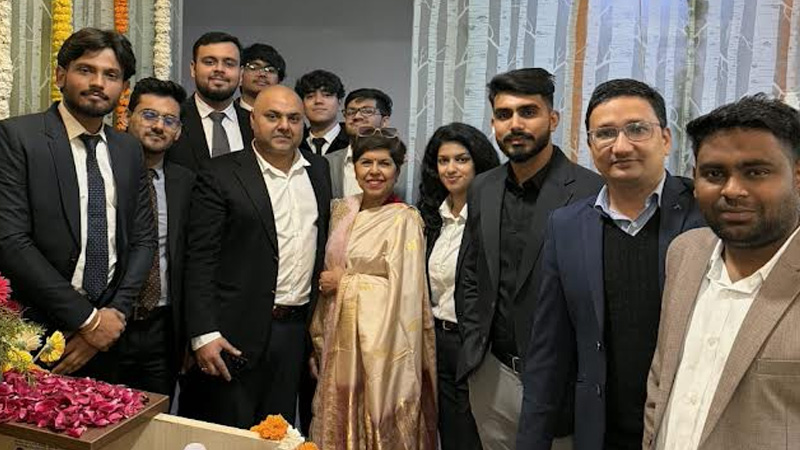
MUMBAI: Bharathcloud is bringing its cloud closer to power. The Hyderabad-based sovereign AI cloud services provider has opened its Delhi office, marking its formal entry into North India and setting the stage for its next phase of growth.
The expansion comes as India’s digital transformation fuels rising demand for AI-ready cloud infrastructure, driven by wider adoption of artificial intelligence, machine learning, the Internet of Things and data-heavy applications. With the new office, Bharathcloud plans to onboard more than 100 employees in 2026, strengthening its workforce to support customers across government, enterprises, MSMEs and social sectors.
The Delhi presence is expected to sharpen the company’s engagement with organisations seeking secure, scalable and cost-efficient cloud platforms that comply with India’s data sovereignty requirements. It also positions Bharathcloud closer to policy, public sector and enterprise decision-makers in the region.
Founded in Hyderabad, Bharathcloud offers AI-ready cloud infrastructure including Kubernetes-as-a-Service, zero-trust security architecture and multi-level data protection frameworks. Its platform supports AI and ML workloads, blockchain application migration from hyperscalers and distributed data management, with an emphasis on reliability, low latency and operational continuity.
“With the Delhi expansion, we are positioning Bharathcloud to engage more closely with AI-driven enterprises and technology hubs in North India,” said Bharathcloud co-founder Rahul Takallapally. He added that the move would help nurture local cloud and AI talent while accelerating the adoption of secure and resilient AI infrastructure across sectors.
The company currently operates in Hyderabad, Bengaluru, Mumbai, Kolkata, Lucknow and Chennai, employing over 200 people and serving more than 1,500 clients across manufacturing, healthcare, financial services, IT and media. Aligned with national initiatives such as Digital India and Make in India, Bharathcloud continues to focus on building indigenous AI-cloud infrastructure to support data localisation and the country’s growing appetite for next-generation digital solutions.
With its Delhi office now live, the company is signalling a clear intent: to make sovereign, AI-ready cloud infrastructure not just an alternative, but a mainstream choice for India’s north as well as its tech capitals.


MIB sets OTT accessibility rules, mandates captions and audio description

Boney Kapoor acquires remake rights of Tamil political satire Thalaivar Thambi Thalaimaiyil

Netflix India names Rekha Rane director of films and series marketing

Zabeen signs off from TV9 after shaping the network’s public voice

Dhawan steps up to bat for Delhi’s grassroots sports push

Orient Beverages pops the fizz with steady Q3 gains and rising profits

Cheekatilo shines in the dark with record debut on Prime Video

These ’90s fashion trends are making a comeback in 2017
The final 6 ‘Game of Thrones’ episodes might feel like a full season
According to Dior Couture, this taboo fashion accessory is back
The old and New Edition cast comes together to perform
Phillies’ Aaron Altherr makes mind-boggling barehanded play
Uber and Lyft are finally available in all of New York State
Disney’s live-action Aladdin finally finds its stars
MIB sets OTT accessibility rules, mandates captions and audio description
Boney Kapoor acquires remake rights of Tamil political satire Thalaivar Thambi Thalaimaiyil
Netflix India names Rekha Rane director of films and series marketing
Zabeen signs off from TV9 after shaping the network’s public voice
Dhawan steps up to bat for Delhi’s grassroots sports push
Orient Beverages pops the fizz with steady Q3 gains and rising profits
Cheekatilo shines in the dark with record debut on Prime Video
-

 e-commerce3 weeks ago
Swiggy Instamart’s GOV surges 103 per cent year on year to Rs 7,938 crore
-

 News Broadcasting2 weeks ago
Mukesh Ambani, Larry Fink come together for CNBC-TV18 exclusive
-

 News Headline1 month ago
From selfies to big bucks, India’s influencer economy explodes in 2025
-
 iWorld5 months ago
Billions still offline despite mobile internet surge: GSMA
-

 News Headline2 months ago
2025: The year Indian sports saw chaos, comebacks, and breakthroughs
-

 Applications2 months ago
28 per cent of divorced daters in India are open to remarriage: Rebounce
-

 News Headline2 weeks ago
JioStar announces biggest ever talent line-up for an ICC event
-

 News Headline2 months ago
Game on again as 2025 powers up a record year and sets the stage for 2030
